To save content items to your account,
please confirm that you agree to abide by our usage policies.
If this is the first time you use this feature, you will be asked to authorise Cambridge Core to connect with your account.
Find out more about saving content to .
To save content items to your Kindle, first ensure no-reply@cambridge.org
is added to your Approved Personal Document E-mail List under your Personal Document Settings
on the Manage Your Content and Devices page of your Amazon account. Then enter the ‘name’ part
of your Kindle email address below.
Find out more about saving to your Kindle.
Note you can select to save to either the @free.kindle.com or @kindle.com variations.
‘@free.kindle.com’ emails are free but can only be saved to your device when it is connected to wi-fi.
‘@kindle.com’ emails can be delivered even when you are not connected to wi-fi, but note that service fees apply.
This chapter re-examines slavery and abolition in the writing and reception of the Declaration of Independence. Far from being marginal parts of the nation’s founding document, as previous generations of scholars asserted, both slavery and abolition proved to be essential to the making and meaning of the Declaration. Indeed, during and after the American Revolution, the Declaration testified to the nation’s high abolitionist ideals and the enduring problem of slavery in American statecraft. By examining not only Jefferson’s ideas about black freedom in the Revolutionary era but a wide range of reformers who meditated on it as well – including African American writers and reformers like Benjamin Banneker – this essay argues that the Declaration itself remains a testament to the conflicted nature of emancipation in the American mind.
This essay explores the deep and longstanding relationship between African Americans and the Declaration of Independence. From the 1770s to the present, black activists and thinkers have consistently excoriated the paradox of an American democracy that proclaims inalienable rights while systematically denying black citizens’ rights. Drawing on figures such as Frederick Douglass, Sojourner Truth, Frances E. W. Harper, Anna Julia Haywood Cooper, and Shirley Chisholm, the text illustrates how African Americans have employed the Declaration as a foundation for their demands for the abolition of slavery, civil rights, and equality. It examines black protest rhetoric’s critique of white supremacy, hypocrisy, and the failure of the United States to live up to its foundational principles. And it emphasizes the crucial role black women have played in advancing black liberation and expanding the scope of equality to include gender and race. Through the centuries, African Americans have called for the United States of America to reconcile its practices with its founding document’s principles of equality and justice for all.
The official abolition of serfdom in 1861 was preceded by several laws and partial reforms. If serfdom underwent a profound transformation during the first half of the nineteenth century, many legal constraints remained after its abolition. Despite these restrictions, however, the new context did not halt but rather promote economic growth, which was mainly based on pluriactivity and labor intensification. Regional differentiation was crucial, as were the profound differences in the profitability of different Russian colonies.
Founded in 1478 and not permanently abolished until 1834, the Spanish Inquisition has always been a notorious institution in history as an engine of religious and racial persecution. Yet, Spaniards themselves did not create its legal processes or its theoretical mission, which was to reconcile heretics to the Catholic Church. In this volume, leading international scholars assess the origins, legal practices, victims, reach, and failures of Spanish inquisitors across centuries and geographies. Grounded in recent scholarship and archival research, the chapters explore the Inquisition's medieval precedents as well as its turbulent foundation and eradication. The volume examines how inquisitors changed their targets over time, and how literal physical settings could affect their investigations and prosecutions. Contributors also demonstrate how deeply Spanish inquisitors cared about social status and legal privilege, and explore the scandals that could envelop inquisitors and their employees. In doing so, this volume offers a nuanced, contextual understanding of the Spanish Inquisition as a historical phenomenon.
This chapter asks how Mexicans remembered the histories of slavery, abolition, and Afro-descendants once independence was achieved, slavery abolished, and calidad classifications prohibited by law. Through an examination of the Mexican press between 1821 and 1860, this work traces the creation of historical narratives that downplayed the importance of slavery for Mexican history, while at the same time used the figure of Afro-Mexicans to cement different political projects. The purpose of this chapter, then, is to document that these subjects remained being part of Mexican public life through the press. More than restoring these questions’ visibility in Mexican history, the relevance of an analysis such as this rests on exposing the political uses and rhetorical power these themes had during that period. Slavery, abolition, and Afro-Mexicans’ presence in the country were points of reference in the creation of national identities and historical narratives that still bear weight in modern Mexican society.
This introduction provides an overview of the theories and methodologies necessary to reveal the social, economic, and political lives of Afro-descended Mexicans after the abolition of slavery and caste. Beginning with the cofradía del Rosario in what is now Morelia, it sets the stage for the collection by showing how references to Afro-descended communities continued after independence in 1821. The introduction argues that the limited sources about Afro-descended Mexican citizens do not preclude the study of these communities after emancipation. Instead, it requires careful, often against the grain, readings of racial identities as well as of individual and collective agency, historical themes related to slavery and freedom that are better known in the colonial period. Ultimately, the introduction attempts to provide a roadmap for future studies into the history of Afro-Mexicans in the nineteenth century.
After gaining independence in 1821, the Mexican government passed laws that abolished the transatlantic slave trade to Mexico in 1824 and the institution of slavery in 1829. While these dates are concrete, the process and implementation of both laws entailed more complexity than these firm dates suggest, and created real and perceived consequences for inhabitants in Mexican territories. This chapter argues that abolition was a contentious social and political process that placed settlement, citizenship, and freedom at the forefront of discussions for the nascent nation in the 1820s and 1830s. The chapter also argues that the process of abolishing slavery in Mexico was steeped in colonial history and set the stage for contentious individual and collective action through the national government in Mexico City and the state/local government of Coahuila y Tejas from 1821 to 1836.
In this chapter we examine the connection between religion and abolition. After discussing early antislavery voices, such as the Essenes and St. Gregory of Nyssa, we recount in detail the growing Christian rejection of slavery in the seventeenth and eighteenth centuries. Attention is given to the arguments and action of early Quaker abolitionists, including John Woolman and Anthony Benezet, to Anglicans like Thomas Clarkson and William Wilberforce, and to antislavery activism in North America leading up to the American Civil War. We then provide a theoretical evaluation of the role of Christianity in the nineteenth-century rejection of slavery. The chapter closes with an exposition of Islamic abolitionism in the nineteenth and twentieth centuries, focusing on Ahmad Bey, Rashid Rida, Mohsen Kadivar, and Bernard Freamon.
As the first book-length examination of abolition and its legacies in Mexico, this collection reveals innovative social, cultural, political, and intellectual approaches to Afro-Mexican history. It complicates the long-standing belief that Afro-Mexicans were erased from the nation. The volume instead shows how they created their own archival legibility by continuing and modifying colonial-era forms of resistance, among other survival strategies. The chapters document the lives and choices of Afro-descended peoples, both enslaved and free, over the course of two centuries, culminating during the Mexican Revolution of 1910. Contributors examine how Afro-Mexicans who lived under Spanish rule took advantage of colonial structures to self-advocate and form communities. Beginning with the war for independence and continuing after the abolition of slavery and caste in the 1820s, Afro-descended citizens responded to and, at times, resisted the claims of racial disappearance to shape both local and national politics.
The end of the American Revolution energised concerns about the political, economic, and moral state of an empire that had become inextricable from the plantation economy and the transatlantic trafficking of enslaved Africans. Intent on forging an empire without slave-trading, some Cambridge students and fellows took a leading role in attacking the slave economy, enslavers, and the consumption and production of goods tied to the plantation economy. Other past and present Cambridge fellows, however, were emboldened by defeat in the Revolution to support enslavers, arguing that enslavement was the principal foundation of Britain’s rapidly growing economy and should remain entrenched in the British Caribbean. The problem of the slave trade was particularly evident in Britons’ engagement with West Africa, where antislavery activists, colonisers, and explorers had to negotiate and collaborate with local slave-traders and imperial companies to achieve their aims. These conflicts reveal the challenges and limitations of idealism when confronted with the realities of Britain’s slave empire.
The slavery debates at Cambridge did not end with the emancipation of enslaved people in the Caribbean and India in 1843. In fact, undergraduates, fellows, and professors increasingly turned their attention to enslavement in the United States of America. Cambridge-educated abolitionists, such as Edward Strutt Abdy and Alexander Crummell, sought to mobilise opinion in both America and Britain against the persistent power of the enslaver class in the Southern United States. The outbreak of the American Civil War (1861–1865) inspired growing sympathy amongst educated British elites, including those at Cambridge, towards the Confederate cause, with many comparing American enslavers to landed British gentry in order to build camaraderie between British and American elites. The Confederacy, in turn, sought to lobby university men and mobilise student opinion in their favour to further the cause of Confederate diplomatic recognition in Britain.
Following the abolition of the slave trade, Cambridge men turned their intellectual attentions to the institution of slavery as a whole. Nevertheless, students, alumni, and fellows were torn on how best to create an empire of free labour and on the prospects for freed people of colour in post-emancipation societies. The early nineteenth century was a colorful era of experimentation as Cambridge activists sought to gradually achieve abolition without precipitating the violence and rebellion that characterized the Haitian Revolution, whilst Black and radical white abolitionists advocated for an immediate end to racial slavery. Historians have long ignored this phase of Cambridge debate on enslavement post-1807, which has resulted in a historiography of Cambridge abolitionism which overemphasizes its radical nature. In reality, a growing conservatism dominated this period of abolitionist thought at Cambridge – particularly as some Cambridge fellows and alumni continued to eschew pro-slavery rhetoric.
Following the colonisation of Ireland, North America, and the Caribbean, British society, politics, and the economy were forever transformed by the growing transatlantic empire. The University of Cambridge was intimately connected to that Atlantic world. The introduction provides context on Cambridge’s history and the long-term development of racial slavery, examining how enslavement and the plantation economy were of incredible significance to British life from the beginning of the seventeenth century through to the end of the American Civil War and beyond. More than a history of plantation owners purchasing stately homes or consumers eagerly consuming sugar, a case study of Cambridge’s town and gown communities highlights the vast spectrum of connections, ties, and interests that many Britons held to a slave empire.
The book concludes by pointing out two major shifts that my reading of the Shepherd produces: one focused on how the centrality of slavery in the Shepherd that complicates earlier treatments of the text as most invested in baptism and/or repentance, and the other focused on the ethical and historical anxieties that emerge from the enslaved–enslaver relationship being so deeply embedded in early Christian literature, ethics, and subject formation. Additionally, I point to how my findings reveal why the Shepherd would be appealing to late ancient Christians: its visionary, dialogical, parabolic, and ethical content are aimed toward crafting obedient enslaved believers who were unified in their ecclesiastical vision. The work of feminist, womanist, Africana, and slavery studies scholars offer an intellectual and ethical scaffolding upon which I contend with the centrality in early Christian thought of God as an enslaver and believers as enslaved persons, as well as the continuations and challenges of the embeddedness of slavery in Christian vocabulary into the twenty-first century.
From his 1982 conviction for killing a police officer and death sentence to the 2010 commutation of that sentence to life-in-prison-without-parole, Mumia Abu-Jamal has experienced and studied mass incarceration intimately as a political prisoner. At the local level, Mumia’s case is a microcosm of the period of the 1970s and 1980s in Philadelphia – the highpoint of rogue white supremacy within the city’s police department and the District Attorney’s office. At the macro level, the period of his incarceration spans the decades of exponential carceral expansion in the US that began in the 1980s. In the more than four decades since his 1982 conviction, the Abu-Jamal has penned thirteen books and thousands of short radio commentaries from prison, most notably Live from Death Row, which features harrowing, first-hand accounts of aging men and their struggles for medical care in the face of physical illness, younger men who are psychically and spiritually pulverized by guard brutality, barbarous conditions, humiliating body cavity strip searches, and the unnatural social isolation of death row imprisonment.
Angela Davis, George Jackson, and other prominent Black intellectuals and radicals shaped abolition in different ways. The evolution and popularization of abolition promoted by Angela Davis was influenced by her own traumatic incarceration. Jon Jackson, the younger brother of George Jackson, had worked with Angela Davis to support the incarcerated men through the Soledad Brothers Defense Committee. Without her permission, in August 1970, Jonathan Jackson took guns belonging to Angela Davis to wage a raid at Marin County Courthouse in order to take hostages that could be exchanged to free Black prisoners. Prison guards shot and killed Jon Jackson, two Black prisoners, and a white judge in a stationary van. Davis fled the state, fearing reprisal from reactionaries, and was arrested by the FBI in October. During her incarceration, George Jackson was also killed by prison guard(s) in August 1971. Acquitted of all charges in 1972, Angela Davis advocated for abolition and over decades aligned abolition with advocacy academics; her work also increasingly focused on gender leadership of women and feminism, as noted in Women, Race and Class.
George Jackson inhabits a central position in the living archive of diasporic Black radical and global revolutionary intellectuals. This chapter examines how Jackson’s political thought emerged through his consistent self-identification as an ordinary Black person inhabiting the historical, structural antiblackness of the United States. Against the telos of many carceral/prison narratives, Jackson’s Soledad Brother reflects the developing thought of a Black liberationist, carceral insurrectionist, and diasporic revolutionary whose primary political and cultural work is not focused on achieving his personal freedom (i.e. release from prison) but rather on organizing and proliferating radical ruptures of an existing oppressive order – what Jackson famously identifies in Blood in My Eye as “perfect disorder.” To study Soledad Brother and Blood in My Eye is to meditate on the consistency and militant commitment with which Jackson exhibited characteristics that made him an influential educator, organizer, and political intellectual during and beyond his lifetime, especially among contemporaneous and subsequent generations of politically activated (Black) captives of the state.
Women’s prison zines in the 1970s represent a pivotal moment in the evolution of feminist grassroots media, marking a sustained effort by incarcerated women to create their own platforms for self-expression and political organizing. Emerging from Black Power, queer liberation, and prison abolition movements, zines challenged dominant narratives about crime, punishment, and women’s experiences of incarceration. Historically, the carceral state and its monopoly over the bodies of imprisoned individuals played crucial roles in suppressing the voices and experiences of incarcerated women, particularly women of color and LGBTQ+ individuals. Zines like Through the Looking Glass, No More Cages, and Bar None were consequential to incarcerated women’s ability to forge solidarity networks, articulate anti-carceral feminist perspectives, and imagine alternatives to incarceration. The chapter utilizes literary analysis to delineate the impact of these zines, demonstrating how these publications functioned as tools for activism, self-expression, and community-building within the constraints of the carceral system.
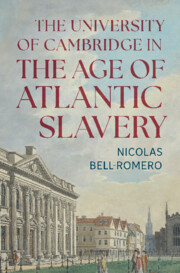
In this powerful history of the University of Cambridge, Nicolas Bell-Romero considers the nature and extent of Britain's connections to enslavement. His research moves beyond traditional approaches which focus on direct and indirect economic ties to enslavement or on the slave trading hubs of Liverpool and Bristol. From the beginnings of North American colonisation to the end of the American Civil War, the story of Cambridge reveals the vast spectrum of interconnections that university students, alumni, fellows, professors, and benefactors had to Britain's Atlantic slave empire - in dining halls, debating chambers, scientific societies or lobby groups. Following the stories of these middling and elite men as they became influential agents around the empire, Bell-Romero uncovers the extent to which the problem of slavery was an inextricable feature of social, economic, cultural, and intellectual life. This title is also available as open access on Cambridge Core.
Decades before Canada abolished the death penalty, it removed infanticide from the Criminal Code’s offences punishable by death. In 1948, this form of culpable homicide became punishable by imprisonment up to a maximum of three years. Although this statutory invention has been linked to the post-war rise in the pathologization of women’s violence and tied to legislators’ concerns over jury nullification, its nexus with the death penalty’s abolition has been overlooked. If the prospect of capital punishment did not deter women from killing their newborns, could the death penalty be justified for other forms of culpable homicide? Critics who posed this question about neonaticide wedged open the consideration of other forms of homicide and categories of offenders, undermining long standing certainties over the deterrent potency of capital punishment. Rather than a step in the abolition movement, the amendment merits acknowledgment as a significant move against the death penalty.