

Introduction
The past year has been a particularly dynamic one for the British School at Athens (BSA), marked by a rich programme of fieldwork, research, academic events, outreach, and collaborations. Among the most significant milestones of 2024 was the celebration of the fiftieth anniversary of the Marc and Ismene Fitch Laboratory. This anniversary provided not only an occasion for reflection and celebration but also a chance to strengthen collaborations, expand outreach, and look toward the future.
Fitch Laboratory fiftieth anniversary
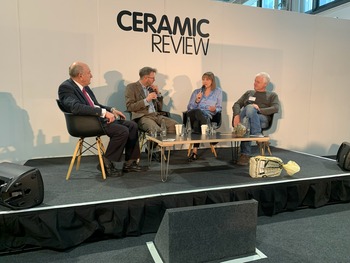
A central focus of the Laboratory’s anniversary was its mission to deepen engagement with contemporary potters and craftspeople – an integral dimension of its research activities (Fig. 2.1). In April 2024, the BSA collaborated with the Craft Potters Association of the UK to curate three panel discussions at Ceramic Art London, one of Europe’s leading ceramic art fairs (Fig. 2.2). These conversations brought together potters, industry experts, and archaeologists, including Dr Evangelia Kiriatzi and Dr Carlotta Gardner from the Fitch Laboratory and Dr Carmen Ting from the University of Leicester. The themes addressed ranged from clay as a commodity to the crafting of identities and the technological choices that shape material culture.

Fig. 2.1. Work in the Fitch Laboratory in 2024. Photo: Ceramic Review.

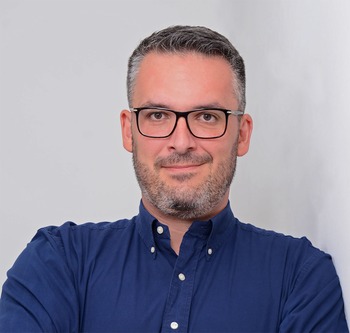
Fig. 2.2. Panel discussion ‘Clay as a commodity’ at Ceramic Art London. Left to right: Jonathan Noake (MD Potclays Ltd), Toby Brundin (then director of the Craft Potters Association), Carlotta Gardner (BSA), and Matthew Blakely (potter). © BSA.
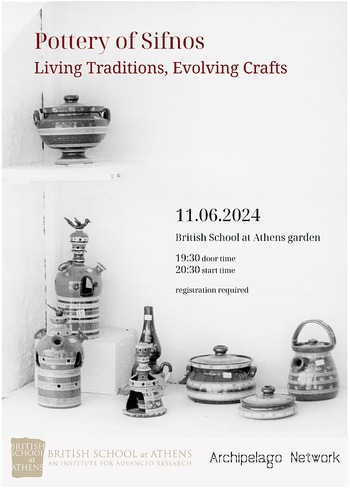
Building on this momentum, in June the BSA partnered with the Archipelago Network to co-organize the Athens premiere of Jacob Moe’s documentary films on the potters of Siphnos (Fig. 2.3). The screenings were complemented by commentary from Dr Kiriatzi, Professor Rebecca Sweetman, and Toby Brundin, then director of the Craft Potters Association, enriching the dialogue between archaeology and contemporary craft practice.

Fig. 2.3. Poster from the screening of Archipelago Network’s films with archival photos from Siphnos. Courtesy of Archipelago Network. © Archipelago Network.
Later in the year, two celebratory events were organized to mark the Laboratory’s half-century: one in London and another in Athens. The London event (Timeless Connections: Linking Britain and Greece Through Archaeological Science), hosted at the British Academy on 24 October, featured a series of short talks, including Dr Maria Duggan’s (Newcastle University) work on Byzantine pottery from Tintagel in Cornwall (Fig. 2.4). This occasion brought together both long-standing collaborators and new friends in an atmosphere of shared discovery and conviviality. The celebrations culminated in a three-day academic conference at the BSA in Athens, titled Half a Century of Archaeological Science in Greece: Past, Present, Future, on 29 November, with Prof Shadreck Chirikure of University of Oxford as keynote speaker (Fig. 2.5). The conference explored the transformative role of archaeological science in understanding the human past in Greece, with particular attention to mobility and movement, everyday life, and landscape histories.

Fig. 2.4. Maria Duggan presenting her research on Tintagel at the British Academy for the London Fitch fiftieth anniversary conference. © BSA.

Fig. 2.5. Attendees and speakers at the conference Half a Century of Archaeological Science: past, present, future. © BSA.
Events
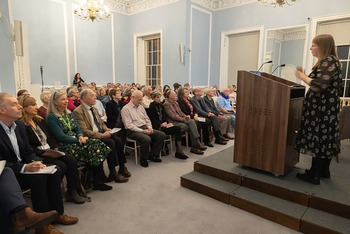
Beyond the Fitch anniversary, 2024 saw a wide range of academic and outreach activities at the BSA. Highlights included a Byron-themed cultural event with traditional dancers (Byron @ 200: Poets, Patriots & Philhellenes, 25 November; Fig. 2.6), the launch of the Greek translation of Islam Issa’s Alexandria: The City that Changed the World, and a reading by Linda France, winner of the inaugural Michael Marks Poetry Pamphlet Award, on 14 October. Public talks attracted enthusiastic audiences, such as a conversation between author Victoria Hislop and historian Paul Cartledge (Fig 2.7), and a lecture on the history of Greece’s economy by Dr Yiannis Stournaras, governor of the Bank of Greece, on 3 October.

Fig. 2.6. The Greek Friends event Byron @ 200: Poets, Patriots, and Philhellenes organized by Ginger Zaimis, with the dancers of Lykeion ton Ellinidon in costume. © BSA.

Fig. 2.7. Victoria Hislop and Paul Cartledge in conversation at the Greece: Finding Buried Stories event in London in June 2024. Photo by Katerina Kalogeraki, © BSA.
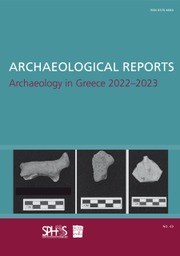
Conferences and publications further reflected the vitality of the BSA’s research agenda. Among the year’s many events were three major conferences that highlighted current areas of focus. Dr Sanja Vucetic, along with the Committee of the Roman Seminar, organized the New Directions in the Archaeology of Roman Greece: Connectivity, Interaction and Innovation conference, where Profs Miguel John Versluys and Greg Woolf gave keynote lectures. Particular thanks are owed to the Swedish Institute and its director, Dr Jenny Wallensten, who provided an alternative venue during a heatwave that rendered the Upper House temporarily unusable for a conference titled Education in and beyond the Greek Gymnasium, co-organized with the Academy of Athens by BSA Assistant Director Dr Giorgos Mouratidis and Dr Natalia Kazakidi (Academy of Athens). Notable publications included the 119th Annual of the British School at Athens, the seventieth volume of Archaeological Reports, and a landmark two-volume study, Phylakopi, Melos, 1896–99: The Finds in the National Archaeological Museum, Athens, by Dr Robin Barber on the material from the early excavations of Phylakopi, which is now housed in the National Museum of Greece.
The BSA’s commitment to interdisciplinary engagement was further demonstrated by its presence at the British Academy Summer Showcase, where Carlotta Gardner and Tulsi Parikh co-curated A Time-Traveller’s Odyssey: Exploring Sacred Journeys Through Archaeology and Science (Fig. 2.8). This exhibit encouraged visitors to reconstruct ancient journeys to Greek sanctuaries, create votive offerings, and explore how archaeological science can uncover the origins of artefacts. Contributions from Hallvard Indgjerd, Bonna Wescoat, the Carl Zeiss Foundation, Multaka Oxford, and Jennifer Lucy Allen made the exhibition a lively and enriching experience.

Fig. 2.8. Tulsi Parikh (BSA Research Associate) at her and Carlotta Gardner’s British Academy Summer Showcase activity, A Time-Traveller’s Odyssey. © BSA.
BSA Students and Fellows
Students and Fellows continued to form the heart of the BSA’s intellectual community. In 2024, four students joined the School: Rachel Phillips (Macmillan-Rodewald student), researching Late Bronze Age mortuary practices; Cary students Andriana Xenaki, examining settlement patterns in the mountains of eastern Crete, and Sebastian Marshall, investigating Greek and Anatolian landscapes in Victorian illustrated travelogues; and Richard Bradford McConnell postdoctoral student Matthew Evans, focusing on Hellenistic and Roman gymnasia. While Xenaki is nearing completion of her doctorate, Evans, Marshall, and Phillips have all progressed to postdoctoral positions, underscoring the strong trajectory of BSA-supported scholarship (Fig. 2.9).

Fig. 2.9. BSA School Students in 2024. Left to right: Sebastian Marshall, Matthew Evans, Rachel Phillips. Photo by Catriona Gallagher, © BSA.
The tenure of Leventis Fellow in Hellenic Studies Tulsi Parikh came to a close, with her place taken by Rachel Phillips. During her fellowship, Parikh advanced research on the human experience of sacred space through movement and sensory engagement, while also contributing significantly to the School’s teaching programme and outreach efforts. The BSA remains deeply grateful to the Leventis Foundation for its ongoing support of this fellowship.
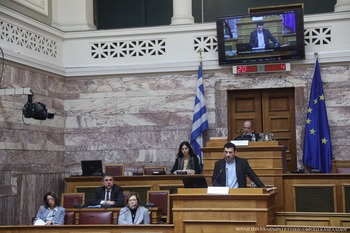
The 1821 Niarchos Fellowship, held by Dr Michalis Sotiropoulos (Fig. 2.10), also concluded in 2024. Sotiropoulos is preparing a collective volume entitled Philhellenism and the Greek Revolution of 1821: Towards a Global History, which will soon be published. Dr Sotiropoulos took up the position of the first lecturer in Modern Greek Studies at Edinburgh.

Fig. 2.10. Dr Michalis Sotiropoulos (Stavros Niarchos 1821 Fellow) at the Hellenic Parliament conference. Photo: ΒΟΥΛΗ ΤΩΝ EΛΛΗΝΩΝ/ ΓΡ. ΤΥΠΟΥ/ © ΦΡΟΣΩ ΚΑΝEΛΛΙΔΟΥ (Hellenic Parliament press release, © Frosso Kanellidou).
Visiting Fellows
The School’s Visiting Fellows, Dr Eva Mol (University of York; Fig. 2.11) and Prof Gerasimos Tsourapas (University of Glasgow; Fig. 2.12), pursued innovative projects. Dr Mol advanced work on her forthcoming book, which explores fragmented and connected cases of mythmaking and the role of places, objects, and legends in shaping new historical realities. At the BSA, her research focused on caves and baetyls (animated stones) in Greek antiquity. Prof Tsourapas undertook fieldwork examining the role of migrant and refugee movements in shaping the political history of modern Greece. His project evolved from an initial exploration of the intersections between labour migration, forced displacement, and foreign policy into the foundations of an ambitious monograph recasting Greek–Turkish relations through the lens of migration and diaspora communities.

Fig. 2.11. Dr Eva Mol (Visiting Fellow 2023–24) at the Ploution cave (Pluto’s Gate to the Underworld) in Eleusis. © Eva Mol.

Fig. 2.12. Dr Gerasimos Tsourpas, Early Career Fellow at the BSA 2023–24. © Gerasimos Tsourpas.
Arts Bursary award
In 2024, the Arts Bursary, a joint initiative between the BSA and the University of the Arts London, was awarded to Tina Rowe (Fig. 2.13). Rowe’s work centred on questions of identity and its public expression, approached through her doctoral research and her distinctive practice as a photographer. During her residency, she used her personally crafted large-format analogue camera to capture the BSA and its archives in striking and emotionally resonant images.

Fig. 2.13. Tina Rowe (BSA UAL Arts Bursary 2023–24) taking portraits of BSA staff members with her large-format camera. Photo by Catriona Gallagher, © BSA.
BSA digital humanities
The BSA’s archives and digital initiatives also saw significant advances. Archivist Amalia Kakissis and Digital Assets Manager Eleni Gkadolou have been instrumental in leading the British International Research Institutes’ Digital Coordination and Strategy Project coordinated by Dr Konstantina Georgiadou and, more recently, Jessica Holland. This initiative is using Linked Open Data to uncover underutilized connections across the eight Institutes’ collections, with initial digital stories focusing on women in archaeology and institutional histories (Fig 2.14).

Fig. 2.14. Screenshot from the Women Transcending Boundaries project. © The BIRI DCS Project. Reproduced with the kind permission of the Council for British Research in the Levant, British Institute at Ankara, British Institute of Persian Studies, British Institute at Eastern Africa, British School at Rome, British School at Athens, British Institute for Libyan & Northern African Studies.
Another major digital project, Transforming Access to Mediterranean Cultural Heritage Science Collections, funded by UKRI’s RICHeS programme, is a collaboration between the BSA, the British School at Rome (BSR), and the British Institute at Ankara (BIAA). Led by Prof Mark Jackson (Newcastle University) and Dr Nathan Meyer (BSA), the project seeks to develop standards-based infrastructure to improve access to science heritage collections, both digital and analogue. By integrating resources such as the BSA’s geological collections, the BSR’s marble collection, and BIAA’s chipped stone assemblages, the project aims to transform how these institutes manage and share research data. Ultimately, it has the potential to make over a century of archival, scientific, and excavation data accessible to a much wider audience.
BSA taught courses
2024 saw a substantial increase in courses taught at the BSA. These include taught courses for undergraduate and postgraduate students and courses for UK and Greece-based school teachers and professionals, and range from communicating archaeology to epigraphy (Fig. 2.15), Linear B, and Byzantine studies, alongside the ever-popular BSA Summer School and the new Ancient City of Athens course (Fig. 2.16). The success of these courses owed much to the dedication of staff and collaborators, especially Assistant Director Dr Giorgos Mouratidis, who leads the teaching programme, as well as organizers such as Prof John Bennet, Prof Polly Low, Prof Peter Liddel, Dr Tulsi Parikh, Prof Rebecca Sweetman, Dr Rossana Valente and Dr Flavia Vanni.

Fig. 2.15. Students working on their assignments in the Epigraphical Museum of Athens, as part of the 2024 postgraduate course on Greek epigraphy. Photo by Peter Liddel © BSA.

Fig. 2.16. Undergraduate students with Assistant Director Georgios Mouratidis on the 2024 BSA Summer School. © BSA.
Library
The BSA’s Library continues to thrive thanks to the dedication of interns and volunteers who generously contribute their time. Among them in 2024 were Atlas Intern Myrto Stamataki and Archive Intern Melissa Bergoffen, who has now moved on to a doctoral position at the University of Crete. The Library also welcomed Mia Ridge from the British Library, who presented at the synergasia event at the Goethe Institute (2 December) on the theme of artificial intelligence, reflecting on lessons from a decade of digital scholarship. The year’s Annual Frede Lecture was delivered by Prof Benjamin Morrison of Princeton University, who examined the concepts of δόξα (perception/opinion) and ἐπιστήμη (science) in Aristotle and their implications for ethical thought.
Archive
The Archive also played a central role in 2024. The Annual Bader Archive Lecture was given by Dr Senta German of Montclair State University, who explored the enduring legacy of de Jong’s restorations and the pivotal role played by US Marshall Plan funding in their realization (Fig. 2.17). A significant new initiative, the Sinclair Hood Archive Project, began in January with the appointment of Archive Assistant Hannah Gwyther. With support from the Knossos Trust, Gwyther is working to make unpublished excavation records accessible to researchers, further enriching the BSA’s archival holdings.

Fig. 2.17. Senta German (Montclair State University) delivering the Annual Bader Archive Lecture in May 2024, presenting ‘Piet de Jong and the Post War Restorations of Knossos’. © BSA.
As part of the BIRI Digital Coordination and Strategy Project, Archivist Amalia Kakissis organized a hybrid workshop on 26–27 February on the use of Linked Open Data and digital storytelling to promote and disseminate archival collections. The workshop brought together BIRI staff, collaborators, and experts from across Europe, underlining the School’s leadership in digital innovation. Among other highlights, the John Pendlebury Family Papers were launched on the BSA Digital Collections website during a lecture in Heraklion, an achievement made possible through the generous support of the Wykeham Patrons of Winchester College. The Archive also contributed materials to Prof Ioanna Sitaridou’s Romeyka in Turkey exhibition at the Mohammed Ali (MOHA) Research Center in spring 2024 (29 March–28 April).
The BSA remains deeply indebted to the interns and volunteers whose contributions sustain the vitality of the Archive. In 2024, these included Isabel Fountain, Emily Wilkinson, and Ian Knight – now a new member of staff – alongside Pauline Blanchet, who worked on the Hasluck papers, and Alexia Lodge, who updated the BSA art collection, focusing on works from the artist residencies with the University of the Arts London. Their work culminated in a digital showreel for the British Embassy’s celebration of King’s Birthday Party. The BSA also gratefully acknowledges donations that enrich its collections. Notably, Robert McCabe presented four framed black-and-white prints from his time with Alan Wace during the Mycenae excavations in 1955, while James and Halina Graham generously donated a second Emily Penrose diary, this one from 1886, which records the family’s move to Greece and their arrival in the newly built BSA’s Upper House.
Knossos Research Centre
At Knossos, 2024 marked the launch of the ambitious redevelopment of the Stratigraphical Museum, a project set to transform it into one of Greece’s most advanced archaeological research centres. The initial stages of the project involved preparing the site for the installation of 26 shipping containers to temporarily house the museum’s collections (Fig. 2.18). The careful transport and storage of artefacts are being professionally documented for archival purposes and for a documentary tracing the history of the Stratigraphical Museum from its founding in 1905 to the present day. Alongside this, a photographic project is underway to capture the relationship between people and archaeological finds in new and creative ways.

Fig. 2.18. Twenty-six shipping containers are now being installed for temporary storage of the Knossos Stratigraphical Museum collections. © BSA.
The Knossos Research Centre also maintained a lively programme of academic events. Lectures addressed subjects as varied as Minoan lamps and lighting, the Olympic Games and ethics, and the history of the Educational Society of Heraklion, founded by Stefanos Xanthoudides and Iosif Hadzidakis. The cultural festival Earth, Water, Fire: Celebrating Cretan Pottery from Antiquity to the Present was held for the third consecutive year in Thrapsano from 6–10 July, underscoring the importance of safeguarding Crete’s ceramic heritage – an endeavour that lies at the heart of the BSA’s research strategy. Another highlight was Conversations with the Minoan ‘Snake Goddesses’ on 26 July, presented by Prof Nicoletta Momigliano on behalf of the Many Lives of a Snake Goddess Project in collaboration with the Knossos Research Centre and the Cultural Association of Knossos. This event examined the restoration, significance, and reinterpretation of the famous figurines, exploring their shifting meanings beyond the sphere of archaeology. A further major event was the exhibition (organized by the BSA Archivist and Knossos Curator) and workshop dedicated to John Pendlebury, his contributions to Cretan archaeology, and his role during the Second World War (Fig. 2.19). Hosted at the Vikelaia Municipal Library of Heraklion with support from the Region of Crete and the Municipality of Heraklion, the event offered fresh perspectives on Pendlebury’s enduring legacy.

Fig. 2.19. Knossos Curator Kostis Christakis talking to viewers of the Pendlebury exhibition at the Vikelaia Library of Heraklion. © BSA.
The Fitch Laboratory
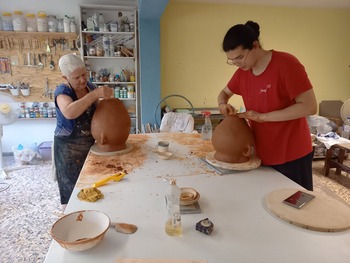
The Fitch Laboratory continued to spearhead interdisciplinary research, exemplified by two innovative projects. The first, led by Timothée Ogawa as part of the EU-funded PlaCe-ITN initiative, focuses on cooking pottery from Toumba Thessaloniki (Fig. 2.20). His research reconstructs the chaînes opératoires of cooking vessels spanning over 1,500 years, examining production methods and culinary practices to assess continuity and change in local traditions. Combining cutting-edge methods – palaeoproteomics, ceramic petrography, elemental analysis, and experimental reconstructions – the project involves collaborations with archaeologists, scientists, and craftspeople, including colleagues from the Aristotle University of Thessaloniki. Early findings suggest that cooking ware was largely produced and consumed locally, with minimal variation in techniques across more than a millennium, pointing to remarkable continuity in culinary traditions even as other forms of pottery evolved.

Fig. 2.20. Timothée Ogawa (PLaCe-ITN MSCA Early Stage Researcher) and Christine Willis (potter) working on replicating cooking pottery from Toumba Thessaloniki as part of Timothée’s research towards his PhD. © BSA.
A second project, supported by a Fitch Laboratory bursary, was undertaken by Rafael Laoutari of the University of Cambridge within the framework of the Oued Beht Archaeological Project. This British–Italian–Moroccan collaboration, led by Prof Cyprian Broodbank, Dr Giulio Lucarini, and Dr Youssef Bokbot, investigates a newly discovered early farming site in northwest Africa dating to ca. 3400–2900 BC – an exceptional find outside the Nile Valley. Working with Fitch Director Dr Evangelia Kiriatzi, Laoutari examined pottery production and exchange at Oued Beht. The research revealed a long-standing, previously undocumented tradition of grog-tempered pottery spanning from the fifth to the second millennium BC, offering the first detailed insight into the ceramic practices of early northwest African farming communities. These findings illuminate the region’s socio-economic networks and highlight its connections to broader prehistoric traditions.
BSA projects
The BSA continues to express its gratitude to colleagues in the Ministry of Culture and Sport for their unwavering support and collaboration. In particular, Secretary General Georgios Didaskalou, Director General of Antiquities Dr Olympia Vikatou, and Director of Prehistoric & Classical Antiquities Dr Elena Kountouri, along with numerous staff across the Ephorates of Antiquities, have been essential to the success of BSA fieldwork. Special thanks are extended to Tania Gerousi and Niki Papaconstantinou, whose expertise and energy have been instrumental to the School’s projects.
Toumba Serron 2024
The third excavation season at the Neolithic village of Toumba Serron (Map 2.1; ID20636), located on the eastern side of the Strymon Valley in Northern Greece, took place under challenging summer heatwave conditions. Despite these difficulties, the team, directed by Dr Dimitra Malamidou (Ephorate of Antiquities of Serres), Dr Nicolas Zorzin (National Cheng Kung University-Taiwan), and Dr James Taylor (University of York), continued to explore Late Neolithic structures and the site’s large earthen perimeter wall. Collaborations with the Transforming Data Reuse in Archaeology (TETRARCHs) project enabled the team to advance digital practice through field experiments, observations, and community-focused workshops.

Map. 2.1. Sites of BSA study and fieldwork in 2024. 1. Toumba Serron; 2. Emborio–Chios; 3. western Samos; 4. Kato Choria; 5. Olynthus; 6. Palaikastro.
The 2024 season built on previous excavation and drilling operations, as well as geophysical surveys conducted between 2019 and 2023. Among the season’s key achievements was the uncovering of an oval house measuring 4.30 by 2.95 metres, constructed using mud in the pisé technique, alongside stake holes 5–7cm in diameter (Fig. 2.21). Associated household structures, including a possible kiln and yard, provide new insights into the settlement’s structural phases. These in situ residential remains challenge previous assumptions that Late Neolithic II strata on the hill had been largely destroyed.

Fig. 2.21. Post-excavation orthophoto of Trench I6.21, which shows the kiln area, the waste deposit, and the mudbrick wall of the oval house. © Hellenic Ministry of Culture: Ephorate of Antiquities of Serres/BSA.
The continuation of the enclosure wall to the east was confirmed, corroborating geophysical survey results. Evidence suggests that the wall was actively used throughout the Late Neolithic I period and possibly abandoned during the transition to Late Neolithic II. The presence of a refuse dump and earlier grave discoveries outside the enclosure in the northern region supports this interpretation.
The Emborio Hinterland Project
The Emborio Hinterland Project reported a successful 2024 season (ID20638), which included a final three-week survey and a preliminary three-week museum study. This is a synergasia between the Ephorate of Antiquities of Chios and the BSA, directed by Dr Olga Vassi (Ephorate of Antiquities of Chios) and Prof Andrew Bevan (UCL). Covering approximately 9.4 square kilometres, the team identified numerous sites, including at least four new prehistoric scatters alongside material spanning the Archaic, Classical, Hellenistic, Roman, and Medieval periods.
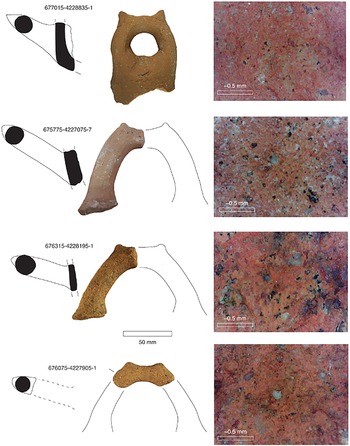
The preliminary study season proved particularly fruitful for understanding prehistoric material. New small sites in the Emborio hinterland were identified, with Mycenaean material featuring prominently, including both decorated and undecorated sherds. Notably, work by Dr Kristina Zannikos and Dr Jannis Kozatsas uncovered diagnostic material from the Middle and earliest Late Bronze Age, previously absent from research on Chios. These findings included bead-rim bowls, deep-incision handles, and coarse brown fabric with tripod legs. A series of horned handles from horizontal bowls suggest additional, enigmatic Early Bronze Age to Middle Bronze Age components (Fig. 2.22). While ‘matt-painted’ Minoanising pottery known from earlier excavations has not yet been confirmed, some candidate sherds remain under study for the 2025 season.

Fig. 2.22. Examples of double-wart/horned handles and accompanying fabric macrographs. © Hellenic Ministry of Culture: Ephorate of Antiquities of Chios/BSA.
Although a small amount of later material was sampled to guide future research, much of the Archaic through Modern survey material remains to be fully analysed, a task reserved for the upcoming final study season.
Samos
In Samos, WASAP (the West Area of Samos Project) completed its fieldwork phase in 2024 and moved into the study and analysis phase (ID20635). The four-year field campaign, led by Dr Anastasia Christophilopoulou (Boston MFA), Dr Michael Loy (Durham University), and Prof Naoíse Mac Sweeney (University of Vienna), revealed extensive human activity and connections across the island’s uplands (Fig. 2.23). Highlights of 2024 included the discovery of the first sherds with figural decoration and a set of chipped stone tools.

Fig. 2.23. Map of points of interest registered in the north basin study area as part of the extensive survey by WASAP. © Hellenic Ministry of Culture: Ephorate of Antiquities of Samos and Ikaria/BSA.
Fieldwork activities focused on three main areas: exploratory tract walking in the northwest basin; gridded collection and extensive survey around Velanidia; and museum study and preparatory work for public engagement in Pythagorio. Ethnographic and local knowledge guided detailed investigation of areas of interest (AOIs), leading to the identification of up to 20 AOIs, most notably the Fourniotiko region, where Hellenistic black-glaze pottery and first-millennium BC materials were particularly abundant.
Naxos
The Kato Choria Excavation Project (ID20637) represents one of the first systematic investigations of early Medieval settlement in the Cyclades (Fig. 2.24). This is a synergasia between the Ephorate of Antiquities of Cyclades and the BSA, directed by Dr Dimitris Athanasoulis (director of the Ephorate), Prof Jim Crow (University of Edinburgh), and Prof Mark Jackson (Newcastle University). The project seeks to understand domestic life during this traditionally underexplored period and its relationship with the monumental fortress at Kastro Apalirou.

Fig. 2.24. Map of Kato Choria/Paleoglisies with selected areas for investigation (after Crow and Veloudaki). © Hellenic Ministry of Culture: Ephorate of Antiquities of Cyclades/BSA.
In 2024, excavations revealed burials inserted into earlier structures, which are being radiocarbon dated (Fig. 2.25). Investigations of Areas D and F provided evidence for domestic activities and burial practices, with ceramics suggesting an eighth- to eleventh-century chronology. Area F revealed a substantial stone building, which appears to have collapsed in situ, preserving semi-articulated arrangements of stones and some surface contexts. Soil sampling will provide further insight into the building’s usage. Overall, the project offers the first evidence of non-monumental extra-mural settlement in the Kastro Apalirou region.

Fig. 2.25. Trench D.2. View to the south of inhumation burials in cist [4211] lying in fill [4210]. Photo by Mark Jackson, © Hellenic Ministry of Culture: Ephorate of Antiquities of Cyclades/BSA.
Olynthus
The Olynthus Project, led by Dr Bettina Tsigarida (Ephorate of Antiquities of Pella), Dr Zosia Archibald (Liverpool), and Prof Lisa Nevett (Michigan), focused on studying coarse and plain wares from House B ix 6 on the North Hill, amphorae from the North Hill, and fine wares from the South Hill’s final occupation phase. In parallel, the Fitch Laboratory conducted a petrographic study of 12 millstones, revealing volcanic, gabbro, and clastic sediment sources. Further analysis is required to pinpoint exact origins, which are likely distributed across Eastern Macedonia, Thrace, and the Aegean volcanic arc.
Palaikastro
At Palaikastro, Crete, the team led by Prof Carl Knappett (University of Toronto) and Dr Andrew Shapland (Ashmolean Museum) focused their attention in 2024 on conserving and cataloguing finds in preparation for publication. Materials from the East Beach demonstrate long-term occupation spanning Middle Minoan I to Late Minoan III. The large pottery deposit excavated in 2022 on Chiona promontory was fully processed, providing insight into LM IIIA storage practices within this urban neighbourhood.
People
In staffing, the BSA welcomed three new members in 2024: Miltos Kalavrytinos (IT systems administrator), Ian Knight (digital humanities assistant), and Dr Nathan Meyer, who returned to lead the RICHeS project as well as heading up the IT department. We also welcomed David McClay as head of development.
The BSA mourned the loss of several distinguished scholars in 2024, including Prof John Boardman, Dr John Hayes, Dr Roger Howell, Prof Colin Renfrew, Prof Keith Rutter, and Dr Ken Wardle, all of whom maintained profound connections with Greece and the School.
The Director expresses sincere thanks to the staff at Athens, London, and Knossos; the BSA Council and subcommittee members; the BSA Friends Chair and committee; the publications team; and all supporters and collaborators who work behind the scenes. Special recognition is due to Deputy Honorary Treasurer Huw Smith and Chairman Professor Sir Roderick Beaton for their exceptional dedication and energy.
Competing interests
Rebecca Sweetman compiled her contribution while Director of the British School at Athens.










 Open access

