


2.1 Introduction
The manifesto calls on educators to inspire and support young people with the skills they will need to respond to the pressing climate and environmental crises and to navigate a world that is changing rapidly and unequally. Whilst the importance of sustainability education is easily recognised in principle, it can be challenging to integrate it within a curriculum dominated by traditional disciplines. In this response, Watson and Garciacano draw on their experiences from a school in Mexico City, providing practical examples and underpinning concepts that illustrate how sustainability education can be embedded in the curriculum and school culture as part an approach that empowers individuals to become active and informed agents of change.
2.2 The Educational Panorama in Terms of Sustainability Education
So often in education, we talk of preparing children for jobs that haven’t been created yet or equipping them with the skills to address tomorrow’s challenges. But, as clearly put forward by Amy Munro-Faure, Emily Shuckburgh and Bhaskar Vira (Chapter 1), the time to act is now. What is required is an education that allows children to develop an understanding and awareness of the interlinked climate and environmental crises occurring at this very moment, and to be able to take meaningful action, however small, through what they are presently taught in school.
Schools are incredibly relevant to sustainable efforts on a local and in some cases a global scale; this is due to their ability to reach a broad cross-section of a community and beyond that individual their family and other significant individuals in their lives. To bring about real change in terms of providing a rich, environmentally responsive education, all actors in a school need to work together, identifying relevant issues and opportunities. However, there are significant challenges faced across all types of organisations, including schools, which are that understanding, adoption and monitoring currently depend on a few individuals taking the initiative. This means that, often, actions linked with environmental issues and climate change are approached through isolated efforts and philanthropy and not seen as a lengthy process which must be embedded in the curriculum and the culture of the school from the earliest stages of a child’s life in a school all the way to their graduation day.
Therefore, it is very important that all members of the school community, including students, parents, administrative and academic staff, suppliers and the wider community, be actively involved in sustainable initiatives and have sufficient information and motivation. There are some fantastic examples of programmes, such as the Harmony approach (Harmony Project, 2024), which places the principles of nature at the heart of curriculum design, or schools such as the Green School (2024) in Bali, which is doing pioneering work in developing educational approaches that drive forward the importance of educating learners about the reality of the environmental and climate crises we’re facing. However, for the most part, education, like many other systems, is slow to change, and there is not yet a critical mass or a significant coordinated approach towards teaching for a sustainable future. As Scoffham and Rawlinson (Reference Scoffham and Rawlinson2022, p. 12) echoed, ‘Sustainability, the most urgent issue of our time, is hardly mentioned in the formal curricula of most “developed” nations.’
Unfortunately, in many schools, it is a ‘business as usual’ approach, focusing on maintaining ‘high academic standards’. And because of this, there is not sufficient time or space to meaningfully address issues related to the crises that we face. This may stem from a lack of understanding and knowledge, or simply from apathy – if one is not directly affected or cannot see the impact of their choices, why change? This mindset is dangerous and wastes the potential of education to address climate and environmental issues. Moreover, as Dunne and Martin (Reference Dunne, Martin, Biddulph and Flutter2021, p. 82) argued, education for sustainability need not ‘run counter to the drive for high standards of attainment’.
It is clear we can no longer avoid creating informed and relevant learning opportunities for young people. This is particularly true in Mexico City, where we are directly impacted by both the climate and environmental crises. In what follows, we speak about the ways we are working to address these challenges. We use the six underpinning concepts put forward in Chapter 1 to structure our examples and explore potential next steps for us as an institution.
2.3 The Mexican Context (Environmental and Climate Crises)
Nowhere on Earth will be exempt from the interlinked climate and environmental crises. In Mexico, geography and human actions have created a unique challenge in which multiple, compacting issues require a significant, coordinated approach. Mexico has ratified the Paris Agreement and has worked to incorporate the Aichi Biodiversity targets into a national strategy. It was also the first of the large oil-producing countries to adopt climate change legislation with the General Climate Change Law in 2012 (Government of Mexico City, 2019). However, when one takes a deeper look at Mexico’s progress statistics, cross-checked against the Sustainable Development Goals (SDGs), there are multiple areas, such as the efficient use of natural resources, sustainable uses of forests and the protection of threatened species, in which Mexico has made no progress, or is even moving backwards.
Across Mexico, challenges such as deforestation, water insecurity and droughts and a projected 40–70 per cent decline in workable farmland, alongside vulnerability to natural disasters, such as earthquakes and hurricanes, makes for a precarious climate and environmental context (Climate Reality Project, 2018). Acknowledging these significant and worrying national challenges, we now look to Mexico’s capital – Mexico City.
2.4 The School Context: What Are We Doing and Where Are We Going?
The capital of Mexico has its own unique geography with multiple microclimates, and, built on reclaimed swamp land, it is vulnerable to all of the aforementioned climate-related issues. Our school is situated in the south of Mexico City; the area is hilly and forested, full of coniferous trees and homes built on steep inclines. Locally, there are severe issues with water scarcity, droughts and habitat destruction, and on our own grounds – built on a former landfill site – we experience severe soil erosion and an ecological area built on a former landfill site. Our school is an all-through school, providing education for children from the age of eighteen months to eighteen years, which means we have a unique opportunity to actively support and contribute to our children’s development as compassionate citizens who have a positive impact on the world around them.
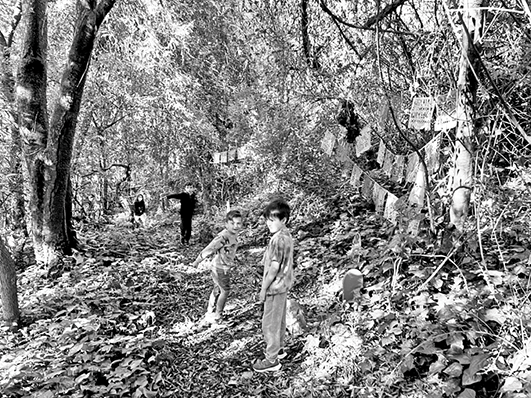
To illustrate some of the ways the school has attempted to address climate and environmental challenges (see Figure 2.1 as an illustration of the spaces created to enable this learning to become explicit), we will utilise the underpinning concepts put forward by Munro-Faure, Shuckburgh and Vira: active citizenship, creativity and resilience, knowledge and understanding, listening and compassion, systems thinking and interdisciplinarity and local action with global impact. All of these activities and practices relate to active citizenship, and many invoke or apply to several of the other five concepts; there is significant crossover. It is also important to state that, together, these separate actions have culminated in the launch of an internal Centre for Sustainability, our attempt at creating a coordinated effort both within and beyond our community.
1) Fostering creativity and resilience. As an educational institution, much of the work we do to support children’s holistic development focuses on developing resilience and creativity. However, such skills must be put into, and used in, context. Here are some examples of how we foster creativity and resilience as a school:
● Arts-themed projects. Spanning at least one week or longer, these projects use art as a medium to address a particular theme. Our upcoming project utilises a text: ‘La Tierra es Mi Amiga’ (The Earth is My Friend) each level of the school from early years to Year 6 (eighteen months to eleven years) are working to create an image of themselves in nature, with the youngest identifying what they love and appreciate about nature and the older children considering specific ecosystems and learning about these through the research process conducted whilst creating their unique artwork.
● Themed days and weeks. Our yearly calendar is planned carefully to provide meaningful events to draw awareness to, and develop understanding of, a range of issues that affect our community and our world. For example each year we hold an Earth Week. This event is conducted with the support of parent volunteers from the schools’ Ecological Committee and involves experts within and beyond our community. This year, our focus is water scarcity. Each year group will participate in a range of different activities; one example is finding ways to wash a baby doll with a limited amount of water to challenge children to think creatively about the ways in which we use the resources we have.
2) Developing knowledge and understanding. It is essential children have a deep and informed understanding of climate change, biodiversity loss and wider sustainability challenges. As an all-through school, we have a unique opportunity to carefully plan how we can support children as they acquire and explore concepts in an age-appropriate way, while exposing them to the ‘big ideas’ they need to understand. We do this in the following ways:
● Curriculum design. In early years and primary, we operate using a topic-based approach to learning, and each topic has been designed to have a specific sustainability focus. For example a topic in nursery; children learn about toys and the importance of sharing toys with others when we no longer want them, developing the early foundations for understanding circular economies. Year 1 has a topic named ‘What a Wonderful World’, which focuses on animals and plants. Throughout this topic, children develop and grow their own rooftop garden, learning about the challenges of caring for plants, the threats they face from insects, disease, overexposure to sun and heat, and a lack of water. At primary level, children in Year 3 learn about the impact of humans on marine life, in particular the Deep Horizon Oil Spill in 2010 and the significant damage that human activity can have on marine ecosystems.
● Reaching out. Whilst each topic has a sustainability focus, we complement this by reaching out to experts to add deeper meaning to the learning and further develop children’s knowledge and understanding of the real-world implications of these topics. One of our reception topics, ‘To Infinity and Beyond’, focuses on space and new technologies, and children have the opportunity to speak to an expert who works for NASA to find out about space beyond the role of the astronaut.
3) Creating space for listening and compassion. The importance of authentic listening, perspective-taking and compassion cannot be underestimated in these challenging times. It is important to equip children with these attributes so as not to end up in conflicts, finger-pointing and blaming one another for the situations we find ourselves in. Moreover, as argued by Munro-Faure, Shuckburgh and Vira, it is critical that we ‘listen to one another as we collectively search for solutions’. We approach this in the following ways:
● Philosophy for children and debating. In our early years and primary sections we utilise the Philosophy for Children programme. This is not only powerful for developing children’s abilities to express their ideas in a second language, it also encourages children to think deeply about their own ideas and those of others. Understanding that there is not always one answer to a problem or one perspective on a topic or issue. This practice is further developed in secondary through debating exercises, where children can analyse and weigh up different arguments and perspectives. A strong emphasis is placed on listening – to develop deep understanding and consideration of the ideas of others. Children are given the opportunity to approach topics beyond their basic themes, and deal with bigger concepts – for example they might engage with the fact that countries pollute, but also try to understand ideas of power, political influence, culture, and economics, and the ways their coalescence contributes to pollution. As we collectively search for solutions, children need to have the capacity to consider the validity and strengths in the perspectives of others.
● High-quality texts for empathy. An area that we have been investing time and staff training on has been the ways in which we use key learning texts, selected not only for their academic potential but also for the emotional skills they might foster in their readers. Each topic in kinder and primary features a range of texts which allow the children to connect with the feelings and perspectives of the characters.
4) Harnessing the potential for systems thinking and interdisciplinarity. In our early years and primary sections, the use of a topic-based approach to learning allows for a range of opportunities for interdisciplinary learning, and at a secondary level participatory and collaborative programmes further facilitate this:
● Inquiry-focused learning. Each topic in early years and primary has an inquiry focus which allows children to engage with ‘big ideas’ and see connections between them. For example, in Year 1, when learning about ‘Adventurers and Explorers’, children ask the question, ‘How do we show respect for the places we visit?’ developing the concept of responsibility and respect when visiting new places and knowing new people. This guides the children to plan their own adventure respectfully, considering the impact of leaving behind waste or taking away something from its natural habitat.
● Cross-department projects. At a secondary level, there are increased opportunities for collaboration across disciplines. For example a recent project shared between the Arts and Science Departments resulted in children designing plant pots and growing plants. From an arts perspective, children learnt about the history of pottery, and where different ceramic materials are sourced and how to work with them. On the science side, students learnt about composite materials and components, as well as physical and chemical properties.
5) Supporting local action with global impact. We situate our school firmly in the local community and the issues that affect us.
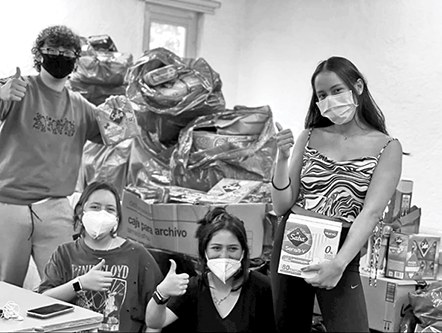
● Global social leaders. This is a voluntary programme that empowers students to develop their own social enterprise. With guided support, students consider all aspects of their project, including its alignment with the SDGs and how to reach out to external partners and organisations and plan for impact. Students’ participation in this programme was life changing, not just for them but for the individuals touched by their projects and the adults involved in supporting them. Some examples of initiatives set up by students through this programme were: an early stimulation education programmeFootnote 1 for mothers in prisons, enabling them to support their children (who are allowed to remain with their mothers until the age of three); another drew inspiration from Akira Miyawaki’s methodology (Lewis, Reference Lewis2022) of urban forest to create a plant nursery in our school (see Figure 2.2).
● Local action projects and connecting with local organisations. In both an organised and organic way, school-based action and interaction with local organisations is supported by senior leadership from all quarters of the school community – students, parents and staff. For example, within our school community, students run an enterprise selling locally produced, sustainably farmed honey, and parents run a weekly recycling programme in conjunction with local organisations.
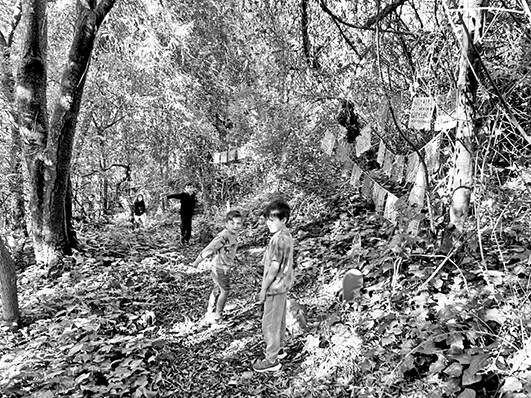
Figure 2.1 Our ecological areas on the Early Years and Main School site provide a meaningful space to observe living things grow and change.
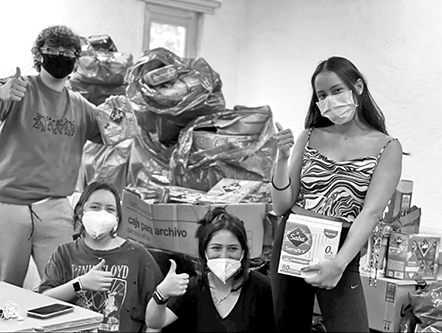
Figure 2.2 Some of the students behind the ‘Authors of Our Future’ initiative who gathered donations of sanitary products for young mothers in prison and designed early stimulation training for these women.
Whilst we are proud of and celebrate each of these different activities, and hope they will be useful ideas for other educators looking for ways they can develop their schools’ approaches to climate and environmental education, we are aware that many of these actions are isolated and require a coordinated, strategic approach. As a result, we have been working to develop our own Centre for Sustainability Education.
The purpose of the Centre is to unify the efforts made across the school, ensuring that climate and environmentally responsive themes are the golden threads that weave their way throughout everything we do as an organisation. The purpose of this initiative is to reach across and beyond, maximising education’s multiplying effect to touch the lives of and empower our students, our parents, our local communities, staff and external partners, and ultimately generate research and resources for other schools and organisations to use themselves. Echoing the words of Munro-Faure, Shuckburgh and Vira, we are taking to heart the idea that ‘every action counts’. We hope that, through our work, we can offer a ‘meaningful and tangible [beacon] for change that can be replicated again and again’.
Over to You
Much of what we describe herein is about space making. Spaces are important for children. School is often a space of safety, of care and of freedom as well as a space that becomes the opposite. In terms of the themes we present, the following questions could guide the reader in their own space for new thinking to bring about better climate and environment science learning and action:

 Open access