





1 Introduction
1.1 Setting and enumerative problem
Compact complex surfaces with trivial canonical bundle are either K3 surfaces, already at the center of many studies, or abelian surfaces, for which there also exists a vast literature, though they seem to be less studied in the realm of enumerative geometry.
As a complex variety, an abelian variety $\mathbb {C} A$
is a complex torus, that is, the quotient of
$\mathbb {C} A$
is a complex torus, that is, the quotient of $\mathbb {C}^2$
by a rank
$\mathbb {C}^2$
by a rank $4$
lattice L. Through the exponential map, it may also be seen as a quotient of
$4$
lattice L. Through the exponential map, it may also be seen as a quotient of $(\mathbb {C}^*)^2$
by a rank
$(\mathbb {C}^*)^2$
by a rank $2$
lattice
$2$
lattice  . To become an abelian variety, the complex torus needs to be endowed with the choice of a polarization [Reference Griffiths and HarrisGH14, Chapter 2.6], which is a skew-symmetric form $Q\in \wedge ^2 L^*$
satisfying conditions known as Riemann-bilinear relations (see Definition 2.3), or alternatively an ample line bundle, of which Q is actually the Chern class.
$Q\in \wedge ^2 L^*$
satisfying conditions known as Riemann-bilinear relations (see Definition 2.3), or alternatively an ample line bundle, of which Q is actually the Chern class.
The most naive enumerative geometry in abelian surfaces consists in counting the number of genus g curves in a given homology class $\beta \in H_2(\mathbb {C} A)\simeq \wedge ^2 L$
passing through g points. This problem was addressed and solved in [Reference Bryan and Conan LeungBL99] for primitive classes, which are elements of the second homology group
$\beta \in H_2(\mathbb {C} A)\simeq \wedge ^2 L$
passing through g points. This problem was addressed and solved in [Reference Bryan and Conan LeungBL99] for primitive classes, which are elements of the second homology group $\wedge ^2 L$
that cannot be expressed as a multiple of a smaller class.
$\wedge ^2 L$
that cannot be expressed as a multiple of a smaller class.
The above enumerative problem can be set in the reduced Gromov-Witten theory framework, where it is shown to be deformation invariant: it does not depend on the abelian surface and only depends on the curve class $\beta $
through its divisibility d and its self-intersection
$\beta $
through its divisibility d and its self-intersection $\beta ^2=2d^2n$
. We denote the invariant by
$\beta ^2=2d^2n$
. We denote the invariant by $N_{g,d,n}$
.
$N_{g,d,n}$
.
Though the primitive case has been known for some time (see [Reference Bryan and Conan LeungBL99] and [Reference Bryan, Oberdieck, Pandharipande and YinBOPY18] for computation of other reduced Gromov-Witten invariants), tackling the computation of invariants for divisible classes turns out to be quite challenging. Only a handful of computations are known in this case.
1.2 Tropical limit and result
In 2020, T. Nishinou proved a correspondence theorem [Reference NishinouNis20] for curves passing through points in abelian surfaces, adapting to the abelian setting the tropical correspondence theorem for curves in toric surfaces proved independently by G. Mikhalkin [Reference MikhalkinMik05] and T. Nishinou-B. Siebert [Reference Nishinou and SiebertNS06]. The correspondence theorem transforms the enumerative problem into a combinatorial problem dealing with some piecewise linear graphs called tropical curves in a real torus  , here known as tropical abelian surface.
The correspondence theorem theoretically allows the computation of the above mentioned invariants for any curve class, provided one is able to deal with the combinatorics of the tropical enumerative problem. Without any further assumption, this is a difficult problem. Assuming the tropical abelian surface and the point configuration are stretched, this problem was solved by the author in a series of papers [Reference BlommeBlo22a, Reference BlommeBlo22b, Reference BlommeBlo22c]. The highlight comes in [Reference BlommeBlo22c] with the proof a multiple cover formula satisfied by the invariants, which we now state.


In particular, the above multiple cover formula reduces the computation for nonprimitive classes to primitive classes, for which we have an explicit formula from [Reference Bryan and Conan LeungBL99], also possible to achieve via tropical methods and the correspondence theorem.
This multiple cover formula is actually a specific case of a more general formula of the same shape that should be satisfied by all reduced Gromov-Witten invariants of abelian surfaces, as conjectured by G. Oberdieck in [Reference OberdieckObe22]: the N should be replaced by some GW-invariant and only the exponent $4g-3$
of k may change. In the case of point insertions, this formula is the one stated in Theorem 5.2, and was already proven by the author in [Reference BlommeBlo22c].
$4g-3$
of k may change. In the case of point insertions, this formula is the one stated in Theorem 5.2, and was already proven by the author in [Reference BlommeBlo22c].
1.3 Idea of proof
The proof presented in [Reference BlommeBlo22c] is quite technical and relies on the fact that it is possible to choose tropical abelian surfaces with nonequivalent polarizations for which the tropical curves are floor decomposed, that is, enclosed in a discrete data called diagrams. The curve count is recovered by painful computations. The key is that the same diagrams can be used to compute the invariants for both a primitive class and a nonprimitive class. One finally observes that the multiple cover formula is already satisfied at the level of diagrams.
Algebraically, the proof from [Reference BlommeBlo22c] may be seen as follows: it is possible to construct two families of abelian surfaces with distinct polarizations that degenerate to a central fiber which is chain of $E\times \mathbb {P}^1$
(with E an elliptic curve) glued along their divisors
$E\times \mathbb {P}^1$
(with E an elliptic curve) glued along their divisors $E\times \{0/\infty \}$
. Though the pieces are the same, the central fibers differ by a twist (translation) in the E direction when going around the chain of
$E\times \{0/\infty \}$
. Though the pieces are the same, the central fibers differ by a twist (translation) in the E direction when going around the chain of $\mathbb {P}^1$
. This twist is responsible for the distinct polarizations. A decomposition formula breaks the invariants as a sum of pieces indexed by diagrams, and the multiple cover formula is already true at the level of diagrams.
$\mathbb {P}^1$
. This twist is responsible for the distinct polarizations. A decomposition formula breaks the invariants as a sum of pieces indexed by diagrams, and the multiple cover formula is already true at the level of diagrams.
In [Reference BlommeBlo22c], the construction from the previous paragraph is achieved tropically by choosing a tropical twist: the underlying tropical abelian surfaces are not the same though the diagrams are the same. The idea of this paper is to choose instead a complex twist, so that the tropical abelian surfaces are this time the same. Therefore, the curves to which we apply the correspondence theorem are the same, and the multiple cover formula may now be seen at the level of the tropical curves. This way, the proof avoids any kind of tropical enumeration, solely relying of the existence of tropical correspondence, and no explicit solving.
The method of this paper could probably be generalized for other reduced Gromov-Witten invariants if one had a suitable decomposition formula, which is for now unknown. In particular, this method does not yet work to prove the multiple cover formula for refined invariants from [Reference BlommeBlo22c] since the latter are not related to anything on the complex setting yet.
1.4 Plan of the paper
In the second section, we recall some basics about abelian surfaces, both complex and tropical. In the third section, we explain how a polarization on a Mumford family yields a tropical polarization of its tropicalization. In Section 4, we recall the setting of Nishinou’s correspondence theorem [Reference NishinouNis20] for Mumford families of abelian surfaces before proving the multiple cover formula in Section 5.
2 Abelian surfaces, curves and deformations
2.1 Complex abelian surfaces
We start with the definition of a complex torus.
Definition 2.1. A complex torus is a quotient $\mathbb {C}^2/L$
, where L is rank
$\mathbb {C}^2/L$
, where L is rank $4$
lattice in
$4$
lattice in $\mathbb {C}^2$
.
$\mathbb {C}^2$
.
We denote a complex abelian surface by $\mathbb {C} A$
. We write
$\mathbb {C} A$
. We write $\Omega $
the
$\Omega $
the $2\times 4$
period matrix whose columns span L. Choosing a
$2\times 4$
period matrix whose columns span L. Choosing a $\mathbb {C}$
-basis of
$\mathbb {C}$
-basis of $\mathbb {C}^2$
inside L, we can write
$\mathbb {C}^2$
inside L, we can write  , where
  is a supplement of $\mathbb {Z}^2$
. Via the exponential map coordinate by coordinate, we obtain a biholomorphic map
$\mathbb {Z}^2$
. Via the exponential map coordinate by coordinate, we obtain a biholomorphic map

where the map  is the composition of the inclusion
  and the coordinate exponential.
Remark 2.2. Composing with the logarithmic map  , both lattices $\mathbb {Z}^2$
and
$\mathbb {Z}^2$
and  may be seen in $\mathbb {R}^2$
:
$\mathbb {R}^2$
:  via the log map and $\mathbb {Z}^2$
via the canonical inclusion.
$\mathbb {Z}^2$
via the canonical inclusion.
An orientation of a lattice is a generator of its top-exterior power. We can take orientations of $\mathbb {Z}^2$
and
$\mathbb {Z}^2$
and  that induce the same orientation of $\mathbb {R}^2$
, yielding a well-defined orientation of L. The orientation it induces on
$\mathbb {R}^2$
, yielding a well-defined orientation of L. The orientation it induces on $\mathbb {C}^2$
is however the opposite of the complex orientation. This is due to the fact that the two middle coordinates are switched.
$\mathbb {C}^2$
is however the opposite of the complex orientation. This is due to the fact that the two middle coordinates are switched.
From now on, we assume that  , and we have chosen compatible orientations of $\mathbb {Z}^2$
and
$\mathbb {Z}^2$
and  . The second homology and cohomology groups of $\mathbb {C} A$
are respectively
$\mathbb {C} A$
are respectively $\wedge ^2 L$
and
$\wedge ^2 L$
and $\wedge ^2 L^*$
. Following [Reference Griffiths and HarrisGH14, Chapter 2.6], we now define a polarization of a complex torus.
$\wedge ^2 L^*$
. Following [Reference Griffiths and HarrisGH14, Chapter 2.6], we now define a polarization of a complex torus.
Definition 2.3. A polarization on $\mathbb {C} A=\mathbb {C}^2/L$
is an invertible skew-symmetric integer matrix Q satisfying Riemann bilinear relations:
$\mathbb {C} A=\mathbb {C}^2/L$
is an invertible skew-symmetric integer matrix Q satisfying Riemann bilinear relations:

More intrinsically, Q is an element of $\wedge ^2L^*$
, skew-symmetric forms on L, with skew-symmetric matrices after the choice of a basis of L (i.e.,
$\wedge ^2L^*$
, skew-symmetric forms on L, with skew-symmetric matrices after the choice of a basis of L (i.e., $\mathbb {Z}^2$
and
$\mathbb {Z}^2$
and  ).
).
Using the orientation of L given by the choice of compatible orientations on $\mathbb {Z}^2$
and
$\mathbb {Z}^2$
and  , we have the pairing coming from the wedge-product:

The associated quadratic form is actually twice the Pfaffian.
Remark 2.4. As $H^2(\mathbb {C} A)=\wedge ^2L^*$
, the integer matrix Q is in fact the Chern class of an ample line bundle
$H^2(\mathbb {C} A)=\wedge ^2L^*$
, the integer matrix Q is in fact the Chern class of an ample line bundle  on
on $\mathbb {C} A$
. The zero-locus of a section of
$\mathbb {C} A$
. The zero-locus of a section of  is thus Poincaré dual to $Q\in H^2(\mathbb {C} A)$
. Due to the change of orientation, the intersection pairing on
$Q\in H^2(\mathbb {C} A)$
. Due to the change of orientation, the intersection pairing on $H^2(\mathbb {C} A)$
coming from the cup-product and the complex orientation is actually the opposite of the above Pfaffian pairing.
$H^2(\mathbb {C} A)$
coming from the cup-product and the complex orientation is actually the opposite of the above Pfaffian pairing.
2.2 Poincaré duality and polarization
Before going to the tropical world, we give a formulation of Poincaré duality assuming the polarization takes a particular triangular form in the decomposition  .
.
Lemma 2.5. Assume  for some integer matrices $C,T$
. Then, we have the following:
$C,T$
. Then, we have the following:
-
(1) The matrix T is skew-symmetric of size $2$
, its upper-right coefficient is equal to its Pfaffian, and
$\operatorname {Pf}(Q)=-\det C$
.
$2$
, its upper-right coefficient is equal to its Pfaffian, and
$\operatorname {Pf}(Q)=-\det C$
. -
(2) If B is the comatrix of C, we have
$$ \begin{align*}\operatorname{Pf}(Q)Q^{-1} = \begin{pmatrix} -T & B \\ -B^\intercal & 0 \end{pmatrix}.\end{align*} $$
-
(3) The map
$Q\in \wedge ^2L^*\mapsto \operatorname {Pf}(Q)Q^{-1}\in \wedge ^2L$
is actually the Poincaré duality map
$H^2(\mathbb {C} A)\to H_2(\mathbb {C} A)$
.





Proof. The first point follows from a direct computation. For the second point, the inverse matrix is given by
 $$ \begin{align*}Q^{-1} = \begin{pmatrix} (C^{-1})^\intercal TC^{-1} & -(C^{-1})^\intercal \\ C^{-1} & 0 \end{pmatrix}.\end{align*} $$
We set $B=(\det C)(C^{-1})^\intercal $
, which is actually the comatrix of C. In particular, it has integer coefficients. The Pfaffian of
$B=(\det C)(C^{-1})^\intercal $
, which is actually the comatrix of C. In particular, it has integer coefficients. The Pfaffian of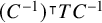 $(C^{-1})^\intercal TC^{-1}$
, equal to its upper-right coefficient, is
$(C^{-1})^\intercal TC^{-1}$
, equal to its upper-right coefficient, is $\operatorname {Pf}(T)/\det C$
, so that
$\operatorname {Pf}(T)/\det C$
, so that $(\det C)(C^{-1})^\intercal TC^{-1}=T$
. Therefore, since
$(\det C)(C^{-1})^\intercal TC^{-1}=T$
. Therefore, since $\operatorname {Pf}(Q)=-\det C$
, we get the desired expression.
$\operatorname {Pf}(Q)=-\det C$
, we get the desired expression.
The matrix $\operatorname {Pf}(Q)Q^{-1}$
is an element of
$\operatorname {Pf}(Q)Q^{-1}$
is an element of $\wedge ^2L=H_2(\mathbb {C} A)$
. It coincides with the Poincaré duality
$\wedge ^2L=H_2(\mathbb {C} A)$
. It coincides with the Poincaré duality $H^2(\mathbb {C} A)\to H_2(\mathbb {C} A)$
by a direct computation on a basis of
$H^2(\mathbb {C} A)\to H_2(\mathbb {C} A)$
by a direct computation on a basis of $\wedge ^2L$
and
$\wedge ^2L$
and $\wedge ^2L^*$
.
$\wedge ^2L^*$
.
Up to a change of basis of L, it is possible to assume that $T=0$
and C is diagonal, so that Q is in diagonal antidiagonal form:
$T=0$
and C is diagonal, so that Q is in diagonal antidiagonal form:

where $d_1|d_2$
. The numbers
$d_1|d_2$
. The numbers $d_1,d_2$
can actually be recovered as follows:
$d_1,d_2$
can actually be recovered as follows: $d_1$
is the divisibility of Q, that is, the gcd of the coefficients, and
$d_1$
is the divisibility of Q, that is, the gcd of the coefficients, and $d_1d_2=|\operatorname {Pf}(Q)|$
. The pair
$d_1d_2=|\operatorname {Pf}(Q)|$
. The pair $(d_1,d_2)$
is called the type of the polarization. However, finding such a basis may require to choose a different decomposition of
$(d_1,d_2)$
is called the type of the polarization. However, finding such a basis may require to choose a different decomposition of  , that is, the change of basis may not preserve the given decomposition.
2.3 Tropical abelian surfaces
We recall some basics on tropical abelian surfaces and tropical curves in the latter, following [Reference Mikhalkin and ZharkovMZ08], [Reference BlommeBlo22a] and [Reference NishinouNis20].
Definition 2.6. Let  be a rank $2$
lattice with an inclusion in
$2$
lattice with an inclusion in $\mathbb {R}^2$
. Choosing a basis of
$\mathbb {R}^2$
. Choosing a basis of  , the inclusion is given by a matrix S.
-
⊳ The quotient
is called a tropical torus. -
⊳ A polarization on a tropical torus
$\mathbb {T} A$
is a linear map (with C as in Chern) such that the bilinear map induced by the composition is symmetric and positive definite. -
⊳ A tropical abelian variety is a tropical torus endowed with a choice of polarization.
 is called a tropical torus.
 (with C as in Chern) such that the bilinear map induced by the composition
  is symmetric and positive definite.
Remark 2.7. As  and
and  , the composition $S^\intercal C$
does indeed make sense as a map
$S^\intercal C$
does indeed make sense as a map  , which induces a bilinear map
  , which we may ask to be symmetric.
Taking the adjoint, we have  , and C can also be seen as an element of
  . The reason is that as in the classical case, the polarization is actually the (tropical) Chern class of an ample tropical line bundle, that is, an element of
  .
.
An abstract (irreducible) tropical curve is (connected) metric graph $\Gamma $
with some unbounded edges called ends. The genus of an irreducible tropical curve is its first Betti number. The ends are used to encode marked points and avoid dealing with marked vertices. A tropical curve is trivalent if every vertex is adjacent to exactly three edges (or ends).
$\Gamma $
with some unbounded edges called ends. The genus of an irreducible tropical curve is its first Betti number. The ends are used to encode marked points and avoid dealing with marked vertices. A tropical curve is trivalent if every vertex is adjacent to exactly three edges (or ends).
Definition 2.8 (parametrized tropical curve).
-
⊳ A parametrized tropical curve is a map
$h:\Gamma \to \mathbb {T} A$
from an abstract tropical curve
$\Gamma $
, which is affine with integer slope on the edges, contracts the ends, and satisfies the balancing condition at vertices. -
⊳ The degree is the homology class realized by the curve in
. -
⊳ The gcd
$\delta _\Gamma $
of a parametrized tropical curve
$h:\Gamma \to \mathbb {T} A$
is the gcd of the lattice lengths of the slopes.


 .
.

The degree of a tropical curve is denoted by B, as curve classes in the complex setting are usually denoted by $\beta $
. The degree B may be seen as a map
$\beta $
. The degree B may be seen as a map  and written as a matrix after a choice of coordinates. Its transpose has the following explicit description: for $\varphi \in (\mathbb {Z}^2)^*$
, we have
$\varphi \in (\mathbb {Z}^2)^*$
, we have

where the sum is over the edges of $\Gamma $
, which are
$\Gamma $
, which are $1$
-simplices in
$1$
-simplices in  , and
, and $n_e$
is their slope. As the slope
$n_e$
is their slope. As the slope $n_e$
is reversed when the orientation is reversed, the sum does not depend on the orientation of the edges. The sum is indeed a cycle due to the balancing condition. Seen as an element of
$n_e$
is reversed when the orientation is reversed, the sum does not depend on the orientation of the edges. The sum is indeed a cycle due to the balancing condition. Seen as an element of  , denoting by $l_e$
the length of the edge e, the isomorphism with
$l_e$
the length of the edge e, the isomorphism with  is given by

Lemma 2.9. If $h:\Gamma \to \mathbb {T} A$
is a tropical curve of degree B, then
$h:\Gamma \to \mathbb {T} A$
is a tropical curve of degree B, then $\det B>0$
and
$\det B>0$
and $BS^\intercal $
is symmetric and positive definite.
$BS^\intercal $
is symmetric and positive definite.
Proof. Let $\varphi \in (\mathbb {Z}^2)^*$
. We have an explicit expression of
$\varphi \in (\mathbb {Z}^2)^*$
. We have an explicit expression of $B^\intercal (\varphi )$
as an element of
$B^\intercal (\varphi )$
as an element of  . Take a second linear form
  , with restriction
  on
on  . We get

As $l_e>0$
, the symmetry and the positivity follows. As
$l_e>0$
, the symmetry and the positivity follows. As $\det S>0$
, we deduce that
$\det S>0$
, we deduce that $\det B>0$
, which also follows from the positivity of the self-intersection of the tropical curve.
$\det B>0$
, which also follows from the positivity of the self-intersection of the tropical curve.
After a choice of basis, both degree and polarization are represented by a $2\times 2$
matrix, related by the Poincaré duality. The analog of the transformation
$2\times 2$
matrix, related by the Poincaré duality. The analog of the transformation $Q\mapsto \operatorname {Pf}(Q)Q^{-1}$
is here given by
$Q\mapsto \operatorname {Pf}(Q)Q^{-1}$
is here given by $C\mapsto (\det C)(C^{-1})^\intercal $
, which is actually the comatrix of C. It is also the restriction of
$C\mapsto (\det C)(C^{-1})^\intercal $
, which is actually the comatrix of C. It is also the restriction of $Q\mapsto \operatorname {Pf}(Q)Q^{-1}$
on antidiagonal matrices:
$Q\mapsto \operatorname {Pf}(Q)Q^{-1}$
on antidiagonal matrices:
-
⊳ If C is a polarization, its comatrix
$B=(\det C)(C^{-1})^\intercal $
is the degree of a curve. -
⊳ Conversely, given a degree class B, its comatrix
$C=(\det B)(B^{-1})^\intercal $
is a polarization.


With B and C related as above, $S^\intercal C$
is symmetric if and only if
$S^\intercal C$
is symmetric if and only if $BS^\intercal $
symmetric.
$BS^\intercal $
symmetric.
Following [Reference BlommeBlo22a], it is usually easier to find the matrix B than C, as the matrix of  may be read by choosing a fundamental domain of
  , and making the sum of slopes of the edges intersecting the right and top sides of the fundamental domain respectively.
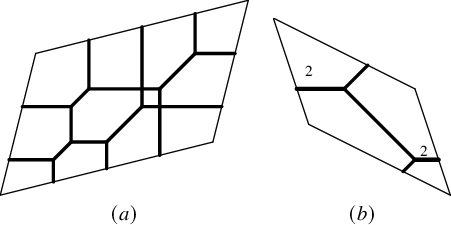
Example 2.10. On Figure 1 we see two examples of tropical curves in their respective abelian surface. In each case, the basis of $\mathbb {Z}^2$
is the canonical basis, and the basis of
$\mathbb {Z}^2$
is the canonical basis, and the basis of  is given by the bottom and left sides of the parallelogram.
-
⊳ For the first tropical curve, the degree is
, and the lattice is given by a matrix of the form , with
$\alpha ,\beta>0$
and
$\det S>0$
for orientation purpose. The polarization is , and we may check that
$BS^\intercal $
is positive definite. -
⊳ The second tropical curve gives an example where the matrices are not diagonal. In this situation, we have
, the lattice is given by a matrix of the form . The polarization is , and we may check that
$BS^\intercal $
is positive definite.
 , and the lattice is given by a matrix of the form
  , with

 , and we may check that
 , the lattice is given by a matrix of the form
  . The polarization is
  , and we may check that

Figure 1 Two examples of tropical curves in tropical tori.
We finish with the definition of the Mikhalkin multiplicity of a tropical curve.
Definition 2.11. Let $h:\Gamma \to \mathbb {T} A$
be a parametrized tropical curve with
$h:\Gamma \to \mathbb {T} A$
be a parametrized tropical curve with $\Gamma $
trivalent and h an immersion (except for eventual contracted ends due to marked points). The Mikhalkin multiplicity of
$\Gamma $
trivalent and h an immersion (except for eventual contracted ends due to marked points). The Mikhalkin multiplicity of $\Gamma $
is
$\Gamma $
is  , where the product is over trivalent vertices (not adjacent to a marked point) and $m_V$
is the index of the lattice spanned by adjacent slopes, or equivalently the determinant of two among the outgoing slopes.
$m_V$
is the index of the lattice spanned by adjacent slopes, or equivalently the determinant of two among the outgoing slopes.
3 Deformation and Mumford families
3.1 Mumford families
Let $D^\times \subset \mathbb {C}$
be the punctured unit disk and
$D^\times \subset \mathbb {C}$
be the punctured unit disk and  a rank $2$
lattice with a preferred basis. Take two morphisms
$2$
lattice with a preferred basis. Take two morphisms  given by a matrix $(s_{ij})$
and
$(s_{ij})$
and  given by a matrix $(z_{ij})$
. We construct the family of lattices in
$(z_{ij})$
. We construct the family of lattices in $\mathbb {C}^2$
depending on a parameter
$\mathbb {C}^2$
depending on a parameter $t\in D^\times $
given by the period matrix
$t\in D^\times $
given by the period matrix $(I\ Z_t)$
, where
$(I\ Z_t)$
, where

where  is a formal logarithm of the parameter t. To make it well-defined, assume that S has values in $\mathbb {Q}^2$
. Write
$\mathbb {Q}^2$
. Write $S=\frac {S'}{r}$
with
$S=\frac {S'}{r}$
with $S'$
having integer coefficients. Then, up to scaling, which amounts to a base change on
$S'$
having integer coefficients. Then, up to scaling, which amounts to a base change on $D^\times $
setting
$D^\times $
setting $t=(t')^r$
, we can assume that S has integer coefficients. Under the latter assumption, changing
$t=(t')^r$
, we can assume that S has integer coefficients. Under the latter assumption, changing  by some multiple
  does not change the lattice spanned by $(I\ Z_t)$
.
$(I\ Z_t)$
.
In the multiplicative setting, we set  so that $(\zeta _{ij})$
gives the morphism
$(\zeta _{ij})$
gives the morphism  . The complex torus is
  .
.
Definition 3.1. Let $(Z,S)$
be chosen as above.
$(Z,S)$
be chosen as above.
-
⊳ The family of complex tori determined by the data
$(Z,S)$
is called a Mumford family and is denoted by
$\mathscr {A}(Z,S)$
. -
⊳ The tropicalization of
$\mathscr {A}(Z,S)$
, denoted by
$\mathbb {T}\mathscr {A}(Z,S)$
, is the tropical torus where is the inclusion given by S.


 where
where  is the inclusion given by S.
 By point in $\mathscr {A}(Z,S)$
, we mean a section of the form
$\mathscr {A}(Z,S)$
, we mean a section of the form  . Its tropicalization is the point
  .
.
3.2 Polarization on a Mumford family and tropicalization
We now give the definition of a polarization on a Mumford family, and study its relation with tropical polarizations.
Definition 3.2. Let $\mathscr {A}(Z,S)$
be a Mumford family. A matrix Q is a polarization of the family if it induces a polarization on each torus of the family. The family is called a polarized Mumford family.
$\mathscr {A}(Z,S)$
be a Mumford family. A matrix Q is a polarization of the family if it induces a polarization on each torus of the family. The family is called a polarized Mumford family.
In [Reference Griffiths and HarrisGH14, Chapter 2.6], given a polarization Q on an abelian surface $\mathbb {C} A$
, it is possible to pick a basis where Q is in diagonal antidiagonal form:
$\mathbb {C} A$
, it is possible to pick a basis where Q is in diagonal antidiagonal form:  , where $\Delta $
is a diagonal matrix with positive entries dividing each other. The entries of
$\Delta $
is a diagonal matrix with positive entries dividing each other. The entries of $\Delta $
are uniquely determined and form the type of the polarization. In such a form, it is possible to deform
$\Delta $
are uniquely determined and form the type of the polarization. In such a form, it is possible to deform $\mathbb {C} A$
in a Mumford family where Q keeps being a polarization. This is used in [Reference BlommeBlo22a] to apply Nishinou’s correspondence theorem [Reference NishinouNis20]. However, we do not actually need this antidiagonal form to deform in a Mumford family keeping the polarization. The precise relation is as follows.
$\mathbb {C} A$
in a Mumford family where Q keeps being a polarization. This is used in [Reference BlommeBlo22a] to apply Nishinou’s correspondence theorem [Reference NishinouNis20]. However, we do not actually need this antidiagonal form to deform in a Mumford family keeping the polarization. The precise relation is as follows.
Proposition 3.3. Let $\mathscr {A}(Z,S)$
be a Mumford family with S an invertible real matrix. Polarizations on the family are the integer skew-symmetric matrices Q satisfying the following conditions:
$\mathscr {A}(Z,S)$
be a Mumford family with S an invertible real matrix. Polarizations on the family are the integer skew-symmetric matrices Q satisfying the following conditions:
-
(1) The matrix and its Poincaré dual have the following form:
where B and C are the comatrix of each other, -
(2)
$BS^\intercal $
is symmetric and positive definite: C is a tropical polarization of the tropicalization
$\mathbb {T}\mathscr {A}(Z,S)$
, -
(3) Q satisfies Riemann bilinear relation for
$\Omega =(I\ Z)$
:-
⊳
$BZ^\intercal -ZB^\intercal =T$
, -
⊳
$-i\operatorname {Pf}(Q)(B\overline {Z}^\intercal -ZB^\intercal -T)$
is (hermitian and) positive definite.
-




Conversely, given a polarization Q on an abelian surface $\mathbb {C} A$
determined by the period matrix
$\mathbb {C} A$
determined by the period matrix $\Omega =(I\ Z)$
and having the form stated in (1), we can deform
$\Omega =(I\ Z)$
and having the form stated in (1), we can deform $\mathbb {C} A$
in a Mumford family
$\mathbb {C} A$
in a Mumford family $\mathscr {A}(Z,S)$
by picking any S such that C induces a polarization of the associated tropical torus.
$\mathscr {A}(Z,S)$
by picking any S such that C induces a polarization of the associated tropical torus.
Proof. Assume that  . Then, the first part of Riemann-bilinear relation for the period matrix $(I\ Z_t)$
writes itself as follows:
$(I\ Z_t)$
writes itself as follows:

As the relation is true for every t and a polynomial in  , we deduce that all coefficients are $0$
.
$0$
.
-
(1) As S is invertible, the vanishing of the last coefficient implies that
$K=0$
, so that
$\operatorname {Pf}(Q)Q^{-1}$
has the desired form. The form of Q follows from the form of
$\operatorname {Pf}(Q)Q^{-1}$
, proving (1). -
(2) Using
$K=0$
, the vanishing of the second coefficient is now equivalent to
$BS^\intercal $
being symmetric. -
(3) The vanishing of the first coefficient yields the first part of (3).


We now write the second Riemann-bilinear condition: $-i(I\ Z_t)Q^{-1}(I\ \overline {Z_t})^\intercal $
is positive definite. We multiply by
$-i(I\ Z_t)Q^{-1}(I\ \overline {Z_t})^\intercal $
is positive definite. We multiply by $\operatorname {Pf}(Q)^2=-(\det B)\operatorname {Pf}(Q)$
. Using that
$\operatorname {Pf}(Q)^2=-(\det B)\operatorname {Pf}(Q)$
. Using that $BS^\intercal $
is symmetric, we get the following positive matrix:
$BS^\intercal $
is symmetric, we get the following positive matrix:

Taking $|t|\to 0$
, we deduce that
$|t|\to 0$
, we deduce that $(\det B)BS^\intercal $
is positive definite. Since
$(\det B)BS^\intercal $
is positive definite. Since $\det S>0$
, we also have
$\det S>0$
, we also have $\det B>0$
and
$\det B>0$
and $BS^\intercal $
is positive definite, finishing the proof of (2). Taking
$BS^\intercal $
is positive definite, finishing the proof of (2). Taking $|t|\to 1$
, we finish the proof of (3).
$|t|\to 1$
, we finish the proof of (3).
Conversely, starting with a polarization Q of the given form for $\Omega =(I\ Z)$
, picking any matrix S such that C induces a tropical polarization on the corresponding tropical torus, it is clear we get a polarized Mumford family.
$\Omega =(I\ Z)$
, picking any matrix S such that C induces a tropical polarization on the corresponding tropical torus, it is clear we get a polarized Mumford family.
Writing  ,
,  and
and  , the first Riemann condition on $B,Z,T$
is expressed as follows:
$B,Z,T$
is expressed as follows:
 $$ \begin{align*}b_{11}z_{12}+b_{21}z_{22}-b_{12}z_{11}-b_{22}z_{21}=\tau.\end{align*} $$
As the induced tropical polarization on $\mathbb {T} \mathscr {A}(Z,S)$
only depends on C and not T, the latter may not be primitive even if the starting polarization Q is primitive. On the curve side, it means the tropical degree B may be divisible even though the complex curve class
$\mathbb {T} \mathscr {A}(Z,S)$
only depends on C and not T, the latter may not be primitive even if the starting polarization Q is primitive. On the curve side, it means the tropical degree B may be divisible even though the complex curve class $\operatorname {Pf}(Q)Q^{-1}$
is not.
$\operatorname {Pf}(Q)Q^{-1}$
is not.
Maybe more concretely, the class of a complex curve is $\beta =\operatorname {Pf}(Q)Q^{-1}$
, Poincaré dual to the Chern class. The degree of the tropicalization is only its upper-right term B. The classes
$\beta =\operatorname {Pf}(Q)Q^{-1}$
, Poincaré dual to the Chern class. The degree of the tropicalization is only its upper-right term B. The classes $\operatorname {Pf}(Q)Q^{-1}$
and
$\operatorname {Pf}(Q)Q^{-1}$
and  may differ by a multiple of the fiber
  of the tropicalization map, precisely this
  .
.
4 Correspondence Theorem
4.1 Enumerative problems
4.1.1 Complex enumerative geometry
Let $\mathbb {C} A$
be a complex abelian surface with
$\mathbb {C} A$
be a complex abelian surface with $\beta \in H_2(\mathbb {C} A,\mathbb {Z})$
a curve class given by the polarization. We can consider the moduli space of genus g stable maps with n marked points realizing the homology class
$\beta \in H_2(\mathbb {C} A,\mathbb {Z})$
a curve class given by the polarization. We can consider the moduli space of genus g stable maps with n marked points realizing the homology class $\beta $
, denoted by
$\beta $
, denoted by $\mathcal {M}_{g,n}(\mathbb {C} A,\beta )$
. It is endowed with a reduced virtual fundamental class
$\mathcal {M}_{g,n}(\mathbb {C} A,\beta )$
. It is endowed with a reduced virtual fundamental class $[\mathcal {M}_{g,n}(\mathbb {C} A,\beta )]^{\mathrm {red}}$
of rank
$[\mathcal {M}_{g,n}(\mathbb {C} A,\beta )]^{\mathrm {red}}$
of rank $g+n$
. We have the evaluation map
$g+n$
. We have the evaluation map

We get a reduced Gromov-Witten invariant by taking $n=g$
and pulling back the product of cohomology classes Poincaré dual to a point in
$n=g$
and pulling back the product of cohomology classes Poincaré dual to a point in $\mathbb {C} A$
:
$\mathbb {C} A$
:

The number $N_{g,\beta }$
is deformation invariant in families of polarized abelian surfaces, and only depends on
$N_{g,\beta }$
is deformation invariant in families of polarized abelian surfaces, and only depends on $\beta $
through its divisibility d and self-intersection
$\beta $
through its divisibility d and self-intersection $\beta ^2=2d^2n$
. We thus denote the invariant
$\beta ^2=2d^2n$
. We thus denote the invariant $N_{g,d,n}$
. It corresponds to the number of genus g curves in the class
$N_{g,d,n}$
. It corresponds to the number of genus g curves in the class $\beta $
passing through a generic configuration of g points in
$\beta $
passing through a generic configuration of g points in $\mathbb {C} A$
.
$\mathbb {C} A$
.
4.1.2 Tropical enumerative geometry
The tropical point of view on enumerative geometry in tropical abelian surfaces is studied in [Reference BlommeBlo22a]. All statements recalled in this section are proved in the latter. Although the tropical invariance may be proven by tropical methods, it can also be deduced from Nishinou’s correspondence theorem [Reference NishinouNis20].
Let $\mathbb {T} A$
be a tropical abelian surface with a curve class B given by its tropical polarization. We have a moduli space of genus g parametrized tropical curves realizing the class B, denoted by
$\mathbb {T} A$
be a tropical abelian surface with a curve class B given by its tropical polarization. We have a moduli space of genus g parametrized tropical curves realizing the class B, denoted by $\mathcal {M}_{g,n}(\mathbb {T} A,B)$
. We have the evaluation map
$\mathcal {M}_{g,n}(\mathbb {T} A,B)$
. We have the evaluation map

Taking $g=n$
and given a generic configuration
$g=n$
and given a generic configuration  of g points in $\mathbb {T} A$
, there is a finite number of tropical curves passing through
$\mathbb {T} A$
, there is a finite number of tropical curves passing through  .
.
If $\mathbb {T} A$
is furthermore assumed to be generic among the tropical abelian surfaces with a given polarization, and
$\mathbb {T} A$
is furthermore assumed to be generic among the tropical abelian surfaces with a given polarization, and  is still a generic point configuration in $\mathbb {T} A$
, these tropical curves are trivalent and immersed (no flat vertex). We can thus count the tropical curves passing through
$\mathbb {T} A$
, these tropical curves are trivalent and immersed (no flat vertex). We can thus count the tropical curves passing through  with multiplicity
  . The count does not depend on
  in
in $\mathbb {T} A$
nor on
$\mathbb {T} A$
nor on $\mathbb {T} A$
. Furthermore, if we only count curves with a given gcd
$\mathbb {T} A$
. Furthermore, if we only count curves with a given gcd $k|B$
, we also get an invariant count, denoted by
$k|B$
, we also get an invariant count, denoted by $N_{g,B,k}^{\mathrm {trop}}$
.
$N_{g,B,k}^{\mathrm {trop}}$
.
The multiplicity  is
is $(4g-3)$
-homogeneous in the sense that if we multiply every edge weight by k, the multiplicity is multiplied by
$(4g-3)$
-homogeneous in the sense that if we multiply every edge weight by k, the multiplicity is multiplied by $k^{4g-3}$
(a k for the gcd and a
$k^{4g-3}$
(a k for the gcd and a $k^2$
for each vertex). Therefore, we have that
$k^2$
for each vertex). Therefore, we have that $N^{\mathrm {trop}}_{g,B,k}=k^{4g-3}N^{\mathrm {trop}}_{g,B/k,1}$
. Furthermore, using the invariance in the generic choice of S proven in [Reference BlommeBlo22a], the invariant is unchanged when B is multiplied by an invertible matrix on the right or the left, which amounts to a change of base in
$N^{\mathrm {trop}}_{g,B,k}=k^{4g-3}N^{\mathrm {trop}}_{g,B/k,1}$
. Furthermore, using the invariance in the generic choice of S proven in [Reference BlommeBlo22a], the invariant is unchanged when B is multiplied by an invertible matrix on the right or the left, which amounts to a change of base in  or
or $\mathbb {Z}^2$
. The equivalence class of B is fully determined by its divisibility d and its determinant
$\mathbb {Z}^2$
. The equivalence class of B is fully determined by its divisibility d and its determinant $d^2n$
since it is a
$d^2n$
since it is a $2\times 2$
integer matrix.
$2\times 2$
integer matrix.
Remark 4.1. More precisely, the multiplicity provided by the correspondence theorem from [Reference NishinouNis20] is  times some lattice index. Here, marked point are considered as vertices of the graph so that there are $3g-3+g$
edges, since a trivalent genus g graph has
$3g-3+g$
edges, since a trivalent genus g graph has $3g-3$
bounded edges, and each marked point subdivides an edge in two edges. We thus get that this multiplicity is
$3g-3$
bounded edges, and each marked point subdivides an edge in two edges. We thus get that this multiplicity is $(4g-3)$
-homogeneous. Meanwhile, such a graph having
$(4g-3)$
-homogeneous. Meanwhile, such a graph having $2g-2$
vertices, Mikhalkin’s multiplicity is only
$2g-2$
vertices, Mikhalkin’s multiplicity is only $(4g-4)$
-homogeneous (a
$(4g-4)$
-homogeneous (a $k^2$
for each vertex), so we see that both cannot agree and we are missing a term: the gcd
$k^2$
for each vertex), so we see that both cannot agree and we are missing a term: the gcd $\delta _\Gamma $
.
$\delta _\Gamma $
.
4.2 Correspondence theorem
Choose a Mumford family $\mathscr {A}(Z,S)$
with tropicalization
$\mathscr {A}(Z,S)$
with tropicalization $\mathbb {T} A$
, which we assume to be polarized and generic in the space of tropical abelian surfaces with a given polarization. Choose a generic point configuration
$\mathbb {T} A$
, which we assume to be polarized and generic in the space of tropical abelian surfaces with a given polarization. Choose a generic point configuration  in
in $\mathbb {T} A$
. We have a finite number of genus g tropical curves of degree B passing through
$\mathbb {T} A$
. We have a finite number of genus g tropical curves of degree B passing through  .
.
Assume 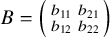 , and for $\delta |B$
, set
$\delta |B$
, set
 $$ \begin{align*}\sigma(Z,B,\delta)= \zeta_{11}^{-b_{12}/\delta}\zeta_{12}^{b_{11}/\delta}\zeta_{21}^{-b_{22}/\delta}\zeta_{22}^{b_{21}/\delta}.\end{align*} $$
We can now state the realization and correspondence theorem, coupled to the multiplicity computation from [Reference BlommeBlo22a].
Theorem 4.2 [Reference NishinouNis20, Theorem 1.1 & 1.2].
Let $\mathscr {A}(Z,S)$
be a Mumford family with generic tropicalization
$\mathscr {A}(Z,S)$
be a Mumford family with generic tropicalization $\mathbb {T} A$
. Let
$\mathbb {T} A$
. Let  be a configuration of g points with generic tropicalization
  . Let
. Let $h:\Gamma \to \mathbb {T} A$
be a parametrized tropical curve of degree B passing through
$h:\Gamma \to \mathbb {T} A$
be a parametrized tropical curve of degree B passing through  with gcd $\delta _\Gamma $
.
$\delta _\Gamma $
.
-
(1) The parametrized tropical curve is realizable in
$\mathscr {A}(Z,S)$
if and only if
$\sigma (Z,B,\delta _\Gamma )=1$
. -
(2) If the curve is realizable, there are precisely
complex curves in
$\mathscr {A}(Z,S)$
passing through and tropicalizing to
$h:\Gamma \to \mathbb {T} A$
.


 complex curves in
 and tropicalizing to
The condition $\sigma (Z,B,\delta _\Gamma )=1$
, referred to later as realizability condition, amounts to the Riemann-bilinear relation. Its necessity can be deduced from the Menelaus condition [Reference MikhalkinMik17]. In [Reference NishinouNis20], the right-hand side of the condition is rather
$\sigma (Z,B,\delta _\Gamma )=1$
, referred to later as realizability condition, amounts to the Riemann-bilinear relation. Its necessity can be deduced from the Menelaus condition [Reference MikhalkinMik17]. In [Reference NishinouNis20], the right-hand side of the condition is rather $(-1)^{\sum m_V/\delta }$
, but it is proved in [Reference BlommeBlo22a] that this quantity is actually always
$(-1)^{\sum m_V/\delta }$
, but it is proved in [Reference BlommeBlo22a] that this quantity is actually always $1$
.
$1$
.
Remark 4.3. The union of images of the tropical curves induces a polyhedral subdivision of $\mathbb {T} A$
. The latter can be used to add a central fiber to
$\mathbb {T} A$
. The latter can be used to add a central fiber to $\mathscr {A}(Z,S)$
which the gluing of toric surfaces among their toric divisors (see [Reference NishinouNis20] and [Reference BlommeBlo22a]). Nishinou’s correspondence theorem states that the deformation of curves in the central fiber is essentially unobstructed.
$\mathscr {A}(Z,S)$
which the gluing of toric surfaces among their toric divisors (see [Reference NishinouNis20] and [Reference BlommeBlo22a]). Nishinou’s correspondence theorem states that the deformation of curves in the central fiber is essentially unobstructed.
5 Multiple cover formula
We now get to the proof of the multiple cover formula. The idea is to use two distinct Mumford families $\mathscr {A}(Z_0,S)$
and
$\mathscr {A}(Z_0,S)$
and $\mathscr {A}(Z_1,S)$
carrying distinct polarizations
$\mathscr {A}(Z_1,S)$
carrying distinct polarizations $Q_0$
and
$Q_0$
and $Q_1$
, that yet induce the same tropical polarization C on their common tropicalization. Applying the correspondence theorem in both families yields the curve counts for a primitive class, and for the nonprimitive curve class. To conclude, we observe that the multiple cover formula is true for each tropical curve, which are the same for both Mumford families.
$Q_1$
, that yet induce the same tropical polarization C on their common tropicalization. Applying the correspondence theorem in both families yields the curve counts for a primitive class, and for the nonprimitive curve class. To conclude, we observe that the multiple cover formula is true for each tropical curve, which are the same for both Mumford families.
Before getting to the proof, we describe the Mumford families we use.
-
⊳ Let
be a matrix with divisibility d and determinant
$d^2n$
. We could take an explicit B but do not even need this level of specificity. -
⊳ Let S be a (integer) matrix such that B induces a tropical polarization on the corresponding tropical abelian surface and assume that S is generic among them. In particular, for a generic choice of point configuration
, the genus g degree B curves passing through are trivalent. -
⊳ Let
$\tau \in \mathbb {Z}$
be some integer and let .
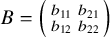 be a matrix with divisibility d and determinant
 , the genus g degree B curves passing through
  are trivalent.
 .
. Let  be a complex matrix such that the complex torus $\mathbb {C}^2/(I\ Z_\tau )$
admits the polarization
$\mathbb {C}^2/(I\ Z_\tau )$
admits the polarization $Q_\tau $
defined by
$Q_\tau $
defined by
 $$ \begin{align*}\operatorname{Pf}(Q_\tau)Q_\tau^{-1}=\begin{pmatrix} -T & B \\ -B^\intercal & 0 \end{pmatrix}.\end{align*} $$
Then, using Proposition 3.3, the Mumford family $\mathscr {A}(Z_\tau ,S)$
admits the matrix
$\mathscr {A}(Z_\tau ,S)$
admits the matrix $Q_\tau $
as polarization. We set
$Q_\tau $
as polarization. We set  to be the multiplicative coordinates of the Mumford family. The realizability condition from Theorem 4.2 can be reformulated as follows.
Lemma 5.1. The realizability condition in the Mumford family $\mathscr {A}(Z_\tau ,S)$
for a trivalent immersed parametrized tropical
$\mathscr {A}(Z_\tau ,S)$
for a trivalent immersed parametrized tropical $h:\Gamma \to \mathbb {T} A$
is equivalent to
$h:\Gamma \to \mathbb {T} A$
is equivalent to $\delta _\Gamma $
dividing
$\delta _\Gamma $
dividing $\tau $
.
$\tau $
.
Proof. The first part of the Riemann bilinear relation coming from the polarization of the family $\mathscr {A}(Z_\tau ,S)$
is
$\mathscr {A}(Z_\tau ,S)$
is $BZ_\tau ^\intercal -Z_\tau B^\intercal = T$
, which are size
$BZ_\tau ^\intercal -Z_\tau B^\intercal = T$
, which are size $2$
skew-symmetric matrices. Taking the upper-right coefficient, it can be rewritten
$2$
skew-symmetric matrices. Taking the upper-right coefficient, it can be rewritten
 $$ \begin{align*}b_{11}z_{12}^\tau+b_{21}z_{22}^\tau-b_{12}z_{11}^\tau-b_{22}z_{21}^\tau=\tau.\end{align*} $$
Dividing by $\delta $
for some
$\delta $
for some $\delta |d$
and taking the exponential, we get that
$\delta |d$
and taking the exponential, we get that

so that realizability condition $\sigma (Z_\tau ,B,\delta )=1$
from Theorem 4.2 is equivalent to
$\sigma (Z_\tau ,B,\delta )=1$
from Theorem 4.2 is equivalent to  , or in other terms $\delta _\Gamma |\tau $
.
$\delta _\Gamma |\tau $
.
We can now prove the multiple cover formula.
Theorem 5.2. The invariants $N_{g,d,n}$
satisfy the multiple cover formula
$N_{g,d,n}$
satisfy the multiple cover formula

Proof. We consider the values $\tau =0$
and
$\tau =0$
and $\tau =1$
and use the correspondence theorem for the Mumford families
$\tau =1$
and use the correspondence theorem for the Mumford families $\mathscr {A}(Z_0,S)$
and
$\mathscr {A}(Z_0,S)$
and $\mathscr {A}(Z_1,S)$
. Choose a generic point configuration
$\mathscr {A}(Z_1,S)$
. Choose a generic point configuration  in the tropical abelian surface
  where
where  is given by S. Now, choose lifts
  (resp.
  ) in
) in $\mathscr {A}(Z_0,S)$
(resp.
$\mathscr {A}(Z_0,S)$
(resp. $\mathscr {A}(Z_1,S)$
), that is, sections of the families which tropicalize to
$\mathscr {A}(Z_1,S)$
), that is, sections of the families which tropicalize to  .
.
Let $\mathscr {C}(B)$
be the set of genus g tropical curves of degree B passing through
$\mathscr {C}(B)$
be the set of genus g tropical curves of degree B passing through  . For
. For $k|B$
, let
$k|B$
, let $\mathscr {C}_k(B)\subset \mathscr {C}(B)$
be the subset of curves with gcd k. Stress that we have a bijection between
$\mathscr {C}_k(B)\subset \mathscr {C}(B)$
be the subset of curves with gcd k. Stress that we have a bijection between $\mathscr {C}_k(B)$
and
$\mathscr {C}_k(B)$
and $\mathscr {C}_1(B/k)$
obtained by just dilating edge weights (and lengths).
$\mathscr {C}_1(B/k)$
obtained by just dilating edge weights (and lengths).
As the tropicalizations of $\mathscr {A}(Z_0,S)$
and
$\mathscr {A}(Z_0,S)$
and $\mathscr {A}(Z_1,S)$
are the same, the tropical solutions are the same.
$\mathscr {A}(Z_1,S)$
are the same, the tropical solutions are the same.
-
⊳ For the family
$(Z_0,S)$
, the polarization
$Q_0$
has divisibility d and self-intersection
$2d^2n$
. The phase condition
$\delta _\Gamma |0$
is always satisfied. Therefore, we get
$$ \begin{align*}N_{g,d,n} = \sum_{\Gamma\in\mathscr{C}(B)} m_\Gamma.\end{align*} $$
-
⊳ For the family
$(Z_1,S)$
, the polarization
$Q_1$
is primitive and also has self-intersection
$2d^2n$
. The phase condition
$\delta _\Gamma |1$
is only satisfied for curves with gcd
$1$
, so-called primitive curves. Therefore, we get that


To conclude, we only need to sort out tropical curves in the first point according to their gcd, and apply the second point for the classes $B/k$
:
$B/k$
:

Acknowledgements
The author would like to thank Francesca Carocci for the 5-min conversation that led to an epiphany and the surprising revelation that the same idea from [Reference BlommeBlo22c] actually yielded a much shorter proof.


 Open access

