

It should come as no surprise that ASA’s 68th annual meeting was an intense, cathartic series of events. Arriving in Atlanta at the tail end of what has been a long and harrowing year for many members of our community, attendees greeted each other across the cavernous hotel foyer with excited waves and warm hugs. As I exchanged my own hellos and hugs with far-flung friends and colleagues, I was struck by the irony of meeting in a hotel that served as the set for several iconic Hunger Games scenes. I suspect I was not alone in this, at least among fellow millennials. Everywhere one looks, exploitation is dressed up as competition for the entertainment of oligarchs.
The fact is that for many ASA attendees, 2025 was an endless administrative gauntlet of budget delays, funding cuts, program closures, and hiring freezes. Many others endured internet harassment, immigration anxieties, and infringements on academic freedom. Amid these many challenges and injustices, however, members also shared triumphant stories of new career paths, private funding support, and institutional reinvestment in the field. Several major institutions, including ASA’s home base, Rutgers University, have positioned themselves to increase support for African studies and programs in Africa. Given this broader context, one of the meeting’s most recurrent and resonant questions was: how will we prepare the next generation to understand Africa given scarce resources and uneven institutional support in the current political climate?
The 2025 Program Chairs, Pedro Monaville and Anatoli Ignatov, anticipated the urgency of this question when they set the meeting’s intellectual and political tone with their thematic essay, “Crossing Boundaries and Recovering Intellectual Traditions.” That essay rightfully highlights the “multiple, intersecting crises” of the moment: the crisis of “late capitalism, leading to growing socio-economic inequalities and precarity; the crisis of the nation-state and liberal democracy, signified by the global resurgence of far-right populism; the crisis of militarism, made visible by the suffering and deaths of thousands of people fueled by record high world military expenditure; and the ecological crisis….” In response to this timely essay and the rapidly shifting political landscape, ASA’s program quickly filled with sessions addressing the impact of these intersecting crises on the academic landscape. Anene Ejikeme (Trinity University), for instance, led a discussion on study abroad “in the post-pandemic Trump world,” sponsored by Africa Network—a community of Africanists in Liberal Arts colleges. This dynamic session focused on resilience and explored specific strategies for building ethical and mutually beneficial partnerships with African institutions. ASA’s Advocacy Committee sponsored a studio session on advancing academic advocacy. The unique format of the studio session allowed attendees to discuss their recent institutional advocacy experiences in small groups, compare their respective outcomes, and strategize around future advocacy efforts. That session was facilitated by current ASA Board members Anita Plummer and Jennifer Hart. Similarly, the Association of African Studies Programs hosted a candid discussion on the devastating impacts of Title VI termination, including the total or near-total closure of many African language programs across the United States.
Several incisive sessions on US foreign policy in Africa underscored the importance of collaboration between scholars and practitioners. These included two roundtables on current US policy concerning Africa: “US Policy Toward Africa Under the Trump Administration” co-chaired by Krista Johnson (Howard University) and Adekeye Adebajo (University of Pretoria); and “The US Africa Command and Trump’s National Security Policy Toward Africa” co-chaired by Daniel Volman (African Security Research Project) and Jessica Piombo (Naval Postgraduate School). Both roundtables analyzed the administration’s pernicious policies vis-à-vis US Africa Command and considered modes of response and resistance for different stakeholders. Other highlights included a roundtable sponsored by the Association of Concerned Africa Scholars (ACAS), Ending Vaccine Apartheid, which combined advocacy and statistical analysis to illuminate systemic global health inequities, using the withdrawal of the US President’s Emergency Plan for AIDS Relief (PEPFAR) as an occasion to demonstrate how corporate interests perpetuate vaccine injustice. In another compelling ACAS-sponsored discussion, veteran scholar-practitioner Joel Samoff spearheaded a critical debate on the complexities of the demise of the United States Agency for International Developmenty (USAID), asking: “how will we build back better?”
Beyond US Africa policy, this year’s program saw notable growth in cutting-edge subthemes. African Studies Review (ASR) organized a series of working groups on Africa and artificial intelligence. Working groups are a new session type designed to foster deeper collaboration and feedback between scholars in the publication process. Experimenting with this new format, participants had three and a half hours to dive deep into the burgeoning literature and peer review each other’s draft articles for the forthcoming ASR forum organized by James Yékú and Leah Junck. Topics included AI applications for research, feminism and personhood, ethics, representation bias, and technological decolonization. The call for papers yielded over forty submissions, indicating an overwhelming interest in how this technology might be variously utilized and/or weaponized across academic contexts.
The field also continues to see a broader trend towards global Black thinking. This is most recently demonstrated by Yale University’s rebrand of African American studies as Black studies. This move is meant to bring Africa, African American, and Diasporic studies into closer campus conversation for a more mobile, twenty-first-century approach to the field. The annual meeting included over a dozen sessions addressing this trend in relation to the theme of boundary crossing. “Your Black Is Not My Black” took a more literal approach, nuancing the complex sociopolitical implications of global resettlement in Africa beginning with Ghana’s 2019 “The Year of Return.” Womai Song (Earlham College) led the conversation, which deftly navigated the sensitive, multivalent identity politics, misconceptions, and colonial traumas inherent in such a project. In a more figurative approach to boundary crossings, Ghost Rivers of Global Black Studies explored Black intellectual genealogies, arguing that their subterraneity in public cultural discourse belies their centrality in underpinning a global Black consciousness. The proverbial tributaries highlighted by panelists included Ghanaian playwright Efua Sutherland, the clandestine ANC publication Sechaba, and the late Tejumola Olaniyan, celebrated scholar and former ASA Board member.
Although the Atlanta program was hardly the first to celebrate intellectual legacies, participants were more explicit in linking such legacies to histories of resilience and resistance. ASA celebrated Frantz Fanon’s centenary this year with a roundtable on Fanon at 100 and ASR Distinguished Lecturer Lewis Gordon’s inspired presentation of “Fanon’s African Dream.” Gordon explored Fanon’s commitments to a political life centered on justice, health, and coexistence, and the way that these commitments shaped his often-overlooked aspirations towards an “antiviolence future.” Members also celebrated and honored the legacies of senior scholar-activists including Bob Edgar, Georges Nzongola-Ntalaja, and Allen Issacman.
The program also reflected newly established funding legacies, thanks to the generosity of African studies scholars. Hundreds celebrated the ASA Women’s Caucus’ fiftieth anniversary by attending commemorative sessions and honoring the new Robertson Fund to support Dependent Care Grants and travel for early career scholars working on gender and Africa. Claire Robertson, the Fund’s benefactor, spoke eloquently about the need to champion the voices of African women and defend gender and sexuality scholarship for another fifty years. Literature scholars excitedly discussed the new ASA Christie and Chinua Achebe Fund, announced just a few weeks prior. The Fund will honor the legacy of literary giant Chinua Achebe through its support for a distinguished lecture at ASA to highlight humanistic scholarship and creative industries. The Fund will also endow a manuscript award aimed at fostering the next generation of creative authors.
The Presidential Lecture was one of the most striking thematic convergences in Atlanta. Elizabeth Schmidt delivered “Lessons from the Archive: The Case of Southern Rhodesia” to an audience eager to learn historic modes of resistance. The talk drew direct correlations between the Trump administration and Southern Rhodesian political tactics, inspiring attendees to reflect on their individual role in overcoming contemporary authoritarianism.
The president’s lecture came at a fortuitous moment of cautious celebration and optimism in the wake of a sweeping New York mayoral victory for Ugandan-born Zohran Mamdani, son of esteemed African studies scholar Mahmood Mamdani. Mamdani’s victory is a victory for African studies. It is a public reminder that African identities and legacies are inherently complex, worthy of celebration, and irreducible to the insider/outsider binary enforced at our most heavily policed geopolitical boundaries and increasingly imposed in our homes, schools, businesses, and places of worship. If the annual meeting produced any answers with respect to preparing the next generation to understand Africa, it is perhaps this: that scholarly societies can be the third spaces we need to achieve our ends, where resilience, care, and collaboration counteract the cheap cruelties catalyzed by intercultural ignorance. As tightknit and welcoming global networks, scholarly societies are spaces where scholars, practitioners, and the public can gather to incubate ideas that impact and shape our communities and collective futures. ASA is committed to bolstering the ties that make African studies a uniquely (re)generative, solidaristic community, particularly in the months and years ahead.
***
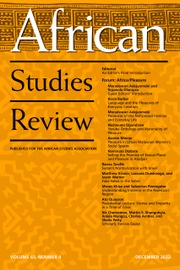
Like the papers presented at the 2025 ASA annual meeting, the articles in the December issue of ASR highlight the rich panoply of research into the urgent questions and issues besetting African societies, including resistance against dictatorial regimes and economic anxieties as the welfare state collapses in the face of neoliberalism. In fact, Mahder Serekberhan’s essay in the issue, “Working Peoples for Political Change: The 2018/2019 Sudanese Uprising”—winner of the 2023 ASA Graduate Student Paper Prize—began its life at the 2022 annual conference. Serekberhan’s article returns to the 2018–19 uprising in Sudan that resulted in the overthrow of the long-serving ruler Omar al-Bashir. She argues that the successful regime change resulted from the grassroots resistance structure and organizational prowess of “working peoples,” a group constituted primarily of women, young people, and other precarious workers in Sudan’s highly stratified society. Centered on the activities of the Neighborhood Resistance Committees and Tea Sellers Association during the uprising, the essay foregrounds the dynamics that characterized the self-organizing of these groups. Serekberhan concludes that “the nonhierarchical coordination of numerous self-organized autonomous groups, representing different sections of the working peoples of Sudan, created bottom-up participatory processes that shifted the balance toward the overthrow of al-Bashir and challenging the state.”
Hangala Siachiwena’s piece on Zambia shares with Serekberhan’s article a context of dissatisfaction with the status quo and demands for state-led development oriented toward improving the lives of citizens. In “Policy Reform After Structural Adjustment in Zambia: The Politics of Restoring a Statist Development Agenda, 2011–2014,” Siachiwena situates Michael Sata and his Patriotic Front Party’s victory in the 2011 Zambian elections within a larger context of discontentment with the deregulatory, neoliberal policies of his predecessors. Complicating the understanding of Sata as a populist, Siachiwena underscores his engineering of a statist developmental agenda that recalls the postindependence leadership of Kenneth Kaunda. Analyzing party manifestos, speeches, budget addresses, and development plans, the article locates Sata’s vision of government as one that prioritizes large-scale infrastructure and social welfare provision for citizens over neoliberal retrenchment of state support. Highlighting “broader tensions between neoliberal and statist development models in Africa’s poststructural adjustment context,” Siachiwena recalibrates our understanding of policy reforms in Zambia and of populism and political economy on the continent.
Political economy also underpins Pritish Behuria’s contribution to the issue. Behuria’s “The Deceptive Allure of Luxury Tourism: The Political Economy of Luxury Strategies in Mauritius, Botswana, and Rwanda” positions tourism as a critical lens for understanding government economic policies and political reverberations across the studied locales. In the article, Behuria examines the adoption of luxury tourism, which entails ecotourism and other projects targeting tourists with high spending ability. On the surface, such strategies are considered more sustainable, with less negative impact on local communities and the environment. Behuria’s article demonstrates, however, that the African realities are divorced from the ideal. The carbon footprint of private jets and other forms of luxury travel coupled with the repatriation of profits from African countries by foreign-owned companies undermine the supposed benefits. As luxury tourism failed in these countries, Behuria shows how the more democratic states with weaker political parties (Mauritius and Botswana) adjusted their policies to address increasing inequality in the immediate term while the more authoritarian state (Rwanda) doubled down on its high-end strategy for the perceived long-term rewards.
The other articles in the issue transition readers from political economy to cultural economy. Fauziyatu Moro and Reginold A. Royston’s “Deep Listening: Podcast Audiences and Affective Resonance in Urban Ghana,” seeks to address the limited engagement with African podcasting in media studies. Employing focus groups of listeners and interviews with hosts and producers, the authors provide an overview of the podcast landscape in Accra and across the continent. Focusing on the podcast “Sincerely Accra” as case study, Moro and Royston delineate how affective connections generated from resonant themes, audience participation, use of indigenous language, and music create an interpretive community of podcast producers and listeners. They underscore the intimacy shared between the show producers and listeners and the process by which this produces “deep listening.” Podcast emerges in Moro and Royston’s telling as a form of new media that derives its cogency in the African media landscape from its continuity with prior technologies of orality, including local sonic and storytelling aesthetics.
Staying with West Africa, the final article in the issue explores the ways that historical memory has been mobilized in the Katiba Macina and Boko Haram conflicts in Mali and Nigeria, respectively. The power of orality that underpins Moro and Royston’s article is also at work in how the armed groups rationalize their ideological position. In “Historical Memory Matters: Mobilizing the Past in the Boko Haram and Katiba Macina Conflicts,” Jennifer Lofkrantz, Bréma Ely Dicko, and Chitra Nagarajan posit that the “perceptions, reactions, and choices of both fighters and civilians involved in these conflicts and how they contextualize them” draw on understanding of nineteenth-century historical developments in these communities. While Boko Haram sees its work as fulfilling the mission of the nineteenth-century Jihad that created the Sokoto Caliphate, Katiba Macina draws inspiration from the Caliphate of Hamdallahi. The acceptance of these versions of historical memory, according to the authors, depends on the positionality of the individual in society and their perception of the positionality of their ancestors. Taken together, Lofkrantz, Dicko, and Nagarajan accentuate the role of historical memory in understanding the dynamics of contemporary conflicts.
Rounding out this issue is a scholarly review essay on state fragility, governance, and security in Nigeria and Ghana, followed by a dossier of tributes honoring the late Congolese philosopher and writer V. Y. Mudimbe, book reviews, and film reviews. In addition to the regular book reviews, the issue features review forums on two books in African studies: Ana Lucia Araujo’s Humans in Shackles: An Atlantic History of Slavery, and Claudia Gastrow’s The Aesthetics of Belonging: Indigenous Urbanism and City Building in Oil-Boom Luanda. We are also delighted to debut a new genre of reviews on film festivals with Steven W. Thomas’s examination of the 2025 New York African Film Festival. Adding to the innovative expansion of the journal’s film section is a film review forum on Elesin Oba, the Netflix adaptation of Wole Soyinka’s Death and the King’s Horseman, directed by Biyi Bandele. The combination of deep learning and fresh intelligence in the film section radiates across the issue. As we close out 2025 with this latest offering from ASR, we wish everyone a rejuvenating break and a wonderful new year.


