

Introduction
Health Technology Assessment (HTA) plays a critical role in informing resource allocation and policy decisions, particularly in achieving Universal Health Coverage (UHC) (1). In response to the increasing demand for HTA in Asia, the HTAsiaLink network was established in 2011 as a regional platform to strengthen HTA capacity, enhance knowledge exchange, and reduce duplication of efforts (Reference Teerawattananon, Luz and Yothasmutra2). The network functions on a voluntary basis, promoting collaboration among HTA agencies without the requirement of membership fees, and was established without seed funding, relying entirely on the voluntary engagement and strong commitment of its members. HTAsiaLink fosters collaboration through knowledge-sharing initiatives, capacity-building programs, and joint research projects, with the annual HTAsiaLink Conference serving as its flagship event. Over the past 14 years, membership has expanded from three to over fifty institutions across twenty economies.
While the network has been instrumental in advancing HTA in Asia, its sustainability depends on voluntary contributions. This inclusive and voluntary model represents one of the network’s core strengths, promoting shared ownership and broad regional representation. However, it also poses challenges in ensuring long-term engagement and operational stability. HTAsiaLink must proactively address emerging challenges and strengthen its value to members to remain relevant in an evolving healthcare landscape.
This review reflects on the strategic planning process not merely as an internal milestone for the network, but as a case study with broader implications for the HTA community. The experience sheds light on how voluntary regional networks can engage members, align diverse priorities, and build consensus in the absence of formal governance or dedicated funding structures. These reflections may be useful for other networks facing similar circumstances and seeking ways to enhance collaboration and long-term planning. This commentary outlines the process of developing the network’s first strategic plan, focusing on how member input, contextual factors, and available evidence were used to shape the final product. It aims to contribute to ongoing conversations about how HTA networks can evolve their governance and strategies in ways that are responsive to member needs and adaptable to changing environments.
Structured development process
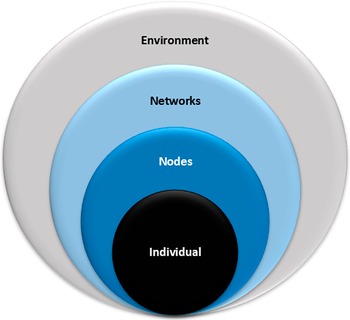
The strategic plan was developed through three key steps: (i) analyzing strategic frameworks of other HTA networks; (ii) assessing members’ needs in capacity building and HTA institutionalization; and (iii) formulating and collecting input for a 5-year roadmap based on these findings. The Individual, Node, Networks, and Environment (INNE) framework was adopted as an analytical tool to organize and interpret efforts aimed at capacity building across multiple levels (Reference Matachi3). Recognizing that different levels require distinct strategies, the INNE framework (see Figure 1) was applied to both qualitative and quantitative methodologies. It guided the targeted review of strategic plans from nine international networks and organizations focused on HTA and health policy, identifying best practices in stakeholder engagement, capacity building, and policy alignment (refer to the full report (4)). In addition, it shaped the design of a survey and key informant interviews (KIIs) aimed at assessing member engagement levels, expectations, and concerns. This framework enables a focused exploration of network members’ perspectives and needs across multiple dimensions of capacity building.

Figure 1. Elements of the Individual, Node, Networks, and Environment (INNE) framework used to design data collection tools and analyze data across four capacity building levels.
HTAsiaLink’s strategic development can be seen in the context of broader movements in global HTA collaboration. To provide this context, we reviewed the missions and activities of organizations such as Health Technology Assessment international (HTAi) (5), a global society promoting HTA; the International Network of Agencies for Health Technology Assessment (INAHTA) (6), which connects government HTA agencies worldwide; the International Society for Pharmacoeconomics and Outcomes Research (ISPOR) (7), an organization advancing health economics and outcomes research; the Patient-Centered Outcomes Research Institute (PCORI) (8), which funds stakeholder-engaged health research; the International Decision Support Initiative (iDSI) (9), a partnership supporting HTA capacity in low- and middle-income countries; the United Nations Development Programme (UNDP) (10), a United Nations agency promoting sustainable development; and the Africa Centres for Disease Control and Prevention (Africa CDC) (11), a regional public health agency focused on strengthening disease control in Africa, all of which prioritize HTA in healthcare decision-making. While these initiatives vary in structure and geographic focus, they share a common goal of advancing HTA. Their diversity underscores the notion that there is no one-size-fits-all approach to achieving this objective.
HTAsiaLink embodies a unique model of collaboration that distinguishes it from other global HTA networks in its approach and operational principles. First, HTAsiaLink’s inclusive model broadens access to network resources and opportunities by minimizing barriers through the absence of membership and registration fees. Second, it brings together a diverse range of institutions, including HTA agencies, academic bodies such as universities, and public research centers, many of which operate independently of commercial interests. This structure cultivates a neutral and collaborative environment that encourages open dialogue and facilitates knowledge sharing. However, this model presents challenges for HTAsiaLink, especially concerning its long-term financial sustainability.
Engagement of members in shaping the network’s roadmap, facilitated through surveys and KIIs, led to the identification of five key themes: HTA capacity building; collaboration; knowledge exchange; HTA utilization; and network sustainability. The results further underscore the importance of building on existing efforts while simultaneously exploring targeted initiatives to address emerging needs. Moreover, they highlight the need to create opportunities for members to actively contribute to decision-making and take on leadership roles within the network, fostering a sense of ownership and long-term commitment.
These findings informed the network’s strategic goals and actionable plans. Continuous feedback loops were established, incorporating input from Board members and experts to ensure the plan remains relevant and adaptable. The final strategic plan is data-driven, responsive to member needs, and designed for periodic reviews and refinements.
The way forward: Positioning HTAsiaLink in the growth of HTA in Asia
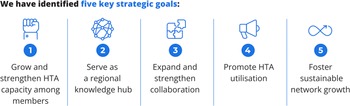
The strategic plan provides a roadmap for HTAsiaLink’s growth and impact, outlining five strategic goals (see Figure 2) and four key actions with defined metrics for success (available in Annex 1 of the Supplementary Material) to be achieved by 2030. To support monitoring and accountability, both quantitative and qualitative indicators have been established. For example, member engagement will be tracked through the indicator “number of highly engaged members,” with verification based on an annual membership engagement survey assessing participation frequency and event satisfaction. The target is for members to participate in at least three network events or collaborative projects per year. This indicator contributes to the broader outcome of fostering an engaged and growing network characterized by a supportive environment, shared ownership, and transparency.

Figure 2. Five strategic goals outlining key objectives to guide the network’s direction over the next 5 years, ensuring alignment with the broader vision and mission to support growth and broaden impact.
Achieving the strategic goals requires active participation from members, guided by the Board, Secretariat, and Editorial Team. The Board, consisting of nine members from nine economies, provides strategic leadership, decision-making support, and oversight to ensure alignment with HTAsiaLink’s mission, and is elected after each conference in accordance with the by-laws. The Secretariat and Editorial Team, both based at HITAP, manage daily operations, communications, coordination, and knowledge dissemination.
Building on its strengths, the network will enhance capacity building and knowledge exchange while exploring new approaches tailored to diverse member needs. Active engagement will be key to sustaining these efforts, with initiatives such as topic nominations to integrate member input into network activities, volunteering to take on leadership roles to enhance inclusivity through event coordination, and mentorship programs to expand learning opportunities for early-career researchers. These initiatives will be instrumental in cultivating the next generation of network leaders and ensuring the network’s long-term sustainability.
HTAsiaLink will continuously strengthen collaborations with non-member stakeholders, for example, policymakers, academics, other non-profit international organizations, and like-minded networks. This effort aims at expanding the network’s influence, fostering broader knowledge exchange, and promoting cross-disciplinary partnerships. A monitoring and evaluation framework has been developed to track progress, categorizing actions into easy wins, mid-priority, and long-term objectives. This structured approach will enable timely adjustments and continuous improvement, ensuring the network remains a key driver of HTA advancement in the region.
A review of various strategic plans reveals common priorities, including strengthening HTA, improving health outcomes, advancing research, aligning policies, and fostering global partnerships. Organizations employ different strategies to achieve these goals, such as inclusive and participatory planning, active stakeholder engagement, and strong data-driven approaches. By drawing on these insights, HTAsiaLink can refine its strategic direction, ensuring it remains comprehensive, forward-thinking, and aligned with international best practices.
Achieving international standards in HTA requires HTAsiaLink to continuously elevate its practices, adopt global best practices, and align its activities with international benchmarks. By fostering a dynamic network, HTAsiaLink can navigate challenges, seize emerging opportunities, and solidify its role as a leading platform for advancing HTA in the region. While HTAsiaLink’s strategic plan is ambitious, it is built on a foundation of collaboration, evidence-informed policymaking, and capacity building. Compared to other strategic plans, HTAsiaLink’s approach is uniquely positioned to address regional needs while incorporating best practices globally. Its adaptability allows for application in other HTA networks, offering valuable lessons for policy alignment in diverse healthcare environments. Despite challenges such as limited technical capacity and the need for continuous stakeholder engagement, there are significant opportunities for HTAsiaLink to drive meaningful progress. In the current global geopolitical landscape, where healthcare demands continue to rise due to population aging, technological advancements, and increasing expectations, ensuring the efficient and sustainable use of healthcare budgets is crucial. HTAsiaLink plays a vital role in addressing these challenges by fostering regional collaboration, strengthening institutional capacity, and promoting knowledge exchange, ensuring that HTA remains responsive to the evolving healthcare landscape and policy needs. With a well-defined strategic plan, HTAsiaLink is positioned to enhance HTA implementation efficiently, ensuring that healthcare decisions remain informed, equitable, and sustainable across the Asia-Pacific region.
Supplementary material
The supplementary material for this article can be found at http://doi.org/10.1017/S0266462325100573.
Acknowledgements
We would like to express their sincere appreciation to Francis Carlo Panlilio, Thuso Tlhaole, and Henny Aryani for their invaluable contributions to the initial stage of the development of the strategic plan. We are also deeply grateful to the HTAsiaLink Board for their guidance and strategic direction, and to the HTAsiaLink Members, whose active participation and constructive feedback have been instrumental in enhancing the quality and relevance of the network’s initiatives. Additionally, we extend our thanks to Christian Suharlim for his support and insightful feedback throughout the process.
Author contribution
B.S.K.O., I.M.M.G., L.-C.C., S.S.K., T.F., and Y.T. have conceptualized the commentary. R.S. and L.P. have prepared the initial draft, with N.K. and S.V.D. providing review and input. All authors have contributed to the final revisions and approved the final version of this document.
Funding statement
The development of the strategic plan was supported by the American people through the U.S. Agency for International Development (USAID) MTaPS Program, implemented by a consortium led by Management Sciences for Health, contract no. 7200AA18C00074. The contents are the responsibility of the HTAsiaLink network and do not necessarily reflect the views of USAID or the US Government.
Competing interests
The authors have no competing interests to declare.


 Open access

