Skip to main content Accessibility help
×
Hostname: page-component-68c7f8b79f-lqrcg Total loading time: 0 Render date: 2026-01-09T10:35:37.988Z Has data issue: false hasContentIssue false

Prologue

Published online by Cambridge University Press:  08 November 2025

Birgit Tremml-Werner
Affiliation:
Stockholms Universitet

Summary

In 1928 a ‘friendship testimonial’ in the form of an obelisk was erected in the Japanese town of Onjuku in Chiba (see Figure P.1). The obelisk stands at the presumed site where the Spanish colonial official Don Rodrigo de Vivero (1564–1636) stepped ashore after being rescued from a shipwrecked journey from the Philippines to Mexico in 1609. This Prefectural Historic Monument, known as the Mexico Commemorative Tower, manifests historical ties with Chiba’s sister city Acapulco across the Pacific. A year after the construction of the obelisk, historian Murakami Naojirō (村上直次郎, 1868–1966) published a Japanese translation of Vivero’s memories of Japan.

Information

Type
Chapter
Information
Negotiating Imperialism
Murakami Naojirō's Archival Diplomacy
, pp. 1 - 4
Publisher: Cambridge University Press
Print publication year: 2025
Creative Commons
Creative Common License - CCCreative Common License - BYCreative Common License - NC
This content is Open Access and distributed under the terms of the Creative Commons Attribution licence CC-BY-NC 4.0 https://creativecommons.org/cclicenses/

Prologue

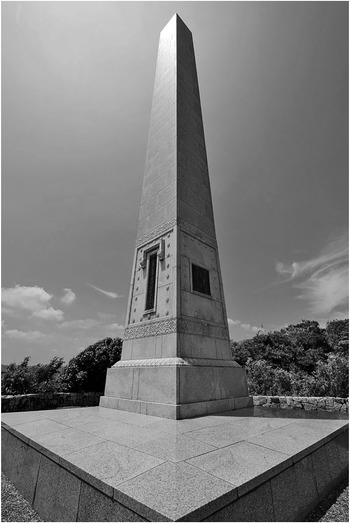
In 1928 a ‘friendship testimonial’ in the form of an obelisk was erected in the Japanese town of Onjuku in Chiba (see Figure P.1).Footnote 1 The obelisk stands at the presumed site where the Spanish colonial official Don Rodrigo de Vivero (1564–1636) stepped ashore after being rescued from a shipwrecked journey from the Philippines to Mexico in 1609. This Prefectural Historic Monument, known as the Mexico Commemorative Tower, manifests historical ties with Chiba’s sister city Acapulco across the Pacific.Footnote 2 A year after the construction of the obelisk, historian Murakami Naojirō (村上直次郎, 1868–1966) published a Japanese translation of Vivero’s memories of Japan.Footnote 3 Murakami, a prolific scholar and part of the Japanese academic establishment, had used Vivero’s report for the Spanish king and other sources from the Spanish archive a few years earlier to historicize Japan’s seventeenth-century transpacific exchange.Footnote 4 In this process, he moreover framed the encounter between the stranded Spanish nobleman and the Japanese ruler Tokugawa Ieyasu (1543–1616) as an act of friendly state relations and the beginning of Japan’s official diplomatic negotiations with Mexico and Spain. Hence, his research laid the foundation for the lavish trilateral commemorations in Japan, Mexico, and Spain between 2009 and 2014.

A photo of a seventeen-meter-high concrete obelisk in a park. The monument includes inscriptions referring to the Tokugawa clan, the King of Spain, and the President of Mexico.

Figure P.1 Onjuku Japan–Spain–Mexico Commemorative Tower (日西墨三国交通発祥記念之碑). The monument was erected in 1928 to commemorate the rescue of the capsized Spanish galleon San Felipe on its way from Manila to Acapulco.

https://ja.wikipedia.org/wiki/日西墨三国交通発祥記念之碑

Source: Wikipedia Creative Commons, CC BY-SA.

Celebrating ‘four hundred years of friendship’ in 2009, Onjuku’s mayor Ishida Yoshiro stressed that the prosperity of both Pacific countries started with the encounter in the 1600s, while Mexican ambassador to Japan, Miguel Ruiz Cabañas Izquierda, emphasized that the Mexican people would never forget the heroic actions of local fishermen and female divers (ama) in rescuing the 317 shipwrecked passengers.Footnote 5 What most historians would intuitively debunk as myth-building was a powerful act of cultural diplomacy. Communities, nation-states, and civil actors use historical memory to engage target audiences and ultimately influence which aspects of the past are remembered and how.Footnote 6 As historical memory overlaps with tourism, new meanings enter globalized memory regimes.Footnote 7 In the case of the anniversary of bilateral friendship in 2009 and the 2013–14 biennial (año dual in Spanish official jargon), commemorative initiatives were approved by the heads of the Japanese and Spanish governments at an official meeting in Tokyo.Footnote 8 Hundreds of thousands visited museums and libraries in Seville, Madrid, Valladolid, Sendai, Mexico City, Osaka, and Tokyo, where diplomatic documents from the early 1600s were displayed. In addition, exhibition catalogs, online blogs, and stage performances contributed to the legacy of the past encounter and created new archives and sites for commemoration. Japanese policymakers encouraged visitors to study the history of friendship (yūkō, 友好) between Japan, Spain, Mexico, and the Philippines.Footnote 9 The language of ‘friendship,’ ‘relaciones diplomaticas,’ ‘relaciones amistosas,’ or heiwa gaikō (peaceful foreign relations) has become ubiquitous in this historicizing process. Yet, while seemingly source terms, none of these catchy phrases appeared in archival records of the seventeenth century. They were instead semantic and linguistic creations that originated in the mid-nineteenth century and were made available through archival diplomacy.
Footnotes

1 My translation for ‘yūkō no akashi’ (友好の証).

2 Sister-city relations were established in 1978.

3 Tōkyō Teikoku Daigaku Shiryō Hensangakari 東京帝國大学文学部史料編纂掛, ed., 大日本史料 Dai nihon shiryō (Japanese historical materials), vol. 12/6, vol. 12/2 (Tōkyō: Tōkyō Teikoku Daigaku, 1906). Murakami contributed to various issues of volume 12. Other source collections dealing with what came to be interpreted as the earliest incidents of bilateral relations between Japan and Spain, and Japan and Mexico respectively, were included in Murakami Naojirō, ed., Ikoku nikki shō. Ikoku ōfuku shokanshū (Tokyo: Sanshūsha, 1911). Murakami even chose to open the Ikoku nikki shō edition with the translation of a letter from Vivero as interim governor general in the Philippines to Japan. Toward the end of his career, Murakami edited a source edition combining the accounts of Rodrigo de Vivero and Sebastian Vizcaíno: Don Rodorigo nihon kenbunroku; Visukaino kingintō tanken hōkoku (Tokyo: Sunnansha, 1929).

4 Murakami, ‘Nihon bōekishi jō ni tokuhitsu taisho subeki Kazusa no kuni Iwada kō’ (12/1926). This article appeared in a pamphlet published for the inauguration of the monument commemorating relations between Spain and Japan in the seventeenth century. For full bibliographic details of Murakami’s writings, see ‘List of Murakami’s Publications.’

5 One of the many outcomes of cultural diplomacy was a sculpture conspicuously entitled ‘el abrazo’ (the embracement) by Mexican artist Rafael Guerrero Morales (1934–2006). It is located next to the memorial of 1928. See www.town.onjuku.chiba.jp/content/files/old/kikakuzaiseika/kikaku/400/400kinensi.pdf (accessed September 12, 2019). To commemorate the meeting between Tokugawa Ieyasu and the high-ranking Spanish official Rodrigo de Vivero, an Association of Japanese-Mexican friendship was founded. A logo including the words ‘Spain Onjuku Mexico 400 aniversario’ served as soft power branding. As part of an information campaign, the Japanese Ministry for Foreign Affairs (MOFA) underlined the importance of the encounter between Ieyasu and Vivero for international diplomacy. See also Alicia Girón et al., La Misión Hasekura: 400 Años de Su Legado en las Relaciones Entre México y Japón, vol. 1 (Mexico City: Universidad Nacional Autónoma de México, 2015).

6 David Clarke, ‘Theorising the Role of Cultural Products in Cultural Diplomacy from a Cultural Studies Perspective,’ International Journal of Cultural Policy 22, no. 2 (2016): 147–63. Cultural diplomacy is often associated with soft power, which describes the efforts of persuading foreign publics and thereby pushing one’s own agenda in a noncoercive way. See Joseph S Nye, ‘Soft Power: The Evolution of a Concept,’ Journal of Political Power 14, no. 1 (2021): 196–208.

7 Rafiq Ahmad and Anne Hertzog, ‘Memory, Tourism and Place in a Globalizing World,’ Tourism and Hospitality Research 13, no. 1 (2014): 201–5. For a survey on how the art of memory has become integrated with historical thinking, see Patrick H. Hutton, History as an Art of Memory (Princeton: Princeton University Press, 1993).

8 See www.accioncultural.es/es/a_o_espa_a_japon and www.es.emb-japan.go.jp/relaciones/400_japon_espana.html (Año Dual España-Japón) (both accessed September 12, 2023). The event used to have its own website (www.esja400.com/), but the content has been removed. For an overview of the activities and events held in Spain and Japan, see www.exteriores.gob.es/Embajadas/TOKIO/es/espanajapon/Paginas/inicio.aspx (accessed August 12, 2023).

9 Onjukumachi kokusai kōryū kyōkai, ed., 日本とメキシコの友好400年未来に向けて Nihon to mekishiko no yūkō 400nen mirai ni mukete (400 years of friendship between Japan and Mexiko) (Onjukumachi: Onjukumachi kokusai kōryū kyōkai, 2011), 3; 38. See also Ángel Nuñez Ortega, Noticia Histórica de las Relaciones Políticas y Comerciales Entre México y el Japón Durante el Siglo XVII, Archivo Histórico Diplomático 2 (México: Secretaría de Relaciones Exteriores, 1923). For Onjuku, see www.town.onjuku.chiba.jp/sub4/3/mexico_kinentou1.html (accessed July 23, 2024).

Figure 0

Figure P.1 Onjuku Japan–Spain–Mexico Commemorative Tower (日西墨三国交通発祥記念之碑). The monument was erected in 1928 to commemorate the rescue of the capsized Spanish galleon San Felipe on its way from Manila to Acapulco.https://ja.wikipedia.org/wiki/日西墨三国交通発祥記念之碑

Source: Wikipedia Creative Commons, CC BY-SA.

Accessibility standard: Inaccessible, or known limited accessibility

Why this information is here

This section outlines the accessibility features of this content - including support for screen readers, full keyboard navigation and high-contrast display options. This may not be relevant for you.

Accessibility Information

The HTML of this book is known to have missing or limited accessibility features. We may be reviewing its accessibility for future improvement, but final compliance is not yet assured and may be subject to legal exceptions. If you have any questions, please contact accessibility@cambridge.org.

Content Navigation

Table of contents navigation
Allows you to navigate directly to chapters, sections, or non‐text items through a linked table of contents, reducing the need for extensive scrolling.
Index navigation
Provides an interactive index, letting you go straight to where a term or subject appears in the text without manual searching.

Reading Order & Textual Equivalents

Single logical reading order
You will encounter all content (including footnotes, captions, etc.) in a clear, sequential flow, making it easier to follow with assistive tools like screen readers.
Short alternative textual descriptions
You get concise descriptions (for images, charts, or media clips), ensuring you do not miss crucial information when visual or audio elements are not accessible.

Visual Accessibility

Use of colour is not sole means of conveying information
You will still understand key ideas or prompts without relying solely on colour, which is especially helpful if you have colour vision deficiencies.
Use of high contrast between text and background colour
You benefit from high‐contrast text, which improves legibility if you have low vision or if you are reading in less‐than‐ideal lighting conditions.

Save book to Kindle

To save this book to your Kindle, first ensure no-reply@cambridge.org is added to your Approved Personal Document E-mail List under your Personal Document Settings on the Manage Your Content and Devices page of your Amazon account. Then enter the ‘name’ part of your Kindle email address below. Find out more about saving to your Kindle.

Note you can select to save to either the @free.kindle.com or @kindle.com variations. ‘@free.kindle.com’ emails are free but can only be saved to your device when it is connected to wi-fi. ‘@kindle.com’ emails can be delivered even when you are not connected to wi-fi, but note that service fees apply.

Find out more about the Kindle Personal Document Service.

  • Prologue
  • Birgit Tremml-Werner, Stockholms Universitet
  • Book: Negotiating Imperialism
  • Online publication: 08 November 2025
  • Chapter DOI: https://doi.org/10.1017/9781009640817.001
Available formats
×

Save book to Dropbox

To save content items to your account, please confirm that you agree to abide by our usage policies. If this is the first time you use this feature, you will be asked to authorise Cambridge Core to connect with your account. Find out more about saving content to Dropbox.

  • Prologue
  • Birgit Tremml-Werner, Stockholms Universitet
  • Book: Negotiating Imperialism
  • Online publication: 08 November 2025
  • Chapter DOI: https://doi.org/10.1017/9781009640817.001
Available formats
×

Save book to Google Drive

To save content items to your account, please confirm that you agree to abide by our usage policies. If this is the first time you use this feature, you will be asked to authorise Cambridge Core to connect with your account. Find out more about saving content to Google Drive.

  • Prologue
  • Birgit Tremml-Werner, Stockholms Universitet
  • Book: Negotiating Imperialism
  • Online publication: 08 November 2025
  • Chapter DOI: https://doi.org/10.1017/9781009640817.001
Available formats
×