


Kiambu is rich, but we are poor!
People have increased. These shambas [farmlands] look like villages.
There are no shambas here!
The final quote above came from a young woman, a daughter from a neighbouring homestead, during one of my early attempts to survey households in Ituura. Her words reflect the way in which farmland in the neighbourhood has shrunk, over generations, to become small patches where one can barely build a house, let alone practice cultivation. In an immediate sense, this is an effect of inheritance norms: family-owned farmland is sub-divided between children each generation, creating smaller and smaller plots for new inheritors. But set in its historical context, we can see that the origins of this contemporary predicament are to be found in colonial-era dispossession and the land poverty to which it gave rise. This was palpably felt then, but is also having stark consequences now, its long-term trajectory having produced a contemporary crisis of surplus people, bereft of farmland, unable to find employment and unable to cultivate. ‘People are still increasing and no jobs.’ The words of Ituura elder, seventy-two-year-old Francis Njeru, describe the predicament of Ituura’s residents, especially its youth.
This chapter outlines the history of this predicament, illustrating the emergence of land poverty in central Kenya, contextualising the economic landscape. It illustrates how a century of material change has shaped contemporary moral ideas and projects oriented around the reproduction of the family, which remains a vital moral concern. Weaving history with interviews carried out with Ituura’s older generation, the chapter shows how a gap has emerged between an older demographic of economically ‘stable’ peasants and a younger generation of men who find themselves bereft of economic opportunity. What we see is a gradual process of what Deborah Bryceson has called ‘de-peasantisation’ (Reference Bryceson2019), characterised by the eroding viability of family farming and an increasing reliance on wages in a context of widespread unemployment. Yet aspirations for better lives remain powerful, and it is from this gap between downward mobility and heightened hopes for the future that disillusionment and disappointment have turned younger men towards lives of short-term abandon.
Setting the scene for the chapter that follows, which explores Ituura as a neighbourhood deeply affected by a wider hopelessness amongst central Kenya’s younger generation, this chapter directs attention towards Kiambu’s older generation, their narratives of success, and their perspectives on the generational change they see as playing out today. These are sometimes moralising narratives that condemn young men for their failure to adopt the labour ethic with which old men characterise their own histories – a desire to work, to be and become moral through work, to raise a family, and leave a legacy for the future. The older generation recommends ‘adding’ to the wealth one already has, and safeguarding precious family land inherited from their fathers. Kiambu elders observe the consuming proclivities of a younger generation that seems to prefer idleness to work, alcohol to marriage, and spending money on short-term bingeing rather than adding value to their homes. They lament the state of ‘our’ youth, and the erosion of the moral values of work – substituted with the desire to enjoy leisure and live ‘comfortable’ lives. In this respect, this chapter illustrates the way poverty and inequality are understood through a labour theory of virtue, a labouring ideology that attaches moral meaning to perseverance against the grain of poverty and valorises careful economisation.Footnote 1
Of course, the delinquency occasionally ascribed to young men is far from a straightforward matter of moral choice, even if their elders can sometimes frame it that way. The sheer time it takes for younger men to accumulate the cash it would take to improve their fortunes encourages them to ‘give up’, swapping work for acts of hopeless consumption, as we will see more thoroughly in Chapter 2. In this way, the chapter charts the economic basis of what Richard Wilk (Reference Wilk2014) has called ‘binge economies’, modes of rapid spending of wages amongst the low paid, in total opposition to mainstream discourses that valorise and stress the need for careful economisation (Day, Papataxiarchis, and Stewart Reference Day, Papataxiarchis, Stewart, Day, Papataxiarchis and Stewart1999). The roots of these binge economies can be found in Kiambu’s political history of land poverty and cash scarcity – reducing the economic prospects for its youth to proceed to adult futures. It is towards this deepening sense of hopelessness that I turn in Chapter 2.
Yet, while older men criticise their youth for ‘laziness’ and alcohol drinking, the chapter closes by highlighting cases in which such men have contradicted their own wisdom, especially by selling land to construct houses – a tacit admission that labour cannot create the sorts of middle-class lives to which young men aspire. The alleged hypocrisy of their moralising – critiqued in strident terms by young men like Mwaura – paves the way for the book’s evolving narrative arc: the hollowing-out of a moral economy of patrilineal masculinity, and its rootedness in land, maintained through labour and passed forward through kin.
Ten Millionaires, Ten Million Beggars
Kiambu County is ostensibly one of the richest counties in Kenya. The World Bank estimates its GDP per capita to be the highest of all the country’s forty-seven counties (Business Daily 2015). According to Kenya’s National Bureau of Statistics (KNBS), the county’s poverty rate is 23.3 per cent, well under the national average of 36.1 per cent (KNBS 2018: 299). From the perspective of migrants arriving from other parts of rural central Kenya, peri-urban southern Kiambu County is a frontier of opportunity, an urban crescent folded around Nairobi (stretching from Kikuyu town in the west to the industrial centre of Thika town in the east) where jobs in the wage economy can be found, not least in the booming construction industry. Land prices in its satellite towns have grown at a rapid pace in recent years, fuelled by housing speculation in central areas of Nairobi and the reasonable quality of roads between Nairobi and these northern environs (Wanzala Reference Wanzala2016).Footnote 2 Since at least the early to mid-2000s, Kiambu has been experiencing a sustained process of urbanisation, and its growing real estate sector reflects sales by inheritors of land (Kamau Reference Kamau2017). New and amazing malls being constructed in northern Nairobi provide potent images of middle-class lifestyles to which many of my interlocutors from the rural hinterlands aspired.
What is masked by images and statistics indicative of growing wealth is a chasm of inequality in Kiambu between a small class of large landowners and a much larger population of smallholders.Footnote 3 The average plot size in the county is 0.36 hectares (0.88 acres), but amongst the larger farms growing cash crops of tea and pyretheum, the average is 69.5 hectares (172 acres) (County Government of Kiambu n.d.a). Kiambu is one of the most densely populated regions of Kenya (County Government of Kiambu n.d.b), and yet, as the economist David Ndii (Reference Ndii2016) surmised, ‘Even today, you can still ramble your way from Limuru to Gatundu [a 50km journey] without setting foot on a peasant holding.’ Ituura, the site of my fieldwork, is precisely such a cluster of small land parcels pressed between much larger tranches of land belonging to elite families whose wealth was inherited from the colonial era.
Kiambu County’s history is etched in its landscape, a history that will be familiar to scholars as an example of a context where land abundance in pre-colonial times gave way to scarcity via colonial era expropriation and population growth. In central Kenya, this predicament was never subsequently addressed politically in any substantial way after independence, not least because the post-independence Kikuyu political elite had benefited from their proximity to the colonial state, hoarding vast amounts of land.Footnote 4 As the prominent Kikuyu politician and champion of poor Kenyans J. M. Kariuki remarked in 1974, a year before his assassination in the midst of Jomo Kenyatta’s increasingly authoritarian grip on Kenya’s politics, ‘Kenya has become a nation of 10 millionaires and 10 million beggars.’ Kenyatta’s exhortations to Kenyans to embrace ‘freedom through work’ (uhuru na kazi) in the aftermath of the colonial period marked the obfuscation of the political origins of land inequalities, re-embedding the labour ideology of Kikuyu gerontocrats as the ideal source of economic success and personal virtue for an era of piecemeal work in the informal economy.
In the aftermath of independence, the fate of most Kikuyu in Kiambu was to become ‘part-time proletarians’ (Peterson Reference Peterson2001). Though inherited ‘ancestral’ land close to Nairobi gave them an advantage that their landless cousins in Nairobi now lacked, as this chapter shows, they are now approaching ‘the end of the land’ (Li Reference Li2014a). Exacerbated by the practice of sub-dividing land amongst inheritors, shrinking plots with every new generation, land poverty in central Kenya has forced a general reliance on cash incomes from beyond farms (shambas in Kiswahili, often used with an anglicised plural or mũgũnda sing., mĩgũnda pl. in Kikuyu). ‘Subsistence to cash’ is how Kiambu’s history has been described (Bullock Reference Bullock1974).
While living close to Nairobi provides an economic ‘out’ of sorts, it comes with its own distinct challenges. The buying power of wages is low. Consider, for instance, that the national average wage for an employee in the agricultural sector (i.e., a farm foreman, clerk, or vehicle driver) is 8,595 KSh per month (KNBS 2018: 51). Plots of land of around half an acre in peri-urban Kiambu now cost as much as 2.5 million KSh (on the lower end), upward of 7 million on the higher end. Fees for day schools can reach 9,000 KSh and over 50,000 KSh for boarding schools (Shiundu Reference Shiundu2018). Saving for such life projects – expanding landholdings or educating children beyond local day secondary schools – is a challenging task. And if costs are high, gaining a job in the first place – at least a permanent one – can be just as challenging. Some of Kiambu’s older generation now in their seventies and eighties might have benefited from a post-independence era of expanding employment opportunities in Nairobi (see Smith Reference Smith2008), but their sons and grandsons work in the informal economy for piecemeal, low wages.
Scarcity of land and scarcity of cash is nothing new in central Kenya, and in the century or more since Kiambu became the heart of a settler colony, the brute fact of material lack has shaped moral debate in the region about how to live a good life. Scarcity raised the stakes for central Kenya’s poor, making normative pathways of masculine and feminine life – of having children, constructing a house, and educating those children and enabling them to a prosperous though modest future – all the more difficult, and all the more pressing (cf. Haugerud Reference Haugerud1995: 191).
What we observe in central Kenya during the colonial period is the deep restructuring of economic life on the basis of what Chris Gregory calls ‘limited goods’ (Reference Gregory1997: 79). Inheriting smaller chunks of their land from their fathers, Kiambu smallholders are reliant upon cash to fund their life projects. Not only has off-farm income protected smallholders from the need to sell inherited, ‘family land’, but the careful accumulation of wealth from beyond the farm, purposed towards children’s educations and the construction of fine houses, has been framed as a moral duty – to work and embellish one’s home, to pave the way for the future in kin.
The Colonial Origins of Land Poverty
In 1902, the stretch of the Uganda railway from Mombasa to Lake Victoria was completed, marking a watershed moment in the incorporation of eastern Africa under the auspices of British colonial rule. The British East Africa Company, chartered in 1888, had established British military and trading influence on Kenya’s coast as a private company associated with the Crown, but in 1895, East Africa became a British protectorate, then inclusive of much of contemporary Uganda. The railway consolidated this process of territorial incorporation, providing a key strategic link between Mombasa on the eastern coast and the city of Kisumu, on the shores of Lake Victoria – a new route across what is today Kenya for the movement of goods and soldiers. The problem the protectorate faced was paying for it. To make the colony profitable, the Foreign Office encouraged the farming of the central highlands due to its plentiful rains and good soil quality. The short distance to Nairobi also made it attractive. Rights along the railway – that cut through Nairobi just to the south of Kiambu – were alienated to settlers in the early part of the century, and the creation of specific African reserves soon followed.
By that point, Kiambu itself had been settled by Kikuyu only relatively recently, by mbarĩ – broad alliances, more like ‘corporations’ (Lonsdale Reference Lonsdale, Berman and Lonsdale1992: 336) than static lineages.Footnote 5 These were vehicles of expansion, constituted of kin and non-kin who had migrated from further north, seeking new sites of settlement in the southern forests on the northern borders of what today is Nairobi. Kikuyu migrants found these forests inhabited by Ndorobo, a hunter-gatherer people from whom they bought and seized land, clearing it for agriculture (Kershaw Reference Kershaw1997: 38 n.9).Footnote 6 These southern mbarĩ were in turn bolstered by the arrival of migrants from further north who settled on the land of established pioneers as tenants (ahoi, lit. ‘those who ask’), exchanging their assistance in clearing land for rights in grazing and cultivation (Bullock Reference Bullock1974: 702–3; Kershaw Reference Kershaw1997: 20). By the turn of the century, Kiambu had become the southernmost frontier of Kikuyu expansion, a fluid boundary between them and neighbouring Maasai that inhabited the grassland plains to the south of Nairobi (Overton Reference Overton1988: 109). Youth raided nearby Maasai for goats they could use to pay a bride-price (see, e.g., Kershaw Reference Kershaw1997: 65, 39 n.22; Muriuki Reference Muriuki1974; Ambler Reference Ambler1988), and by the beginning of the twentieth century, some Kikuyu had begun to seek work in Nairobi – then only beginning to emerge as the country’s major urban centre (Overton Reference Overton1988).
Alienation was to prove a dramatic ‘exogenous shock’ (Bates Reference Bates2005: 17) on existing practices of landholding and livelihoods in Kiambu. Kitching notes how quickly Kiambu became densely populated. ‘[L]and will shortly be unobtainable’, wrote Kiambu’s District Commissioner in 1916, such was the enormity of alienation to Boer and then European buyers (Kitching Reference Kitching1980: 30). Kiambu continued to remain a frontier for Kikuyu arriving from further north, increasingly because of Nairobi’s proximity rather than as an opportunity to expand southwards into Masailand. Boundaries placed by the colonial government froze any southward expansion that might have relieved the pressure of population growth. The ‘African reserves’ – territory designated specifically for Kikuyu outside of the white farms – were formalised in 1926. These were ‘reserves’ in a double sense. On the one hand, they were to be set aside for African production, and on the other, they were to constitute a ‘labour reserve’, providing cheap labour for white farms (Lonsdale and Berman Reference Lonsdale and Berman1979: 494). To give a sense of the scale of exploitation, by 1927, 50 per cent of ‘able bodied male natives’ in central Kenya were in registered employment, and in areas of Kiambu, that figure rose to practically 70 per cent.Footnote 7 The majority of these were unskilled single men who worked on short-term contracts away from the reserves as agricultural labourers, construction workers, domestic servants, and in government departments.
Overpopulation in the reserves soon set in, and access to land became a pressing existential issue (Dawson Reference Dawson and Gregory1981). As the epicentre of expropriation, it was from Kiambu that many families left, literally seeking pastures anew for their herds in the Rift Valley (Kitching Reference Kitching1980: 30; Clough Reference Clough1990: 71). A growing class of landless Kikuyu emerged – men and women who had fallen on hard times, or who had previously been tenants, turfed off the land of wealthier families from whom they had previously held use-rights to land. ‘The tenants who had occupied uncultivated land and swelled the fighting strength of the Kiambu lineages during precolonial times were now expendable’ (Clough Reference Clough1990: 70). Contestation emerged from the kaleidoscopic webs of social relationships that characterised land access. Land scarcity played out through forms of enclosure and exclusion that drove wedges between kin and non-kin. Descent soon became the default logic for claiming access to land (Lonsdale Reference Lonsdale, Berman and Lonsdale1992: 361–3). Litigation broke out in a struggle to establish clear rights where no government-recognised system of ownership prevailed, producing enmity and mistrust (Sorrenson Reference Sorrenson1967; Kitching Reference Kitching1980: 52; Kershaw Reference Kershaw1997).
Under the conditions of land poverty, a process of social stratification took root within the ‘native reserves’ defined by two polarities – on the one hand, wealthy Kikuyu amassed land at the expense of their neighbours, and on the other, poor Kikuyu attempted to stave off outright landlessness through seeking wages in local towns and cities (Iliffe Reference Iliffe1987: 148; Berman Reference Berman, Berman and Lonsdale1992: 229; Lonsdale Reference Lonsdale, Berman and Lonsdale1992: 358–9). Scarcity of land and its inability to meet subsistence needs provoked new types of household as families were ‘forced to obtain their subsistence on the market’ (Kitching Reference Kitching1980: 152), turning either to cash crops – crops that yielded low rates of return throughout the 1930s and 1940s – or wage labour (Iliffe Reference Iliffe1987: 153). Male absence created increasing reliance on female labour in poor households, and undermined patriarchal authority (see, e.g., Peterson Reference Peterson2001). Land sale became a common means through which the poor staved off outright destitution (Clough Reference Clough1990: 70). Meanwhile, wealthy Kikuyu, particularly local chiefs appointed by the British government, continued to amass land from those who sold it out of economic necessity (Kitching Reference Kitching1980; Maas Reference Maas1986).
These transformations set the scene for the Mau Mau rebellion that rocked the colony in the mid-1950s. In many ways, the seeds of the rebellion were sown in Kiambu. It was returning migrants, ‘squatters’, from the Rift Valley – those tenants who had left Kiambu land in the 1910s and 1920s – who had lost the most and had the least to lose by open revolt. They were evicted from white-owned Rift Valley farms in aftermath of the Second World War when rising food prices on the global market encouraged large landowners (on whose farms the migrants had been squatting) to enclose. In an overpopulated Kiambu, there was no welcome for those who returned. Many of the Mau Mau’s most desperate fighters who took to the forest appear to have been Rift Valley returnees. From the forest, they attacked chiefs associated with the regime who regularly used force to mete out violence to their Kikuyu neighbours (Anderson Reference Anderson2005). They were neither universally liked nor understood as the heroes they are described as today (Branch Reference Branch2007). The majority of casualties in the rebellion were not British soldiers, but fellow Kikuyu. The Mau Mau rebellion was a pejorative name for ‘greedy eaters’ – how its young members were perceived in onomatopoeic terms. The slogan of their actual name, the Kenya Land and Freedom Army, was ithaka na wĩathi – land and freedom, a demand that spoke to the existential and moral demands being made, that respectable masculine life was only possible with land to make a home for oneself.
In the 1950s, the colonial government changed its approach to land titling in direct response to the uprising. The rebellion had awakened colonial anxieties about the nature and pace of social change. In response, titles were issued with the aim of creating a class of wealthy peasants sympathetic to, and reliant upon, the government (Sorrenson Reference Sorrenson1967: 118; Thurston Reference Thurston1987: 71–3, 108). Holdings to be titled would have to be at least four acres. Those with less would be resettled to the fortified villages constructed by the government to contain Mau Mau. Their land claims would be completely disregarded. For the colonial government, this was not so much a problem but rather an anticipated side-effect of their titling programme, which they believed would create a class of wealthy peasants whose land would be worked by the landless who would miss out on securing their holdings, or eventually be forced to sell meagre plots out of poverty.
Wealthy Kikuyu took advantage of their proximity to state machinery to accumulate as much land as possible during this window, and exclude others, particularly those who were absent from land (mostly Mau Mau fighters in the forest or in imprisonment) that they could claim for their own (Thurston Reference Thurston1987: 103). From the micro-politics of titling, a Kikuyu ‘aristocracy’ emerged (in the words of Sorrenson (Reference Sorrenson1967)), comprising large family-owned estates (Bates Reference Bates2005: 39). Kiambu was split in rather stark terms between smallholders and largeholders – a situation that continues to this day. Some estimates are that enormous proportions of Kikuyu remained landless at independence, 23 per cent of those that dwelt in Kenya’s central province (Iliffe Reference Iliffe1987: 148).
As later chapters illustrate, the ‘end of the land’ (Li Reference Li2014a) produced by titling – the sheer inability to expand anywhere else due to its enclosure – has instituted a zero-sum dynamic: to expand one’s landholdings laterally, one does so at the immediate expense of kin, inheritance being the critical moment at which one might reconfigure the boundaries of ownership as it passes from a single figure to a multiplicity of inheritors. The winners-and-losers logic of such disputes is given by inheritance under conditions of material scarcity, in which there are few places to look for property other than within the family. It is a logic given by this history, revealed in its subdivided landscape of patchwork plots. This situation is further compounded by ambiguity over claims to inherited land that is usually held in the name of a single person, sometimes the person who originally acquired the title deed in the 1950s or 1960s (Haugerud Reference Haugerud1995: 160). In Kiambu, as in many other parts of Kenya, while freehold titles have been introduced, actual access to land continues to take place on a ‘customary’ or what observers have called an ‘informal’ basis. The sons and daughters of men who received titles in the 1950s have married and established farms on titled land that has been subdivided informally, in word rather than law (Haugerud Reference Haugerud1989: 66), creating ambiguity over precisely who should inherit what when the original title holder dies, a phenomenon that fuels competing claims.
Prosperity after Independence? The ‘Kenya Debate’
In Ituura, a neighbourhood of post-peasant smallholder farmers situated in southern Kiambu County, seven kilometres from the contemporary boundary of Nairobi County, these transformations had profound effects.
For the neighbourhood’s oldest generation, men and women now in their seventies and eightiesFootnote 8 who can recall the Mau Mau uprising and its aftermath, what they called ‘freedom’ (wĩathi in Gĩkũyũ or uhuru in Kiswahili) was welcomed. It marked the end of colonial government’s curfews and forced labour – the so called kawaida work where local men were taken to dig trenches on white-owned farms. Most of this generation spent the early parts of their lives living in one of the fortified villages that were created during the emergency, the aim of which was to concentrate Kikuyu in locations where they could be observed and guarded. They recalled the violence of the Home Guard, loyalist Kikuyu employed as soldiers (askari) by the colonial government, who came around killing cattle and beating people to extort cash. Some testified to having taken the Mau Mau oath (kũnyua muuma), helping its roving bands of fighters by spying on government forces, for instance.
However, the freedom of independence also came with new, bitter realities. The demarcation of land by the colonial government in 1957 created new tensions in what had been the reserves as wealthy families accumulated large amounts of land through manipulating the process. John Lonsdale (Reference Lonsdale, Berman and Lonsdale1992: 459) called the demarcation of individual landholdings under the Swynnerton plan a ‘bitter’ encoding of ‘mbarĩ’ lineage ideology into central Kenya’s landscape – favouring the wealthy peasant landowner, concretising its claims through individual ownership, and marginalising calls to redistribute land in the wake of independence. Swynnerton’s workings had already seen chiefs use consolidation for accumulation (Sorrenson Reference Sorrenson1967: 243). Many residents in Ituura possessed a story about how their families had been allocated a smaller portion of land than what their grandfathers would have allocated them, were it not for the chicanery of other Kikuyu close to the government.Footnote 9
Kimani, a fifty-five-year-old man from the mbarĩ ya Igi, one of the sub-clans that had settled in the area after buying land from Ndorobo at the turn of the century, claimed that the family of local Senior Chief Koinange wa Mbiyu had stolen large portions of his father’s land. Others alleged that Koinange had used his role as a chief, specifically his capacity to settle land litigation cases, to extort land from those involved in protracted litigation, accumulating land across southern Kiambu, far beyond his family’s home in contemporary Kiambaa. Those who were on the side of the government (‘pande wa thirikari’) were said to have gained land close to the Old Limuru Road – then a key connection between Nairobi and tea-growing rural Kenya beyond.
In local discourse, the political history of demarcation has not been forgotten. But like the protagonists of Greet Kershaw’s ethnography of two Kiambu settlements in the 1950s (Reference Kershaw1997: 336), most came to accept their fates, lacking the power to challenge the new Kikuyu elite that had essentially inherited the country’s political machinery at independence. To have even a modicum of land was a success.
For Ituura residents, the key upshot of this period was that the land one had was now incredibly precious, and utterly limited. In central Kenya, men had always been ‘rooted’ to the land.Footnote 10 The mbarĩ lineages that had settled in Kiambu had bought their lands from the hunter-gatherer Ndorobo people, trading goats for space in the forest that they hewed down, creating cultivated spaces through their own physical efforts (Kershaw Reference Kershaw1997; Lonsdale Reference Lonsdale, Berman and Lonsdale1992). Kershaw showed that groups of men who purchased land in mutual company on this frontier swore oaths that they would never sell, tying their futures to each other and to the land they purchased, becoming rooted to the land. Valeer Neckebrouck (Reference Neckebrouck1983) called this effect a form of ‘geo-kinship’, a marriage-like commitment between the new purchasers and the land itself. The aim was to retain land within communities of known persons, similar to the principle of ‘retrait lignager’ discussed by Ray Abrahams (Reference Abrahams2011). Purchase and cultivation created sedimented sentiments of attachment to land, associating masculine effort and the vitality of the lineage’s future with the maintenance of the land. Oaths recognised the preciousness of land – the cost in goats that it had taken to acquire it, and the cost in sweat it had taken to clear it. This was a profound expression of the relationship between labour, land, and social reproduction. Curses could fall on those who sold land outside the family.
The closure of the southern frontier had stopped Kikuyu expansion further south towards Masailand in the colonial period, straight-jacketing them within the ‘African reserves’. But in the wake of Swynnerton, titling rooted men even more profoundly in their small plots on the outskirts of an emerging Nairobi. The challenge now became provisioning the next generation, one that spurred men to pursue wages in nearby Nairobi. The colonial period had already forced tens of thousands of Kikuyu out of the household and into the wage economy to accrue cash that would allow them to maintain meagre landholdings.
Reliance on off-farm income in the aftermath of independence was therefore no novelty. As Gavin Kitching (Reference Kitching1980: 402) has shown in his discussion of changing livelihoods life in Kenya, the ‘discovery’ of the informal economy in the 1970s by the International Labour Organization undoubtedly masked the slow expansion of ‘unofficial’ forms of occupation in the emerging towns and cities of Kenya that had been occurring right through the colonial period. However, in Ituura, the generation after Mau Mau – the generation of men who were in their seventies and eighties during my fieldwork between 2017 and 2022 – was the first to pursue cash wages in a substantial way. Most of their fathers, born in the early twentieth century, were farmers whose plots were still large enough to herd cattle.
Consider Francis Njeru, a seventy-two-year-old man who had worked as a teacher after the colonial period, up until his retirement in the 2010s. Njeru’s father possessed seven acres of land. Having moved from Kiambu to the Rift Valley, he had cleared land there and farmed, like so many migrants who left Kiambu in the early twentieth century (Kitching Reference Kitching1980). After demarcation in 1957, he returned home to Ituura, receiving 4.5 acres and later purchasing another 2.5. Forced to begin farming again, he worked briefly for the Delamere milk company. Njeru inherited 1.5 acres from his father, a plot that, in 2022, he knew he would need to distribute to his own four sons. This foreshadows the predicament the younger generation now finds themselves in – dwindling plots, forcing an even stronger reliance on cash wages, as we shall soon see.
Francis Njeru’s family marked a new, somewhat typical form of household, characterised by male absence. While he worked as a teacher, his wife tended to his dairy herd on his homestead. In the post-independence era, the stereotypical Kikuyu household in central Kenya comprised an absent husband, working for wages in Nairobi or elsewhere. Wives often remained at the homestead tending to coffee. Being allowed to grow coffee for export like European farmers was a major point of contention for Kikuyu towards the end of the colonial period. As Sorrenson (Reference Sorrenson1967) noted in his study of land tenure reform brought about by Swynnerton in the 1950s, even the land-poor wanted titled land to secure what little they had in legal terms and begin growing coffee (Reference Sorrenson1967: 250). Coffee became a standard cash crop for smallholders in the 1960s (Waters Reference Waters1972). Kiambu itself became a ‘coffee belt’ (Kahura Reference Kahura2019), and the regions described in this book as now covered in urban sprawl – Ruaka, Ndenderu, Gachie – were once landscapes of coffee farms.
The relative prosperity of areas of central Kenya in a post-independence, newly titled world provoked immense debate amongst scholars about how to appraise this new era. Did Kenyan farmers’ new status as commodity producers allowed them to partake in petty capitalism? Colin Leys (Reference Leys1974) argued that ‘a peasant society’ had emerged in Kenya, blocking the formation of large-scale agrarian capitalism. In a similar regard, Michael Cowen (Reference Cowen, Heyer, Roberts and Williams1981) described how the ‘middle peasantry’ had benefited from increased commodity production in the 1960s, producing tea and milk, becoming the de facto form of capitalism in central Kenya. As commentators have noted, Leys’ Marxist analysis – meant to describe an agrarian capitalism ‘on the run’ from a resurgent tier of prosperous peasant farmers – was used in spite of his politics to argue for the positive effects of rural capitalism in a post-independent Kenya (Chege Reference Chege and Schatzberg1987). However, detractors drew attention not so much to the function of increased commodity production as to the legacies of colonial-era land alienation and its transfer to a Kenyan elite. Apollo Njonjo (Reference Njonjo1981) argued that while a ‘kulak class’ existed, so too did ‘a working class with patches of land’, forced to pursue wages from beyond the farm, much as Gavin Kitching had shown (Reference Kitching1980). Proletarianisation, not prosperity, was the legacy of the demarcation era.
These debates have gone unresolved, but it is worth remarking that ethnographers too have identified the prosperity produced by cash crops, in certain pockets. Amrik HeyerFootnote 11 has shown how some areas of Murang’a (the region to the north of Kiambu) became very wealthy through coffee growing, funding the construction of stone houses and the education of children. My own interviews with Ituura’s elder generation (now in their seventies and eighties) has revealed a mixed picture. After independence, many households practised a typical ‘straddling’ of commodity production and wage work, split along gendered lines, as mentioned earlier, though whether out of choice or necessity likely varied.
Kiambu’s contemporary landscape of inequality – its enormous tea farms contrasting with its patches of peasant smallholders who have supported their households through wages as much as farming – suggests that Njonjo’s (Reference Njonjo1981) assessment of a land-poor rural underclass has been realised. To the extent that a ‘middle peasantry’ existed in Kiambu in the 1960s commodity-boom era, their descendants have had to cope with smaller plots of land. Samuel Orvis’ (Reference Orvis1993) take on the debate is therefore most compelling – that ‘static’ impressions of a central Kenya comprised of a middling peasantry or ‘workers with plots’ (based on data from the 1960s and 1960s) are of little use over half a century later. As he suggested, a more productive approach is to look at the changing ‘relationship between off-farm and on-farm economic activities within individual households’ (Reference Orvis1993: 23–4, my emphasis). Orvis anticipated that population pressure would eventually cause a middle peasantry to collapse. As Orvis wrote, based on his analysis of Kisii in western Kenya, ‘growing numbers of straddlers [across farming and wage labour] will be unable to maintain straddling … because they will be unable to make the key investment that at some point will be essential for most: land’ (Reference Orvis1993: 35). His analysis argued that ‘peasant-worker households’ would eventually become far more like Njonjo’s ‘workers with plots’, precisely because of dwindling landholdings caused by practices of sub-dividing land between heirs.
In Kiambu today, even a cursory glance at subdivided peasant neighbourhoods bears out Njonjo’s thesis. The average landholding now stands at less than an acre according to Kiambu County government data (County Government of Kiambu (n.d.a.)). This is hardly lost on Ituura residents. Njeru remarked upon Ituura in the 1960s: ‘At that time we were not very many. You find one [household] here. Another one, there! Another there!’, he claimed, pointing into the distance. Njeru had seen land pressure in Ituura rise within his own lifetime. Straightjacketed by the relatively high cost of land, Kiambu farmers knew that future generations would themselves face dwindling plots. Crucially, this has created a generational divide within households. Rather than proletarians – ‘workers with plots’ – young men face becoming virtual paupers (Denning Reference Denning2010), bereft of land and livelihood, struggling to generate cash and respectability within the neighbourhood.
The shortage of land for future generations was seen as a pressing issue by older men, a recognition that it would drive their youth into the labour market, only to encounter even more limited opportunities. ‘What are you going to inherit?’, asked John Thairu, the sixty-five-year-old father of a neighbouring family.
For example, if your father had sold a plot and he didn’t invest somewhere else what do you do? You become poor. People in Kimbu are becoming poor. Look around, what do you have? You are surrounded by foreigners. What we have is plots, what do you do with a plot, 100 by 100? You just build for your family. Kiambu is becoming like a slum because we do not expand. Getting money now is not easier. Where do you get your money? You do not have a career. You can sell a plot, but where do you take that money. People from outside Kiambu come and buy, they build but they have their home ground. Somebody from Kiambu sells, where do you go? Why do you move from where the business community is? You go to have fun with the money from land. That time [in the past] the young generation was making money and I can say we were investing, but now you are here and you don’t have a career, where do you go? The career you know is go to driving school, become a matatu tout, driver, is that a career?
Along with the subdivision of land, the 1980s marked the end of ‘straddling’ livelihoods as an effective route to prosperity. This was amplified by the collapse of coffee prices in the 1980s. In central Kenya, the crash – widely blamed on the failure of Daniel arap Moi’s presidency – meant that many families experienced severe reduction in returns (Mbataru Reference Mbataru2007). HeyerFootnote 12 notes that the coffee crash undermined male domestic authority, just as landlessness had done in the 1940s and 1950s. Thairu lamented the end of the coffee era:
We were frustrated, what do you do when you are frustrated? You go out and drink. Your wife demands money, your children demand money but, if you have one hundred shillings what do you do? You go and drink. Let’s say it caused a lot of household problems, because those times I used to see my father even coming with meat and now I can’t even afford to do that.
As a result of male failure, women became more prominent in domestic affairs, and in supporting their families as household ‘sustainers’ in the informal economy.Footnote 13 Farmers evidently diversified into other crops like napier grass for livestock and a renewed reliance on cash. But it is notable that coffee farms are far less common in the region today. Coffee, once a ‘sentimental crop’ (Kahura 26 September 2019), is being replaced by blocks of rental accommodation, illuminating that the new way to realise land’s value is not from farming but from its sale or ‘development’. An inability to access prosperity through any other means is forcing a new wave of land sales, as inheritors of this peri-urban interstice look to generate cash by selling their assets.
New Ways to Prosperity?
When Mwai Kibaki was sworn in as president in December 2002, Kenya was in the midst of economic malaise. Kenyatta’s successor, Daniel arap Moi, had inherited a one-party state from Kenyatta’s Kenya Africa National Union (KANU) government, which had gradually clamped down on political dissent, most notably by outlawing Oginga Odinga’s Kenya People’s Union, which had splintered from KANU in the late 1960s.Footnote 14 Today, Kenya’s immediate post-independence period is seen as having sown the seeds for the ethno-nationalist character of its contemporary politics. Moi stoked these fires throughout his long presidency (1979–2002) to disrupt growing calls for ‘multi-party’ sponsoring of militias to carry out attacks across Kenya in a bid to divide his opponents (Branch and Cheeseman Reference Branch and Cheeseman2009).
However, Moi also presided over a period of then unprecedented corruption, bankrupting the state in the process. In the 1990s, government officials moved over half a billion US dollars from the treasury to Goldenberg International, a company to export gold that had never existed in the first place (Smith Reference Smith2008: 34). The Goldenberg scandal came to symbolise the apotheosis of corruption under Moi. Such was Moi’s government association with corruption, not merely in political-economic terms but in archly moral ones, that the singer Eric Wainaina was able to lament the debasement of public life as having diminished the Kenyan people. ‘Nchi ya kitu kidogo’, he sang (country of the bribe [lit., small thing]), ‘Nchi ya watu wadogo’ (country of small people). Economic growth under Moi had ground to a sluggish 0.6 per cent in December 2002 when he handed over power to his successor (Business Daily 2013).
If corruption and economic malaise had defined the Moi era, Kibaki’s that followed was characterised by economic liberalisation and rapid growth, which Kiambu residents today recall as an era of prosperity and new possibility. One of the major transformations brought about by Kibaki’s government was enormous infrastructure projects like the Thika Road, which has played a major role in turning southern Kiambu into an urban corridor, a metropolitan extension of Nairobi. Enormous new residential areas have sprung up around it. Ruaka Town, for instance, a patchwork of coffee farms in the 1980s and 1990s, is now a bustling extension of the city. As Nairobi expands, the rising value of land in Kiambu has caught the eye of property developers catering towards both a growing middle class and labour migrants from further afield. These dynamics have given rise to desires to become rentiers amongst Ituura residents – to construct rental accommodation on one’s own land, or indeed, to sell it outright.
Concerned about the future of Kiambu’s coffee growing and food more generally, its county government outlawed the uprooting of coffee plants in favour of housing in 2018, ‘We do not want to see people uprooting coffee to put up houses,’ said Kiambu County governor, Ferdinand Waititu (Wainaina Reference Wainaina2018, 5 March). But the horse had already bolted, and many have continued to build illegally. ‘In high potential areas, coffee farming has no competition with real estate in terms of return of investment,’ Mwari Maina from Nyeri wrote in a letter to Kenya’s Daily Nation newspaper. ‘The price of half an acre in high potential areas in Kiambu averages Sh20 million and it’s impossible to grow coffee that has equivalent value.’
One of my friends, James, a farmer from Chungwa Town in his early forties, remarked that Kiambu was storing up issues for its future. ‘Where will our food come from?’ But there was another issue: the temptation amongst post-peasant land sellers to spend the immense sums made through sale on short-term consumption. ‘Those people had never seen half a million shillings before, now they had a million shillings,’ James told me, echoing perspectives I heard numerous times throughout my fieldwork about the pitfalls of selling land. ‘A lot of them started to … [Me: Drink?] Yah! And when that starts what follows is … getting sick. Many of my age-mates from Ruaka went that way.’
As we shall see in Chapter 4, elders from the commodity-producing era continue to insist on the sensibility of retaining land, even if it is to be built upon. Sale often has connotations of foolish self-expropriation, and a failure of masculine duty to manage household affairs astutely. As one elder from Ituura described it,
The money from sale of land is not very good, because people who sell land rarely have a plan. The seller is given money that they have never seen all their life, and they think that money will never finish so they spend it inappropriately.
While selling inherited land outright is frowned upon as taboo by some, others defend the notion as one of a limited set of options. Selling a portion of inherited land to build became fairly common during my research and was defended by some as a viable economic decision in the face of limited options. As one of my neighbours put it to me, pushing back on the idea that there was something wrong with selling to build:
But how do you expect people not to sell their land and yet they have their land, and more tenants are asking for houses? The problem that we have is that we don’t have money and most of us, we don’t want to work hard looking for other ways to get money.
In his research on the coffee trade in western Kenya, Kevin Donovan (Reference Donovan2021) has shown how the rapid wealth it generated subverted normal age-based hierarchies, creating a new generation of prosperous younger coffee farmers who had short-circuited the slow temporal relationship between work and wealth (see also Meiu Reference Meiu2015). In Kiambu today, this era of coffee has come and gone. As a cash crop, it is coffee that now represents slow wealth, generated from careful farming, and the maintenance of the land. Instead, it is land sale that represents wealth generated ‘out of time’, contravening normative teleologies of slow labour. But land sale in Kiambu should not be seen purely as an opportunity to generate ‘fast wealth’, but as an older generation reneging on obligations towards children. As we will see in this book, it was associated with the breaking of kinship obligations, especially towards children. As stated by Ndovu, a seventy-six-year-old elder and Njeru’s brother, selling land was selling your children’s inheritance, eschewing the value of familial continuity, its extension over generations via the land itself.
If the parents say that you have no right to sell the land because the land was left to me by your grandfather, this land I have left for you is for your children, there is no need for your children to go and rent a house at Chungwa. How do you expect those people will be brought up [if land is sold]? There is no child who is supposed to sell land which was left by his fathers.
Cash-hunting at Land’s End
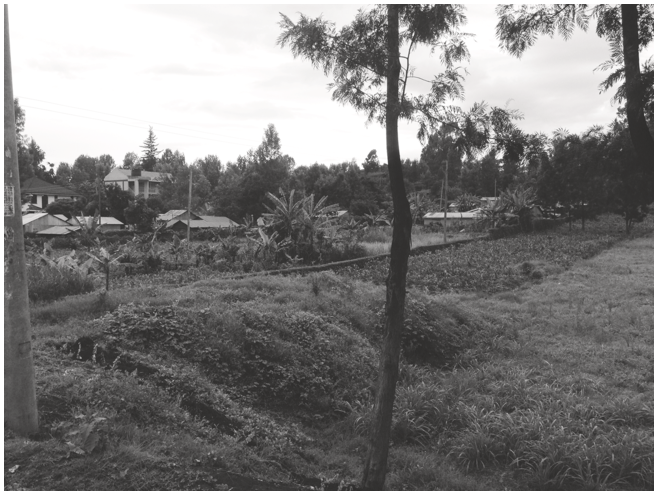
With these debates and possibilities in mind, we can turn our attention towards the landscape of contemporary Ituura, a neighbourhood of individual homesteads, each one bordering upon the next (see Figure 1.1). Save for the influx of outsiders living in rental accommodation that is increasingly being built by local residents, the neighbourhood remains one of consanguineally related male-headed households. All of these homesteads occupied larger plots of land and have been sub-divided several times, passed down on the basis of exclusive patrilineal descent until recently (Chapter 7).
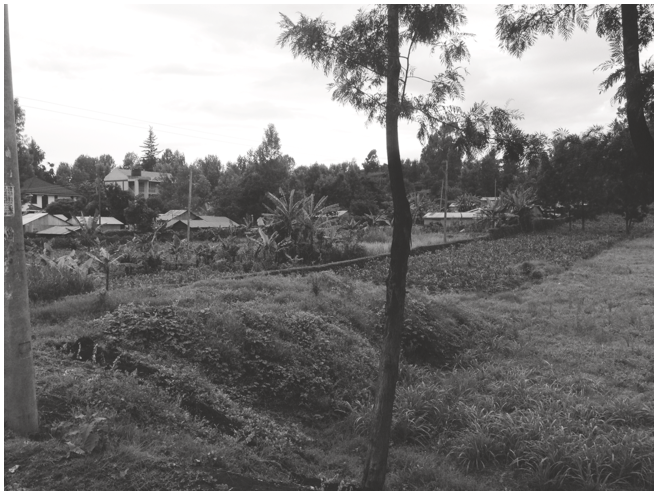
Figure 1.1 The neighbourhood of Ituura, 2018
Figure 1.1Long description
The napier grass fields in the foreground of the photo are usually fed to animals. Beyond them are homes, some noticeably finer than others. Some are made from corrugated iron. Further beyond are concrete houses with painted facades. Power lines rise above them. Grey clouds loom overhead. Ituura's landscape of rich and poor, its peri-urban status, is in full view.
My own fieldwork began at the homestead of Paul Kimani, a fifty-two-year-old lorry driver, the son of a man named Gathee (1903–84). Primarily a farmer, growing maize and herding goats, Gathee lived through the changes already described. It is likely that he never participated in Mau Mau directly due to the proximity between his home and the nearby farmland of white settlers, but he was thought to have been sympathetic to their cause. Gathee gained title to his land in the late 1950s when official titling began in Kiambu, although, as Kimani claimed, some of it was ‘grabbed’ (kuiba) by members of the Koinange family in the 1950s or 1960s, diminishing his holdings significantly. That his sons began to work for wages speaks to the generational shift that took place over the course of the twentieth century – from agriculture to wages.
Kimani had been born in 1965, two years after Kenya’s independence. His life trajectory was fairly typical of other Kiambu men I came to know in Ituura, in so far as he worked for piecemeal cash through ‘hustling’, returning to the homestead only sporadically. By the time I met him in January 2017, he had been working as a long-haul lorry driver for around ten years. Having only attended primary school in his youth, like most of his male siblings, he had lived his younger years farming and eventually found work as a pickup driver. He lived in a temporary house, made of corrugated iron and wooden planks, in anticipation of a stone house as yet unfinished. He was neither rich nor exactly poor. He and his family would not concede that they were ‘working-class’ – a term reserved for a Nairobi-based middle class for whom white-collar office work is the norm, but they were ‘somewhere’, in the words of Mwaura. They are, in a sense, emblematic of Kiambu’s demographic of aspirant post-peasants, people who have lived their lives in the shadow of the city, relying on wages rather than farming to pursue their life projects.
The fortunes of Gathee’s various children paints a portrait of life in a ‘localised patriline’ (Moore Reference Moore1986) at the edge of a city. Gathee had three wives, and each of them was allocated a separate strip of his land. Each of these strips had long been divided amongst the sons of these wives.
On the strip belonging to Kimani’s mother, Leah Njoki (1918–2018), land had not yet passed to the young sons of Kimani and his brother Murigi. Mwaura, at nineteen years of age when my fieldwork began, was first in line to inherit. But on the strip belonging to Gathee’s second wife, the land of his male children had already been divided amongst his male grandchildren – creating tiny plots, barely 50 × 100 hectares; plots incapable of supporting subsistence, forcing a reliance on wages.
In general, a homestead comprises a single house surrounded by a garden (shamba) used either for farming or for the construction of rental housing. These homesteads usually belong to men who have inherited land from their fathers, either formally through generating the title deed from the state land registry, or informally by the verbal will of their parents. Individual plots are usually surrounded by hedges, fences, or walls.
In some cases, multiple different houses are clustered on a single plot of land that is registered in the name of the person considered the household head. Clustering dwellings separately means that farmland can be kept intact, to serve the food requirements of all households. Whether the land can meet those food requirements throughout the year, however, is another question. The crops grown on shambas tend to form the mainstay of their residents’ diets – potatoes (viazi), kale (sukuma), maize (mbembe), and beans (mboco). These crops are rarely sold and are primarily used for partial subsistence. Purchasing food places a strain on most people’s budgets, depending on their access to land.Footnote 15 The thirty-year-old wife of a local man, who had moved from the far more rural Nyandarua County, lamented this, recalling her youth when practically all of her food was taken from her family’s much larger shamba of four acres.
While many homesteads have maintained separate fields, those on smaller plots tend to have abandoned arable farming altogether, instead using their limited space to build upwards – creating chicken coops and pig sties on two or three levels. Kiambu County is a place of innovation when it comes to getting the most out of a small space. One can be surprised by the number of pigs being kept on these small plots. Animal rearing of this sort is popular, and residents attune their practices to the return for animals and the relative difficulty seen to be involved in rearing them. Pigs, once popular, are recognised as being difficult to rear because of their susceptibility to disease. Quail eggs, popular in the early 2010s, gave some businessmen in Ituura a start in their careers. During my fieldwork, Mwaura and I purchased rabbits to rear and sell – ‘high level hustling’, as he jokingly put it, little more than a way to create a small amount of cash to supplement paid work outside the farm.
Families have adapted farming practices carefully to a lack of space, but wealthier households might be able to raise the capital to construct, or at least begin constructing, rental accommodation aimed at labour migrants, particularly young men from elsewhere in central Kenya, who have moved to live near Nairobi. In general, however, it remains desirable to have land available for farming since the food it provides cuts household costs significantly. The pressure on wages from food is significant. ‘We need cash’, was how Njeru described this situation, recognising the inability to support a household through subsistence.
Nairobi’s expanding sprawl provides an outlet for the land-poor, just as the city itself did throughout the twentieth century (Bullock Reference Bullock1974: 709, 713). A recent survey of Kiambu demonstrated that, while farming remains common, usually oriented towards subsistence as it was for my interlocutors in Ituura, sources of income from beyond the farm are crucial in the livelihoods of Kiambu dwellers, regardless of background (Government of Kenya 2014; cf. County Government of Kiambu n.d.c.; cf. Haugerud Reference Haugerud1995: 190). This survey noted ‘business’ as the most important source of net income for Kiambu residents beyond farming activities. An ambiguous category, ‘business’ (biacara), as used by Kenyans, evokes the broadening of a term to encompass practically any small-scale economic venture, from establishing a shop with mobile banking facilities to hawking goods. The category of ‘business’ shows that in spite of government celebration of enterprise and business ownership, life in the ‘informal economy’ (see, e.g., Hart Reference Hart1973) is not only normal but intermittent, incapable of providing a consistent means through which younger men can accumulate wealth.
Taking up a popular idiom for such work, Tatiana Thieme has called this ‘the hustle economy’ (Reference Thieme2017), where ‘hustling’ (a discourse reproduced by interlocutors of all ages) refers to the business of wage-hunting through taking-up odd jobs in whatever can be found through friends, relations, and even strangers. Notions of ‘just struggling’ or ‘trying’ (no kũgeria) are widespread, a casual response to a greeting frequently heard on the streets of Kiambu’s town. Notions of ‘hustling’ or ‘trying’ can, of course, manifest as casual labour, but while a common language of economic struggle unites, distinctions are observable, especially between generations.
However, the concept of ‘hustling’ also occludes the careful journeys of economisation that life in the informal economy requires, not least the stories of ‘investment’ and ‘growth’ through which people in Kiambu describe their economic lives, so too the generational gaps in economic stability. Guyer’s concept of an economy of ‘niches’ cultivated by persons based on their own evaluations of the economy and their creative responses to it is useful here (Reference Guyer1997: 223; cf. McDougall Reference McDougall2004: 156). Older men tend to have carved out a niche for themselves already, usually by long-term saving, or acquiring loans to purchase or rent a vehicle – usually a pickup truck, used to transport goods for larger farmers, but perhaps a taxi, or in the case of Paul Kimani, a lorry. Meanwhile, taxi drivers and those with pickups could expect to earn 20,000–30,000 KSh per month. This was usually enough to maintain a modest household and pay for the school fees of children.Footnote 16 Land ownership is important here, as men who have obtained title deeds are able to use them as collateral for loans to begin such business ventures.
A Labour Ethic
For Kiambu elders who inherited diminished plots, their survival and success were underpinned by ‘straddling’ livelihoods: the pursuit of ‘off-farm income’ (Kitching Reference Kitching1980: 3) from waged work, and its gradual reinvestment in the household and the surrounding farmland. These were not simply ideas about the morality of work as a route to success, but articulations of distinction and generational change. Often, this theory of economic action was articulated against the backdrop of what older men saw as a culture of youth delinquency. To senior men, hopeless young men appeared swept up in a culture of idleness and consumption, having lost the desire to ‘progress themselves’. As we saw in the Introduction, a discourse of crisis has been brewing in central Kenya for some time, centred on the abstract figure of the ‘boy child’ that Kikuyu elders say has been neglected in comparison to his sisters, so regularly the target of NGO empowerment and education intervention (Pike Reference Pike2020). At the heart of this crisis is a feeling that Kikuyu men are not becoming upstanding patriarchs, living lives of short-term consumption rather than building for the future. The voices of elders have blamed youth for their predicament. Consider, for instance, an excerpt from Paul Ngige Njoroge’s (Reference Njoroge2017) A People Called the Agĩkũyũ: Yesterday, Today … And Tomorrow?, published in Nairobi and sold in bookstores during my fieldwork, a contemporary appraisal of wayward youths:
There is a crisis especially among the young Gĩkũyũ. Unable to get jobs and sometimes shunning any demanding manual work, there are large numbers of Gikuyu young men without hope of making a productive contribution to society. There are young men who have no desire to marry and start a family. Hopelessness and disaffection are rife in the ranks of young people.
In Ituura, older men narrativised the significance of persevering in the cash economy, contrasting their efforts with those of young people today. ‘They want to get rich quickly. But you have to struggle to get money’, Njeru insisted, speaking to me outside his stone house in February 2022.
Let me say that one thing that the young people are making mistake on is giving up so fast. They try something new and as soon as they feel like it’s not working they just give up. During our early days we would always help our parents in the coffee plantation so we understood the art of hard work, we rarely involved ourselves in alcohol and drug abuse as seen today. We settle down and we were responsible from the word go, our sons and daughters have become too lazy and are only waiting for us to hand over our inheritance so that they can misuse it.
As men like Njeru saw it, money earnt by young men in Ituura and the surrounding peri-urban environs of Chungwa was spent all too quickly, rarely reinvested. ‘As you know very well, many people around they are only thinking about taking beer, isn’t it?’, Njeru asked Mwaura when we interviewed him in February 2022. Mwaura sheepishly agreed, saying nothing of his own engagement in such economies of consumption (Chapters 2 and 8). ‘If one is working, in the evening they are going there [to the local bar] to spend the money instead of saving for tomorrow’, Njeru continued. ‘They are not thinking about tomorrow. They are only thinking about today. And tomorrow will need money.’
Such just-so stories were also marked by the refusal of the young to embrace the suffering the older generation believed they had. ‘We struggled’, Njeru told me. ‘You have to struggle!’ This lack of desire to ‘work’ was connected to desires to consume the wealth of others in their discourse.
Njeru was hardly alone in his moralising. Young men across Kiambu were regularly chastised for their delinquency by older men. ‘Our youth are lazy! Very lazy!’ Andrew, an elderly shopkeeper in nearby Chungwa Town was standing outside his store in August 2017. ‘We used to help our parents on the shamba.’ Such days were long past, he suggested. Like others from Ituura’s peri-urban interstice who lamented the effects of ‘immoralities’ (waganu) associated with Nairobi, Andrew attributed this social breakdown to the influence of the nearby city he gestured towards.
All these metropolitan areas around Nairobi. We are all around this Nairobi. They are getting those bad habits. Very bad habits! 50 shillings! He [i.e., a youth] can go from here to Nairobi. In Nairobi there is everything. Alcohol …
The temptations of the city, he suggested, were too strong. His words belie his generation’s suspicion of small amounts of money, quickly earned, and easily spent. As we shall see in Chapter 6, this money is known as ‘mbeca cia werere’ (easy come, easy go money), which one earns easily from low-status, low-paying jobs such as working as a matatu tout, money that is spent even quicker.
It was not only masculine destitution that elders lamented, but a general sense of a corrosive short-termism, one that threatened not just masculine continuity but the health of the social order itself. In Ituura, older men I interviewed saw the generational divide in starkly moral terms, as a shift in orientations away from their own who had ‘added’ to its wealth. By contrast, the current generation only seem to spend and expropriate it:
People of today are very different, and most of the people whereby their fathers were very rich and they left a lot of money, they do not add it; it is only to use, when somebody was left with two acres they do not care, they are selling it so what comes after is only to drink beer. So the children are adding nothing to what the parents left.
My language teacher Gikari explained to me that a common story about Kiambu is that while the elder generation became rich through coffee plantations and hard work, a younger generation became accustomed to their parents’ wealth. Spoilt by their relative privilege, they were said to have become reluctant to work for their own futures.
However, amongst others, there was also a recognition that young men’s disappointments emerged from the mismatch between their lifestyle aspirations and their economic means, creating a downward spiral towards destitution. Thairu captured this in his more sympathetic perspective towards young men.Footnote 17
Today the young generation want to have a car and to have a good lifestyle, what do you do if you finish your money? You sell a plot, buy a car, go drinking, this money is not generating anything. When I was younger we had nowhere to go, now you have places to go and you want to show off that you have money so, you spend, but this money you are spending but nothing is coming in, nothing trickling down. Then you finish the money and you don’t have another plot to sell, what do you do? You commit suicide. You do not have an income, the money you got from selling the plots you do not have and you have nothing to sell, what do you do? You just kill yourself, you are depressed and have nobody to give you food. You don’t have any career so you can’t go to work, furthermore because you had money you can’t lower your status to go for mjengo (construction work). It is better to kill yourself than to be seen as hustling, or you have a wheelbarrow.
Mwalimu Mbira, a seventy-year-old former schoolteacher from Ituura, had a similar perspective on this shift towards impatient and immediate forms of acquiring and enjoying wealth, with dangerous consequences in terms of crime and, as he saw it, ‘corruption’:
For some people, when they go to work wherever they are employed, they steal public property to make themselves rich. People see this [other] person [once] had nothing but [then suddenly] they have gathered wealth within one year. Therefore, a mentality develops, that one cannot make money through working hard, [that instead] they must make a deal, they must do something [extreme or illegitimate] to get the money. So there are changes that have come about because of the values we have; they are different from what we used to have.
And as we will see more of in Chapter 2, these perspectives were by no means confined to Ituura’s older generations. Mwaura pointed me towards considering Njeru’s three children, all adult men in their thirties and forties during my research. In his view, they themselves were ‘drunkards’, and he told me how their father had bought them a pickup truck to transport and sell charcoal, hoping that they would establish a business for themselves. Abandoning the enterprise no sooner than it had begun, Njeru’s children sold the car’s parts piece-by-piece to purchase alcohol at the local Motel. In Mwaura’s eyes, it was evidence of the morality of the older generation and the failures of his own.
Short-cuts to Consumption
With plots limited and wages low, ideas about the morality of labour find themselves under pressure from these shifting material constraints. While an elder generation can now look back on its ‘struggling’ from a position of security, a younger one is looking ahead at a future of limited prospects, losing faith that their elders’ success can ever be emulated when their joblessness consigns them to hours upon hours spent in the neighbourhood.
From the perspective of those at the bottom of the socio-economic rung – far removed from the achievement of elders like Njeru – modes of rapid accumulation make logical sense given the lengthiness of the aforementioned journeys of life-long economising for familial longevity. As Pierre Bourdieu (Reference Bourdieu2000: 221) has put it in a rather more elevated register, ‘below a certain threshold of objective chances, the strategic disposition … which presupposes practical reference to a forth-coming … cannot be constituted’. Young men balk at the economic struggling their elders exhort, wondering if they will ever ‘make it’ to that ‘level’ of ‘stability’ themselves.
A conversation between Mwaura, two older men, and me that took place at a mourning ceremony for a neighbour, early on in my fieldwork, revealed the sense of trepidation younger men feel when they begin ‘hustling for themselves’. The two older men, in their late forties, explained to me – the anthropologist outsider – the difficulty of generating cash except by selling land because of the difficulty of acquiring bank loans due to high interest rates. They were cautious about repossession and pointed me towards the back-pages of the Daily Nation, where ‘so many’ smallholder plots were being put up for auction. Mwaura’s sardonic interjection was to say that he would never become rich unless he became ‘a criminal or a politician’, in other words, someone who exploits others, using morally spurious tactics to generate wealth quickly.
The possibility of skipping through these stages is obviously enticing to young men, since the implications of a life spent ‘hustling’ are starkest for them, particularly those who only completed primary school or part of secondary school. The prospect of many years spent hustling was enough to encourage young men I came to know in Chungwa Town to become petty criminals, stealing to spend (Lockwood Reference Lockwood2020b). I have shown how they attempt a ‘short-circuiting’ of the logic of long-term, gradual economising and accumulating by practicing a type of ‘impatient accumulation’ and ‘immediate consumption’ designed to make them feel wealthy, even if only temporarily. Their low wages barely seemed enough to save, and they engaged in practices of drinking home brewed beer (keg) and ‘third generation’ spirits, often made illegally yet packaged and sold on shop shelves throughout the region (Willis Reference Willis2002; Mutisya and Willis Reference Mutisya and Willis2009).
As we saw at the beginning of this book, the sale of ancestral land, of precious plots of peasant land, have stirred similar debates about the dangers of ‘fast wealth’. Mwaura would point out to me in 2022 that the simulation of wealth through illicit accumulation were not confined to the young men judged by their elders. Mwaura explained that Francis Njeru’s own stone house – the one we sat outside to speak to him that same year, where he exhorted young men to ‘struggle’ – had in fact only been built because he had sold a piece of land. Nor had Njeru stopped there,
The last time he sold land he only used the money to build a house for himself. The rest of the money he put in the bank. Now he has spent the rest of the money. Now he just wants some money to just feed his ego. To just stay like that and still having money.
For Mwaura, this was evidence of the flawed nature of labour theory of success – that hard work was not enough to ‘make it’ where one wanted to go in life.
This guy [Njeru] he’s been a teacher. He’s been a teacher for the whole of his life until he’s retired, and he has nothing to show for it. Then all of a sudden he wants to sacrifice his land to build a stone house which he was unable to build when he was a teacher.
In other words, Njeru was a hypocrite, criticising the young for their love of money and consumption when he was making similar calculations himself. What’s more, Njeru’s selling of land evoked the older generation’s ‘selfishness’, as Mwaura saw it – that they prioritised their own ‘comfort’ over the fates of their children:
[Njeru] can’t work anymore, he just wants to chill and have money without investing money. It’s a behaviour these old people are bringing up to themselves.
For all the narratives of hard work, older men were disposing of family land at their own personal discretion.
Conclusion
This chapter has observed the economic transformation of the Kiambu region of Kenya over the course of the twentieth and early twenty-first centuries: the end of family farming, the emergence of a crisis of surplus people, a younger generation consigned to ‘wageless lives’, trying to find economic niches from which they can earn a living. Desires on the part of this generation to avoid their predicament, to ‘skip ahead’ through theft or appropriating then expropriating family land begets moralising judgement from the older generation, who continue to insist on the path of ‘slow labour’ and careful economisation. This moral debate about the viability of work recurs throughout the book’s chapters. The question for Kiambu’s youth, as much as its elders, was whether their limited land and low wages could support a patrilineal family, a vision of the good life being undercut by a growing hopelessness amongst this demographic.
The erosion of peasant livelihoods and the associated debates about the economic viability of the patrilineal household, of life itself, form the backdrop of this book as it moves forward into discussing the ethnographic setting of Ituura itself. In Chapter 2, I begin my journey into the landscape of male destitution in earnest, showing how my earliest weeks in Kiambu were shaped by encounters with youth alcoholism, and how I came to understand the hopelessness young men experience through participating in their lives and talking with them about their experiences of economic privation. It underscores the reproduction of the debate about work’s virtue amongst themselves, and the need to avoid becoming ‘wasted’ by ‘hanging on’ to the labour ethic: to hope itself.

 Open access