

The PollyVote project, established in 2004, applies insights from general forecasting literature to the field of election prediction. Focused on combining forecasts, the PollyVote has been used to predict the six US presidential elections from 2004 to 2024 (Graefe Reference Graefe2024), the three German federal elections from 2013 to 2021 (Graefe Reference Graefe2022a), and the 2022 French presidential election (Graefe Reference Graefe2022b), with the combined forecasts often ranking among the most accurate in predicting final election outcomes (Graefe Reference Graefe2019, Reference Graefe2023). This article continues the tradition by presenting a forecast for the 2025 German federal election using the PollyVote method. For this election, PollyVote integrates data from three components: polls, expectations, and models. In addition to focusing on forecast accuracy, the PollyVote provides insights into the development and performance of different forecasting approaches over time, contributing to the ongoing development of election forecasting as a field of study.
For this election, PollyVote integrates data from three components: polls, expectations, and models. In addition to focusing on forecast accuracy, the PollyVote provides insights into the development and performance of different forecasting approaches over time, contributing to the ongoing development of election forecasting as a field of study.
Forecast composition
For the 2025 German election, the PollyVote methodology follows the same basic framework that was used to predict the last election in 2021, averaging forecasts within and across three main component methods: polls, expectations, and models.
Polls
Polls are among the most commonly used methods for anticipating election outcomes, offering a snapshot of public sentiment at a specific point—for instance, “if the election were held today” or, in Germany’s context, “the coming Sunday.” However, polls are not designed to provide long-term forecasts, as voter preferences often shift significantly over time. This limitation makes their predictive value less reliable the farther away the election date is.
A notable challenge with polls is the variation in results from different survey institutes, driven by methodological differences such as sampling techniques or question phrasing (Erikson and Wlezien Reference Erikson and Wlezien2012). Here, poll aggregation can help. PollyVote thus incorporates the poll aggregator from Zeit.de for the 2025 German federal election. Zeit.de employs a weighted approach, giving greater importance to more recent polls and to pollsters whose polls were more accurate in previous elections.
By combining polls from different pollsters, aggregation can smooth out random errors, potentially yielding a more stable and accurate overall estimate. However, systematic biases—such as those caused by nonresponse or herding—persist across polling firms and cannot be eliminated through aggregation alone (Gelman et al. Reference Gelman, Goel, Rivers and Rothschild2016). Analyzing German election polls from 1994 to 2021, Selb et al. (Reference Selb, Chen, Körtner and Bosch2023) find that systematic biases are an industry-wide issue, with average absolute election-day biases ranging from 0.9 to 3.2 percentage points per party. Notably, polling variance in Germany is estimated to be 1.5 to 3 times larger than what standard margins of error imply, suggesting that polls systematically underestimate uncertainty. These findings align with similar analyses of US polling (Shirani-Mehr et al. Reference Shirani-Mehr, Rothschild, Goel and Gelman2018), indicating that systematic nonresponse and other methodological biases are not unique to Germany but rather a common challenge in election polling.
Expectations
Judgment plays a crucial role in forecasting, whether as an input to forecasting models (e.g., in the selection of data or variables) or in the form of direct forecasts, referred to here as expectations. Judgment can be especially valuable for addressing rare events or structural shifts that statistical models may fail to capture effectively (Lawrence et al. Reference Lawrence, Goodwin, O’Connor and Önkal2006). Additionally, judgment can help mitigate potential errors from other forecasting methods. For instance, expectation-based forecasts can adjust for directional errors in polling, particularly when there is concern that polls may not reach certain segments of the electorate. In election forecasting, expectation-based methods commonly include expert judgment, citizen forecasts, and betting markets (Graefe Reference Graefe2024). Among these, betting markets are incorporated into the PollyVote forecast as of the time of this writing.
Betting markets offer a platform for participants to wager on election outcomes, where individuals are generally motivated to make accurate predictions. The main idea is to encourage engagement only when participants believe their analysis or insights provide an edge over the market consensus, as their rewards—whether financial or reputational—are directly linked to the accuracy of their predictions. On platforms like PolyMarket, for instance, participants can bet real money on various outcomes related to the upcoming German election, such as the anticipated vote shares of the CDU/CSU, SPD, and AfD. The more accurate their predictions, the greater their financial gains, and conversely, the less accurate, the more they stand to lose. In contrast, Wahlfieber.de is a play-money betting market included in the PollyVote since 2013. Unlike real-money markets like PolyMarket, Wahlfieber provides participants with an initial virtual currency endowment to trade shares. Performance rankings incentivize participants, with prizes awarded to the top performers.
Models
The models component of the PollyVote combines forecasts from five distinct models, four of which are featured in this symposium, with the exception of Groß (Reference Groß2021). These models use different variables and model specifications to predict the parties’ vote shares in German elections. Notably, these models differ in the degree to which they rely on polling data.
The models by Zweitstimme.org (Erfort et al. Reference Erfort, Stoetzer, Gschwend, Koch, Munzert and Rajski2025) and wer-gewinnt-die-wahl.de (Groß Reference Groß2021) are the most polling dependent, using polling data enriched with additional information such as past election results and the composition of governing parties. These models produce daily updated forecasts, akin to prominent US models like those from the recently discontinued FiveThirtyEight or The Economist. In addition to projecting parties’ vote shares, which contribute to the PollyVote, they deliver probabilistic forecasts of various electoral outcomes, such as the likelihood of a party winning a plurality of votes or the viability of specific coalitions.
Jérôme, Jérôme, and Lewis-Beck (Reference Jérôme, Jérôme and Lewis-Beck2025) present their traditional political-economic model, grounded in the concept of government responsibility or retrospective voting. This approach connects electoral outcomes to the performance of the incumbent government, based on the premise that voters reward or punish the government according to its economic and political achievements. Although the model incorporates polling data, including the popularity of the incumbent chancellor and voting intentions for various parties, it also integrates structural economic indicators (e.g., the unemployment rate) alongside contextual factors such as party coalitions and electoral rules.
Marcinkiewicz and Stegmaier (Reference Marcinkiewicz and Stegmaier2025) adopt a state-level approach to forecast outcomes exclusively for the CDU/CSU. Their model incorporates economic factors (i.e., GDP growth), social factors (i.e., religious affiliation data), and political factors (i.e., the party’s previous performance), and the current political context. Although the political context is assessed using public opinion data—specifically the popularity gap between the CDU/CSU’s chancellor candidate and the SPD’s candidate—the model avoids relying on traditional vote intention polls.
Finally, the model developed by Quinlan, Schnaudt, and Lewis-Beck (Reference Quinlan, Schnaudt and Lewis-Beck2025) stands out as the only forecast that entirely excludes public opinion data, relying exclusively on structural factors. Their political-history model incorporates five main variables: short-term partisanship, grand-coalition governance, the influence of Land minister presidents, the legacy of German reunification, and the enduring effects of the 2015 refugee crisis. The model predicts vote shares for the CDU/CSU, SPD, and all other parties combined.
Election forecast
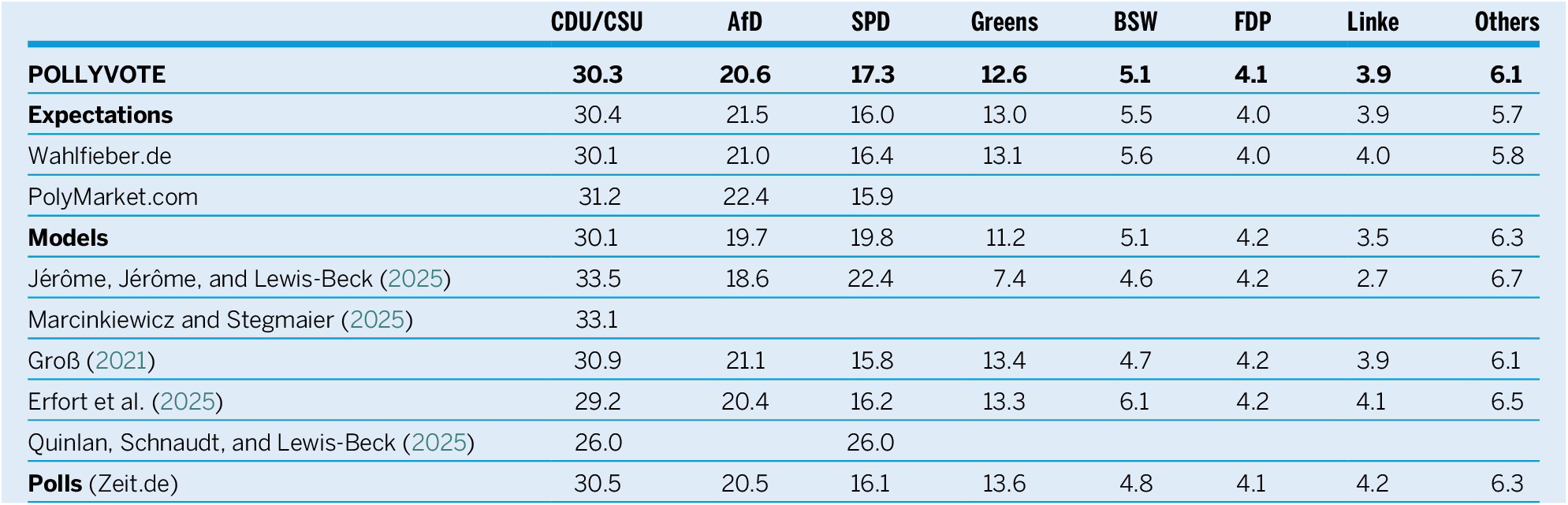
Table 1 provides an overview of the PollyVote forecasts and its components for the seven largest parties in Germany as of January 30, 2025. Overall, the forecasts exhibit a high degree of consistency. For example, all but one forecast concur that the CDU/CSU will secure the largest share of the vote, with the PollyVote projecting 30.3%. The sole exception is Quinlan, Schnaudt, and Lewis-Beck (Reference Quinlan, Schnaudt and Lewis-Beck2025), which forecasts an equal share of 26.0% for both the CDU/CSU and SPD. This divergence is likely because Quinlan, Schnaudt, and Lewis-Beck (Reference Quinlan, Schnaudt and Lewis-Beck2025) provide the only forecast that entirely excludes public opinion data, relying solely on structural factors. In contrast, all other forecasts incorporate some form of public opinion, typically drawing on traditional preelection polls—either as explanatory variables within a model or as an indirect influence on betting-market participants. In other words, by excluding public opinion data, the model by Quinlan, Schnaudt, and Lewis-Beck (Reference Quinlan, Schnaudt and Lewis-Beck2025) may highlight a potential bias in current polls, suggesting that polls could be overestimating support for the CDU/CSU while underestimating that for the SPD.
Table 1 PollyVote and component forecasts of the parties vote shares (in %) for the 2025 German Federal Election

Note: Latest forecasts are as of January 30, 2025. Exceptions: Zeit.de, PolyMarket.com, Groß (Reference Groß2021), and expectations refer to January 29, while Wahlfieber.de refers to January 28. PollyVote separates these forecasts, using the share of both parties in the models by Erfort et al. (Reference Erfort, Stoetzer, Gschwend, Koch, Munzert and Rajski2025) and Groß (Reference Groß2021). Marcinkiewicz and Stegmaier (Reference Marcinkiewicz and Stegmaier2025) predict the CDU/CSU vote share. Quinlan, Schnaudt, and Lewis-Beck (Reference Quinlan, Schnaudt and Lewis-Beck2025) predict the vote shares for CDU/CSU and SPD. Polymarket runs contracts that predict vote shares of CDU/CSU, SPD, and AfD.
Among the forecasts that include predictions for the AfD, most position the far-right party in second place, resulting in a PollyVote projection of 20.6% of the vote. Only two forecasts deviate from this rank order: Quinlan, Schnaudt, and Lewis-Beck (Reference Quinlan, Schnaudt and Lewis-Beck2025) and Jérôme, Jérôme, and Lewis-Beck (Reference Jérôme, Jérôme and Lewis-Beck2025), both of which expect the SPD to secure more votes than the AfD. The PollyVote predicts the SPD to rank third, with 17.3% of the vote, followed by the Greens at 12.6%. For smaller parties, all point forecasts agree that both the Left and the FDP will fall short of the 5% threshold required to enter parliament. However, there is considerable uncertainty regarding whether the new leftist party, BSW, will surpass this threshold. Forecasts range from a of 6.1% by Erfort et al. (Reference Erfort, Stoetzer, Gschwend, Koch, Munzert and Rajski2025) to 4.6% by Jérôme, Jérôme, and Lewis-Beck (Reference Jérôme, Jérôme and Lewis-Beck2025), leading to a combined PollyVote forecast of 5.1%.
DATA AVAILABILITY STATEMENT
Research documentation and data that support the findings of this study are openly available at the Harvard Dataverse at https://doi.org/10.7910/DVN/XJMT0Y.