Occasionally, in the archives, historians come across a manuscript that stops them in their tracks, even though it is not connected to the topic on which they are currently working. This happened, in the course of my last research project, in the form of an unusual interrogation document in the Bibliothèque nationale in Paris, dated 10 May 1570, which forms the basis for this book. It was intriguing, partly because it was exceptional among the documents around it that were mainly in the form of correspondence, not to mention for its legibility, but also because it had a story to tell with which, at that moment, I did not have time to engage. Nevertheless, I noted its details down on the off-chance that I might be better able to give it my full attention at some future point. Returning to the document some years later, looking to discover what became of the man, Jean Tivinat, who was being interrogated, I came up against an archival dead end. Yet, while doing so, I located the clandestine letters that he was planning to carry from France to England, and I began to identify many of those who were mentioned in the interrogation and to place the document in its broader context. Thus, from small beginnings, as I delved further, so the project expanded and began to encompass a network of connections, not only on either side of the Channel but across sixteenth-century Europe.
In particular, the interrogation brought into sharp focus the role of the man who supplied the letters as well as those to whom they were being carried. Most prominent among these recipients was Odet de Coligny, the cardinal of Châtillon, one of three brothers who led the Huguenot movement in its formative stages, who was then in exile in England. Despite the fact that most of the documentation that survives in the English State Papers regarding his period of refuge was published more than 130 years ago, an analysis of those persons who were in, or interacted with, the cardinal’s household during these years has not been systematically undertaken.Footnote 1 Memorably hidden in a basket of cheese, the cache of correspondence that Tivinat was carrying is able to supplement and augment what we already know and to provide clues which allow us to fill in some of the gaps in various individual biographies, particularly for the members of the confessional network around Odet de Coligny. Most of those letters have only survived because they were intercepted and sent on to the authorities in Paris, where they were transcribed. Combined with other similar documents and episodes, they reveal to us an otherwise hidden and secretive world.
The transcribed letters themselves are not unknown. They featured in the ‘Coligny’ exhibition of 1972 at the Archives nationales in Paris, although their brief entry in the catalogue as ‘277 bis’ makes their inclusion look very much like an afterthought.Footnote 2 The uninspiring title given to these transcriptions, ‘News from France addressed to the Cardinal of Châtillon’, which is vague and, as we shall see, rather misleading, may explain their neglect. In addition, on first inspection they appear rather dull, repetitive and obscure, full of names and details of which I have only gradually been able to make some sense. Partly this is because of the passage of time and my own ignorance of the individuals and matters involved, but also because the writers were deliberately concealing their identities and those of their recipients and those about whom they were writing, so as to lessen the danger of interception. Over time, however, the letters have begun to yield their secrets, to reveal the context in which they were produced and the networks which they sustained.
In writing this book, I have wanted to capture for the reader exactly how this project came together and, by doing so, to reconstruct something of the process of trial and error of the historian’s craft. Because of the secretive nature of its subject, it has involved a greater degree of detective work to reassemble the pieces and, more than is usual, therefore, I have shown my workings in the knowledge that the resulting picture inevitably remains somewhat incomplete.Footnote 3 Thus, Chapter 1 is a close analysis of the interrogation document and what it can tell us about the world in which Tivinat moved and in which clandestine correspondence was shared. The intention is both to reveal the concerns of the authorities and how they went about extracting the information that they sought, as well as to show how historians can tease out and scrutinise the details and evidence that a single document like this might contain. In particular, the process of identifying the man who supplied the letters is as crucial for us as it was for the authorities in tracing the networks that lay behind these activities and understanding how they operated.
From the arrest and interrogation, I wanted next to investigate the regional context of these events, which took place in the strategic port of Dieppe in Normandy. That location is vital for understanding the response of the authorities, including the local governor and the interrogator, the risks being taken by the defendant and others who embarked on this route, as well as their cross-Channel connections. Furthermore, since the archives in Dieppe were mostly destroyed at the end of the seventeenth century, this makes the governor’s correspondence and other sources surviving in Paris and Rouen even more vital in allowing us to reconstruct the Norman connections of the case. Next, it was of central importance to study the households, in the suburbs of Paris and London, between which the letters were being carried. In order to understand the impact of the presence of the cardinal of Châtillon in England on the Elizabethan regime, it is necessary to explore what the correspondence reflects both about his role and that of those connected to him, including official ambassadors to and from France, as well as the Huguenot leadership and their agents. Yet, I have concluded that it is through the Protestant ministers connected to the cardinal that we can best reconstruct the wider international aspect of these confessional links across western Europe, primarily focused on Geneva, the Empire and the Netherlands, as well as France, at a time of significant political tension and uncertainty. As the fragments of these networks have come together, so too has the identification of other correspondence that forms links in a chain of clandestine contacts that supported the Huguenot movement and its allies.
Finally, understanding how these information networks intersected with more traditional forms of espionage and diplomatic secrecy underscores the complexity of communication, the fragility of trust and the haphazard detection of treachery in sixteenth-century Europe. Here, our story once again intersects with wider political anxieties about Catholic plots against Protestant England, in particular, and the role of French exiles in both exposing and galvanising these and other networks. It sheds new light on a key moment in the history of both states, as they sought to deal with disaffected confessional groups and individuals that threatened the authority and stability of their monarchical regimes in ways that tied their destinies more closely together. Neither could afford to ignore the significance of external alliances with internal parties that sustained an ongoing effort to displace and replace the prevailing orthodoxies.
A European Network
The years c. 1566–1572 were significant not just for the futures of the Catholic/Protestant divide in France and England, but for the progress of the Reformation throughout Europe, including the Dutch Revolt in the Low Countries and the deposition by the Protestant lords of Mary Queen of Scots.Footnote 4 In England, these years saw the intensification of the Catholic resistance that produced the Northern Rising of 1569 and the Ridolfi Plot of 1571 as well as the excommunication of Queen Elizabeth by the papacy in 1570. In France, the second and third civil wars (1567–1570), with a few months of supposed but nervous peace in between, saw the major battles of Saint-Denis (November 1567), Jarnac and Moncontour (March and October 1569). These years also brought the deaths of significant figures on both sides, including the Catholic commander, the Constable Anne de Montmorency (November 1567), and three of his nephews, the Coligny brothers, François (May 1569), Odet (March 1571) and Gaspard (August 1572), as well as Louis de Bourbon, prince of Condé (March 1569) and Jeanne d’Albret, queen of Navarre (July 1572), all established leaders of the Huguenot cause. The presence of foreign troops supporting both sides in France, especially from the Empire, and the overlap with Dutch resistance to Spain in the Low Countries, provided a further tense backdrop, which extended into the period of peace from August 1570 and up to the Saint Bartholomew’s massacres of August to October 1572. This period also marked a changing of the guard in terms of the leadership generation on both sides, with the four Henris, the Catholic dukes of Anjou (b. 1551) and of Guise (b. 1550), and the Protestant princes of Navarre (b. 1553) and of Condé (b. 1552), all coming of age and assuming command of their respective forces. The events of 1572 and their repercussions would shape all their destinies as well as the confessional makeup and future of the kingdom.
None of this was clear in May 1570, when our story begins, falling between the deaths of Louis of Condé and François de Coligny and those of his brothers Odet and Gaspard, and in the middle of uneasy negotiations for peace. These events provide an important context for our reading of this tale, but it in turn provides a deeper understanding of the complexities of the interrelationships, individual, regional, national and international, of the Huguenot movement and its allies at this crucial moment in its history. 1568 saw the conjunction of both Catholic and Protestant alliances in Europe, each feeding off mutual distrust and the fear of foreign intervention in domestic affairs. Spain and the papacy, in collaboration with Catholics in France and England, and with Mary Queen of Scots and her supporters, were believed to be plotting the assassination of Huguenot and Dutch leaders, as well as of Queen Elizabeth. These rumours served to strengthen an alliance between the Protestant powers and groupings, including the Huguenot and Dutch nobility, German princes, the Swiss cantons and England. This international backdrop intersects with the networks that are revealed to us through the letters intercepted in Dieppe, thus, panning out from the regional and national context to encompass the confessional politics of Europe as a whole.
Historiographical Connections
Once embarked on this project, I became keenly aware of several recent historiographical trends on which it could fruitfully build and, hopefully, to which it can make a meaningful contribution. Most relevantly, work on forms of early modern communication and how they were distributed to those who were reliant on them has taken great strides in recent decades. This focus has provided a vital grounding for our understanding of how networks were established and maintained, particularly at a time of religious division and conflict. There has been a close interest in studying correspondence, not just for its content, but also what it can tell us about the dynamics of cultural exchange and forms of political power and social etiquette, as well as its role in sustaining those scattered by persecution and migration.Footnote 5 Closely connected to such insights, our understanding of the function and development of news and information networks in the period has also undergone something of a revolution.Footnote 6 In addition, the European diaspora created by the Reformation has proven to be fertile ground for studies of the exile experience, which has shed light on the disrupted lives of those displaced by persecution, temporarily as well as permanently, dependent on the goodwill of their new hosts and the maintenance of ties with those left behind.Footnote 7 All of this provides an essential backdrop for understanding the context of the story discussed here.
In my own field of the French religious wars, there has been a renewed focus on the transnational aspects of the conflict and, thus, how it intersected with the fortunes of other confessional communities across Reformation Europe.Footnote 8 In particular, Hugues Daussy’s comprehensive and meticulous mapping of these links for the Huguenots, in the period up to 1572, has proved invaluable for this project.Footnote 9 Other foundations have been laid by those studies which have addressed the wider European context for particular regions and from different confessional perspectives.Footnote 10 Still others have done so through detailed examination of scholarly, diplomatic, mercantile and maritime Protestant networks.Footnote 11 The close relationship between diplomacy and information-gathering, especially in the form of reports, discourses and treatises, as well as traditional ambassadorial dispatches, has also been explored.Footnote 12 The ‘new diplomatic history’ has enhanced these approaches, focusing not just on the supposed origins of diplomacy in early modern Europe and the role of ambassadors but also on medieval and global developments and the part played by other agents both formally and informally.Footnote 13 In particular, the more ad hoc use of a variety of participants in the gathering of intelligence alongside a body of semi-professional diplomats and informants has been increasingly recognised.
The secondary literature on early modern espionage and intelligence networks is extensive and continues to expand in new directions and to provide fresh insights.Footnote 14 Much of it has been concentrated on Elizabethan England, with an in-depth focus on the activities overseen by Francis Walsingham and William Cecil.Footnote 15 As we will discover, Catholic plots by agents with ties to Mary Queen of Scots, with particular relevance for France, also feature among the links to Jean Tivinat’s circle of contacts. The classic studies by John Bossy uncovered a cabal of informants based ‘in and around the house of the French ambassador’ in London, in the mid-1580s.Footnote 16 The involvement of ambassadors in espionage was to be expected and, indeed, Henry Norris, English ambassador to France, at whose residence Tivinat collected the letters, was suspected of conniving with the Huguenot leadership. Although there are clear parallels between the activities of ‘servants and agents and friends’ of the French ambassador, in the 1580s, and those linked to the household of the English ambassador in Paris, in the 1560s and 1570s, especially given Walsingham’s stint there from 1571 to 1573, there are also key differences between the networks uncovered.Footnote 17 The wider European and confessional context of both is evident, however, and recent work on those individuals lower down the chain of command, particularly English agents who operated in Europe, have also been both pertinent and informative for understanding how such networks were developed and sustained.Footnote 18
By comparison, there is much work still to be done to recreate these same structures for sixteenth-century France. In part, this is because the sources are not as readily accessible, and often more dispersed, as well as because royal direction of such operations does not appear to have been so systematically organised by a single ‘spymaster’.Footnote 19 In contrast, there is already a considerable body of scholarship on Franco-Spanish relations.Footnote 20 Book-length studies of early modern French espionage are mostly focused on a later period, but recent publications have begun to bring our attention further back to the agents operating around certain individuals at court or working for the crown in the provinces and beyond, before, during and after the religious wars.Footnote 21 Yet, all these studies, like those for England and elsewhere, focus primarily on what we might call official or ‘state-sponsored’ intelligence-gathering. We know far less about how subversive groups such as the Huguenots and their allies operated, a hidden gap which this book seeks to fill.Footnote 22 The support afforded by the Huguenot leadership to those undertaking these activities was inevitably precarious and uncertain due to the waves of persecution and political rehabilitation that the movement faced. That said, there was considerable overlap and collaboration between the clandestine network presented here and those agents more visibly serving ambassadors and other diplomats, as well as the Calvinist leadership and the Huguenot nobility. While these groups sometimes operated with a shared sense of confessional purpose; however, they also had motives, objectives and priorities of their own, which required them also to keep some distance from one another, presenting a further challenge to their effectiveness.
Truth and Secrecy
Tivinat’s arrest exposes his involvement, not just in carrying clandestine correspondence but in a network of information-gatherers who were intent on ensuring that communication between leading members of the Huguenot movement was sustained. Understanding what was at stake for its members, both individually and collectively, is essential for our comprehension of their activities. With its peripatetic and disparate leadership, and dependence on exiles, ministers and agents of various sorts, keeping the movement successfully interconnected was a formidable task. By contrast, the diplomacy and intelligence of largely static courts and centres of governance, with their continuity of personnel, were more straightforward to coordinate. These same regimes, of course, were intent on disrupting potentially disloyal elements, such as for France, the Reformed churches as well as the Huguenot aristocracy supported by sympathetic Protestant princes abroad. Maintaining effective channels of communication in such circumstances required strategic thinking, a degree of agility and resourcefulness, as well as absolute discretion, with networks based on trust and shared resolve to overcome the obstacles to a collective endeavour. As Odet de Coligny put it, unity was essential to ‘the advancement of the true religion and of the pure service of God (and) the defence of His cause’.Footnote 23
As we will discover, many of those who participated in such networks were Huguenot ministers committed to supporting the furtherance of their cause through devotion to their faith. It may appear contradictory to emphasise the simultaneous upholding of religious truth and the maintenance of secrecy in their undertakings. Yet, deceit, concealment and dissembling were essential requirements for sustaining underground channels of communication given the ongoing persecution in their homeland. Robert Kingdon long ago identified a policy or rule of secrecy as a necessary and key element in the sending out of ministers from Geneva. They were conditioned both to uphold and advance the ‘truth’ of their religion as well as to do so by whatever means possible. The start of the movement and the establishment of its early churches operated in secret, with ministers often moving around in disguise to hidden meetings in obscure locations, using pseudonyms and false identities in order to evade the authorities.Footnote 24 Recent work has also demonstrated the extent to which, despite its denials, the Calvinist leadership was implicated in clandestine activities of various sorts to undermine its opponents and even to foster revolt.Footnote 25
Thus, ministers were already well-used to and experienced in the sort of subterfuges and strategies that were part and parcel of the precarious practices of a successful courier or distributor of clandestine correspondence. We are, thus, looking through a rather different lens than that of the age of secrecy or of dissimulation, discussed by Michel de Montaigne and others, in assessing the practices and behaviour of such figures within the context of confessional conflict and practical expediency.Footnote 26 Those involved were well aware of the dangers they were courting, including arrest, incarceration, interrogation and, even, execution, as well as hardened in mitigating these risks, through flight, concealment and other subversive practices. Clerics operated in their European networks with a sense of mission and vocation, not seeking monetary reward for this undertaking, which was embraced as serving God’s cause, and collaborating with others of like mind. Nevertheless, they were also pragmatic, making use of established couriers, means and routes of carriage, and tried and tested methods of concealment. They took a calculated risk in entrusting their security and that of their correspondence to others’ messengers and contacts, but it was a necessary action if there was to be any hope of sustaining a regular and effective flow of information. As the main correspondent in the cache of letters carried by Tivinat put it, these were everyday challenges, part of ‘so many assaults which nowadays beset those who are doing this work’.Footnote 27 The secretive nature of that work inevitably makes its reconstruction difficult and its operatives necessarily hidden, except on those occasions when their endeavours, and those of the individuals they employed, were exposed. There often remain unanswered questions and trails that are cold including, in this instance, the back story, motivation and fate of the courier himself.
‘He who was arrested at Dieppe’
Despite my best efforts, the merchant whose arrest first sparked my interest remains a shadowy figure. All that we know about Jean Tivinat comes from his identification at the beginning of the interrogation document and his own responses to the questions that followed.Footnote 28 Nevertheless, these do provide clues that can allow us to reconstruct and piece together what we can of his background as well as the circumstances of his detention.Footnote 29 First, he was declared to be ‘a native of Dauphiné, from the village of Plamboys, in the diocese of Vienne’. This seems too specific a reference to have been made up on the spur of the moment. ‘Plamboys’ is likely present-day Planbois, a hamlet of the small rural commune of Saint-Didier-de-la-Tour.Footnote 30 Planbois sits in the north of the regional département of Isère, about equidistant between the towns of Lyon and Grenoble, which both witnessed considerable upheaval during the early religious wars. ‘Aged about thirty’, Tivinat would, thus, have reached adulthood by the time that the conflict began. Drawn to Protestantism, he likely attended clandestine assemblies in Vienne in 1561, or those held in public by 1562, with two and later four ministers attending to the growing congregation.Footnote 31 Like other towns in Dauphiné, Vienne changed confessional hands several times in the face of Protestant and Catholic armies during the early wars.Footnote 32 As a result of the royal edict of Amboise of 1563, Protestant services were controversially forced out of the town, but only as far as Sainte-Colombes, described as ‘practically a suburb’ lying just outside its walls.Footnote 33 With Huguenots in the region said to be metaphorically ‘dying of thirst’, as they only had access to their religion through the generosity of local nobles, in December 1565, the Genevan church was requested to send a minister to serve the people of the towns and villages near La-Tour-du-Pin, just 5–6 km from Planbois.Footnote 34
Ultimately, we cannot be sure where Tivinat was first exposed to and embraced Protestantism, but the major town of Lyon is a strong possibility, given its proximity to Vienne, its vibrant mercantile community, and Huguenot domination from 1562 to 1563 during the first war.Footnote 35 The cloth merchant may well have mingled with like minds among his fellow traders and coreligionists there.Footnote 36 In any case, he had chosen at some point to leave the region to pursue his career elsewhere, far away from its tensions during the third war from 1568 to 1570, the culmination of a decade of episodic local violence between the faiths. At a time when Tivinat was sending his merchandise and carrying correspondence across the Channel, such was the hostility to the Huguenot leadership, the false rumour of the death of Admiral Gaspard de Coligny provoked a ‘feu de joie’ and the burning of his effigy in front of Vienne cathedral.Footnote 37 Some six months later, Tivinat would be detained at Dieppe, on his way from Paris to London, to deliver letters addressed to the admiral’s brother. With Planbois some 530 km from Paris and 720 km from Dieppe, he was, indeed, far from home ‘without residence nor regular dwelling place’ on his arrest in May 1570. As an itinerant merchant selling his textile wares between France and England, and an occasional visitor to the French church in London, Tivinat would appear to have been a perfect choice as go-between for the Huguenot cause. Less conspicuous than the messengers that the English ambassador employed, and their French equivalents sent by the Huguenots, he had been able to operate successfully in this capacity for at least twenty months up until his arrest and probably well before. He may, therefore, not have been particularly wary that this latest trip might result in his capture and imprisonment.
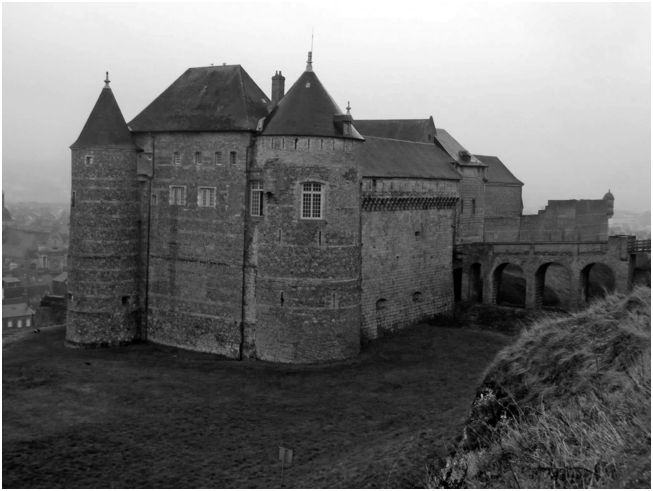
It was at the château of Dieppe (Figure I.1) that Tivinat was held, and where his interrogation took place on 10 May, four days after his arrest. The edifice still occupies a commanding position on a terrace carved out of the chalky escarpment overlooking the town and its harbour. The main site was built in the fourteenth century at the same time as the town walls, and both were reconstructed in the 1430s and 1440s after Dieppe was seized back from the English during the Hundred Years War. The enclosure was extended after 1574, shortly after the events explored here, to include the church of Saint-Rémy. In the 1580s, further applications were made to raise funds for the construction of ‘a grand terrace and platform in front of the château’.Footnote 38 We know nothing about Tivinat’s experience of imprisonment except that he was detained for at least another week, but contemporary reports cite town châteaux as miserable places of incarceration where prisoners could be left to languish and even starve, as was the fate for a group of English prisoners at Bordeaux in 1563.Footnote 39
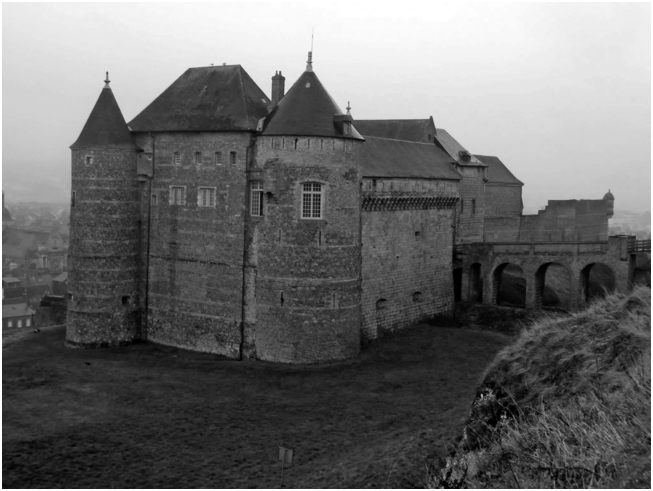
Figure I.1 Château of Dieppe
Fortuitously, however, surviving accounts reveal that the château at Dieppe was still being used a century later for the detention of Huguenot prisoners following the Revocation of the Edict of Nantes in 1685 and suggest what such an ordeal might have been like. In particular, the story of Jean Perigal, ‘young man from the town of Dieppe’, provides vivid detail about his mistreatment by the soldiers of the château, and contrasting descriptions of the conditions in which he and his father and other prisoners who refused to abjure were held.Footnote 40 Arrested on 6 December 1685, and subjected to more than a week of beatings, Perigal was isolated in a cold dungeon in a tower at the far end of the château, where he slept on straw and could only catch a glimpse of the sea by climbing on a pile of wood.Footnote 41 By contrast, after more than two years of imprisonment elsewhere, he and his companions were returned to Dieppe, on 27 March 1688, where they were now given rooms in the château usually occupied by the garrison, with proper beds and views over the town, the coast and the countryside, before being allowed to leave and seek refuge in England.Footnote 42 The conditions faced by Perigal and his fellow prisoners were probably not very different from those a century earlier, and it seems likely, therefore, that Tivinat would have been confined to such a cell, while his interrogator sought to extract his testimony about the activities in which, and the agents with whom, he was involved.
The interconnections between the correspondence that a single Frenchman was carrying on a given day to networks from Scotland to Spain and from England to Geneva, to areas of theological discussion and diplomatic negotiation, to confessional support networks and evidence of plots, reveal how tight-knit the events of this period were. They also demonstrate how one serendipitous archival discovery, and the careful study of one document, can reveal what was happening behind the scenes of major developments and provide some insight into the experiences of those whose contribution to them would otherwise be lost to us. Without a single chance interception and exposure, this book could not have been written, but before we delve more deeply into the broader significance of this episode, let us return to where we began, to the document and the basket of cheese that first piqued my curiosity.