


Introduction
Recent decades have seen a growing empowerment of supranational institutions (SIs) in international cooperation. Across many international organizations (IOs), states have conferred greater authority on supranational bureaucracies, courts and parliamentary assemblies, which increasingly enjoy some autonomy from member governments (Hooghe et al., Reference Hooghe, Marks, Lenz, Bezuijen, Ceka and Derderyan2017; Zürn et al., Reference Zürn, Tokhi and Binder2021). This development has spurred an intense interest in the question of supranational influence: whether, when and why SIs manage to exert independent influence over political outcomes in international cooperation (e.g., Barnett & Finnemore, Reference Barnett and Finnemore2004; Biermann & Siebenhüner, Reference Biermann and Siebenhüner2009; Carrubba et al., Reference Carrubba, Gabel and Hankla2008; Copelovitch, Reference Copelovitch2010; Eckhard & Ege, Reference Eckhard and Ege2016; Franchino, Reference Franchino2007; Hawkins et al., Reference Hawkins, Lake, Nielson and Tierney2006; Johnson, Reference Johnson2014; Moravcsik, Reference Moravcsik1999; Pollack, Reference Pollack2003; Tallberg, Reference Tallberg2002; Thomson, Reference Thomson2011; Tsebelis & Garrett, Reference Tsebelis and Garrett2001). While this literature initially focused on the European Union (EU), later research examines supranational influence across a broad range of IOs. The general consensus is that SIs indeed can influence policy outcomes, while the conditions and mechanisms for such influence remain contested (Eckhard & Ege, Reference Eckhard and Ege2016).
In this article, we offer a novel approach for studying supranational influence. We are motivated by one key insight. In the standard analysis, supranational influence is identified by considering whether activities by SIs move outcomes away from what we would expect based on the combined preferences of the member states of an IO (e.g., Carrubba et al., Reference Carrubba, Gabel and Hankla2008; Copelovitch, Reference Copelovitch2010; Moravcsik, Reference Moravcsik1999; Pollack, Reference Pollack2003). Yet, as the collective of member states yields ground to SIs, some states are bound to do more of the compromising than others. As students of bargaining and negotiation know well, concessions are rarely evenly distributed. We, therefore, have to explore how SIs exert differentiated influence vis‐à‐vis member states. We need to move from treating the member states of an IO as a collective principal to viewing them as multiple principals with their own unique relationships to a common supranational agent (Nielson & Tierney, Reference Nielson and Tierney2003; Thomson, Reference Thomson2008).
This simple insight draws our attention to crucial questions about supranational influence: How do political outcomes in international cooperation reflect the varying impact of SIs on member states? Which member states give in more or less when SIs exert influence? What makes member states more or less susceptible to supranational influence? Our approach to supranational influence engages with these questions. In advancing it, we make three central contributions.
First, we develop a method for estimating differentiated supranational influence in IO bargaining. The introduced measure evaluates the influence of an SI towards member states on a bilateral basis, moving beyond earlier treatments of member states as a collective. We conceptualize differentiated supranational influence as the extent to which an SI shifts individual member states towards its own preferences and away from the outcome expected under pure interstate bargaining. This demanding conceptualization avoids that we capture SI influence as strategic facilitation of intergovernmental negotiations, which is the conventional role associated with an SI.
Second, we theorize the differentiated pull of SIs on member states, advancing conjectures for why some compromise more than others in interactions with SIs. Inspired by resource dependency theory, we argue that states are varyingly dependent on the resources of an SI, which affects their likelihood to accept or resist supranational influence. When states are more dependent, the SI can exploit its position to greater effect than if states are less dependent. Specifically, we argue that three conditions shape member states’ dependencies on supranational resources and thus their susceptibility to supranational influence: their dependence on policy developments advocated by SIs, their dependence on SIs as coalitional partners and their dependence on SIs for realizing the objectives they care most about.
Third, we offer the first empirical application of this approach by examining the differentiated influence of the European Commission in EU bargaining. While many IOs see growing empowerment of SIs, this trend was first observed in the EU, which also has witnessed the most intense academic debate about supranational influence. Testing our approach in this context is therefore a natural first step. Our principal analysis examines the 2010–2015 crisis negotiations to reform the Eurozone based on a dataset of policy preferences and negotiated outcomes (Wasserfallen et al., Reference Wasserfallen, Leuffen, Kudrna and Degner2019). As an extension, we evaluate whether our approach performs equally well under ordinary political conditions, by applying it to the best known and recently updated dataset on everyday EU policymaking (Arregui & Perarnaud, Reference Arregui and Perarnaud2022; Thomson et al., Reference Thomson, Stokman, Achen and König2006, Reference Thomson, Arregui, Leuffen, Costello, Cross, Hertz and Jensen2012).
The analysis of differentiated supranational influence in the EU illustrates the usefulness of our approach. The principal findings are threefold. First, the Commission was highly influential in the reform of the Eurozone, exerting varying degrees of bilateral influence vis‐à‐vis the member states. Second, member states yielded more ground to the Commission when they were more dependent on European policy solutions, were less attractive as coalition partners and attached less importance to the issues under negotiation. Third, these findings extend to everyday policymaking in the EU as well, involving less acute time pressure and less extreme political stakes. Having established these results in the context of the EU, we conclude the article by discussing how they may help us to shed light on supranational influence in international cooperation in general.
Supranational influence in international cooperation
The question of whether, when and why SIs exert influence in international cooperation has been a constant theme of research over past decades (for an overview, see Eckhard & Ege, Reference Eckhard and Ege2016). A significant part of this literature has focused on the EU, but growing research also examines supranational influence in other IOs, such as the International Monetary Fund (IMF), United Nations, World Bank and World Trade Organization (WTO).
In Europe, the debate over supranational influence first emerged in the 1950−1970s, when early neofunctionalists (Haas, Reference Haas1958; Lindberg & Scheingold, Reference Lindberg and Scheingold1970) and intergovernmentalists (Hoffmann, Reference Hoffmann1966) debated whether the powers conferred on the European Commission enabled this SI to influence the course of European integration. This debate resurfaced in the 1980s and 1990s, when intergovernmentalists (Garrett, Reference Garrett1992; Moravcsik, Reference Moravcsik1993) and neofunctionalists (Sandholtz & Stone Sweet, Reference Sandholtz and Stone Sweet1998; Sandholtz & Zysman, Reference Sandholtz and Zysman1989) clashed on the question of independent supranational influence: Did the SIs only perform delegated functions in ways consistent with member state interests or did they push European integration in directions unwanted by the member states?
Over the past two decades, a new wave of research in EU studies has engaged with the question of supranational influence. Some studies apply principal‐agent analysis, finding that the influence of SIs varies with the control mechanisms put in place by member states (e.g., Delreux & Adriaensen, Reference Delreux and Adriaensen2017; Franchino, Reference Franchino2007; Pollack, Reference Pollack2003; Tallberg, Reference Tallberg2002). Other studies explore supranational influence through the lens of legislative politics, arriving at varying conclusions: while some find that the Commission is overshadowed by the Council and the European Parliament (e.g., Kreppel & Oztas, Reference Kreppel and Oztas2017; Rasmussen, Reference Rasmussen2007), others find that the Commission's formal agenda‐setting role yields opportunities for influence in legislative bargaining (e.g., König et al., Reference König, Lindberg, Lechner and Pohlmeier2007; Thomson, Reference Thomson2011).
These debates in EU studies are increasingly mirrored in international relations (IR) scholarship examining the influence of supranational bureaucracies within the wider universe of IOs. The first strand of research uses principal‐agent analysis to examine the influence of supranational bureaucracies in IOs such as the IMF and the WTO (Copelovitch, Reference Copelovitch2010; Elsig, Reference Elsig2011; Hawkins et al., Reference Hawkins, Lake, Nielson and Tierney2006; Johnson, Reference Johnson2014). A second strand uses organizational analysis and conceives of supranational influence in broader terms, as the product of delegated, moral and expert authority (Barnett & Finnemore, Reference Barnett and Finnemore2004; Biermann & Siebenhüner, Reference Biermann and Siebenhüner2009).
While these literatures have provided a rich understanding of supranational influence in IOs, they are also subject to certain limitations, of which two are particularly important for this article. First, it is a common criticism that existing research uses unclear benchmarks for establishing supranational influence (Eckhard & Ege, Reference Eckhard and Ege2016). One potential consequence is an over‐estimation of supranational influence, for instance, if studies attribute influence to SIs whose proposals anticipate the outcomes of negotiations among member states rather than shape those outcomes (Kreppel & Oztas, Reference Kreppel and Oztas2017; Moravcsik, Reference Moravcsik1999). We share this concern and propose a measure of supranational influence that is clearly defined and prevents such over‐estimation by using, as a benchmark, the expected intergovernmental bargaining outcome, derived from the positions and voting powers of member states.
Second, existing research tends to conceive of supranational influence as a question of the SI versus the collective of member states. This perspective is in many ways natural, since the key purpose of this research – from early theorizing on regional integration to later principal‐agent models – has been to establish whether SIs succeed in promoting outcomes that deviate from the collective preferences of member states. Yet to truly understand the dynamics of supranational influence, we need to unpack the collective of member states. When SIs impact outcomes, some member states do more of the compromising than others. Much like states are treated as separate actors in studies of bargaining and negotiation, research on supranational influence needs to consider the relationship between SIs and individual member states. Expressed differently, the study of supranational influence needs to shift from treating member states as a collective principal to viewing them as multiple principals (Nielson & Tierney, Reference Nielson and Tierney2003; Thomson, Reference Thomson2008). In the following, we, therefore, develop an approach that is sensitive to the bilateral impact of SIs on member states.
Differentiated supranational influence
We part ways with existing scholarship by developing a differentiated approach to supranational influence. This approach unpacks the collective of IO member states to consider an SI's bilateral influence vis‐à‐vis individual member states. We make this move based on the intuition that states are varyingly dependent on the support of SIs and therefore varyingly susceptible to supranational influence.
Conceptualizing differentiated supranational influence
The starting point for our conceptualization is the spatial bargaining framework conventional to rational‐choice approaches to multilateral policymaking (e.g., Achen, Reference Achen, Thomson, Stokman, Achen and König2006; Bueno de Mesquita, Reference Bueno de Mesquita1990; Bueno de Mesquita & Stokman, Reference Bueno de Mesquita and Stokman1994; Voeten, Reference Voeten2001). The spatial bargaining model assumes that issues under negotiation can be represented as a unidimensional continuum and that policy options, actor preferences and outcomes can be located as points on this continuum. Bargaining is conceived as an interaction between actors with fixed and exogenous preferences, which are revealed through the positions actors hold at the beginning of negotiations. Once negotiations get underway, agreements will be reached through concessions distributed across actors. Using this basic model, we first develop our conceptualization of general supranational influence and then our conceptualization of differentiated supranational influence.
General supranational influence
Supranational influence has to be identified against a counterfactual benchmark of what the negotiated outcome among member states would have been in the absence of supranational influence. We identify this intergovernmental baseline based on a compromise model (Achen, Reference Achen, Thomson, Stokman, Achen and König2006). The compromise model seeks to capture institutional realism, in the sense that bargaining is shaped by both formal and informal sources of influence (Thomson, Reference Thomson2011), and it is thus not a pure procedural model (Achen, Reference Achen, Thomson, Stokman, Achen and König2006, 91f; cf., König & Slapin, Reference König and Slapin2006; Tsebelis & Garrett, Reference Tsebelis and Garrett2001). The compromise model does not take the status quo into consideration and is, therefore, particularly useful for modelling negotiations when there is strong pressure to develop new policy and a low likelihood that negotiations would revert back to the status quo (or reversion point).Footnote 1
The compromise model allows us to derive the intergovernmental baseline under varying decision‐making conditions. When decisions require unanimous support, the intergovernmental baseline will be the median preference among member states.Footnote 2 When decisions may be taken by qualified majority voting, the intergovernmental baseline will be the weighted median preference among member states, with weights defined by states’ varying voting power. Figure 1 illustrates how the intergovernmental baseline is derived in a stylized example of unanimous decision‐making among three member states. The policy choices are placed on a continuum from 0 to 100. State A prefers option 0, State B 50 and State C 100. In this example, the intergovernmental baseline is easily identified: the median preference is 50.

Figure 1. Stylized spatial model with three states and one supranational institution (SI).
Adding an SI to this spatial model allows us to specify a measure of general supranational influence. We define general supranational influence as the ability of an SI to move the negotiation outcome away from the intergovernmental baseline towards its own preference. To identify general supranational influence, we thus compare the actual negotiation outcome against the intergovernmental baseline. If they are identical, the SI has not exercised influence. If there is a difference between the intergovernmental baseline and the observed outcome in favour of the preference of the SI, the SI has exercised influence. Formally, we express general supranational influence as followsFootnote 3:
 $$\begin{equation*} \textit{Supr}\textit{anat}\textit{ional}\hspace*{0.28em}\textit{Infl}\textit{uence}=\left|\left(\textit{Posi}\textit{tio}{n}_{\textit{SI}}-\textit{Inte}\textit{rgov}\textit{ernm}\textit{ental}\hspace*{0.28em}\textit{Base}\textit{line}\right)\right|-\left|\left(\textit{Posi}\textit{tio}{n}_{\textit{SI}}-\textit{Outc}\textit{ome}\right)\right|. \end{equation*}$$
Similar to other conceptualizations of influence in studies of bargaining and lobbying (e.g., Dür et al., Reference Dür, Marshall and Bernhagen2019; Thomson, Reference Thomson2011), our conceptualization measures influence indirectly, by capturing its observable effects. Given the difficulties of directly observing supranational influence in a multilateral setting, especially over many cases and a long period of time, this is a reasonable strategy (cf. Dür, Reference Dür2008).
An indirect measure of supranational influence should detect influence even if the underlying mechanisms are unobserved, and it should minimize the risk that strategic positioning is mistaken for influence. Our conceptualization satisfies these criteria: it captures both observable and unobservable influences at the bargaining stage, and by focusing on deviations from the intergovernmental baseline it excludes the possibility that an SI appears influential by way of strategically positioning itself where it expects the negotiations to end up (cf. Bailer, Reference Bailer2014; Barry, Reference Barry1980). In this way, it differs from conceptualizations of influence based on preference attainment, which measure influence as the absolute distance between an actor's initial preference and the agreed outcome (e.g., Lundgren et al., Reference Lundgren, Bailer, Dellmuth, Tallberg and Târlea2019; Thomson, Reference Thomson2011). While preference attainment measures of influence are liable to the suspicion that actors appear influential because of strategic positioning or even luck, our conceptualization safeguards against this problem.
We believe that our conceptualization of supranational influence has significant advantages over existing approaches, in particular by raising the bar for what counts as influence, but two considerations deserve highlighting. First, while the conceptualization provides a measure of potential influence in any one‐shot negotiation, it is most reliable when studying repeated negotiations. If we observe that states make concessions favouring an SI systematically across many negotiations, we would be more confident that the SI had a role in them. Second, conceptualizing supranational influence in a unidimensional model excludes the possibility of logrolling, that is, the trading of concessions across different issues (Aksoy, 2012). This concern is typically raised with respect to member states trading concessions among one another (not towards the SI). Also, logrolling is most problematic if the measure is applied to one or a small number of negotiations. In the aggregate, logrolling does not undermine the measure, as our formula would only indicate supranational influence if SIs actually gained more from such issue linkages over a sequence of negotiations.
Differentiated supranational influence
Reflecting the insight that an SI's influence is likely to vary across member states and negotiations, we build on our general conceptualization and develop a measure of differentiated supranational influence as a second step. Measuring influence in a differentiated – or bilateral – manner is motivated because member state preferences are typically heterogeneous, with member states holding different and competing perspectives. Supranational influence requires that individual member states make concessions and the heterogeneity of preferences among member states implies that states will make differently sized concessions in the process of converging to a bargaining solution. To measure the concessions of each member state vis‐à‐vis the SI, we estimate the net between the influence of the SI and each member state i for each policy issue j:
 $$\begin{equation*} \textit{Diff}\textit{eren}\textit{tiat}\textit{ed}\hspace*{0.28em}\textit{Supr}\textit{anat}\textit{ional}\hspace*{0.28em}\textit{Infl}\textit{uenc}{e}_{\textit{ij}}=\textit{Supr}\textit{anat}\textit{ional}\hspace*{0.28em}\textit{Infl}\textit{uenc}{e}_{j}-\textit{Memb}\textit{er}\hspace*{0.28em}\textit{State}\hspace*{0.28em}\textit{Infl}\textit{uenc}{e}_{\textit{ij}}. \end{equation*}$$
We thus introduce the differentiated component of supranational influence similar to the dyadic modelling approach in international relations and diffusion studies (Gartzke, Reference Gartzke2007; Neumayer & Plümper, Reference Neumayer and Plümper2010). This approach allows us to detect systematic patterns of relational influence within a dyad of actors, in our case, the influence of the SI on each single member state. The differentiated measure of supranational influence gauges how much an SI pulls a single member state away from the intergovernmental baseline in the direction of its own preference on a given issue. Applied to the example of Figure 1, the SI has a positive net influence over States A and B, but zero influence over State C. It is also possible that a member state pulls the SI towards its position, in which case the differentiated supranational influence score is negative. For example, if State A had pulled the outcome to 0, which is beyond the intergovernmental baseline from the perspective of the SI, the SI would have negative influence vis‐à‐vis State A.
This conceptualization allows us to address the concern that SIs do not exert influence themselves, but instead free ride on the influence of powerful states (Garrett, Reference Garrett1992). In the example of Figure 1, State C is as influential as the SI in moving the outcome away from the intergovernmental baseline towards its own preference. The SI could thus potentially free ride on the influence exerted by State C. Because we treat member states as unique actors, our disaggregated approach makes it possible to take the possibility of such influences into account by adding the shared positions of SIs with powerful member states as controls in the statistical modelling.
Explaining differentiated supranational influence
To theorize the sources of variation in differentiated supranational influence, we formulate a framework that emphasizes member states’ varying dependence on an SI, which affects their likelihood to accept or resist supranational influence, all else constant. Our argument is inspired by resource dependency theory, which suggests that organizations enter into transactions with other organizations to secure necessary resources and that these exchanges create dependencies with implications for power (Levine & White, Reference Levine and White1961; Pfeffer & Salancik, Reference Pfeffer and Salancik1978). Building on this logic, we suggest that member states’ varying dependence on the resources of an SI creates expectations about differentiated supranational influence. When states are more dependent on an SI's resources, the SI can exploit its position to greater effect than if states are less dependent. Supranational resources in demand by member states typically include expert information, political support and policy ideas (e.g., Tallberg, Reference Tallberg2002; Pollack, Reference Pollack2003; Barnett & Finnemore, Reference Barnett and Finnemore2004; Hawkins et al., Reference Hawkins, Lake, Nielson and Tierney2006; Biermann & Siebenhüner, Reference Biermann and Siebenhüner2009; Eckhard & Ege, Reference Eckhard and Ege2016).
Specifically, we expect three conditions to shape member states’ dependencies on supranational resources and thus their susceptibility to supranational influence: policy vulnerability, network capital and political salience. The first factor focuses on states’ dependence on policy developments advocated by SIs, the second on states’ dependence on SIs as coalitional partners and the third on states’ dependence on SIs for realizing the objectives they care most about.
To begin with, we expect supranational influence to be greater in relation to member states that are more exposed to a problem and thus experience greater policy vulnerability. SIs generally propose or endorse international‐level solutions to the policy problems they govern. However, some member states are more dependent than others on the international policy measures promoted by SIs. In this respect, member states are not only asymmetrically dependent on one another (Moravcsik, Reference Moravcsik1998) but also asymmetrically dependent on joint international policies. For instance, states with small home markets are more dependent on international free‐trade agreements than states with large home markets, just as states located downstream from a river are more dependent on international efforts to regulate pollution than states located upstream. When member states, because of their vulnerabilities, are more dependent on appropriately designed joint policy solutions coming about, they are also more likely to yield to SIs in negotiations. More dependent states simply have greater incentives to side with SIs, since they may otherwise face significant problems, whereas less dependent states can better afford to pursue their own preferred solutions in negotiations. These dynamics may be particularly strong in situations of crisis when states’ vulnerabilities become especially exposed and SIs are called upon to produce policy solutions. This dependency logic yields our first hypothesis:
H1: The influence of SIs should be greater over member states that experience greater policy vulnerability.
Second, supranational influence is likely to be greater vis‐à‐vis IO member states with a weaker ability to form and join effective coalitions. Coalitions are a defining feature of multilateral bargaining (Hampson & Hart, Reference Hampson and Hart1999). Yet not all states are equally attractive as coalition partners. Some states are more highly sought after as coalition partners because of their authority, skill and expertise in the issues under negotiation – a resource often referred to as ‘network capital’ (Huhe et al., Reference Huhe, Naurin and Thomson2018; Naurin, Reference Naurin2007). When states possess less network capital, they are less sought after as coalition partners and thus less able to protect their interests through interstate coalitions. This makes them more dependent on SIs as an alternative source of political support. SIs may offer the political protection and information that interstate coalitions otherwise can provide. Yet this reliance on SIs comes with a price, namely, greater susceptibility to their influence. This logic supports our second hypothesis:
H2: The influence of SIs should be greater over member states that possess less network capital.
Finally, supranational influence should be greater towards IO member states that hold an issue to be of low political salience. Salience refers to the political importance or weight attributed to an issue, or more technically, ‘the extent to which actors experience utility loss from the occurrence of decision outcomes that differ from the decision outcomes they most favour’ (Thomson & Stokman, Reference Thomson, Stokman, Thomson, Stokman, Achen and König2006, p. 41). If a state finds an issue to be of high salience, it will mobilize its political capital for this cause and make sure not to depend on an SI that pursues its own policy interests. Yet, when states hold an issue to be of lower salience, they are less likely to devote scarce political resources to it, more likely to rely on information from an SI, and less likely to push back against supranational proposals. Following this logic, it should be easier for an SI to get its way with member states that assign low salience to an issue since these states find they have less to lose and can more easily afford to rely on the activities and resources of the SI.
H3: The influence of SIs should be greater over member states that hold issues to be of lower salience.
Empirical analysis
Our approach is potentially applicable to any IO setting with an SI that is expected to enjoy some level of influence. For this first empirical application, we focus on the influence of the European Commission in EU bargaining, in two alternative political contexts: the crisis negotiations to reform the Eurozone 2010–2015, and everyday policymaking 1999–2019. As noted, the growing empowerment of SIs was first observed in the EU and the influence of the Commission has been debated in an extensive literature, making the EU a natural testing ground for our approach. In addition, several other reasons contribute to making the EU a suitable setting for examining differentiated supranational influence in multilateral bargaining.
Because the EU's decision‐making procedures vary across issues, focusing on this IO allows us to investigate differentiated supranational influence under various configurations of delegation and pooling within the same organization. The EU's procedures give the Commission varying formal roles at the stage of agenda‐setting, but no formal powers at the stage of bargaining, when proposals are debated and decisions are taken by the member states in the Council, sometimes in collaboration with the European Parliament (EP). When the EU adopts decisions through the ordinary legislative procedure (OLP), the Commission enjoys exclusive agenda‐setting privileges, as the only actor allowed to introduce legislative proposals, while decisions at the bargaining stage are taken jointly by the Council (based on a qualified majority of weighted member state votes) and the EP. When decisions are taken through the special legislative procedure (SLP), the Commission still functions as the formal agenda‐setter, but the EP only has a right to be consulted and the final decision is taken by the Council based on unanimity. Finally, some decisions, such as treaty revisions, are taken through procedures that are exclusively intergovernmental in nature, involving no formal powers for the Commission and the EP, next to a requirement of unanimity among member states. We exploit this variation in procedures to assess whether the Commission's differentiated influence at the bargaining stage varies across institutional settings.
Focusing on the EU also allows us to analyse differentiated supranational influence based on uniquely comprehensive data on many and diverse episodes of policymaking. The main part of our empirical inquiry uses data on the 2010–2015 negotiations to reform the Eurozone. These data allow us to assess supranational influence under conditions of crisis – or ‘high politics’ – when the stakes are extreme, and the status quo often is regarded as an impossible outcome. In addition, as an extension, we analyse data on everyday EU policymaking during the period 1999–2019, which permits us to investigate supranational influence under conditions of ‘low politics’.
We present the empirical analysis in three steps: (1) a descriptive analysis of influence by the Commission and EU member states in the Eurozone reform negotiations; (2) an investigation of the country‐specific factors explaining the differentiated influence of the Commission in the Eurozone reform negotiations; and (3) a study of the differentiated influence of the Commission in everyday EU policymaking.
Measuring differentiated supranational influence in the Eurozone reforms
Following the outbreak of the Eurozone crisis in late 2009, policymakers adopted a series of reforms of the Economic and Monetary Union (EMU) between 2010 and 2015. They created joint resources for Eurozone states in crisis, strengthened the Stability and Growth Pact, agreed on a treaty to force a balancing of budgets and adopted measures to establish a Banking Union. Our primary data source on the Eurozone reform negotiations is the EMU Positions dataset (Wasserfallen et al., Reference Wasserfallen, Leuffen, Kudrna and Degner2019). It reports the positions of all EU member states and SIs for 39 negotiated issues on the support packages for Greece, the European Financial Stability Facility (EFSF), the European Stability Mechanism (ESM), Six‐Pack, Two‐Pack, Fiscal Compact, and Banking Union.
The EMU Positions dataset records positions on a 0–100 scale and includes both binary choices and policies with multiple options. The EMU reforms were decided through multiple decision‐making procedures, including OLP, SLP and intergovernmental agreements. We use the 35 issues from the EMU Positions dataset for which the positions of the Commission were recorded (online Appendix Table A.1).Footnote 4 For the majority of these 35 issues, there existed no feasible policy outcome that can be interpreted as representing the status quo, either because ‘doing nothing’ was politically impossible or because the issue represents a second‐order decision requiring a substantive outcome (e.g., the size of the ESM).
The EMU data code positions at the final bargaining stage. While this excludes the analysis of proposals that never made it to the negotiation table, it enables our focus on the Commission's differentiated influence vis‐à‐vis individual member states at the bargaining stage and sets our inquiry apart from the conventional focus on Commission influence at the stage of agenda‐setting (cf. Frieden & Walter, Reference Frieden and Walter2019).
To account for the relative power of member states in the calculation of the intergovernmental baseline, we use the qualified majority weights for issues determined via the OLP and equal weights for other procedures. Following the analytical definition of supranational influence developed in the previous section, we first investigate whether the Commission was successful in pulling the outcome away from the intergovernmental baseline. To put the Commission's influence in comparative perspective, we also estimate the influence of member states by calculating the extent to which each single member state was able to pull the negotiation outcome closer to its own preference.
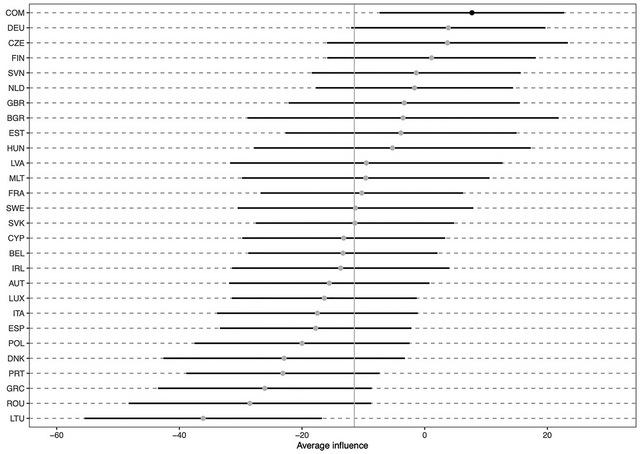
Figure 2 reports the mean influence of the Commission and 27 member states across all 35 policy issues. Positive point estimates correspond to greater influence and vice versa.Footnote 5 The most striking finding is that the Commission has the highest estimated mean influence score, followed by Germany (DEU). The Commission's influence score is statistically distinguishable from the collective average, which implies that it did not consistently adopt a position close to the intergovernmental baseline. This finding contrasts with conventional expectations in much of the EU literature, which either present the Commission as a strategic agenda‐setter whose proposals anticipate expected outcomes (Bailer, Reference Bailer2014) or as an honest broker with limited influence at the bargaining stage (Bickerton et al., Reference Bickerton, Hodson and Puetter2015; Moravcsik, Reference Moravcsik1999).

Figure 2. Mean influence of the Commission and 27 member states in the Eurozone reforms across 35 issues.
Note: Whiskers indicate 95 per cent confidence intervals. The vertical line shows the mean influence.
The results also contrast against earlier findings on influence in the EMU reform negotiations (Lundgren et al., Reference Lundgren, Bailer, Dellmuth, Tallberg and Târlea2019), reflecting differences in how influence is conceptualized. Where Lundgren et al. (Reference Lundgren, Bailer, Dellmuth, Tallberg and Târlea2019) relied on the conventional preference attainment measure (the absolute distance between an actor's preference and the outcome), leading them to find that some large member states, including Germany, were not particularly influential, our measure emphasizes the exercise of influence, leading to contrasting conclusions. While preference attainment measures disadvantage actors with more extremist preferences, since negotiations tend to converge on centrist outcomes, our measure makes it possible to capture the influence such actors exercise when they pull the collective of member states towards their extreme preferences.
More broadly, this result contributes to our understanding of the EMU negotiations emerging in the literature, which has predominantly focused on conflict and cooperation among member states (Frieden & Walter, Reference Frieden and Walter2019; Lehner & Wasserfallen, Reference Lehner and Wasserfallen2019), especially between France and Germany (Degner & Leuffen, Reference Degner and Leuffen2019). While some qualitative studies have pointed to the influence of the Commission in specific issues and stages of Eurozone reform politics (Carstensen & Schmidt, Reference Carstensen and Schmidt2018; De Rynck, Reference De Rynck2016; Smeets et al., Reference Smeets, Jaschke and Beach2019), our findings provide systematic empirical support over the full range of EMU reforms for the hypothesis that the Commission exerted supranational influence beyond the intergovernmental nature of Eurozone politics.
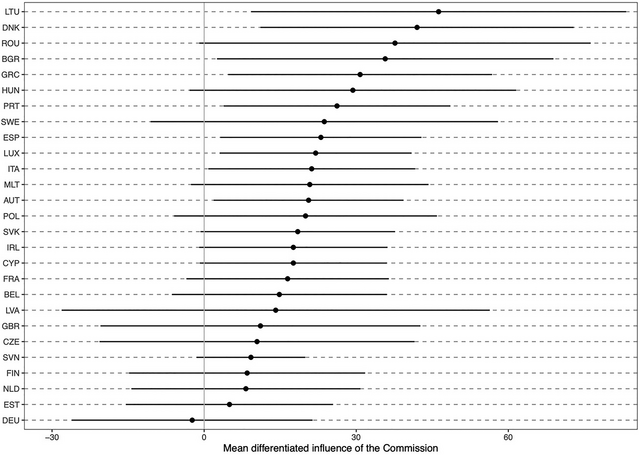
To test our hypotheses on the differentiated influence of the Commission, we rely on our bilateral measure of supranational influence, capturing the influence of the Commission on each individual member state. This measure, which varies by country and policy issue, will serve as the dependent variable in the regression analyses. For an overview, Figure 3 exhibits the mean differentiated influence of the Commission over each member state across the 35 issues. Given that the Commission appears to be the most influential actor of all (see Figure 2), it is not surprising that the point estimates of its mean differential influence are positive for most member states and statistically significant for a majority of them. Variation in the precision of the estimated means is largely a function of variation in the number of positions adopted.

Figure 3. Mean differentiated influence of the Commission over 27 member states. Whiskers indicate 95 per cent confidence intervals (N = 35 issues).
Among the states that were most susceptible to Commission influence, we find Lithuania, Denmark, Bulgaria and Greece. For all of these, the mean differential influence is positive and statistically significant. We also see that the Commission, overall, was influential vis‐à‐vis debtor states (Greece, Portugal, Spain and Italy), while there is no such evidence regarding most creditor states (e.g., Germany, the Netherlands, and Finland).
Explaining differentiated supranational influence in the Eurozone reforms
The analyses above suggested that the Commission was the most influential actor in the EMU reform negotiations and – importantly for the purpose of this analysis – that member states were varyingly susceptible to its influence. We now proceed to the investigation of the country‐specific factors that explain variation in the differentiated influence of the European Commission. To that end, we analyse linear, cross‐nested, hierarchical models, where we account for the clustered nature of the data by including random effects for member states and policies (Gelman & Hill, Reference Gelman and Hill2007).Footnote 6
Our first expectation (H1) is that states with greater policy vulnerability are more susceptible to supranational influence. In the context of Eurozone reforms, we operationalize policy vulnerability based on a measure of member states’ varying economic exposure to the policies considered. We develop this measure in three steps. First, we cluster all 35 issues into three groups, namely, financial regulation, fiscal discipline and fiscal transfers (Lehner & Wasserfallen, Reference Lehner and Wasserfallen2019). In the second step, we identify economic indicators, gauging how economically exposed a country is to new legislation for each policy group: countries with a large banking sector (measured as financial sector liabilities per GDP) are considered more exposed to financial regulations; fiscal discipline measures are more consequential for countries with higher debts (measured as debt per GDP); and recipients of fiscal transfers from the ESM and EFSF are more dependent on the design of such transfer policies (measured with a dummy indicating whether a country received transfers or not). We transform these variables into four different categories from low to high exposure (1–4) to arrive at a common scale.Footnote 7 The theoretical expectation is that countries which are economically more exposed, and hence experience greater policy vulnerability, are more likely to make concessions to align behind European‐level solutions advocated by the Commission.
To evaluate our second hypothesis (H2) that member states with less network capital will be more susceptible to supranational influence, we use data from Naurin (Reference Naurin2007). Naurin's measure of network capital was developed based on several hundred interviews with EU member state representatives, asking them to identify the member states they cooperate with most frequently in negotiations. Member states mentioned more frequently received a higher score, reflecting their greater centrality in the network of EU member states.
To test H3, predicting salient preferences to shield member states from supranational influence, we rely on the salience variable provided by the EMU Positions dataset. This variable is based on expert assessments of the salience of each member state's position for each policy issue on a scale from 0 to 10, with higher scores indicating greater utility losses for a member state from outcomes that deviate from its favoured outcome. As the data coverage of this variable is lower, we use multivariate imputation methods to complete missing salience values (Van Buuren & Groothius‐Oudshoorn, Reference Van Buuren and Groothuis‐Oudshoorn2011). In the robustness checks, we report findings based on a reduced sample and with alternate imputation methods (Table A.7 in the online Appendix).
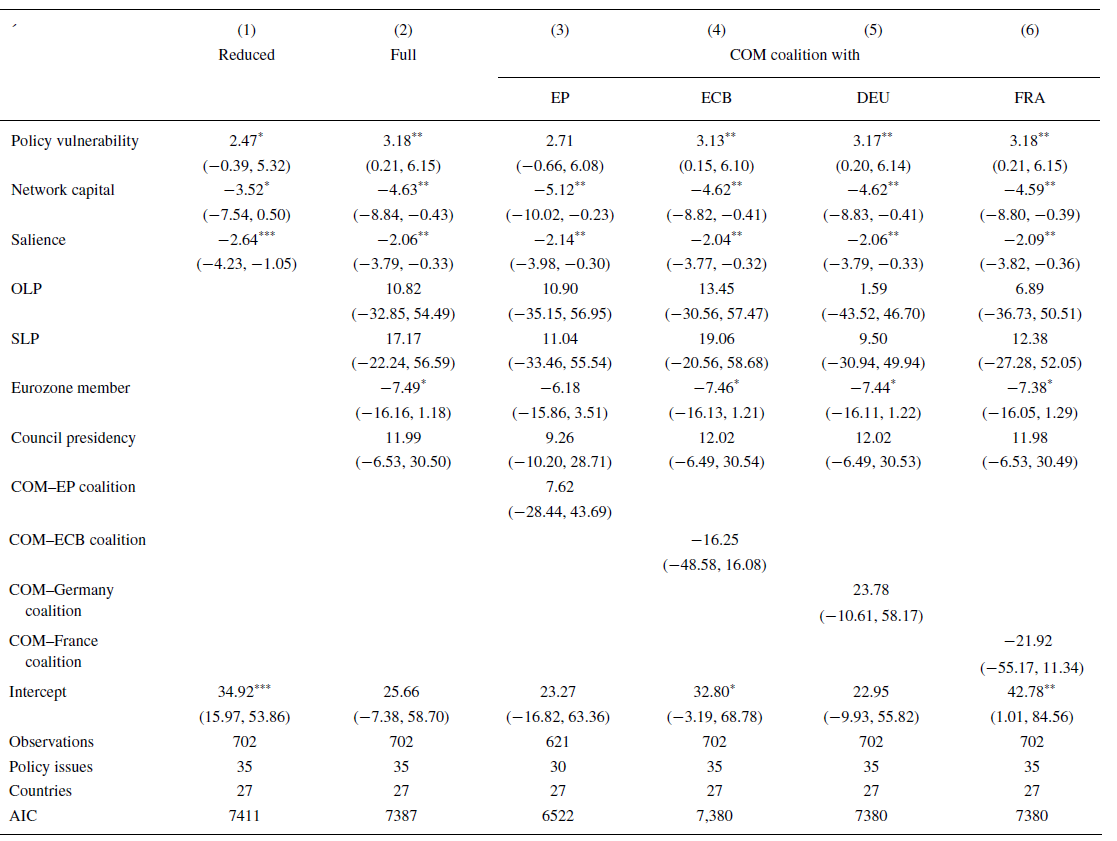
Model 1 in Table 1 includes all three main explanatory variables: policy vulnerability, network capital and salience. While policy vulnerability and salience vary across policies and countries, network capital only varies across countries. Model 2 adds four additional variables to account for possible confounders. The dichotomous variable Eurozone codes whether a country has adopted the Euro and is thus more directly affected by EMU reforms. The variable Council Presidency records whether a country held the rotating presidency of the Council. To capture varying supranational influence across decision‐making procedures, we include a categorical variable that distinguishes between OLP, SLP and intergovernmental agreements, with the latter as the reference category. Finally, to examine whether the Commission benefits from collaboration with powerful member states or other supranational actors, Models 3–6 add control variables coded as 1 if the Commission shared a position with the EP, European Central Bank (ECB), Germany (DEU) or France (FRA) (and 0 otherwise).Footnote 8
Table 1. Linear, cross‐level multilevel models explaining the differentiated influence of the Commission on member states

Note: Random effects for policies and countries. 95% confidence intervals in parenthesis.
Abbreviations: AIC, Akaike information criterion; COM, European Commission; ECB, European Central Bank; EP, European Parliament; DEU, Germany; FRA, France; OLP, ordinary legislative procedure; SLP, special legislative procedure.
* p < 0.1;
** p < 0.05;
*** p < 0.01.
Table 1 presents the main findings. For all three key covariates, the results are consistent with our theoretical expectations: policy vulnerability, network capital and salience are powerful explanations of differentiated Commission influence. As expected, the Commission is more likely to exert influence on member states that are more dependent on the negotiation of European‐level policies, are diplomatically less well embedded in EU networks, and care less about a certain issue. This suggests that the Commission successfully identifies the member states on which it can exert influence in the attempt to pull the bargaining outcome to its side. The effects are also substantive in size. All else equal, moving from the first quartile of network capital (0.57) to the third quartile (1.28) is associated with a 3.1 point reduction in the Commission's influence. Shifts of equal magnitude for policy vulnerability and salience are associated with 9.5 and 8.0 point changes, respectively. The Commission's influence on member states is coded linearly, with a maximum value of 200 for the extreme (and empirically rare) case when the Commission pulls a member state across the entire bargaining range. In this perspective, average effects of 9.5 and 8.0 represent substantive shifts.
None of the controls in our full model (2) are significant at p < 0.05. The coefficients for OLP and SLP are positive, suggesting larger bargaining influence for the Commission under these decision‐making procedures, but these estimates are statistically insignificant. Based on the EMU data, we can thus not confirm the expectation that SIs have more influence in the bargaining stage when decision‐making procedures grant them more extensive formal powers of agenda‐setting (e.g., Franchino & Mariotto, Reference Franchino and Mariotto2013). Also, the results on the Eurozone and Council Presidency variables indicate that the Commission's bilateral influence was not shaped by whether or not a particular member state was a member of the Eurozone or held the Council chairmanship.
Finally, Models 3–6 examine coalitional dynamics. All main explanatory variables are robust to the addition of coalitional variables except for policy vulnerability in Model 3, which is estimated on a smaller dataset due to missingness in EP positions. The model estimates provide no evidence that coalitions with other key SIs (EP, ECB) or powerful member states (Germany, France) are systematic predictors of the Commission's differentiated influence. Thus, the findings suggest that the Commission's influence on member states is not systematically derived from coalitions with one specific supranational or state actor. In other words, the Commission is not free‐riding on the influence and power of other supranational actors or powerful member states. This finding, however, does not exclude the possibility that the Commission may benefit from alternating coalitions with supranational or state actors.
To evaluate whether the reported results are robust to alternative modelling strategies, we carry out a series of additional tests, reported in full in the online Appendix. First, we present results from models without imputed salience scores, which implies a smaller sample and more conservative assumptions, next to models using an alternative imputation method (Table A.7 in the online Appendix). Second, in recognition that there are other ways of computing the intergovernmental baseline, Table A.8 (in the online Appendix) presents results based on a compromise model that disregards procedural rules and weighs preferences purely by voting power. Third, we report results for OLS regressions clustering errors two‐ways on issues and member states (Table A.9 in the online Appendix). With the exception of policy vulnerability in Table A.9, the main findings are robust to all of these alternative specifications.
Extension: Differentiated supranational influence in everyday EU policymaking
As a final step, we extend our empirical inquiry to everyday policymaking. The EMU analysis covers negotiations of high politics during which IO member states sought to respond, often urgently, to circumstances of crisis. Supranational influence, in both its general and differentiated forms, may be particularly likely under such crisis conditions when member states are under time pressure to find solutions and SIs can offer readymade political fixes, as we outlined in the theory section. To investigate whether our findings also hold up in everyday EU policymaking, when the time pressure is lower and status quo outcomes are feasible, we turn to data from the Decision‐Making in the European Union (DEU) project (Thomson et al., Reference Thomson, Arregui, Leuffen, Costello, Cross, Hertz and Jensen2012), which have been productively used in several studies of EU bargaining and Commission influence (e.g., Thomson, Reference Thomson2008; Bailer, Reference Bailer2014), and recently updated with the DEU III dataset (Arregui & Perarnaud, Reference Arregui and Perarnaud2022).
The DEU III dataset covers the positions of SIs and 28 member states across 363 contested issues in EU policymaking between 1999 and 2019. We first calculate the Commission's general influence, again finding that the Commission has the highest estimated influence score (Figure A.1 in the Online Appendix), suggesting it exerts considerable influence also in everyday European policymaking.
We then calculate the Commission's differentiated influence, using both our standard measure and a second measure that incorporates status quo outcomes (reversion points). In the DEU datasets, a reversion point is defined as ‘the decision outcome that would occur if the legislative proposal were not adopted’ (Thomson et al., Reference Thomson, Arregui, Leuffen, Costello, Cross, Hertz and Jensen2012, p. 612). The DEU III dataset records a reversion point for 253 out of 363 issues. For these issues, we use a standard formula for the symmetric Nash bargaining solution (Achen, Reference Achen, Thomson, Stokman, Achen and König2006; Bailer & Schneider, Reference Bailer, Schneider, Thomson, Stokman, Achen and König2006) to calculate an alternate intergovernmental baseline that takes the reversion point into consideration (Nash bargaining solution with reversion point, NBS‐RP), and then – using the same procedures as before – a measure of differentiated supranational influence.
Using both the standard and the NBS‐RP versions of differentiated influence, we then estimate multilevel models, tailoring them to meet DEU data conditions. First, given the broad range of policy issues in the DEU data, there is no possibility of calculating a policy vulnerability variable similar to the one in the analysis of the EMU Positions data. Second, in the case of the DEU data, we can only distinguish between procedures that involve the EP and those that do not. Third, the DEU data do not code the presidency and do not include the position of the ECB. Finally, we exclude the variable for Eurozone membership, which is less relevant for general legislation.
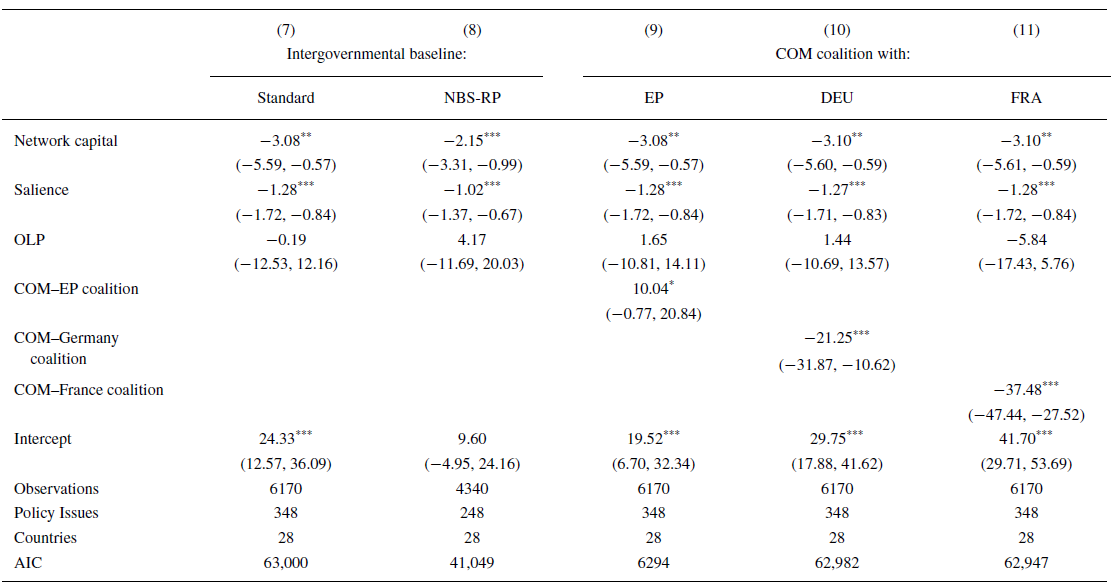
Table 2 reports the estimates. Models 7 and 8 are base models of the two measures of differentiated influence, followed by the addition of coalitional variables in Models 9–11.Footnote 9 The results are consistent with those of the EMU Positions analysis. The coefficients of the main explanatory variables have the same sign and effect sizes are remarkably similar across the two domains. The most sizeable effect is that states with less network capital are more likely to be influenced by the Commission. Also, we find that member states with more salient preferences better withstand the Commission's influence. Moreover, we note that the results do not diverge substantively between Models 1 and 2, suggesting that the results do not depend on whether or not the measure of supranational influence incorporates status quo outcomes. Again, we find no statistically significant association between OLP and the Commission's influence (at the p < 0.05 level), despite this dataset providing greater empirical leverage for studying procedural variation (348 policy issues) compared to the EMU Positions analysis.
Table 2. Linear, cross‐level and multilevel models explaining the differentiated influence of the Commission on member states (DEU III data)

Note: Random effects for policies and countries. 95 per cent confidence intervals in parenthesis.
Abbreviations: AIC, Akaike information criterion; COM, European Commission; ECB, European Central Bank; EP, European Parliament; DEU, Germany; FRA, France, OLP, ordinary legislative procedure; SLP, special legislative procedure; NBS‐RP, Nash barganining solution with reversion point.
* p < 0.1;
** p < 0.05;
*** p < 0.01
Models 8–10 show that the main results are insensitive to the addition of variables for coalitions with the EP, Germany and France. However, we note that coalitional dynamics appear to play out somewhat differently in the DEU data, especially coalitions with Germany and France. In contrast to the EMU Positions data, where we found insignificant estimates on these variables, the DEU data return negative, and significant coefficients, indicating that the Commission exerts less influence when it sides with these countries in everyday EU negotiations.Footnote 10
Taken as a whole, the analyses of both the EMU Positions and DEU data show that the Commission is highly influential at the bargaining stage of EU policymaking and that this influence reflects member states’ varying dependence on the Commission for achieving their policy objectives.
Conclusion
This article started from the premise that SIs exert influence by extracting unequally distributed concessions from member states. Motivated by this insight, we have proposed and tested a novel approach for studying the differentiated influence of SIs in IO bargaining. Our approach includes a new demanding measure of supranational influence, allowing us to identify which member states yield ground when an SI is influential. In addition, it offers conjectures on the sources of differentiated supranational influence to explain why some member states accommodate SIs more than others.
We showed the usefulness of our approach through an application to cooperation in the EU, which offers an ideal empirical setting for studying differentiated supranational influence. We focused specifically on the influence of the Commission at the stage of bargaining when this SI holds no formal powers but has the potential to exert informal influence. The findings show that the Commission exercised considerable and differentiated influence in both Eurozone reform negotiations and everyday policymaking. Consistent with our expectations, it exerted the most bilateral influence in relation to states that were more dependent on European policy solutions, were less attractive as coalition partners, and attached less importance to the issues under negotiation.
Expanding the perspective further, this article has several broader implications. To begin with, it speaks to debates in the study of EU politics. Influential research claims that member states have re‐asserted control over European integration during the past two decades (Bickerton et al., Reference Bickerton, Hodson and Puetter2015). Consistent with this picture, earlier scholarship on the Eurozone reforms emphasizes the intergovernmental nature of the negotiations, focusing on the conflict between debtor and creditor states (Frieden & Walter, Reference Frieden and Walter2019; Lehner & Wasserfallen, Reference Lehner and Wasserfallen2019). Our results offer important complementary insights, highlighting the influence of the Commission in shaping the outcomes agreed by the two camps. In addition, they suggest that the Commission exercises influence in crisis negotiations and everyday policymaking in ways that are not consistent with images of this SI as an anticipatory agenda‐setter (Bailer, Reference Bailer2014) or honest broker (Moravcsik, Reference Moravcsik1999).
In addition, this article has implications for the general study of supranational influence in international cooperation. Whereas this literature traditionally has focused on whether and why SIs are influential, our research suggests that we need to consider how SIs exercise influence, focusing on the ways in which they leverage heterogeneity among member states in positions and dependencies. While the Commission is unusually resourceful and influential in a comparative perspective, the empowerment of SIs is a general trend in international cooperation (Biermann & Siebenhüner, Reference Biermann and Siebenhüner2009; Eckhard & Ege, Reference Eckhard and Ege2016; Hawkins et al., Reference Hawkins, Lake, Nielson and Tierney2006; Hooghe et al., Reference Hooghe, Marks, Lenz, Bezuijen, Ceka and Derderyan2017; Zürn et al., Reference Zürn, Tokhi and Binder2021). Both our empirical measures and our theoretical conjectures are formulated in generic terms and can be applied to other IO contexts where SIs have proven to be influential, such as the IMF, World Bank and WTO.
Acknowledgements
Earlier versions of this article were presented at the 2018 annual meeting of the American Political Science Association in Boston, the 2019 annual conference on the Political Economy of International Organizations in Salzburg and at seminars and workshops organized by the European University Institute, University of Bern, University of Konstanz, Stockholm University and the Horizon 2020 project EMU Choices. We are particularly grateful to Hanspeter Kriesi, Dirk Leuffen, Meltem Müftüler Baç, Ludvig Norman, Uwe Puetter, Francesca Rossi, Frank Schimmelfennig, Gerald Schneider, Dominik Schraff and Amy Verdun as well as three anonymous reviewers for EJPR, for helpful comments on earlier drafts. This article is based on research conducted within the collaborative research project EMU Choices, funded by the European Union's Horizon 2020 research and innovation programme under grant agreement no. 649532. The alphabetical author ordering reflects equal contributions to this article.
Conflict Of Interest Statement
The authors have no competing interests to declare that are relevant to the content of this article.
Data Availability Statement
The data analysed in this article and replication code will be made publicly available in the Harvard Dataverse depository upon publication.
Online Appendix
Additional supporting information may be found in the Online Appendix section at the end of the article:
Table A.1 Policy issues and decision‐making procedures in the sample
Table A.2 Variables and sources
Table A.3 Summary statistics, EMU Positions data
Table A.4 Summary statistics, DEU data
Table A.5 Correlation matrix, EMU Positions data
Table A.6 Correlation matrix, DEU data
Table A.7 Regression estimates, alternative salience measures
Table A.8 Regression estimates, alternative measure of expected outcome
Table A.9 Regression estimates, linear models with two‐way clustered errors
Table A.10 Regression estimates, alternative intergovernmental baseline
Table A.11 Correlations, measures of preference attainment and influence
Figure A.1 Mean influence of the Commission and member states in the DEU dataset.
Figure A.2 Preferences of Germany and France.
Supplementary Information




 Open access

