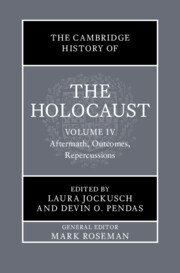
Book contents
- The Cambridge History of the Holocaust
- The Cambridge History Of The Holocaust
- The Cambridge History of the Holocaust
- Copyright page
- Contents
- Figures
- Maps
- Contributors to Volume IV
- Abbreviations
- Additional material
- General Editor’s Introduction
- Introduction to Volume IV
- Part I History
- Part II Geography
- Part III Culture and Ideas
- Part IV Culture and Fields
- 18 Holocaust Commemoration and Memorials
- 19 Holocaust Museums
- 20 The Holocaust and the Medical Professions
- 21 Holocaust Literature
- 22 The Holocaust and the Visual Arts: Perplexity, Meanings
- 23 The Holocaust and Film
- 24 The Future of the Holocaust – Timely Reflections
- Index
- References
19 - Holocaust Museums
from Part IV - Culture and Fields
Published online by Cambridge University Press: 16 May 2025

Book contents
- The Cambridge History of the Holocaust
- The Cambridge History Of The Holocaust
- The Cambridge History of the Holocaust
- Copyright page
- Contents
- Figures
- Maps
- Contributors to Volume IV
- Abbreviations
- Additional material
- General Editor’s Introduction
- Introduction to Volume IV
- Part I History
- Part II Geography
- Part III Culture and Ideas
- Part IV Culture and Fields
- 18 Holocaust Commemoration and Memorials
- 19 Holocaust Museums
- 20 The Holocaust and the Medical Professions
- 21 Holocaust Literature
- 22 The Holocaust and the Visual Arts: Perplexity, Meanings
- 23 The Holocaust and Film
- 24 The Future of the Holocaust – Timely Reflections
- Index
- References
Summary
Museums, including Holocaust museums, display artifacts and other aspects of material culture in order to convey historical events in a manner that allows the visitor to experience them at various levels. The combination of didactic and narrative exhibits generates a sense of identification and empathy with the victims and offers visitors an emotional and even spiritual experience. Thus, Holocaust museums are located in an intermediate zone between the academic establishment and the popular media. Holocaust museums form an integral institution for forming and conveying Holocaust memory. Unavoidably, they are also shaped by the political cultures of their home countries. This chapter examines how different Holocaust museums have been constructed in different times and places to serve both a didactic function for Holocaust education and a political function in shaping contemporary culture.
Keywords
Information
- Type
- Chapter
- Information
- The Cambridge History of the Holocaust , pp. 446 - 466Publisher: Cambridge University PressPrint publication year: 2025
References
Select Bibliography
Berenbaum, M., After Tragedy and Triumph: Essays in Modern Jewish Thought and the American Experience (Cambridge, Cambridge University Press, 1999).Google Scholar
Braun, H., ‘The Jewish Museum Berlin: Past – present – perspectives’, in Libeskind, D. and Binet, H. (eds.), Jewish Museum Berlin (Amsterdam, G+B Arts International, 1999), pp. 103–4.Google Scholar
Cole, T., Selling the Holocaust: From Auschwitz to Schindler; How History Is Bought, Packaged, and Sold (New York and London, Routledge, 1999).Google Scholar
Feldman, J., ‘Between Yad Vashem and Mt. Herzl: Changing inscriptions of sacrifice on Jerusalem’s “Mountain of Memory”’, Anthropological Quarterly 80 (2007), 1147–74.CrossRefGoogle Scholar
Freed, J. I., ‘The United States Holocaust Memorial Museum’, Assemblage 9 (1989), 58–79.CrossRefGoogle Scholar
Harel, D., Facts and Feelings: Dilemmas in Designing the Yad Vashem Holocaust History Museum (Jerusalem, Yad Vashem, 2010).Google Scholar
Kol-Inbar, Y., ‘Exhibiting the Shoah: A curator’s point of view’, Post Script – Essays in Film and the Humanities 32 (2013), 100–10.Google Scholar
Sh. Magid, ‘The Holocaust and Jewish identity in America: Memory, the unique, and the universal’, Jewish Social Studies: History, Culture, Society 18 (2012), 100–35.Google Scholar
Mintz, A., Popular Culture and the Shaping of Holocaust Memory in America (Seattle, University of Washington Press, 2001).Google Scholar
Polonsky, A., ‘The POLIN Museum of the History of Polish Jews in Warsaw’, Polin. Studies in Polish Jewry 29 (2017), 327–50.CrossRefGoogle Scholar
Sh. Rotem, S., Constructing Memory: Architectural Narratives of Holocaust Museums (Bern, Peter Lang, 2013).CrossRefGoogle Scholar
Sh, S.. Rotem, ‘Jewish empowerment or universal values – new directions for American Holocaust museums’, Dapim: Studies on the Holocaust 27 (2013), 129–53.Google Scholar
Stier, O. B., ‘Different trains: Holocaust artifacts and the ideologies of remembrance’, Holocaust and Genocide Studies 19 (2005), 81–106.CrossRefGoogle Scholar
Weinberg, J. and Elieli, R., The Holocaust Museum in Washington (New York, Rizzoli International, 1995).Google Scholar
Young, J. E., The Texture of Memory: Holocaust Memorials and Meaning (New Haven, Yale University Press, 1993).Google Scholar
Accessibility standard: Unknown
Why this information is here
This section outlines the accessibility features of this content - including support for screen readers, full keyboard navigation and high-contrast display options. This may not be relevant for you.Accessibility Information
Accessibility compliance for the PDF of this book is currently unknown
and may be updated in the future.