

Young adults are increasingly encouraged to take steps to become more “career ready.” Internships, volunteer opportunities, and involvement in clubs and organizations are activities that employers look for when hiring new employees (Finley Reference Finley2021, 10). But are young adults motivated to participate in these activities because of the potential career benefits or is the prospect of career benefits a bonus rather than the main motivator?
I focus my attempt to answer this question on civically engaged activities, which I define as knowledge of social and political institutions and processes, skills to participate in civic life, and an interest in taking action to better one’s community (Adler and Goggin Reference Adler and Goggin2005). Civically engaged activities include making informed voting choices, submitting grievances to local government, holding meaningful discussions on political issues, participating in community events, and regularly volunteering with community organizations. Unlike internships, which clearly are career oriented, the underlying idea behind civic engagement is to become a productive contributor to society. Some of the ways that civic engagement manifests, however, can be used for resumé-building purposes, including volunteer opportunities, leadership experiences, and advocacy or non-profit work. I theorize that young adults adopt a rational choice approach in deciding whether to become civically engaged. This approach calculates the expected benefits—whether opportunities for career development, social belonging, or community impact—from civic engagement and compares them to the costs associated with the time and effort involved in participating.
Although prior literature has studied the benefits of civic engagement, scholars have not determined whether promoting these features can motivate young adults to become more civically engaged. Consider a typical flyer advertising get-out-the-vote efforts or a service opportunity. Faculty members, student and community organizations, or a college may produce such a flyer, hoping that young adults see it and identify some benefit from participating in the activity. I study the types of benefits that are more likely to cause a young adult to become motivated to participate, moving from simply noting the existence of a civically engaged activity to being convinced that the benefits to participating outweigh the costs.
Identifying the civic engagement benefits that young adults find motivating is critical for shifting their perceptions toward increased involvement. Offering opportunities to be civically engaged is insufficient to attract young-adult involvement, especially among those who have little prior knowledge about or interest in their local community. Many young adults have other obligations (e.g., work and family duties) such that civically engaged participation requires a significant investment of time and resources. Therefore, understanding their willingness to participate in civic engagement and the factors that influence their motivations can help in developing effective ways for them to become more involved. Furthermore, young-adult motivations deserve to be investigated because interest in and willingness to participate in civic engagement are habit forming; the attitudes formed now are likely to persist throughout adulthood.
To test whether career benefits increase young adults’ willingness to participate in civic engagement, I fielded a preregistered survey experiment to 964 college students at a medium-sized public university in the Deep South. Results from the survey experiment and follow-up focus groups show that highlighting the social benefits of civic engagement is associated with an increased willingness to participate in civic engagement programming; however, emphasizing career benefits did not have the same degree of positive impact. Although young adults frequently are encouraged to become involved in career-oriented activities, this study suggests that career benefits alone may not be sufficient to increase civic engagement participation. The article concludes with specific ways that faculty members can apply these results to students on their campus and to young adults more broadly.
Although young adults frequently are encouraged to become involved in career-oriented activities, this study suggests that career benefits alone may not be sufficient to increase civic engagement participation.
THEORY
This study is focused on interest in and willingness to participate in civically engaged activities. These measures are attitudinal, not behavioral. Because a young adult is willing to participate in a civically engaged activity does not mean that actual participation occurs. Yet, as Gastil and Xenos (Reference Gastil and Xenos2010) found, civic attitudes can be predictive of civic behavior. More generally, political attitudes and political behavior are linked (Hatemi and McDermott Reference Hatemi and McDermott2016). Interest and willingness to participate in civic engagement activities therefore serve as important preconditions that may motivate young adults to take the next step to participate.
Willingness to participate in civic engagement activities can be modeled by considering the cost of and the benefits derived from participating. This utility-maximizing calculation pairs well with employers’ focus on civic engagement as monetary value. Because those who encourage increased civic engagement will frame the benefits of doing so using different potential motivators, I focused on these different approaches. Extensive research in political science has shown the critical importance of framing the impact of attitudes and behaviors (Chong and Druckman Reference Chong and Druckman2007; Entman Reference Entman2007; Pan and Kosicki Reference Pan and Kosicki1993).
In describing what I term “personal career benefit,” I emphasize the resumé-building aspect of civic engagement because young adults are interested primarily in creating and populating a resumé at this stage in life. If these benefits are communicated effectively, it is logical that young adults will be interested in becoming civically engaged to gain a career-development advantage. Indeed, young adults who are civically engaged report choosing to do so because of the benefits of building their resumé and developing career skills (Herman Reference Herman2018; Morimoto and Friedland Reference Morimoto and Friedland2013; Stringer, Kerpelman, and Skorikov Reference Stringer, Kerpelman and Skorikov2011; Sze-Yeung Lai and Chi-leung Hui Reference Sze-Yeung Lai and Hui2021). Career benefits can be long term and manifest in increased promotion potential, higher salaries, and more attractive external job offers. These benefits, albeit important, are less immediate for young adults. Skill building and completing smaller experiences that can be listed on their resumé provide relatively clear short-term, career-related benefits with defined monetary value.
Another possible benefit of civic engagement is opportunities to meet new people (Lanero, Vazquez, and Gutierrez Reference Lanero, Vazquez and Gutierrez2017) and to combat feelings of social isolation. Stukas, Clary, and Snyder (Reference Stukas, Clary and Snyder1999) called these benefits “protection” in that civic engagement offers protection from self-isolation—a phenomenon reminiscent of Tamir’s (Reference Tamir1995, 433) conceptualization of nationalism as offering “redemption from personal oblivion.” Social isolation is a challenge for many young adults, and civic engagement can address social pressures to become more involved. I term these benefits “personal social benefits.” Protection from social isolation is a benefit without a clearly defined monetary value. Meeting new people can and does lead to potential career opportunities. By using civic engagement opportunities to network, young adults can combat social isolation while also improving connections to potential hiring managers. Prior research focuses on meeting new people and combatting social isolation as primary objectives. I adopt this framework, arguing that the primary purpose of civic engagement as a social benefit is to meet people for the purpose of making friends, developing human connections, and being in community. Therefore, this form of civic engagement framing should be less appealing in a cost-benefit framework compared to career-based framing because it offers fewer immediately tangible potential financial rewards.
Most political scientists and civics teachers frame civic engagement as part of an obligation to be a contributing member of society, what I call “external community benefit.” If the primary outcome from participating in civic engagement is that it helps other people, then any one person receives few individual benefits from participating.Footnote 1 In other words, framing civic engagement as primarily beneficial for society presents individuals with a classic free-rider problem (Mansbridge Reference Mansbridge, Matto, McCartney, Bennion and Simpson2017). Framing designed to solve this free-rider problem explicitly mentions individual benefits that derive from civic engagement (Oliver Reference Oliver1980). Framing that emphasizes personal career or social benefits, therefore, is more likely to prompt civic engagement participation compared to framing that emphasizes external community benefit.
Once people receive a message about the benefits of civic engagement, they need to translate it into a set of preferences about their willingness to become civically engaged. Messages designed to increase voter turnout translate into an increased intention to vote and to altered voter behavior—the attitudes-to-behavior connection mentioned previously (Valentino, Hutchings, and White Reference Valentino, Hutchings and White2002; Weber and Thornton Reference Weber and Thornton2012). Subtle cues such as these are enough to trigger an association between the message and existing beliefs about the message topic that can shift attitudes and behavior (Nyhuis, Gosselt, and Rosema Reference Nyhuis, Gosselt and Rosema2016; Siegel-Stechler Reference Siegel-Stechler2021). Therefore, I adopted the cost-benefit calculations described previously and hypothesized that messages that convey more individual benefit will be more likely to increase young adults’ willingness to become civically engaged compared to those that convey community benefit.
Hypothesis 1: Young adults who receive messages about the personal career or social benefits of civic engagement will be more interested in becoming civically engaged compared to young adults who receive messages about the external community benefits of civic engagement.
Hypothesis 2: Young adults who receive messages about the personal career benefits of civic engagement will be more interested in becoming civically engaged compared to young adults who receive messages about the personal social benefits of civic engagement.
RESEARCH DESIGN
To test these hypotheses, I fielded a preregistered survey experiment to college students at a medium-sized public university in the rural Deep South. The online appendix includes details about the survey design (SI.1), survey questions (SI.2), descriptive statistics (SI.4), and an institutional description (SI.6). SI.12 includes the pre-analysis plan, which was registered with the Open Science Foundation.
Most young adults aged 16 to 24 are enrolled in college.Footnote 2 Additionally, young adults who choose not to enroll in college already are starting in careers, meaning that they have fewer career motivations for becoming civically engaged compared to college students. The university chosen for this study does not have established civic engagement programming. This was advantageous because it ensures that young adults were not likely to have much exposure to different rationales for becoming civically engaged.
The survey experiment was part of a broader survey fielded to 964 respondents—a response rate of 13% of the student body at this institution. Respondents were recruited through student canvassing, during classes, and clubs and organizations. They were predominantly undergraduate students (95.9%) who were obtaining degrees in engineering (32.4%), liberal arts (22.9%), science (19.7%), business (13.1%), and education (12.0%). Most respondents were male (51.7%) and white (75.1%); 10.4% were Black and 4.1% were Hispanic. Respondent age and intended graduation year were relatively well distributed (O’Brochta Reference O’Brochta2025). Demographic characteristics were representative of the student body as a whole (see online appendix SI.5). As reflected in the sample of respondents, the student body included more engineering majors than many other universities. It may be more challenging to motivate these students to participate in civically engaged activities because civic skills could be perceived as less likely to fit into an engineering curriculum compared to the liberal arts.
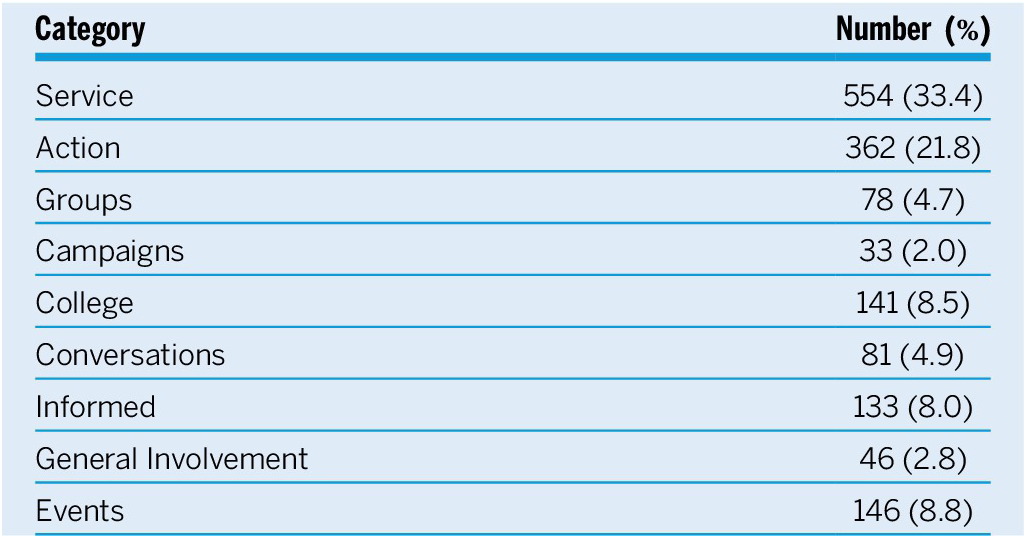
After asking introductory questions about current levels of civic engagement, the survey defined civic engagement and asked respondents to list examples of what they thought constituted civic engagement to ensure that they had a clear idea of the concept. I used a generative coding approach to categorize responses into nine primary categories plus an “other” category and a category for off-topic responses.Footnote 3 Table 1 presents the number of times each category was mentioned and the percentage of total mentions.
Table 1 Civic Engagement Examples

Note: Civic engagement examples are by category (multiple categories could be mentioned).
As expected, respondents described a wide range of activities as civic engagement. Volunteering was the most discussed service-related action, with 466 total mentions. It is interesting that many respondents considered collecting trash as civic engagement. This was mentioned 55 times, far outweighing any other specific examples of volunteer work. In terms of action, respondents overwhelmingly described voting as civic engagement (192 mentions), followed by attending meetings (55 mentions). The college category encompassed joining specific on-campus organizations (81 mentions) and attending on-campus events (56 mentions). Generally, respondents adopted a broad view of civic engagement activities including conversations with others, even if those conversations were about nonpolitical topics. The focus on trash collection as volunteering likely reflects the local context: most of the respondents were not from the small city where the university is located and national service organizations have little presence there. Furthermore, litter is a major problem in the state.
After describing civic engagement activities, respondents were presented with one of three treatments with equal likelihood. The treatment was displayed in the online survey software for four seconds before the dependent variable questions appeared, which ensured that all respondents were exposed to the treatment. Treatments were approximately equal in length and had a similar structure, starting with “Some people say” and then listing two benefits of civic engagement related to the treatment. I listed two benefits to make it less obvious that this was an experimental treatment; however, in each case, the two benefits were closely related to one another. The following wording of each prime emphasized the main motivating factors: meeting people and reducing social isolation for the social prime, providing items suitable for listing on a resumé for the career prime, and making the community better for the external community prime.
-
• Social: “Some people say that civic engagement is important because it makes you feel like an active participant in society and lets you meet others in the community.”
-
• Career: “Some people say that civic engagement is important because it provides you with resumé-building experiences and skills that are useful for many careers.”
-
• External Community: “Some people say that civic engagement is important because it provides benefits to the community and helps other people.”
Following the treatment, respondents were presented with two outcome questions on a five-point Likert scale ranging from “strongly disagree” to “strongly agree.” More Engaged measured whether the treatment had any impact on attitudes toward civic engagement, and Participate measured their intention to change their behavior in response to the treatment.
-
• More Engaged: “I am interested in becoming more civically engaged.”
-
• Participate: “I would want to participate in civic engagement programming that [institution] developed, if I were available to do so.”
The following section presents results from linear regression models with dependent variables normalized between 0 and 1, robust standard errors, and control variables included. Controls included demographic information (i.e., graduation year, ethnicity, undergraduate or graduate student, gender, whether the student had taken a course with a civic engagement component, whether the student worked, and their college); the respondents’ perceived importance of being involved; political knowledge; reported voter registration; the frequency with which they participated in community service, campus events, student organizations, consuming local news, and discussing political events; and attention checks. Online appendix SI.7 displays balance tests, SI.8 includes t-test results, SI.9 includes regression results, and SI.10 contains robustness checks using ordered logistic regression and subsetting to only attentive respondents. All results were consistent with those presented in this article.
RESULTS
Hypothesis 1 states that respondents exposed to either the personal social or career primes will be more likely to want to be more engaged and to be willing to participate in civic engagement programming compared to respondents who were exposed to the external community motivation prime. The mean of More Engaged was 3.75, with respondents exposed to the social prime reporting 3.77, the career prime reporting 3.77, and the external community prime reporting 3.70. The mean of Participate was 3.47, with respondents exposed to the social prime reporting 3.53, the career prime reporting 3.52, and the external community prime reporting 3.38. A simple comparison of means shows that respondents who received the external community prime reported lower interest in engagement and participating in civic engagement activities compared to those who were exposed to the social and career primes.
Figure 1 presents results from linear regression models with dependent variables normalized between 0 and 1. Of the two dependent variables, only the social prime statistically significantly increases respondents’ willingness to participate in civic engagement activities over the external community prime. There was no statistically significant relationship between either prime and interest in becoming more engaged and the career prime and willingness to participate in civic engagement activities. These results provide partial support for Hypothesis 1: the social prime impacts willingness to participate in civic engagement activities.

Figure 1 Coefficient Estimates for Treatments on Civic Engagement Attitudes
Linear regression models with robust standard errors and 95% confidence intervals are shown. Dependent variables are normalized between 0 and 1.
Hypothesis 2 argues that the career prime should have a statistically significantly larger effect on interest in becoming more civically engaged and willingness to participate in civic engagement activities. Neither the simple comparison of means nor the results shown in figure 1 provide support for this hypothesis.
Respondents may have been considering their interest and willingness to participate in civic engagement based on their own understanding of what it is and their personal goals and motivations. I included a set of control variables in the initial model to capture the activities that respondents used in their definition of civic engagement (see online appendix table SI.10.3). Because responses to the definition question required hand coding, it was impossible to block randomize the survey experiment based on it. Respondents who mentioned a service- or college-related activity were statistically significantly more likely to be willing to participate in civic engagement compared to other respondents. Otherwise, defining civic engagement in a certain way had no effect on interest in being more engaged or willingness to participate in civically engaged activities. I also used t-tests to check for potential effects of civic engagement definitions on willingness to participate for each experimental prime and found consistent results. Although respondents defined the activities that constitute civic engagement differently, their definitions largely did not impact their interest in or willingness to become more civically engaged.
Like their definitions, young adults may have predetermined the utility of civic engagement for their intended career before completing the survey experiment. Because the institution has many small majors, I measured intended careers based on the academic college in which students were enrolled: science, engineering, liberal arts, education, and business. Balance tests in online appendix SI.7 show that assignment to treatment was balanced across these colleges. It is interesting that online appendix table SI.9.1 shows no statistically significant effects of a student’s college on their willingness to be more engaged or to participate in civic engagement.
The social prime impacted willingness to participate but not interest in becoming more engaged. This finding suggests that respondents who were affected by the social prime already reported being highly engaged. I define “already engaged respondents” as those who reported participating in civic engagement activities at least a few times per month. Among this group, 44% of respondents “strongly agreed” that they wanted to be more engaged and 35% “strongly agreed” that they wanted to participate in civic engagement programming. The percentages were 18% and 11%, respectively, for respondents who reported participating in civic engagement activities less than a few times per month. As such, one reason that the social prime may not have significantly increased willingness to become more engaged is that those most likely to be impacted already were engaged—that is, a ceiling effect.
The substantive effect of the social prime on willingness to participate in civic engagement activities was comparable to the effect of other influences on participation. The social prime increased willingness to Participate by 3.6 percentage points, accounting for 14.4% of the first to third quartile variation in Participate. This was comparable to the influence of the frequency at which a respondent attended campus events. Moving from the first to the third quartile of the frequency increased willingness to Participate by 2.7 percentage points. Both effects were smaller than the effect of the pretreatment question about the importance of being involved in the community for which moving from the first to the third quartile increased Participate by 7.6 percentage points.
UNDERSTANDING MOTIVATIONS
Results from the survey experiment ran counter to expectations: the personal social benefit appears to motivate willingness to participate in civic engagement more than the career or external community benefit. To better understand how young adults think about civic engagement motivations, I relied on nine focus groups that I conducted with a total of 68 young adult participants. Participants for two focus groups were recruited through an open call at the end of the survey. Those in the seven other focus groups were recruited from various campus organizations and groups that broadly reflected the state of campus civic engagement. This included political science majors, student government leaders, a nonpolitical club, a political club, graduate students, a minority-serving club, and Greek Life members. Recruitment aimed to obtain a variety of perspectives from members within each group and to reflect the broad demographic composition of these campus groups. For example, graduate students, individuals belonging to minority groups, and Greek Life each represented between 5% and 15% of the student body and therefore each was included as one focus group (see online appendix SI.11).
Constituencies and groups varied in their likelihood of being civically engaged, broadly representing students on campus. The aim of the focus group sessions was to determine what motivated respondents to become civically engaged or why they refrained from participating. Focus groups lasted about an hour and followed a standard semi-structured interview format with extensive notes taken by a minimum of three student collaborators.
Focus groups covered a wide variety of topics related to civic engagement. These reported results unpack findings from the survey experiment related to civic engagement motivations. To identify common motivating factors, I used a two-step process. First, student collaborators reviewed their notes, searching for discussions relevant to a wide range of research questions. The student collaborators then used a generative approach to identify overarching themes throughout focus group sessions (Krueger and Casey Reference Krueger and Casey2014; Weiss Reference Weiss1994). Next, I reviewed these themes to identify a list of potential motivations. As a result of this process, I added “personal attachment” as a new motivation to the three motivations described previously (i.e., personal career, personal social, and external community benefits). Finally, I marked specific instances in focus group conversations in which motivations were mentioned and categorized the type of motivation discussed.
The prevailing motivation for becoming civically engaged was personal attachment to an issue for which participation was warranted. This motivation was not included in the survey experiment, and exploring it further is an opportunity for future research. One objective in civic engagement research is to explain to young people how issues that they care about are inherently political. This translation is important, and it may strengthen their personal attachment and motivate future civic engagement. Describing a recent protest on campus, one respondent stated that she was motivated to become more engaged because the protest was organized by “an extremist group that doesn’t like women.” This example demonstrates that the respondent felt the need to participate in counter-protests because of the way the issue had impacted her.
The prevailing motivation for becoming civically engaged was personal attachment to an issue for which participation was warranted.
Some respondents—particularly members of minority-serving organizations—described a deeper form of personal attachment in which civic engagement is part of their responsibility as a citizen, regardless of the issue. For example, one respondent stated, “If you keep waiting on someone else [to get involved in the community], you’ll be waiting forever.” These respondents described how civic engagement was an obligation, akin to a social contract that citizens make as part of living in a community. Young adults motivated by personal attachment gain short-term psychological benefits by participating in activities that align with their values as well as the potential for longer-term policy changes.
Some respondents reported being recruited to participate in civic engagement activities because their friends chose to participate—clearly a social motivation. These responses tended to be from individuals who were members of clubs or organizations—particularly fraternities and sororities—that participate in civic engagement projects. Examples included positive peer pressure from friends to join a club or organization, becoming civically engaged to meet like-minded people, and joining a group to build community with others. Although it is certainly a potential motivation in some settings, none of the participants described being motivated to become civically engaged because of networking opportunities that they believed would help with future job applications. Social benefits were described simply as ways to be in community and to meet new friends with similar interests.
Career development also was a motivating factor, but it was a tertiary motivation behind personal attachment to an issue and personal social benefit. In other words, career benefits alone were not enough to prompt civic engagement. One respondent captured this interplay by stating, “Yeah, [civic engagement] is a nice resumé-booster, but I look at it more as a learning experience and as a way to be involved; it’s not just a hangout session.” Being involved is a social motivation, but the respondent believed that just being involved in any activity is insufficient. Instead, involvement must be meaningful and presumably about an issue of personal importance. Although career objectives are a bonus, this respondent framed career benefits as an incidental perk rather than a primary motivator. Several respondents agreed with the sentiment that resumé-boosting was acceptable if it was not the primary reason for becoming civically engaged. Many respondents were involved in the student government association (SGA) and, therefore, could list their civic engagement work on a section on their resumé with other SGA activities.
Focus group respondents spoke relatively little about being motivated by external community benefits. This may be because the benefits that civic engagement has to the community are assumed or the activity was not worth participating in. Alternatively, it may be because respondents had a narrow definition of civic engagement, focusing on one-time service projects (e.g., trash collection) and voting. These projects are forms of civic engagement, but they are less likely to prompt widespread social and community change compared to sustained volunteering, public policy work, and activism.
Members of fraternities and sororities responded particularly negatively to being motivated to be civically engaged because of career and resumé-building opportunities. These young adults stated that personal attachment, social benefits, and (to an extent) external community benefits should be the primary motivating factors. Their rationale centered around how fraternities and sororities often are perceived as an indicator of status and a method of career advancement. Therefore, having members with career-oriented motivations reflects poorly on the organization, whose primary purpose should be to place interested young adults together in community and to engage in meaningful partnerships with civic organizations. Although only a small percentage of young adults participate in fraternities and sororities, the idea that being motivated by career benefits goes against the supposedly altruistic concept of civic engagement is worth further exploration. It could be that young adults consider career benefits as part of their motivation to become civically engaged but they develop other rationales that they believe align with societal expectations for civic participation.
DISCUSSION AND CONCLUSION
These results ran counter to my expectations. I found that explaining personal social benefits motivates college students to express a willingness to participate in civic engagement activities. Although it is possible, it is unlikely that social-desirability bias explains this finding. The experimental setup reduced the likelihood of socially desirable responses because respondents were exposed to only one experimental prime. Furthermore, the outcome questions were general and did not emphasize why a respondent may be willing to become engaged. Focus group results suggest that career-related considerations may provide a secondary or tertiary motivation for participating in civic engagement when paired with other, stronger motivating factors.
Of course, the emphasis on social benefits may be a result of limiting respondents to college students rather than more broadly sampling all young adults. Future research should examine civic engagement motivations among a representative sample of all young adults—specifically, those who chose not to attend college. State-funded postsecondary tuition assistance means that young adults in this state are less likely to choose not to attend college for financial reasons. Yet, those young adults nevertheless differ from those who choose to attend college in various other ways. Such research must carefully conceptualize an experimental setup that can explain career benefits to young adults who already have started their career. Career-related calculations are different for young adults at different stages of starting and growing their career.
The theoretical argument states that career benefits are more tangible and immediate than social benefits, thereby causing respondents to be more motivated by such benefits. However, if civic engagement is defined narrowly, then career benefits are limited. An individual who participates in a one-time volunteer activity cannot meaningfully place that experience on their resumé and therefore derives few career benefits from attending the event. The focus group results allow civic engagement activities to be classified with more granularity through a conversation with participants. Career benefits were mentioned specifically with long-term civic engagement projects. Indeed, fraternity and sorority members were most likely to mention participating in civic engagement to help their career, although they resisted being motivated by civic engagement exclusively for career benefits. This makes sense because they will list their membership on their resumé and include civic engagement work as a bullet item. Including discrete civic engagement activities within the context of organizational membership provides an easy way to characterize the career benefits of civic engagement.
The institutional and community setting is a potential explanation for respondents’ definitions of civic engagement and their motivation to participate. Future research should study different institutional types in different regions. However, scholars should be mindful that the experiences of young adults in the rural Deep South are important. Young adults in rural areas and in the South are frequently the least civically engaged.Footnote 4 It is more likely that strategies that effectively motivate these young adults to overcome significant barriers to express willingness to become more engaged generalize to young adults in other locations than the reverse.
Based on these results, I make the following recommendations to faculty members who want to motivate young adults to be more civically engaged. First, ask them what they think would or does motivate them to be willing to participate in civic engagement activities. The themes and motivations discussed in this article are likely present elsewhere but certainly are influenced by different young-adult populations. Second, understand the degree to which motivation is sufficient to ensure participation. Motivation is linked to but does not always lead to participation. The linkage is likely stronger among young adults who previously were civically engaged and who have the time and ability to engage further. Third, help young adults to discover and develop personal attachment to civic engagement. Many young adults have connections to make to civically engaged activities and may not have had the space or information to make those connections in the past. Fourth, collaborate with student affairs to develop coherent messaging around civic engagement that emphasizes both social and career benefits. A unified approach is needed to ensure that young adults understand the range of motivations that could prompt civic participation. Fifth, teach young adults how to talk about their civic engagement experiences. There is no shame in being motivated by potential career benefits. Rather, many young adults who participate in civically engaged activities are unfamiliar with how to describe their experiences on a resumé or in an interview. Demystifying how civic engagement can benefit young adults in their career in addition to providing social benefits can contribute to uncovering parts of the hidden curriculum—what faculty members assume that students know but what they may never have been taught.
Demystifying how civic engagement can benefit young adults in their career in addition to providing social benefits can contribute to uncovering parts of the hidden curriculum.
SUPPLEMENTARY MATERIAL
To view supplementary material for this article, please visit http://doi.org/10.1017/S1049096525101303.
ACKNOWLEDGMENTS
I thank Les Guice, Jeremy Mhire, Dave Anderson, Christobel Asiedu, Nazir Atassi, Jamie Boydstun, Irene Casas, Taylor Mack, Drew McKevitt, Jason Pigg, Brenda Savage, Elaine Thompson, and John Worsencroft for their support. Special thanks to the students on the Civic Engagement Survey Team who assisted with survey and focus group implementation: Jessica Adubato, Logan Arnold, Ana Balestrazzi Mirabal, Emma Bowman, Caroline Clifton, Jaci Cook, Emily Cormier, Julie Cupples, Keara Crowe, Seth Davenport, Ace Ellis, Anthony Franklin, Grant Gillespie, David Griffin, Alexandro Hernandez, John Hill, James Jeane, Ethan Jeffus, Grayson Jones, Miles Kelso, Jenny Little, Mahalie Matassa, Eryn McDonald, Garrett McLain, Tyler McMullan, Keegan McQueen, Isabella Moreno, Jayson Nitz, Tre’ Pardue, Victoria Phillips, Priscilla Roshto, Kaitlynn Sweeney, Dalton Templeton, Arabella Touchstone, Victoria Wells, A’Myra Whitby, Bobby Woodruff, and Nay Zapata. Diana Owen, Chapman Rackaway, the audience at the 2024 American Political Science Association annual meeting, the editor, and the reviewers provided helpful comments. This project received generous financial support from the Waggonner Center for Civic Engagement and Public Policy.
DATA AVAILABILITY STATEMENT
Research documentation and data that support the findings of this study are openly available at the PS: Political Science & Politics Harvard Dataverse at https://doi.org/10.7910/DVN/W2XTT7.
CONFLICTS OF INTEREST
The author declares that there are no ethical issues or conflicts of interest in this research.