




In 1917, children in the port city of Brest in western France walked past a poster depicting a sword stabbing through the heart of the German Eagle. The caption read: ‘The Boche Eagle will be vanquished: Tuberculosis should be too’.Footnote 1 Binding Germany and tuberculosis together as common enemies, this poster highlighted the nationalist stakes of this public health crisis in a time of war. The devastating loss of life at the battle of Verdun the previous year had sharpened long-standing concerns about the future of France’s population.Footnote 2 As hundreds of thousands of Frenchmen fell on the battlefield, children represented hope for rebuilding the French nation. As such, their health became an ever more pressing concern. During the First World War, increasing death tolls on the front lines heightened anxieties over the future of the French nation and galvanised health reformers to take action to bolster the health of France’s future citizens. On the front lines, doctors and nurses worked to save the lives of French soldiers wounded by the German enemy. On the home front, public health officials strategised for a different kind of war to eradicate tuberculosis and save the children of France.
Tuberculosis was one of the leading causes of death in France at the turn of the twentieth century. In 1904, the French demographer Jacques Bertillon estimated that the disease was responsible for about one-fifth of the total fatalities in Paris.Footnote 3 Tuberculosis is a bacterial disease transmitted from person to person by inhaling aerosolised droplets produced by coughing.Footnote 4 The disease can spread asymptomatically and remain dormant in an infected individual for years. Doctors and social reformers viewed tuberculosis as a particular threat to children.Footnote 5 In the United States, after the introduction of an improved tuberculin test in 1907, doctors determined that as many as 60 per cent of children who lived in urban areas might have been infected with tuberculosis, even if they did not manifest symptoms.Footnote 6 In France, overcrowded and unsanitary living conditions facilitated the rapid spread of tuberculosis. On the eve of the First World War, statistics on tuberculosis mortality presented to the Chamber of Deputies suggested that out of 692,783 deaths in France, 69,731 were due to pulmonary tuberculosis, making this disease responsible for just over 10 per cent of France’s total mortality in 1912. The report noted that tuberculosis was responsible for 44 per cent of deaths among young working-age people between twenty and thirty-nine.Footnote 7 However, as some doctors were reluctant to report tuberculosis as the cause of death to avoid stigma, these statistics might have been an underestimate of the actual extent of the problem.Footnote 8
The First World War interrupted a nascent effort by French public health officials to try to address the tuberculosis problem on a national scale. In 1901, the government had established the Permanent Commission for the Prevention of Tuberculosis, composed of doctors, politicians and government functionaries who drafted reports and provided recommendations on policies related to tuberculosis.Footnote 9 However, the outbreak of the war in 1914 placed a significant strain on France’s public health resources. By 1916, the Permanent Commission for the Prevention of Tuberculosis had become inactive. The National Committee for the Welfare of Tuberculous Soldiers took over anti-tuberculosis efforts in France, but its resources were devoted to military needs.Footnote 10 Most medical personnel were diverted to the frontlines and France’s hospitals and sanatoria were inundated with wounded soldiers returning from the front. As a result, tuberculosis resources for civilians were extremely limited. In 1916, one observer claimed that there were no beds in tuberculosis sanatoria devoted to women and children as they had all been diverted for soldiers’ use.Footnote 11 Furthermore, large numbers of tuberculous soldiers were being discharged from the army, and soldiers released from German prisoner of war camps often had the disease. Public officials were concerned that these soldiers would spread tuberculosis, particularly to the children in their families.
Although the war majorly disrupted France’s anti-tuberculosis work, it also galvanised supporters with renewed fervour about the necessity of the struggle against the disease. High death tolls on the Western Front and the large numbers of tuberculous soldiers discharged from the army bound up the fight against tuberculosis with the larger war effort. While earlier attempts to pass legislation on tuberculosis dispensaries had not gained much traction, on 11 April 1916, the former prime minister Léon Bourgeois, who chaired the government’s tuberculosis commission, sponsored a new law on dispensaries that passed ‘practically without debate’. It encouraged localities to establish tuberculosis dispensaries that would offer preventative education and tuberculosis testing for the public financed through partnerships with philanthropic organisations, local governments and the central state.Footnote 12
Shortly before the United States entered the military conflict in 1917, the Rockefeller Foundation joined the campaign to combat tuberculosis on the home front. The American oil magnate John D. Rockefeller Sr had established an endowment for the Rockefeller Foundation in 1909 amid widespread public scandal surrounding the anti-trust suits against his Standard Oil Company.Footnote 13 After years of press controversy, the Rockefeller Foundation preferred to support medical causes that would not be controversial or invite criticism. It ultimately appointed an Anti-Tuberculosis Commission to France as a philanthropic endeavour to combat disease and aid France in strengthening and expanding its public health infrastructure.Footnote 14 During the war, the Rockefeller Commission and the American Red Cross worked with French public health officials to develop educational propaganda programmes designed to teach good health and hygiene practices to France’s youth. Navigating differences between their conceptions of citizenship, national identity, family and childhood, French and American health officials introduced programmes like the Modern Health Crusade (La Croisade de bonne santé) to encourage French schoolchildren to view themselves as key agents in preventing the spread of tuberculosis to protect the future of France.
Before the war, French children were the subjects, though not yet the agents, of new public health strategies designed by doctors to combat tuberculosis. In fin-de-siècle France, public health campaigns had targeted ignorant or negligent mothers and insalubrious living conditions, which reformers held to be responsible for the spread of tuberculosis among working-class families. Bourgeois health visitors instructed working-class mothers on proper hygienic housekeeping and childcare.Footnote 15 Hygiene and public health movements focused on intervening in the lives of children, removing them from unhygienic home environments in France’s urban centres and rehabilitating them in the countryside or in sea hospitals managed by a staff of medical professionals.Footnote 16 Measures like these focused on changing environments. They emphasised the restorative nature of fresh air and, by contrast, the insalubrious conditions of their home environment. However, the Rockefeller Commission focused on the children themselves. The Commission created a public health campaign designed to instruct children on hygienic behaviours while instilling them with a sense of individual responsibility. The campaign was premised on two ideas that were in tension with one another: that children needed instruction and protection, yet that they could also instruct and protect others.
Amid France’s population crisis and the growing sentimentalisation of childhood, children were considered worthy of protection as both innocents and as valuable assets to the state.Footnote 17 Soon after it was founded in 1870, the French Third Republic enacted child labour laws and introduced new legislation on education designed to protect working-class children and turn them into productive citizens.Footnote 18 By imposing age limits on children’s labour and requiring children to attend school until age 13, the state increasingly intervened in the lives of children, defining childhood as a distinct phase of life. Nevertheless, as Miranda Sachs and others have noted, these bureaucratic social welfare interventions still reinforced the social hierarchy and perpetuated existing gender inequalities.Footnote 19
Through France’s turbulent political history, the family traditionally served as a bastion of the social order.Footnote 20 However, the pressures of industrialisation and bourgeois concerns over the potentially negative impact of working-class families on their children led nineteenth-century reformers to explore programmes that would remove the child from the environment of the tuberculous family for their moral as much as their physical health.Footnote 21 During the war, however, the social dislocation brought on by the conscription of soldiers on the frontlines, the mobilisation of women on the home front and the displacement of refugee families from the German-occupied territories led public health officials to pursue educational approaches to combating tuberculosis. The public health programme that the Rockefeller Foundation established at this time empowered children to bring knowledge about tuberculosis prevention home to their families. Public health initiatives were transformed from efforts to save the child from the family to efforts to help the child save the family itself.
The historical literature on children and tuberculosis has tended to focus on institutions and other anti-tuberculosis interventions that targeted children’s lived environment.Footnote 22 Children’s lived experiences of tuberculosis and interactions with public health campaigns are harder to capture as there are few sources written from children’s own perspectives. However, recent innovative scholarship on agency and the history of childhood suggests useful avenues forward.Footnote 23 Historians of children and other marginalised groups have highlighted the limitations of agency as a concept as it has been traditionally conceived, arguing that it ‘reifies the dominance of the individual(ised) adult liberal subject who is assumed to have the choice – the power – to exercise autonomous social action’.Footnote 24 This has led some scholars to analyse children’s agency primarily in terms of their resistance to adult agendas. However, Susan Miller has demonstrated that children’s willing compliance should be understood as evidence not of their lack of agency, but rather the extent to which their own interests aligned with those of adults.Footnote 25 Agency can take many forms, from resistance to assent and everything in between.Footnote 26 While the power dynamics were unequal between children and the adults they depended upon, adults’ perceptions of children’s capacity to learn and improve, investment in their education and hopes for their lives as the ‘heirs to the future’ empowered children to either strive to embody these hopes or to develop new ones of their own.Footnote 27 As Sarah Maza has noted, ‘the imagined child has a unique ability to mobilise adults to act on their most emotionally urgent agendas’.Footnote 28 During the First World War, the destruction of life on the battlefield brought the collective hopes for the health of France’s future citizens to a fever pitch. Children, for their part, mobilised themselves to construct that future both within and beyond the boundaries of adult expectations.
While the Franco-American collaboration through the Rockefeller Commission provided substantial material support for tuberculosis dispensaries and home visitation to treat tuberculosis and prevent its spread, this article focuses primarily on the preventative education programmes for children that public health officials developed in the years surrounding the First World War.Footnote 29 As children’s perspectives were rarely preserved in archival sources and those that were tended to be filtered through the agendas and expectations of adults, I will use Mona Gleason’s strategy of ‘empathic inference’, reading sources ‘against the grain’ to ‘imagine and interpret historical events and sources from the point of view of the young’.Footnote 30 By analysing the educational materials, games and programmes developed for their use alongside school essays responding to the anti-tuberculosis campaign, it is possible to reconstruct how children might have encountered this material and thought about it in relation to their own lives.Footnote 31 These public health programmes encouraged children to take an active role in tuberculosis prevention to protect their own health and the health of their families and friends.
The Rockefeller Commission and the Franco-American Campaign
In July 1917, shortly after the United States entered the First World War, France and the United States joined forces to combat childhood tuberculosis. With crucial financial and institutional support from the Rockefeller Foundation and the American Red Cross, they founded the American Commission for the Prevention of Tuberculosis in France.Footnote 32 This Commission coordinated with French authorities, doctors, philanthropists and the French Red Cross to develop a multifaceted programme to protect French society against the ravages of tuberculosis.Footnote 33 Not only did the Commission provide crucial material aid and relief funds to sponsor and expand dispensaries, but they also organised training programmes for home visitors, worked to coordinate between different public and private anti-tuberculosis programmes and developed an extensive educational campaign to call public attention to the gravity of this public health crisis.
Children were critical to this public health campaign. In a 1918 report, Dr Livingston Farrand, the director of the Rockefeller Commission, explained that combating tuberculosis was the ‘best avenue’ for tackling France’s larger public health problem. He noted that ‘experience has long shown that in practical procedure it is impossible to separate tuberculosis from other aspects of public health, and of these aspects the problem of children is probably the most important from the preventative point of view’.Footnote 34 The Commission worked in close association with the Children’s Bureau of the American Red Cross, which funded a children’s dispensary attached to one of the tuberculosis dispensaries the Commission established in the nineteenth arrondissement of Paris.Footnote 35 The Commission chose this district to serve as an urban testing ground for their public health strategies because it was an overcrowded working-class area with factories, slaughterhouses and bad housing where they hoped they could do the most good.Footnote 36 In October 1917, they enlarged an existing dispensary and took over its operations entirely. Within the first two months, they had received 497 visits and had 165 families under their care, mostly women and children.Footnote 37
Expanding on the efforts of charitable institutions before the war, the Commission also sponsored the training of ‘health visitors’, by offering French women scholarships to complete a six- or ten-month training course to teach them how to conduct health visits to educate families about the importance of tuberculosis mitigation efforts and infant and child welfare. Within the first year and a half, these health visitors had made over 31,000 visits to patients’ homes, either to treat bedridden tuberculosis patients or to administer to the welfare of their families.Footnote 38 This social work enabled the dispensary medical teams to identify and treat many more tuberculosis patients than ever before.
The Rockefeller Commission coordinated with local French organisations like the Social Services Organization to help alleviate the difficult home situations for families living with tuberculosis. The material aid they provided in a time of war was crucial. In addition to opening dispensaries and training public health visitors, the Rockefeller Foundation coordinated with the American Red Cross and local French relief programmes to provide material support to tuberculosis patients.Footnote 39 The Commission wanted their public health interventions to be sustainable after the war was over. So, they tried to utilise French personnel whenever possible in their dispensaries and worked to coordinate different local efforts among departmental public health committees. French men and women wrote the publicity material they produced and French artists illustrated it.Footnote 40 The Commission worked with local authorities across France to help coordinate the establishment of many new dispensaries under the Léon Bourgeois Dispensary Law.Footnote 41 While the material relief the Commission provided helped tremendously in the struggle to diagnose and treat tuberculosis patients, arguably its educational propaganda programme was its most significant contribution to tuberculosis prevention.
Navigating the politics of introducing such an ambitious public health education campaign in France required a considerable degree of delicacy and diplomacy. While the American members of the Commission were shocked at how few public health resources were available to the civilian population of France amid the shortages of wartime and frustrated by the bureaucratic system and the constant infighting among French public health officials, they were careful to avoid openly criticising the French medical community as they recognised that the long-term success of their interventions would require French support. In a speech to the National Committee for the Welfare of Tuberculous Soldiers, Dr Farrand explained that ‘the future welfare of the world necessitates a fight against this insidious enemy, tuberculosis, as it necessitates also the battle against the invading enemy beyond the Rhine [. . .] We are not here to give you instruction, but to fight with you against the common enemy. We venture to hope that you will count upon our cooperation and we come to place ourselves entirely at your command’.Footnote 42 France’s long-standing reputation as a world centre of clinical medicine and as the homeland of Louis Pasteur led American representatives to approach their mission with a degree of caution for fear of offending French physicians. In an article in The American Review of Tuberculosis, Dr James Miller emphasised that, although the Commission had bold plans to transform public health, ‘We have carefully avoided in every way possible the implication of any superiority in our methods, for in fact, as is well known, the leaders of French medicine have always been our clinical masters’.Footnote 43 In addition to strengthening their efforts to combat tuberculosis, the cooperation between the French and American medical communities, he noted, ‘undoubtedly will do much to strengthen the ties of affection and mutual interest which bind these two great republics’.Footnote 44 Treading lightly, the Commission officials hoped to be able to radically transform public health in France, binding their alliance in the war with the mutual benefits of containing tuberculosis’s spread.
Eager for American material aid, French public health officials mirrored the Americans’ idealistic pronouncements. Dr Paul Armand-Delille of the Oeuvre Grancher expressed his profound gratitude to his American friends ‘for the aid which you are giving, not only on the fields of battle, but also for the safeguarding of new generations of France in order that, working with yours, she may continue her mission for humanity in defending the right, the justice, and the liberty of peoples and of man’.Footnote 45 Strong populations were the key to the mutual strength of the Franco-American alliance. By protecting the physical strength of the French population, he suggested, American physicians could simultaneously contribute to the spread of the universalist ideals of justice and liberty.
The rhetoric of the supporters of the anti-tuberculosis campaign frequently bound Germany and tuberculosis together as common enemies. In an address to the National Committee for the Welfare of Tuberculous Soldiers in 1917, French President Raymond Poincaré blamed the war for exacerbating the tuberculosis problem. He claimed that ‘Tuberculosis, which before the war had already made such great ravages has unhappily developed in shocking proportions by the fault of our common enemies. The photographs which French mothers and wives receive from their sons and husbands who are prisoners show them emaciated and unrecognisable. Many of them have become tubercular’.Footnote 46 Highlighting the gendered service of soldiers and mothers to the French nation, Poincaré evoked concerns over the dwindling strength of France’s population. Mothers and wives sent their sons and husbands off to fight for France. For soldiers to survive the miserable conditions and elude death in the trenches only to contract tuberculosis and suffer malnutrition in German prisoner of war camps seemed to add insult to injury. While a soldier returning home to his family might be able to have more children to rebuild the French population after the devastation of war, one who returned home with tuberculosis became a threat to not only the health of his family but also the nation at large.
While some French doctors were initially sceptical about the American Commission, many were won over by the enthusiasm, dedication and, perhaps most importantly, the financial resources that the Commission brought to the table. The Sub-Prefect of Nogent-le-Rotrou, a commune in northern France, expressed his warm appreciation for the Commission’s anti-tuberculosis efforts as a broader sign of the Americans’ commitment to France. ‘Not content with mingling the stars and stripes with our tricolor on the battlefield, not content with generously shedding the blood of their sons on the soil of France, not content with coming here to overthrow the enemy of justice and civilization’, he declared, the Americans ‘intend also to conquer that other enemy of the race, no less redoubtable than Germany: tuberculosis’.Footnote 47 Allies in the struggle against tuberculosis, French and American officials appealed to common republican values and rallied around a common set of enemies. The children of France would be both the beneficiaries and key conduits of these public health efforts.
Mass Education and Propaganda
The American Anti-Tuberculosis Commission in France designed an extensive, multifaceted propaganda campaign to educate the public on the dangers of tuberculosis and the means of preventing its spread. It established five mobile propaganda teams to travel all over France giving public health demonstrations. Each truck could hold five people, a print poster exhibition, an electric generator and all of the equipment necessary to project the Commission’s propaganda films, even in small rural villages that had no electricity.Footnote 48 Playing on a sense of spectacle, the team would send one member to the next village or town a few days ahead to make arrangements for the exhibitions, to invite local notables and authorities and to publicise the event, ‘like the impresario of a theatre company’.Footnote 49 They invited locals to come with their families to hear the lectures, noting that the public health presentations would be followed by a concert and film viewing.Footnote 50
These public health spectacles travelled all across France spreading their message. Between 1918 and 1922, the mobile propaganda teams travelled to sixty-five of France’s départements and 1,338 towns to put on numerous anti-tuberculosis events.Footnote 51 The Commission estimated that these events reached over 1.25 million French adults and 1.5 million French children. The Associate Director of the Commission James Alexander Miller noted that they owed their ‘astonishingly great’ success in the first six months of 1918 to the ‘unique features’ of the campaign, ‘especially the use of cartoons, which are strikingly successful and might well be imitated in this country [the United States]’.Footnote 52 The use of portable generators to power the films was often necessary in rural areas, particularly in times of wartime shortage. In April 1918, Selskar Gunn, the director of the Commission’s propaganda team, noted after returning from the town of Vitré that their event was a ‘great success’ that drew a crowd of 500 to a 350-seat theatre. However, he explained that there was ‘no gas or electricity on account of lack of coal’, so they had to illuminate the theatre using six oil lamps.Footnote 53 Ironically, this standing-room-only event spread the word about the importance of fresh air to a large number of people, but it did so in an overcrowded theatre, which ran counter to their public health advice.
The Commission’s anti-tuberculosis propaganda scheme explicitly targeted children first as agents of public health. To drum up support for the travelling exhibits, the Commission developed short preview demonstrations, which it presented in the local schools. Their goal was to get children excited about the events so that they would persuade their families to attend. They began with short discussions followed by a film demonstration that was ‘specially adapted, cheerful, often funny, always instructive’.Footnote 54 The propaganda team tried to make the experience as visually appealing and entertaining as possible. One twenty-minute film, Jinks, was a popular cartoon that depicted a family of bacteria that had taken up residence in the lungs of Mr Jinks, who uses good hygiene and fresh air to fight them.Footnote 55 Other cartoon films depicted the dangers of spitting on the ground.Footnote 56 Many of the films shown by the travelling teams were produced in France by Pathé Frères and combined cartoons created by the French cartoonist Marius Rossillon (pseudonym O’Galop) and films by Dr Jean Comandon, a microbiologist who captured moving microscopic images of bacteria.Footnote 57 The school presentations usually involved a specially created montage of informative films highlighting preventative measures interspersed with O’Galop cartoons about the importance of ‘vanquishing’ tuberculosis specially produced for the Commission. The short clips on a variety of topics and angles on the tuberculosis struggle in the montage were designed to hold children’s attention.Footnote 58 One can imagine how exciting it must have been for children in rural France to have cartoon film strips to watch in the classroom at a time when resources were severely limited by the exigencies of the war.
After the film demonstration, the propaganda team distributed brochures and picture postcards, illustrated with cartoons for visual appeal.Footnote 59 Some of the postcards had the lyrics for anti-tuberculosis songs and the sessions ended with a sing-along to a popular tune. One postcard containing the song ‘Va-t’en, va-t’en microbe’ depicted four children washing and scrubbing away tiny stick figures intended to represent microbes.Footnote 60 Children sang ‘Go away, go away microbe’ and explained that ‘my parents whom I love, will fight with me’ against the ‘assassin microbe’. However, the lyrics also highlighted specific actions that the children singing the song could take themselves: ‘Always proper in class without ever spitting there/ With water I will hunt you [microbe] wherever you may hide’. It also highlighted that their diligence in following good hygiene was a patriotic duty. The song ended: ‘It’s for France itself that I will not forget anything/ We must be in good health for the beautiful land we love’. These interactive sing-alongs set to familiar French tunes gave children the chance to feel like they were part of the larger national struggle.
These special lessons on tuberculosis covered some familiar ground for French children, as they already had lessons on hygiene and science as part of the school curriculum. While the Ferry Laws had introduced free, secular public education for both boys and girls in the early 1880s, French schools remained segregated by gender, except in small rural communities.Footnote 61 During the Third Republic, the primary school curriculum maintained required courses on science and hygiene that had been introduced during the Second Empire.Footnote 62 The girls curriculum had these subjects too, but often connected them to the domestic economy, for example, teaching girls that Pasteur’s research on microbes emphasised how important it was to keep a tidy, clean house free from dirt, in order to protect the health of their family and the future of the French nation.Footnote 63 Le Ménage de Mme Sylvain, a popular illustrated reader for French schoolgirls, highlighted the connections between health and cleanliness. It included drawings of tuberculosis and other microbes and an explanation that these ‘enemies’ lie in the dust all around the house. To clean properly, it noted that girls should avoid using dry feather dusters, which just kicked up dust and microbes into the air, and instead wipe household surfaces with a damp cloth.Footnote 64 Gabrielle Miraben, one of the lecturers who toured on the Commission’s travelling teams, was pleased to see that in most cases the students she presented to were familiar with microbes but noted that ‘an outside voice carries more weight’.Footnote 65 While the Commission’s staff had a vested interest in reporting on the success of the programme, it is likely that the novelty of the film technology and the interactive sing-alongs in these touring programmes would have sparked children’s interest.
Beginning in 1915, French school curricula had begun to incorporate the war into practically all aspects of teaching as a way of mobilising children to support the war effort.Footnote 66 While the war had become less ubiquitous in the curriculum by 1917, some of the children wrote essays about tuberculosis after the Commission’s presentations in the schools, reflecting on its seriousness in the context of the war. School essays, like letters written by children, are challenging sources to interpret because they ‘so often reflect the looming influence of elders’.Footnote 67 Nevertheless, children’s essays do reveal how some children understood the public health lessons and thought about them in relation to their own lives and experiences.
Students at a girls’ school in Vitré, Bretagne, seem to have understood that tuberculosis was a serious threat to the future of France. Florine Coêffé, age eleven, wrote ‘Before the war, France was already ravaged by tuberculosis, now most strong men have left for the “front” and many will come home tuberculous from the prolonged suffering [they] endured, increasing the number of people afflicted with this terrible disease and the French race will gradually disappear almost entirely’.Footnote 68 While prone to exaggeration, Coêffé clearly understood that the stakes of the fight against tuberculosis were high. She framed the ravages of tuberculosis as an additional burden the soldiers at the front must bear, again linking the military and public health struggles together as an existential crisis for the ‘French race’. Educational discourse on the war tended to emphasise the heroism of the soldiers fighting on the frontlines and the debt that children owed them for their tremendous sacrifice.Footnote 69 Girls faced a particular sense of obligation as, unlike boys, they were not expected to serve as soldiers themselves one day.Footnote 70 However, tuberculosis transformed the long-suffering hero returning home into a threat to the future of the French nation. Girls like Coêffé and her classmates could serve the nation by being vigilant and taking precautions to protect their own health and to prevent the spread of tuberculosis to others.
Children’s essays on tuberculosis highlighted strategies for how they could avoid contracting the disease in their everyday lives. In addition to eating healthy, living in clean, well-ventilated lodgings, covering their mouths when they coughed and profiting from as much fresh air as possible, the girls from Vitré appear to have reflected on how specifically to avoid tuberculosis in the school setting. Suzanne Legrand, age ten, wrote that students could prevent the spread of the disease by ‘not gnawing on our dip-pens and then not leafing through our books with wet fingers’. She also noted that ‘tuberculosis is a horrible disease and I hope I don’t get it’.Footnote 71 While French students generally tended to write what they thought the teacher wanted to hear for compositions, occasionally they included more personal insights.Footnote 72 One pragmatic student wrote that ‘If I went to consult a doctor for a cold that wasn’t getting better, I would much prefer that he tell me frankly what I have; at least [then] I could get treated’.Footnote 73 The students learned how to identify the symptoms of tuberculosis, how to apply preventative public health strategies to their own lives and the importance of proactively seeking treatment when they fell ill.
The Commission intended the children to carry their enthusiasm for the anti-tuberculosis mission back to their homes to spread public health advice and increase attendance at the travelling demonstrations. Returning home from school with attractive posters and accounts of the entertaining cinema and songs, the children could serve as ‘voluntary intermediaries and enthusiastic publicity agents’.Footnote 74 Through the preview demonstrations in the schools, the Commission transformed France’s children into emissaries for public health. Not only did the anti-tuberculosis message first reach the ears of the young population that the Commission was most eager to save, but it also drove them to spread the good word of proper hygiene to their families. Of course, the prospect of an entertaining evening out to watch the films might have held more weight with some families than the public health messages they were designed to convey.
Spectacle guided the programmes that the mobile propaganda teams presented to cities and small towns all over France, which often included musical components and speeches from local notables in addition to the public health presentations on tuberculosis and infant mortality.Footnote 75 In March 1918, the mobile propaganda team gave a series of conferences in the city of Rennes in north-western France. For one afternoon programme, the members of the American Commission processed in to an orchestral piece (Duval’s ‘Marche Solennelle’) with the Cardinal of Rennes, who gave an address. The first part of the programme included Commission lectures by Professor Gunn and Dr Bruno about tuberculosis. Then the orchestra played both the American and the French national anthems and a Sousa march. After a collection to benefit the Committee for the Tuberculous Wounded, there was a short concert, featuring local musicians, including a violinist, a cellist and a voice professor from the conservatory who sang the Bell Song from Léo Delibes’ opera Lakmé and ‘Heroes, I salute you!’Footnote 76 Another programme featured performances of music by French composers such as Édouard Lalo, Jules Massenet and Gabriel Fauré and included a special choral performance from the students of the Rennes Conservatory titled ‘Our American Brothers’.Footnote 77 The music selected for the programmes emphasised French national pride by highlighting French composers and performers. However, it also acknowledged the generosity of the American Commission and the fraternity and cooperation of the two nations by including a Sousa march and playing both the French and American national anthems.
While it is difficult to measure the impact of these spectacles on individual behaviour, the Commission’s message about the crucial need to protect France’s children from tuberculosis seems to have gotten across to some attendees. In August 1918, Mme Gervais-Courtellemont wrote to the American Red Cross on behalf of a working-class woman whose sister-in-law was destitute and dying of tuberculosis. She lived in a single room with her four-year-old daughter, whose grandmother was planning to come and live with her in the same room once the child’s mother had succumbed to the disease. Gervais-Courtellemont wrote ‘this working woman who reported the situation realised, thanks to the American propaganda, to what danger this would expose the child’.Footnote 78 She hoped that the American Red Cross would be ‘glad to learn that its propaganda against tuberculosis is having an effect on the working population’.Footnote 79 The desire to protect the health of this four-year-old girl presumably inspired this working-class family to take on the additional expense and logistical challenges of securing different accommodations for the girl and her grandmother.
The propaganda materials the Commission distributed at their events were designed to be short and straightforward, using simple language to reach the widest possible audience, children and adults alike.Footnote 80 One brochure, titled ‘Save the Children’, incorporated attractive colourful illustrations and rhyming poems about health and hygiene, instructing children to play outside in the fresh air and to consult doctors regularly and follow their advice and instructing families to isolate children from family members who were ill with tuberculosis.Footnote 81 These illustrated educational materials were particularly welcome amid the paper shortages caused by the war. Over 1,000 teachers contacted the Education Division of the Rockefeller Commission requesting printed materials to use in schools after an article on the Commission appeared in a French teachers’ magazine in 1918.Footnote 82
During the school preview demonstrations, each school child was given a copy of a little booklet titled To the Children of France.Footnote 83 Designed as a series of questions and answers, the booklet instructed children about what tuberculosis was, how it spread and what they could do to avoid getting sick. The introduction instructed them to ‘read [this little book] attentively until you are certain that it has been inscribed in your memory’.Footnote 84 The pages were illustrated with cartoons of children that reinforced the public health advice and allowed the children reading the booklet to envision themselves as capable of making a difference to protect themselves and those around them from tuberculosis. While illustrations in children’s textbooks in the nineteenth century often depicted children as miniature adults, the cartoons of children in this booklet were caricatured but very childlike and framed the public health advice in terms children could recognise and apply to their own lives.Footnote 85 One cartoon captioned ‘Avoid overcrowded areas’ depicts a small bassinet laden with pillows containing two older children, a baby and a doll looking quite cramped.Footnote 86 By illustrating overcrowding through play using siblings and toys, the cartoon may have inspired children to recreate the overcrowded scene in their own homes so that they could reorganise and correct the hazards of their environment or berate their siblings for not following proper hygienic protocols.
The Commission believed that very few people would be likely to sit down and read a dull health manual, so they incorporated illustrations and cartoons even into the propaganda materials that targeted adults. In total, the propaganda team distributed over 15 million copies of brochures, postcards and other print materials, which highlighted public health measures.Footnote 87 A Commission report from 1918 claimed that the audiences seemed to ‘treasure’ these materials, as ‘It is a rare thing to see a piece of the Commission’s literature lying on the street. Everything that is given out seems to be carefully preserved and taken home’.Footnote 88 Paper shortages in France during the war offer one possible explanation for this claim, but, nevertheless, the Commission made a very deliberate attempt to make the materials fun and visually appealing.
The Commission took advantage of a range of different types of media and spectacle to ensure that their message reached the children they were hoping to protect from the ravages of tuberculosis. In 1919, they developed a puppet show on health and hygiene, modelled after the successful Guignol puppet shows on the Champs-Elysées. M. Henry de Graffigny designed and performed a hygiene play for the puppet theatre that depicted two children talking about microbes on their way to school. The little boy asks the girl if she knows what a microbe is and when she says, ‘It’s a big animal’, he laughs and teases her a bit, explaining that microbes are tiny. Then he explains how they spread through dirt, dust and stuffy air and what measures to take to avoid microbes.Footnote 89 Designed to ‘instruct and amuse’, the puppet play depicts the little boy as the authority on public health and hygiene. Other characters appear in the play – a uniformed soldier who talks about how to keep one’s house clean and a drunk who models what not to do – but the children remain the protagonists. When the drunk falls down dead in the play’s tragic climax, the little girl explains that death comes for alcoholics, so it is unwise to imitate them. Just before the curtain falls, the girl announces to the children in the audience: ‘We need to take care of ourselves [. . .] because our country needs us’.Footnote 90 The puppet play was designed to introduce basic health and hygiene concepts in a dynamic and entertaining fashion that would not only engage its young viewers but also make them feel connected to the larger patriotic mission of protecting their health for the future of France.
In 1919, the puppet shows travelled to thirty départements where 67,000 children heard their public health message. Apparently, they made an impact. The newspaper L’Avenir reported that a schoolmistress had overheard two little girls, ages six and seven, mention advising relatives on proper health measures after viewing the puppet show. During housecleaning, one girl said ‘Aunt Clotilde, don’t make the microbes fly about. You must dampen the floor before sweeping’. Another girl warned her older brother that when he went to buy cakes that he should not choose ones that had been kept outside because ‘You know that the tuberculosis microbes are walking around on them’. The puppet show’s emphasis on hygiene as a patriotic duty gave these young girls an excuse to criticise and correct the behaviour of their older relatives while simultaneously serving as protectors of their families’ health.Footnote 91 It offered them the chance to feel important and empowered at such a young age to be able to take actions on a small scale that were meaningful for the well-being of the family and the nation.
Public Health through Play
The Franco-American collaboration in the fight against tuberculosis also led to the introduction of more formal programmes in schools to reinforce healthy and hygienic behaviour in children. In 1917, Charles M. DeForest of the American National Tuberculosis Association had introduced a new public health programme in the United States called the Modern Health Crusade or Croisade de Bonne Santé. He designed the programme explicitly to ‘create correct habits for health among school children’.Footnote 92 The Modern Health Crusade required children to record their healthy and hygienic behaviours on a scorecard and to progress up the levels of chivalry from page to squire to knight.Footnote 93 Crusaders would get credit for washing their hands before meals, keeping their fingers out of their noses and mouths, eating wholesome foods, sleeping with the windows open and bathing regularly. After a year of successfully completing these health chores, the children would pass from page to squire and then, eventually, to knight.Footnote 94 This programme crossed the boundaries of private life by transforming individual grooming and nutritional choices into a documented record of hygienic behaviour.
The Rockefeller Commission introduced the Modern Health Crusade in France beginning in the Eure-et-Loir region, southwest of Paris.Footnote 95 Despite encountering some obstacles – one writer noted that ‘in some towns there was literally not a single bathtub’ – French children seemed to embrace the programme. In one of the older classes at the Girls School on the rue Sainte-Même in Chartres, all of the students received their Crusaders’ certificates and ‘served as instructors for the smallest crusaders’.Footnote 96 When designing the programme for use in France, Dr Selskar Gunn adapted the Modern Health Crusade to French cultural norms. For example, while the American Crusade prohibited children from drinking coffee and alcohol, the French programme moderated these provisions to allow French crusaders to continue to consume café au lait and watered-down wine’.Footnote 97 An article on the introduction of the Crusade in France noted that although there had been a few objections from parents, as Gunn explained, ‘the children have, as a rule, become so enthusiastic that they will compel their teachers to continue the crusade work’.Footnote 98 Whether it was children’s enthusiasm for the programme or the Commission’s resources and infrastructure, the Modern Health Crusade expanded rapidly in France. By October of 1919, the programme had spread to 641 schools, reaching approximately 33,800 young health crusaders.Footnote 99 The Commission also provided toothbrushes, soap and toothpaste to poor families who found it difficult to access these crucial hygiene supplies amid wartime shortages, so that their children could still participate in the programme.Footnote 100 This combination of educational propaganda and material aid was typical of the Commission’s commitment to practical solutions for implementing preventative measures.
Through the Modern Health Crusade, the Commission sought to transform France’s children into advocates for the health of France’s future. Teachers were instructed to highlight the spirit of competition by holding tournaments between different classes to compete for the best average scores.Footnote 101 The programme provided certificates to crusaders who had successfully completed the health chores required to progress from page to squire and several schools gave a small fete to mark the occasion with singing and a speech from the teacher or from Miss Frances Colbourne, the Commission representative who directed the programme. Reportedly, the students were enthusiastic about the ceremonies and ‘most of the crusaders seem to have learned the songs from the postcards and sang them with much spirit’.Footnote 102 The competitive nature of the Modern Health Crusade was designed to emphasise individual responsibility among the child crusaders for public health. Rivalry between classes to reach knighthood first would have added excitement and might have inspired some children to stick with the programme for reasons beyond just a desire to please their elders.
The Modern Health Crusade programme provided certificates, medals and prizes to children who successfully completed the programme. One of the rewards that they distributed was a colourful board game called Le Coq Gaulois (Figure 1).Footnote 103 The game was designed to reinforce practices of health and hygiene that would not only help them avoid the perils of tuberculosis but also mould them into productive, studious, engaged citizens. The Coq Gaulois game explicitly emphasised children’s responsibility for their own health and hygiene. The fifteen by ten inch game board was illustrated in vibrant, attractive colours and modelled on the historical Game of the Goose, a spiral race game originally developed in the fifteenth century.Footnote 104 While popular among tavern gamblers, French printmakers had produced educational versions of the game to teach subjects like history and geography since the seventeenth century.Footnote 105 In this modern version, children would roll the dice and make their way around a spiral of numbered squares, each one labelled and illustrated with public health advice ‘in order to teach fundamental health habits’.Footnote 106 The goal of the game was to avoid catching tuberculosis while playing around the game board to reach the centre square, labelled ‘First Prize in Health’.
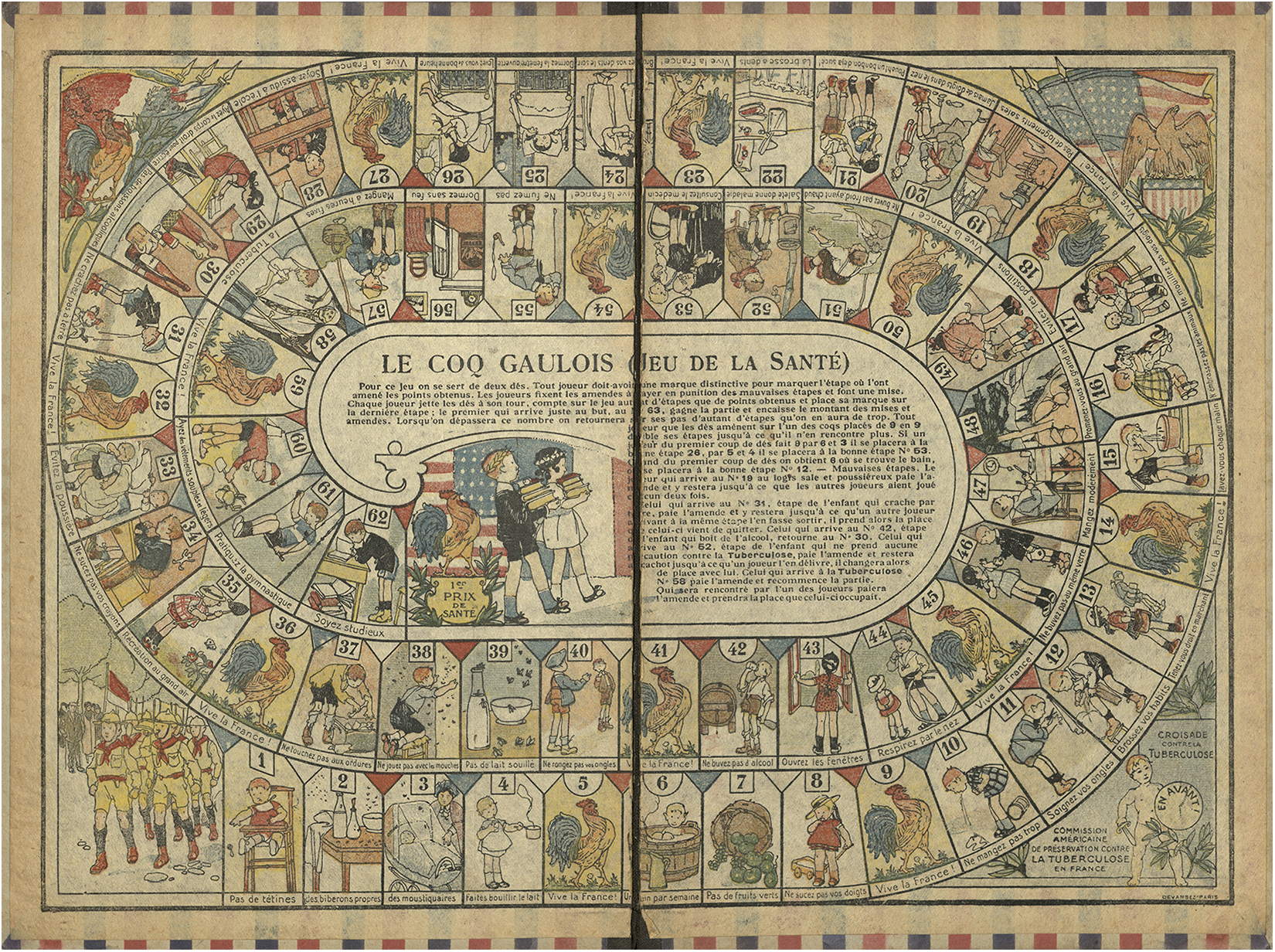
Figure 1. The Coq Gaulois board game.
The rules of the game were both democratic and practical. Children would use their own dice and choose their own distinctive markers. They would also determine the wagers to be paid to the winner and the penalty fines to be paid for landing on a square depicting bad health behaviours. Leaving the specific form and amounts of the wagers up to the players themselves emphasised children’s agency and responsibility. It also enabled children to adapt the game to their own particular context, calibrating the stakes of the game in a manner appropriate to their age and resources, within the limitations of a wartime economy.Footnote 107 Presumably, the child who earned the game as part of their Modern Health Crusade programme would have participated in the programme long enough to be familiar with its health recommendations. However, playing it with friends or siblings who had not participated in the programme would have disseminated its message more broadly.
The game situated the fight against tuberculosis within both a nationalist project of regeneration and the international cooperation of the Franco-American Alliance. The American eagle and the French rooster – the ‘Coq Gaulois’ – flanked by their respective flags grace the top corners of the board, framing the project as a cooperative measure between allies. The other images on the board emphasised children’s agency as foot soldiers in the quest for national regeneration. The bottom left corner contains an image of a boy scout troop marching outside in military formation carrying their flag with adults looking on from a distance. The bottom right corner is labelled ‘Crusade Against Tuberculosis’ and depicts a small naked child holding a sword and a shield labelled en avant! ‘Forward’.Footnote 108 These images of the militaristic fighting youth highlight their centrality to the public health project as crusaders for the nation.
The game provided practical public health advice directly to children through gameplay. Each square was designed to either reinforce good health practices – such as ‘Play in the open air’ or ‘Brush your teeth’ – or to admonish bad health habits – ‘Don’t suck your fingers’, ‘Don’t pick your nose’, ‘Don’t touch waste’. Children also cultivated nationalist sentiment through gameplay. Several ‘Coq Gaulois’ squares were labelled ‘Vive la France!’ Each time a player landed on one of these squares the player’s points were doubled and they moved ahead the same number of spaces as they had rolled to land on the Coq Gaulois square in the first place. As players moved around the board, the Coq Gaulois propelled them forward, reinforcing the connections between their individual hygiene and health practices and their responsibilities to the French nation.
Adults play a very minor role in this game. Only two adult figures appear on the game board: a nurse who covers a baby carriage with a mosquito net and a doctor who listens to a boy’s lungs with a stethoscope. So, rather than presenting adults as instructors in good hygiene, children serve as the primary actors in the game, admonishing one another for poor health choices. Colourful and amusing illustrations served to facilitate comprehension for younger players and to maintain interest in the game. One square, labelled ‘Yuck! A pre-sucked sweet’, depicts a smartly dressed girl recoiling in disgust as a boy offers her a sweet that presumably had already been in his own mouth. This square presented a hypothetical situation that could spread germs and disease and demonstrated how a child should respond to an insalubrious practice that might have been all too tempting within the context of wartime scarcity and rationing.Footnote 109 During game play, landing on this square might have inspired the players to grimace or engage in a chorus of disgusted noises of their own.
Cleanliness, hygiene and proper personal comportment were essential features of the game. The rules specified that certain desirable behaviours or preventative measures would move a player ahead faster. For example, any player who landed on square six, ‘One bath per week’, would move immediately ahead to square twelve, ‘Brush your clothes’. These squares that emphasised good health behaviours enabled the player to advance additional spaces along the game board, just as the ‘Coq Gaulois’ squares did. In this manner, children began to associate preventative health and hygiene measures with participation in a project of national significance.
Negative or negligent health and hygiene practices contained additional penalties to reinforce links between individual responsibility and national welfare. The game particularly targeted behaviours associated with the spread of the tuberculosis bacillus, including spitting on the ground and living in insalubrious housing. Behaviours that might directly harm the health of others contained the harshest penalties. A player who landed on square thirty-one, ‘Don’t spit on the ground’, had to remain there until another player landed on that square before moving backward one space. Behaviours like spitting were not only unhygienic for the individual, but they also risked spreading disease. By penalising negligent or dangerous health practices, the game reinforced the idea that each individual child had a responsibility to take care of him or herself not only for individual advancement but also to prevent harming the rest of society through negligence. Playing their way around the game board enabled children to imagine themselves as active agents of public health and champions of the French nation.
While all of the other squares depicted either prescriptions or proscriptions for behaviour and tools of health and hygiene, the tuberculosis square, number fifty-eight, illustrated the deadly consequences of neglecting the game’s advice. It depicted a sallow, emaciated boy lying in bed as a skeletal grim reaper in a white cloak leaned over him holding a sickle. The image highlighted the real risks of illness or death that resulted from failing in one’s health crusade. Any player who landed on the tuberculosis square had to pay the penalty fine and then begin the game over again, presumably as an ‘infected’ player. Furthermore, if other players encountered this ‘infected’ player on the game board the second time around, they also had to pay the fine and move backward to take that player’s place. In this instance, the rules of the game illustrated the nature of contagion. We can only speculate as to how groups of children played this game. Did they celebrate when they landed on the good habit spaces? Did they embrace the spirit of the game and its patriotic propaganda? Or, like some of my college students who have played the game, did they get overly competitive and laugh as their friends had to pay the fine for landing on a bad health habit, or jeer and shriek with schadenfreude when someone caught tuberculosis in the game? Regardless of how they played the game, requiring them to distinguish between the advantageous healthy spaces and the dangerous unhealthy ones reinforced the game’s public health message.
The Rockefeller Commission sought to engage children through play in the struggle against tuberculosis. In addition to the Coq Gaulois board game, they created a rotating paper viewfinder toy, which consisted of a paper card depicting a group of children watching a magic lantern projection (Figure 2). It read ‘Fight Tuberculosis – See its allies and its enemies’. The card was attached to a paper wheel, which rotated to reveal the different allies and enemies of tuberculosis through a hole cut in the card as though they were projected by the cartoon projector depicted on the card. The child playing with this simple toy would just rotate the wheel to view the allies of tuberculosis (the spitter, overwork, intemperance and closed windows) and its enemies (the doctor, open air, open windows and healthy food). The drawing on the card depicts a boy displaying the images on the projector for a girl and several other children, emphasising the agency of children in spreading preventative anti-tuberculosis advice to their peers. The child manipulating the wheel to view the different images would adopt both the position of the cartoon boy projecting the images to his peers and the perspective of the student learning about the enemies and allies of tuberculosis. A message at the bottom of the toy explained ‘Tuberculosis is a national peril, to fight it is a patriotic duty’, binding the child’s mission to spread public health education to the future of the French nation.Footnote 110 As a result, these games encouraged children to learn from their public health advice and to pass that advice along to their friends.
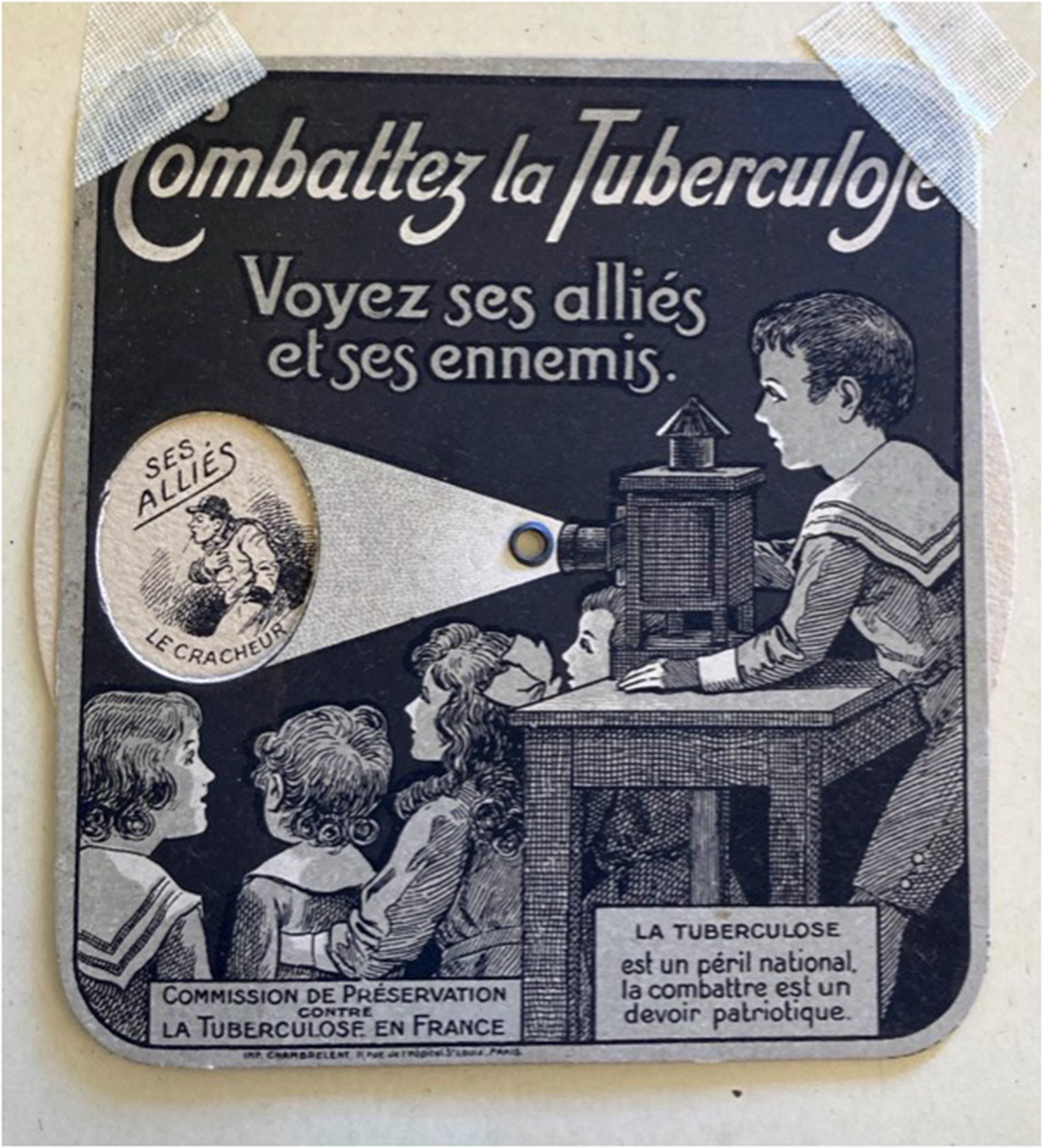
Figure 2. Paper viewfinder toy depicting the allies and enemies of tuberculosis.
At a time when mortars and machine guns were decimating soldiers in the trenches, tuberculosis was an invisible enemy at home, threatening to stifle France’s demographic future. Through these public health programmes, children began to see themselves as active future citizens working to improve public health and hygiene in their schools and local communities. While adults certainly hoped that children would embrace the anti-tuberculosis mission, children’s enthusiasm for anti-tuberculosis programmes like the Modern Health Crusade aligned with adult agendas as a result of their shared interests, even if they did not always play the game in the way that adults had intended. These programmes instilled children with a sense of autonomy and pride at being able to do something with such national significance. On the home front during the First World War, children could play a supporting role, helping soldiers on the battlefield by making bandages or knitting scarves.Footnote 111 However, in the battle against tuberculosis, they could be the combatants. Traditionally, public health programmes emphasised the expertise of public health officials, medical inspectors and teachers, challenging parental authority over family health. However, the educational propaganda of the Rockefeller Commission called on children to take the lead in protecting their own health and the health of their families. In so doing, children served as crusaders for the health of the French nation.
In 1919, shortly after the end of the war, the National Committee for the Welfare of Tuberculous Soldiers became the National Committee for the Prevention of Tuberculosis, marking a return to a civilian focus in the French government’s anti-tuberculosis work. It immediately issued an urgent appeal, calling on ‘the whole of France to mobilise all of its forces [. . .] to defeat tuberculosis and save what is left of its children’.Footnote 112 That same year, Deputy André Honnorat sponsored a law that encouraged the establishment of tuberculosis sanatoriums in each département.Footnote 113 The Franco-American collaboration headed by the Rockefeller Foundation provided crucial infrastructure and support during the war, but in 1923, the Rockefeller Commission’s six-year mission to France came to a close.Footnote 114 The material aid and organisational support it provided were instrumental in transforming the institutional landscape of France’s tuberculosis struggle.Footnote 115 In 1917, before the mission began, France had fifty-two dispensaries. By the end of 1923, there were 498 dispensaries, spread over seventy-nine départements.Footnote 116 These anti-tuberculosis facilities provided a strong foundation for combating the disease.
The war heightened anxieties about France’s population and inspired redoubled efforts to protect and strengthen it further. France ultimately lost 1,358,000 men in the First World War and another 4 million men were declared invalids after the war.Footnote 117 Alarm over the war’s devastation of the French population heightened pronatalist sentiments and led France to pass a new law in 1920 prohibiting the distribution of information about contraception.Footnote 118 However, it also galvanised public health officials to renew their efforts to protect France’s remaining population from the ravages of tuberculosis.
Children continued to be a major focus in the French public health struggle. Most of the public health strategies developed before and during the war focused on ways to prevent children from contracting the disease, through either changing their environment or education. However, after the war, a new tool emerged from the field of bacteriology. Since 1901, two French bacteriologists, Albert Calmette and Camille Guérin, had been conducting animal trials on a strain of bovine tuberculosis that was less virulent with an eye to developing a vaccine. Finally, in 1921, they inoculated their first infant against tuberculosis at Charité Hospital. Over the next few years, they inoculated several hundred more infants and by the end of 1925 the B.C.G. vaccine was made available to doctors more broadly.Footnote 119
While vaccination offered new hope for protecting the most vulnerable children from being exposed to tuberculosis, hygiene education continued to be a crucial aspect of the public health strategy. After the war, French public health officials were eager to continue the educational propaganda campaign begun by the Rockefeller Commission. In 1923, Calmette, who was also, Vice-President of the National Committee for the Prevention of Tuberculosis, highlighted the importance of the work the American Commission had done for children during the war. ‘The admirable campaign so generously undertaken and pursued in a large number of French departments’, he insisted, ‘MUST NOT BE INTERRUPTED. IT MUST CONTINUE WITHOUT CEASING AND EXPAND’.Footnote 120 Although the American Anti-Tuberculosis programme in France was a limited programme to provide emergency aid to France in wartime, it introduced new strategies of public health that explicitly targeted children, rather than adults. Using board games, moving pictures and the Modern Health Crusade programme, children learned how to actively engage in the fight against tuberculosis. During the First World War, at a time when the necessities of total war were destabilising gender norms and traditional family structures, public health officials turned to children as the hope for France’s demographic future and the agents of its regeneration. While children did not always embrace public health propaganda in the way that adults intended them to, these public health games and programmes enabled children to do good, have fun and feel powerful serving the nation while safeguarding the health of its future citizens.


 Open access

