





Box 1. Recommendations for online and direct-to-consumer genomic testing
Online and direct-to-consumer genomic testing recommendations
Direct-to-consumer testing should only be done by individuals/consumers who are well informed, aware of the risks, benefits and limitations of testing, and able to consent to their DNA being collected, analyzed and potentially stored. Where possible, individuals/consumers should also be aware of the alternative option of undertaking testing through healthcare professionals in a clinical context, and the benefits of this.
Decisions about having a child tested should be based on peer-reviewed, published evidence. Genomic testing for children should be within a clinical context where parents are informed, have access to clinical support and professional genetic counseling about this decision or advice, as well as support for the range of results received.
Parents considering direct-to-consumer testing on their newborn are counseled, or given information to encourage them to also have standard government-funded newborn bloodspot screening testing (NBST) on their newborn.
When choosing an online genomic test, preference should be given to tests that will be undertaken in accredited laboratories offering tests registered with the Therapeutic Goods Administration.
Results obtained through methods other than direct analysis from a laboratory accredited to perform genomic testing to inform human health and wellbeing should be interpreted with caution. The Human Genetics Society of Australasia recommends that such results must be confirmed in an accredited diagnostic laboratory prior to relying on them to inform options for treatment, surveillance or risk reduction, or before undertaking cascade testing in family members.
When individuals are concerned about their health, they should consult an appropriate health care professional to decide whether an online genomic test is appropriate and discuss how useful test results could be to make health-related decisions.
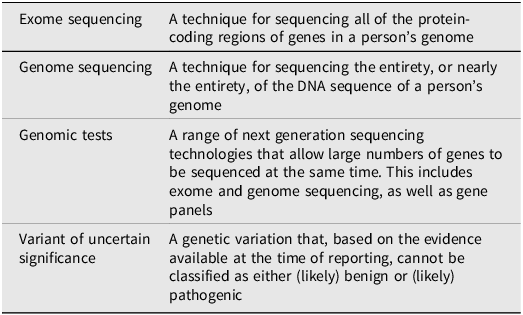
This position statement provides context about the role and status of direct-to-consumer genomic testing options, along with the position of the Human Genetics Society of Australasia (HGSA) on the considerations, discussions and supports to be made available to consumers/patients who choose to pursue online genomic testing. It is a revision of the 2020 Position Statement (Savard et al., Reference Savard, Terrill, Dunlop, Samanek and Metcalfe2020). The terminology in Table 1 lists the definitions that may shift over time as technology and standards change.
Table 1. Terminology

Note: These definitions may shift over time as technology and standards change.
Genomic testsFootnote 1 are becoming widely available beyond clinical settings. Online genomic testing is an umbrella term that describes two distinct genetic testing situations:
-
1. Commercially available tests are marketed to individuals/consumers and can be accessed directly online by the consumer, also known as direct-to-consumer genomic tests. This testing is done in laboratories that generally do not have National Association of Testing Authorities (NATA) accreditation, or equivalent. There is no healthcare professional involved in this testing process. Examples include nutrigenomics or ancestry testing.
-
2. Commercially available testing is also offered through healthcare professionals with formal qualifications in genetics or another recognized specialty (also referred to as ‘clinician-mediated’ testing). This testing is not direct-to-consumer and the testing is undertaken in a NATA accredited or equivalent laboratory. In this situation, the testing is arranged by the healthcare practitioner and returned to the ordering clinician, not directly to the patient. Some examples include reproductive carrier screening arranged by general practitioners or specialized genetic testing in overseas diagnostic laboratories ordered by clinical geneticists or pharmacogenomics testing arranged by psychiatrists.
In this Statement, we focus on the first scenario listed above where genomic information is provided by commercial companies offering direct-to-consumer genomic testing, and that testing is:
-
(a) marketed directly to individuals, consumers or the general public;
-
(b) available to individuals/consumers outside a recognised clinical context;
-
(c) available to individuals/consumers in a clinical context but in the absence of any current or future clinical indication to suggest testing is necessary;
-
(d) available in laboratories who do not have NATA accreditation, or equivalent.
Why Do Individuals Seek Direct-to-Consumer Genomic Testing?
Individuals/consumers may seek direct-to-consumer genomic testing for a variety of reasons. These can include the following:
-
to explore health issues, including to explain past illnesses or present conditions or diagnoses, or to identify predispositions to conditions that have not yet manifested;
-
to explore or understand family history (health and/or genealogical), including parentage;
-
to explore personal genetics and genomics in more depth, such as to satisfy curiosity; or
-
to guide lifestyle or fitness regimens.
Individuals/consumers seeking online genomic testing will do so for different reasons, and they may have more than one reason. They may be motivated by the perception that they will receive results more rapidly than through clinical pathways, or view online genomic testing as a way to explore genomics themselves. In addition, individuals/consumers may encourage relatives and friends to undergo testing. Some companies offer ‘discreet’ testing options using nonstandard samples, such as hair or nail clippings, usually for paternity testing, indicating that these companies facilitate genomic testing of individuals/consumers without their knowledge or consent.
It is the position of the HGSA that direct-to-consumer testing should only be done by individuals/consumers who are well informed, aware of the risks, benefits and limitations of testing, and able to consent to their DNA being collected, analyzed and potentially stored. Where possible, individuals/consumers should also be aware of the alternative option of undertaking testing through healthcare professionals in a clinical context, and the benefits of this.
There is also an emerging market for direct-to-consumer genomic testing in children. This includes testing in newborns and young children for a range of health conditions and other characteristics such as personality traits, dietary recommendations and predicted educational attainment. It is the position of the HGSA that decisions about having a child tested should be based on peer-reviewed, published evidence. Genomic testing for children should be within a clinical context where parents are informed, have access to clinical support and professional genetic counseling about this decision or advice, as well as support for the range of results received.
For further information about genetic testing in newborns and children, please refer to the following HGSA position statements on Predictive and Pre-symptomatic Genetic Testing in Adults and Children (Vears et al., Reference Vears, McLean, La Spina and McInerney-Leo2024), and Genetic Carrier Testing for Recessive Conditions (Vears et al., Reference Vears, Boyle, Jacobs, McInerney-Leo and Newson2023).
Considerations Relating to Newborn Screening
Government-funded newborn bloodspot screening testing (NBST; including both genomic and biochemical tests) is a well-established and carefully planned public health program, which is funded and supported by government health departments in Australia and New Zealand. It is available for all newborns at no cost to parents. The conditions screened for via newborn screening panels have been carefully selected by medical and scientific experts to ensure the tests are as effective as possible with the least possible harm. There are well-established pathways for the follow-up and treatment of babies with abnormal results within the public health system.
The program undergoes continual scientific review, and new tests are added or removed as the evidence supports it. For example, the Australian Health Minister Advisory Council developed the ‘Newborn Bloodspot Screening – National Policy Framework’, forming the standard by which new tests are assessed prior to being introduced as NBST. Recently, conditions such as spinal muscular atrophy and congenital adrenal hyperplasia have fulfilled these criteria and are now being screened. Several additional research projects across the world are evaluating how genomics might be incorporated within newborn screening programs to expand the number of conditions screened. The addition of new screened conditions to a public health program requires consideration of ethical implications, including the development of comprehensive education, consent, and follow-up pathways, and long-term monitoring of both benefits and harms.
The same is not true of direct-to-consumer tests for newborns, although the differences and possible harms from direct-to-consumer genomic tests may not be clear to parents. Furthermore, genomic testing alone is not a replacement for NBST, as some important conditions tested by NBST, such as congenital hypothyroidism, are not reliably detected via genomic testing. There is a high likelihood that untargeted genomic testing will generate a higher number of variants of uncertain significance. Incorrect interpretation of these results can potentially increase anxiety and may also lead to unnecessary procedures or treatments.
As NBST is freely available in all states and territories of Australia and throughout New Zealand, the HGSA recommends newborn screening through state or national newborn screening programs, and not via direct to consumer genomic testing. HGSA recommends that any parents considering direct-to-consumer testing on their newborn are counselled, or given information, to encourage them to also have standard government funded NBST on their newborn.
How Do People Access Online Genomic Testing?
Online genomic tests can be accessed in a number of ways.
-
Individuals/consumers can order tests directly from an online genomic testing company — the increasingly common direct-to- consumer pathway. In this approach, the test is ordered online, the individual/consumer collects their own DNA sample (or with the assistance of a pathology service) and the DNA samples are sent directly to a laboratory for processing. The laboratory may or may not be located in Australia or New Zealand (Allyse et al., Reference Allyse, Robinson, Ferber and Sharp2018). The laboratory will not be NATA accredited and there is no involvement of a healthcare professional.
-
An online genomic testing company may recommend that the test is ordered through a healthcare professional who is an employee of, or contractor with, the testing company. For example, some companies have in-house genetic counselors who can provide pre- and posttest counseling for tests ordered through that company.
-
An online genomic testing company may require that the test is ordered on the individual/consumer’s behalf by a healthcare professional.
-
Individuals/consumers may be referred for testing through their healthcare professional who will order the test via an online portal on behalf of the individual.
Which Laboratory Should Online Genomic Testing Be Arranged Through?
The HGSA recommends that when choosing an online genomic test, preference should be given to tests that will be undertaken in accredited laboratories offering tests registered with the Therapeutic Goods Administration (Royal College of Pathologists of Australasia, Position Statement 2/2013). In Australia, these laboratories are governed by the National Pathology Accreditation Advisory Council (NPAAC) requirements for medical testing for human genetic variation (Australian Commission on Safety and Quality in Health Care, 2022; NPAAC Genetic DTC Guiding Principles, 2014). The NPAAC guidelines provide detailed requirements for laboratories for genetic testing, ensuring samples, data and reports are standardized in accredited settings (Australian Commission on Safety and Quality in Health Care, 2022).
What Formats Are Available for Direct-to-Consumer Genomic Test Results?
Direct-to-consumer testing companies that are not subject to an accreditation process (NATA or equivalent) have no regulations or rules governing how samples are collected, processed and stored, or how data should be analyzed or interpreted. There is some evidence that a substantial proportion of direct-to-consumer test results from unaccredited laboratories are not accurate (Millward et al., Reference Millward, Tiller, Bogwitz, Kincaid, Taylor, Trainer and Lacaze2020).
Information from direct-to-consumer testing companies can be returned to individuals/consumers in a variety of formats. Different approaches to testing and interpretation are used by each company. This can range from providing raw genomic data to interpreted reports generated by the company or a third-party provider, containing results of analyses for the traits and variants they include in their product.
Increasingly, direct-to-consumer DNA testing company websites and third-party genomic interpretive services offer consumers options to do further analyses on their raw or unprocessed DNA data. These websites allow people to use their raw genomic data to generate results for purposes beyond the remit of the original test (Guerrini et al., Reference Guerrini, Wagner, Nelson, Javitt and McGuire2020). For example, results of online ancestry DNA testing could be used to generate health-related information, independent of health professional support or advice, with potential consequences for the individual, their own and their family’s healthcare decisions (Nelson et al., Reference Nelson, Bowen and Fullerton2019).
Results obtained through methods other than direct analysis from a laboratory accredited to perform genomic testing to inform human health and wellbeing should be interpreted with caution. The HGSA recommends that such results must be confirmed in an accredited diagnostic laboratory prior to relying on them to inform options for treatment, surveillance or risk reduction; or before undertaking cascade testing in family members.
Points for Consideration in Direct to Consumer Genomic Testing
The HGSA recognizes that direct-to-consumer genomic tests are accessible to people in Australia and New Zealand, and that many international tests are beyond the scope of domestic regulatory processes. It is the position of the HGSA that individuals/consumers and healthcare professionals/providers should be supported to make informed choices about online genomic testing. This means adequate and ongoing education and resources should be available for individuals/consumers and healthcare professionals/providers before, during and after testing (Metcalfe, Hickerton, Savard, Stackpoole et al., Reference Metcalfe, Hickerton, Savard, Terrill, Turbitt, Gaff, Gray, Middleton, Wilson and Newson2018; Metcalfe, Hickerton, Savard, Terrill et al., Reference Metcalfe, Hickerton, Savard, Terrill, Turbitt, Gaff, Gray, Middleton, Wilson and Newson2018).
Results from direct-to-consumer genomic tests may have an impact on an individual’s perception of their health and/or wellbeing, or the relationship between an individual/consumer and their family, their healthcare professionals/providers and/or the wider health system. To best support and engage with individuals/consumers considering (or who have already undergone) direct to consumer genomic testing, discussions about the following key issues are encouraged:
Choosing to test and choosing an appropriate test. Direct-to-consumer genomic tests and their results can be used for a range of purposes; it is important to consider whether testing is necessary or appropriate and how to choose a test that will provide the information sought.
Expectations. Individuals/consumers may overestimate the utility of results from direct-to consumer genomic tests; it is important to have realistic expectations of the utility of the information obtained from the test, the accuracy of test results and actions that can be taken following receipt of results (either for management of personal health or wellbeing; or pathways to seek confirmation/validation of test results).
Support and information. Direct-to-consumer genomic tests and results can be hard to interpret and understand. It is important to know where, and with whom, help can be obtained and a clear pathway on how this support can be accessed (Savard et al., Reference Savard, Hickerton, Tytherleigh, Terrill, Turbitt, Newson, Wilson, Gray, Gaff, Middleton, Stackpoole and Metcalfe2019).
Actionability. Direct-to-consumer genomic test results may be more useful personally than medically. Results of testing need to be interpreted in the context of an individual/consumer’s personal and family history. Individuals/consumers should consult with their healthcare professional/provider if they are concerned about their health and to seek advice and confirm any health-related genomic test results from an accredited provider before acting on the results.
Family implications. Direct-to-consumer genomic tests generate information not only about the individual/consumer being tested but also about their genetic relatives. Genetic relatives may not want this information generated and may not want to know this information, which may impact on family dynamics. Discussions within families about these issues prior to testing, as well as after results are known, are strongly encouraged.
Evidence. Some direct-to-consumer genomic test results and related reports may not be supported by peer-reviewed, published scientific evidence (Majumder et al., Reference Majumder, Guerrini and McGuire2021).
Rapid change. Direct-to-consumer genomic testing is still a developing field where the evidence base is incomplete. An individual/consumer’s results may differ between companies and/or change over time as new information becomes available. Individuals/consumers should understand that the interpretation of their genomic data can change over time. Updated reports may be issued by the testing company and individuals/consumers should be made aware of this, as well as know how to access these reports.
Regulation. Direct-to-consumer genomic tests may be offered by Australian, New Zealand and overseas companies. The availability of these tests and the techniques used may differ from laboratory to laboratory, and the level of regulation applied to testing companies differs in each country. This makes it difficult to ensure that results from different testing laboratories are consistent, raising questions about their reliability. It should be noted that genomic tests supplied directly to consumers from overseas providers are beyond the scope of Australian or New Zealand regulatory authorities. It is also difficult to determine what legislation or regulation will be applied to how DNA can, or has been, stored, shared and used; this may depend on the country in which the company and laboratory are based, and that could be in different locations (FKalokairinou et al., Reference FKalokairinou, Borry and Howard2020; Savard, Reference Savard2013).
Privacy. Data generated from direct-to-consumer genomic testing may be shared or sold to third parties such as other research groups or companies. It is important to be aware of to what extent domestic law can protect an individual/consumer’s data, and when it cannot. Even in contexts where data is protected within an institution, genomic data may be considered sensitive information for the purposes of privacy legislation, as in Australia, and attract additional obligations for the protection of this information. The HGSA position statement on the ‘Use of human genetic and genomic information in healthcare settings’ provides some context for consideration of these issues.
Commercial interests and/or conflicts of interest. Individuals/consumers should be aware that some companies provide training to healthcare professionals before they are allowed to order a test for a patient. Depending on the content of this training, this may present a conflict of interest. Advice from health professionals employed by, or subcontractors for, online genomic testing companies also may represent a conflict of interest.
Discrimination. Direct-to-consumer genomic test results may affect an individual/consumer’s ability to obtain risk-rated insurance products, such as life insurance. The HGSA position statement on ‘Genetic testing and Personal Insurance products’ (Ayres et al., Reference Ayres, Savard, Mansour, Newson and Boyle2021) is a useful resource to support discussions around the implications of genomic testing on access to insurance.
Within the Australian and New Zealand healthcare systems, there are regulatory and accreditation standards for genomic tests and processes. When individuals are concerned about their health, they should consult an appropriate healthcare professional to decide whether an online genomic test is appropriate and discuss how useful test results could be to make health-related decisions.
Data availability statement
N/A as position paper
Financial Support
This research received no specific grant from any funding agency, commercial or not-for-profit sectors.
Competing interests
Alison McLean has received speaker honorarium from Physician Central and Pfizer.

 Open access

