

Introduction
Greece holds a prominent position in the field of Byzantine sculpture studies. During the Byzantine period, sculpture production flourished across the Greek territory. At various times, local ‘schools’ with distinctive stylistic traits emerged, contributing to the wider tradition of Byzantine sculptural production. Byzantine sculpture served mainly church architecture and met a broad range of structural, decorative, liturgical, and funerary needs through carved reliefs. There was also production for secular buildings, but it remains unknown to us. Today, thousands of Byzantine sculptures survive in monuments, archaeological sites, museums, storerooms, and both public and private collections. Many are also incorporated into later buildings, often as reused spolia. They span a chronological range from the fourth century AD to the early decades of the fifteenth century. Unfortunately, their precise number remains difficult to determine. From the early twentieth century, Greek scholars were among the first to undertake systematic studies of Byzantine sculpture. Pioneers such as Georgios Sotiriou, Andreas Xyngopoulos, and Anastasios Orlandos laid the foundations for the discipline. The wealth of material also attracted prominent international scholars, including André Grabar (Grabar Reference Grabar1963; Reference Grabar1976) and Jean-Pierre Sodini (Sodini Reference Sodini1977). Since those early efforts, academic interest in Byzantine sculpture has remained steady.
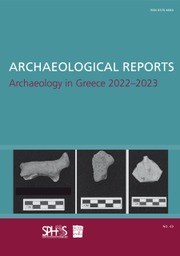
This paper provides an overview of the study of Byzantine sculpture in marble and other hard stones in Greece from 2000 to the present. The choice of this starting point is linked not only to the beginning of a new millennium and the rapid advancement of technology across academic disciplines, but also to specific developments within the field. The year 2000 marked a turning point, as it saw the organization of the first international congress dedicated exclusively to Byzantine sculpture, held in Athens (Pennas and Vanderheyde 2008; Fig. 7.1). Around the same time, several important monographs on aspects of Byzantine sculpture were published (Sklavou-Mavroeidi Reference Sklavou-Mavroeidi1999; Pazaras 2001; Drandakis Reference Drandakis2002), marking a renewed interest in the subject. Over the first quarter of the twenty-first century, scholarly interest in Byzantine sculpture has grown significantly. Research has both deepened and expanded, while museum policies regarding the display and interpretation of Byzantine sculpture have undergone substantial change. The following pages examine and reflect on these developments.

Fig. 7.1. Cover of the book Ch. Pennas – C. Vanderheyde (eds), La sculpture byzantine, VIIe-XIIe siècles. Actes du colloque international organisé par la 2e Éphorie des antiquités byzantines et l’École française d’Athènes (6-8 septembre 2000), BCH Supplément 49, Athènes 2008 © Ch. Pennas, C. Vanderheyde.

Map. 7.1. Sites and museum mentioned: 1. Athens (site), 2. Argos (site, museum), 3. Mount Athos (site), 4. Mani peninsula (site), 5. Chios, Panagia Krina (monument), 6. Mystras (site, museum), 7. Maximianoupolis-Mosynopolis (site), 8. Mount Athos, Vatopedi monastery (monument), 9. Mount Athos, Zygou monastery (monument), 10. Cos (site), 11. Thebes (site, museum), 12. Nikopolis (site), 13. Thessaloniki (site, museum), 14. Naxos (site), 15. Milos (site), 16. Paros (site), 17. Arta (site, museum), 18. Chalkida (site, museum), 19. Didymoteicho (museum), 20. Nea Flogita (museum), 21. Veroia (museum), 22. Ypati (museum), 23. Nafpaktos (museum), 24. Areopolis (museum), 25. Pythagoreio (museum), 26. Chios (museum), 27. Florina (museum), 28. Nisyros (museum), 29. Telos (museum), 30. Karpathos (museum), 31. Kalymnos (museum), 32. Rethymnon (museum), 33. Larisa (museum).
New discoveries
A significant number of sculptures have been uncovered during excavations and the restoration of Byzantine or later monuments and archaeological sites. These finds are usually published by the archaeologists and architects responsible for the projects either in the ‘Chronicles’ section of the Archaeological Bulletin (Archaeologikon Deltion) – the official annual journal of the Greek Archaeological Service – or in conference proceedings. However, the available data remain incomplete. The Archaeologikon Deltion is generally published with a considerable delay, often ranging from six to eight years; the most recent volume, for instance, covers the year 2017. Moreover, some local Ephorates of Antiquities do not provide detailed reports on their activities. Lastly, fragments of Byzantine sculpture are not always deemed significant enough to merit thorough documentation; as a result, detailed descriptions or photographs are often lacking.
A notable example of recent discoveries comes from the restoration of Larissa Castle in Argos, Peloponnese, carried out between 2012 and 2016. During the project, 180 Early Christian and Byzantine architectural elements were unearthed, approximately half of which feature sculptural decoration. The supervising archaeologist, Dr Georgios Tsekes of the Ephorate of Antiquities of Argolis, has provided a preliminary yet informative account of this material, drawing connections between the newly uncovered elements and the previously known finds from the city (Tsekes Reference Tsekes2022).
Recent publications: monographs
The publication of sculptures plays a crucial role in advancing research and expanding knowledge in this field. Around the turn of the new millennium, several significant studies were released, renewing scholarly interest in the subject and encouraging further work. In 1999, the Ministry of Culture published a detailed catalogue of sculptures from the old exhibition of the Byzantine and Christian Museum in Athens. This catalogue was compiled by the late Maria Sklavou-Mavroeidi, supervisor of the museum’s collection of sculptures (Sklavou-Mavroeidi Reference Sklavou-Mavroeidi1999). A few years later, the exhibition was discontinued following the museum’s expansion and reopening. Many of the sculptures featured in the catalogue were incorporated into the museum’s new permanent exhibition, while others were moved to storage or displayed in the museum’s garden. Sklavou-Mavroeidi’s publication retains lasting scholarly value, as a unique resource to this day. Additional material from the museum’s extensive sculpture collection appeared in the catalogue of the temporary exhibition From the Christian Collection to the Byzantine Museum (1884–1930) (Gratziou and Lazaridou Reference Gratziou and Lazaridou2006), as well as in an article focusing on sculptures from the so-called ‘Dark Ages’ (Dimitrakopoulou-Skylogianni Reference Dimitrakopoulou-Skylogianni2005–2007).
In 2001, Theocharis Pazaras, professor emeritus of the Aristotle University of Thessaloniki, published his monograph on the sculptures of the katholikon (i.e. the main church) of the Vatopedi Monastery on Mount Athos (ID 12535; Pazaras 2001). This corpus is of exceptional significance, as it largely reflects the sculptural idiom of Constantinople during the turn from the tenth to the eleventh century. Pazaras later brought together his numerous individual articles and entries on Middle Byzantine sculpture from Mount Athos – alongside previously unpublished material – into a single volume, offering a comprehensive overview of the most significant sculptural ensembles of the monastic republic (Pazaras 2014).
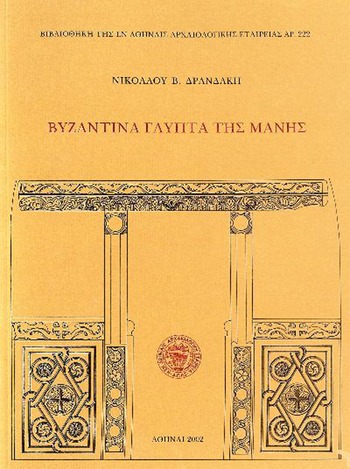
A major contribution to the study of medieval sculpture in southern Greece was the publication of the monograph by the late Nikolaos Drandakis, professor emeritus of the University of Athens, on the Byzantine sculptures of Mani (Drandakis Reference Drandakis2002; Fig. 7.2). This substantial volume documents several hundred sculptures, dating from the eleventh to the fourteenth century, which Drandakis recorded across 82 Byzantine and post-Byzantine monuments in the Mani region. This work, complemented by the professor’s earlier articles (Drandakis Reference Drandakis1972; Reference Drandakis1972–1973; Reference Drandakis1975–1976; Reference Drandakis1980; Reference Drandakis1985; Reference Drandakis1990), offers an invaluable account of the region’s remarkable sculptural wealth, found in what is otherwise a remote and rugged part of the Peloponnese.

Fig. 7.2. Front cover of Drandakis Reference Drandakis2002. © Archaeological Society at Athens.
Catherine Vanderheyde, Maître de conférences of the University of Strasbourg, active in the study of Middle Byzantine sculpture in Greece since the early 1990s, published her doctoral thesis in 2005, originally defended in 1996. The study examines architectural sculpture from the Byzantine theme of Nicopolis (Vanderheyde Reference Vanderheyde2005), covering material from Aetoloakarnania, modern Greek Epirus, and southern Albania. Chronologically, it spans from the Middle Byzantine period to the thirteenth century.
In 2020, Vanderheyde published a second major monograph, this time focusing on sculpture from the eleventh to the fifteenth century (Vanderheyde Reference Vanderheyde2020). This extensive volume presents numerous sculptures from Greece – some well-known, others less so – situating them within their broader artistic and historical context. The following year, another significant contribution appeared: a monograph by Dr Philip Niewöhner (Georg-August University of Göttingen) offering a chronological overview of Byzantine decorative sculpture as a whole (Niewöhner Reference Niewöhner2021). Material from Asia Minor features prominently, with particular attention paid to capitals; however, sculpture from Greece is also extensively discussed. Vanderheyde’s book presents an overview of the field, with long commentary and discussion of various topics, mainly from the perspective of an art historian; Niewöhner’s approach is somehow more ‘technical’, offering a practical guidebook to Byzantine architectural sculpture with rich, up-to-date information. A lot of material from Greece is also included in the recent monograph of Silvia Pedone on the question of polychromy in Byzantine sculpture (Pedone Reference Pedone2022).
Beyond these specialized studies, Byzantine sculpture features prominently in broader scholarly publications. A notable example is the 2002 volume, authored by the late Charalambos Bouras and Laskarina Boura, respectively professor emeritus of the Polytechnical School of Athens and supervisor in the Benaki Museum, on twelfth-century Greek church architecture. This study gathers a large number of well-known and previously unpublished sculptures, and includes chapters offering an analysis that significantly enriches our understanding of Middle Byzantine sculptures in their architectural context (Bouras and Boura Reference Bouras and Boura2002). Charalambos Bouras later published a monograph on Byzantine Athens, in which the sculpture of the city’s Middle Byzantine churches is examined in depth (Bouras Reference Bouras2010; Reference Bouras2017).
Byzantine sculpture also features in studies of individual monuments, such as Charalambos Bouras’s monograph on the architecture of Hosios Loukas monastery (Bouras Reference Bouras2015), Dr Charalambos Pennas’s study of Panagia Krina on Chios (ID 14925; Pennas Reference Pennas2017), and Dr Aspasia Louvi’s work on the churches of Perivleptos and Pantanassa in Mystras (Louvi-Kizi Reference Louvi-Kizi2022). More sculptures have been presented in shorter studies arising from archaeological excavations. These include publications on the Monastery of Zygos on Mount Athos, where significant Early Christian and Middle Byzantine sculptures were discovered (Papangelos Reference Papangelos2005), as well as on sites such as Maximianoupolis-Mosynopolis in Thrace (Zikos Reference Zikos2008) and other locations.
Recent publications: doctoral theses
Significant progress in the study of Byzantine sculpture has been achieved through doctoral research submitted to Greek universities over the past 25 years. These theses have brought to light a substantial body of previously unpublished or only partially documented material. Some focus on major centres of sculpture production or offer comprehensive surveys spanning broad geographical regions, while others adopt integrative approaches, providing more wide-ranging analytical perspectives. A brief overview of these contributions, presented in chronological order of their defence, is therefore appropriate. All these are written in Greek, and most are freely accessible in digital format via the Greek National Archive of Doctoral Theses (https://www.didaktorika.gr/eadd/). Exceptions include those submitted to the Aristotle University of Thessaloniki, which are available through the university library’s website (https://ikee.lib.auth.gr/collection/PhD%20Theses?ln=el%22%20\).
The first doctoral thesis on Byzantine sculpture submitted in the new millennium was authored by Vasiliki Sythiakaki-Kritsimalli, now director of the Ephorate of Antiquities of Herakleion, and defended in 2002. Titled The Architectural Sculpture of Thessaly and Phthiotis in Early Christian and Early Medieval Times, the study focused exclusively on architectural sculpture dating to the Early Christian period and the so-called ‘Dark Ages’, including previously unpublished material (ID 9572, 11046). A revised version was published as a monograph a decade later (Sythiakaki-Kritsimalli Reference Sythiakaki-Kritsimalli2012).
In 2008, Evangelia Militsi-Kechagia, now director of the Ephorate of Antiquities of Messenia, defended her thesis, titled Early Christian Sculpture of Cos: A Contribution to the Study of Architectural Sculpture on Cos, during the Early Christian period (fourth–seventh century). This study includes a catalogue of 226 architectural sculptures and elements, shedding new light on sculptural production in the Dodecanese and along the Asia Minor coast. The thesis was published in 2017 in the local journal Dodecanisos, edited by the Dioceses of the Ecumenical Patriarchate in the Dodecanese (Militsi-Kechagia Reference Militsi-Kechagia2017). Prior to this, the author had published a study on the ambos of Cos (Militsi Reference Militsi1996–1997), later expanded to incorporate Middle Byzantine sculpture from the region (Militsi Reference Militsi2004).
That same year, Nikolaos Melvani, post-doctoral researcher at Johannes Gutenberg University of Mainz, defended his dissertation Late Byzantine Sculpture: Observations on Iconography, Stylistic Evolution and the Social Context. This study addressed a significantly underexplored period, as no comprehensive monograph on Late Byzantine sculpture had previously been produced. A revised English edition was published in 2013 (Melvani Reference Melvani2013).
The doctoral thesis of Eleni Manolessou, archaeologist of the Ephorate of Antiquities of the Cyclades, titled The Medieval Sculpture of Thebes and a Contribution to the Monumental Topography of the City, was completed in 2011. The study catalogues 303 sculptures housed in the Archaeological Museum of Thebes, dating from the ninth to the fourteenth centuries. Several pieces exhibit Western stylistic influences. The material is examined in the context of the topographical development of Byzantine and Latin Thebes.
The 2012 dissertation of Varvara Papadopoulou, director emerita of the Ministry of Culture, Epirus Vetus (4th–7th c.): The Testimony of Sculpture, presents a corpus of 132 architectural, liturgical, and funerary sculptures from across the region of modern Greek Epirus. A significant proportion of the material was discovered in Nicopolis, and was previously known through earlier publications.
The research of Maria Kontogiannopoulou, archaeologist of the Ephorate of Antiquities of Drama, The Middle Byzantine Marble Templa (Chancel Screens) in Northern Greece and Thessaly: Construction – Form – Decoration (2015), focuses on templon screens from the Middle Byzantine period. Based primarily on already published material, the thesis attempts a comprehensive reassessment of the corpus under discussion within its geographical scope.
Giannis Theocharis, archaeologist of the Ephorate of Antiquities of East Attica, defended his thesis in 2014 under the title Architectural Sculpture of Athens from the Early to the Middle Byzantine Period. His research re-examines previously published material, offering new chronologies for several pieces – some of which are notably bold. The revised version, focusing on the period from the eighth to the eleventh centuries, was published in 2022 (Theocharis Reference Theocharis2022).
In 2017, Georgios Tsekes, supervisor in the Ephorate of Antiquities of Argolis, completed his dissertation, Byzantine Sculpture from Arcadia (7th – Early 13th c.). The study catalogues 312 sculptures from Arcadia in the Peloponnese, the majority of which are spolia published here for the first time.
Antigone Tzitzibasi, supervisor of the collection of sculptures in the Museum of Byzantine Sculpture in Thessaloniki, in her 2020 dissertation Architectural Sculpture of Thessaloniki (4th – early 10th c.), analyses 220 pieces from the collection of the same museum, half of which were previously unpublished. The material includes various types of column capitals, the majority of them coming from Thessaloniki.
Two further doctoral theses on Byzantine architecture also include substantial analyses of sculptural material. In Byzantine Churches on Naxos: The Evolution from Early Christian to Middle Byzantine Architecture (2014), Klimis Aslanidis, now associate professor at the Polytechnical School of Crete, offers detailed commentary on the sculptural decoration of the island’s churches, alongside reconstructions of Middle Byzantine templon screens. A revised edition was later published (Aslanidis Reference Aslanidis2017). Similarly, Konstantinos Raptis, assistant professor at the University of Athens, presents in his 2016 thesis, Acheiropoietos Basilica, Thessaloniki: Architecture and Sculptural Decoration, a thorough study of the architectural and liturgical sculpture of this prominent Early Christian monument.
Recent publications: articles
A substantial number of articles have appeared in academic journals, edited volumes, and conference proceedings, presenting assemblages, groups, or individual examples of sculpture from across Greece, spanning all phases of the Byzantine period. A comprehensive review of these studies lies beyond the scope of this overview. However, most titles can be readily located in the annual bibliographic catalogues published in the journal Byzantinische Zeitschrift (https://www.degruyterbrill.com/journal/key/byzs/html).
The majority of these articles have the form of catalogues of new material – especially churches’ decorative elements and regional collections – but there are also titles on wider issues and questions. Certain categories of sculptures have been thoroughly examined or reviewed, such as early Byzantine capitals (Tsigonaki Reference Tsigonaki2023), medieval proskynetaria frames (Kalopissi-Verti Reference Kalopissi-Verti and Gerstel2006), Middle Byzantine altar slabs (Pallis Reference Pallis2018), and Middle Byzantine phialae and baptismal fonts (Pallis Reference Pallis2012). The local workshops and their activity attract many scholars (Sythiakaki Reference Sythiakaki2004; Tsigonaki Reference Tsigonaki2005; Pallis Reference Pallis2006; Mentzos Reference Mentzos2008; Manolessou Reference Manolessou2015; Roussos Reference Roussos2023). There are also studies that trace the use of special materials (Papadopoulou Reference Papadopoulou2001; Vanni Reference Vanni2021), the unfinished members (Bouras Reference Bouras, Emerick and Deliyannis2005), the second use of sculptures (Militsi-Kechagia Reference Militsi-Kechagia2012; Mexia Reference Mexia2019), and the relations between sculpture and epigraphy (Pallis Reference Pallis and Stavrakos2016).
New material has been also presented in studies focusing on the architecture of Byzantine and post-Byzantine monuments. This is a longstanding scholarly practice that complicates the task of systematically tracing and assessing such finds. For instance, a study of the seventeenth-century church of Agia Triada of Adamas, Milos (Cyclades), documents two spolia that, to the best of my knowledge, represent the earliest known examples of Middle Byzantine sculpture from this island (Aslanidis Reference Aslanidis2021).
General assessment of the publications
A brief survey of publications from the past 25 years clearly demonstrates a growing scholarly interest in Byzantine sculpture. Nevertheless, the number of researchers actively engaged in the field, both Greek and other nationalities, remains relatively small. A significant number of those publishing on the subject – archaeologists or architects – engage with it only occasionally. In many cases, their contributions arise from professional duties rather than from a sustained, research-driven commitment to the field. This lack of continuity is a notable limitation, as ongoing engagement fosters both expertise and a deeper understanding of the material. Among Greek scholars, many are members of the Archaeological Service. Their institutional role grants them privileged access to the material and facilitates its publication – a privilege not shared by all researchers.
The body of scholarly work outlined above is generally characterized by academic rigour. Researchers are well informed of current bibliographic developments and adopt multifaceted analytical approaches to their material. One clear limitation, however, lies in the visual documentation, particularly the frequent absence of high-quality drawings of the sculptures under study. In terms of content, Greek scholarship would benefit from more integrative studies, as a large part of the current output focuses on the publication of newly discovered material, typically in the form of catalogues. This imbalance is, to some extent, understandable: given the wealth of previously unpublished material, the priority has naturally been to bring it to light.
Most studies are published in Greek, typically with summaries in English. This remains a perceived drawback, owing to the understandable difficulty the language presents for those without a good command of it. However, recent advances in computer-assisted translation technologies are steadily reducing this barrier. In this context, the language of publication should no longer be regarded as a decisive obstacle to engaging with scholarly work published in languages not widely used in international academic discourse.
Conferences and symposia
Byzantine sculpture from Greece is regularly represented at academic conferences on Byzantine archaeology and art, primarily in the country but abroad as well. The most prominent of these conferences is the annual Symposium on Byzantine and Post-Byzantine Archaeology and Art organized by the Christian Archaeological Society (established in 1884). This event consistently includes relevant papers, some of which are later published in the Deltion of the Christian Archaeological Society (https://ejournals.epublishing.ekt.gr/index.php/deltion/index). New findings are also presented at regional conferences organized by the Ephorates of Antiquities of the Ministry of Culture, as well as by the departments of history and archaeology at Greek universities. The oldest of these events is the annual Conference on Archaeological Work in Macedonia and Thrace.
Conferences devoted exclusively to Byzantine sculpture, however, are rare. The most important example to date was held in Athens in 2000, co-organized by the then Second Ephorate of Byzantine Antiquities and the French School at Athens. It brought together 30 scholars, from 11 countries, who presented new research and offered broader interpretative perspectives. The proceedings were published in 2008 as a supplement to the Bulletin de Correspondance Hellénique (Pennas and Vanderheyde 2008). The conference marked a turning point for the field, drawing attention to the significance of sculpture within Byzantine archaeological and art historical studies, and identifying new directions for future research. To coincide with the event, the Second Ephorate also published a small catalogue of Middle Byzantine sculptures from Paros and Naxos (Pennas Reference Pennas2000).
In 2009, an international symposium on Byzantine relief icons was held in Volos. It was organized by the Department of History, Archaeology and Social Anthropology at the University of Thessaly, in collaboration with the Seventh Ephorate of Byzantine Antiquities. Sixteen scholars participated (http://extras.ha.uth.gr/relieficons/el/). Unfortunately, the proceedings of this symposium were never published.
Museum policy
Over the past 25 years, the Hellenic Ministry of Culture has inaugurated several new archaeological museums across Greece, while a number of older museums have been renovated. The place of Byzantine sculpture within this context is particularly interesting, as it reflects how the country’s official archaeological authorities perceive this form of art. Byzantine sculptures are exhibited in three types of museums: a) collections devoted exclusively to Byzantine sculpture; b) museums dedicated to the Byzantine period that include sculpture; and c) the so-called ‘diachronic’ museums.
The first category is exemplified by the sculpture collection of the Parigoritissa Church in Arta (Epiros) and the archaeological collection at Karambambas Castle in Chalkida (Euboea), both inaugurated in 2009. The Arta Sculpture Collection is housed in the restored refectory of the Parigoritissa Monastery, adjacent to the famous church. It features sculptures from Arta and the surrounding region, dating from the Early Christian period through to the fourteenth century (Papadopoulou, Dimitrakopoulou and Karamberidi Reference Papadopoulou, Dimitrakopoulou and Karamberidi2009). The Karambambas Castle Archaeological Collection is dedicated entirely to marble and stone sculpture. Its exhibition, titled Fragments of a City: An Exhibition of Medieval Sculptures of Chalkida, spans from the Early Christian period to the nineteenth century and includes sculptures associated with the city’s Jewish and Ottoman communities (Delinikolas, Ghini-Tsofopoulou and Pantelidou-Alexiadou Reference Delinikolas, Ghini-Tsofopoulou, Pantelidou-Alexiadou and Simosi2025). Byzantine pieces are especially prominent, many of them on public display for the first time (Pantelidou-Alexiadou and Manolessou Reference Pantelidou-Alexiadou and Simosi2025).
The Byzantine and Christian Museum in Athens is among the major institutions that were either renovated or inaugurated after 2000. It houses a significant collection of Byzantine architectural sculpture, most of which originates from Athens and the wider Attica region. The pieces are arranged according to the chronological and thematic structure of the permanent exhibition (Konstantios Reference Konstantios2008), allowing visitors to trace the development of sculpture across time. An open-air display in the museum garden was later added, combining original sculptures and casts to encourage more direct visitor engagement.
The permanent exhibition of the Museum of Byzantine Culture in Thessaloniki, inaugurated in its current form in 2004, includes 120 sculptures among some 2,000 objects spanning from the second and third centuries to the seventeenth century (Nalpantis Reference Nalpantis2023). Sculpture features prominently in the sections devoted to the Early Christian church and the Middle Byzantine period. The museum’s collection of Middle and Late Byzantine marble icons is also particularly significant, as Thessaloniki was the only centre within the territory of modern Greece where such icons were produced.
The Didymoteicho Museum, inaugurated in 2016, is the northernmost of the regional Byzantine museums. Its permanent exhibition presents sculptures from various sites across what is now Greek Thrace (Linardatos Reference Linardatos2012). Further south, the Byzantine Museum of Chalkidiki is housed in the Centre for Byzantine Culture ‘Justinian’ in Nea Flogita. At present, only one gallery of its permanent collection is open to the public, exhibiting Early Christian sculptures from monuments in the wider region (https://archaeologicalmuseums.gr/el/museum/5df34af3deca5e2d79e8c1a8/byzantine-museum-of-chalkidiki). The Byzantine Museum of Verroia opened to the public in 2008 and showcases sculptures from the Early Christian period, with a particular focus on the Middle Byzantine era (Petkos and Karagianni Reference Petkos and Karagianni2007). The Byzantine Museum of Fthiotida, located in Ypati – medieval Nea Patrai – was established in 2007. It houses a significant collection of sculptures spanning all periods, originating from sites throughout the Fthiotida region (Vasilikou and Douma Reference Vasilikou and Douma2007). The Museum of Nafpaktos Castle – the most recent addition, inaugurated in 2024 – displays for the first time a large number of architectural and liturgical sculptures from across the Byzantine period, all found within the city itself. In the Peloponnese, the Byzantine Museum of Argos, which opened to the public in 2017, stands out for the richness of its sculptural collection (Athanasoulis and Vasileiou Reference Athanasoulis and Vasileiou2016). Sculpture holds a central place in the exhibition, which includes many pieces that had not previously been exhibited or studied (Fig. 7.3). Earlier, in 2001, a new permanent exhibition was installed at the small museum within the archaeological site of Mystras. It is titled Byzantium and the West: The Experience of the Late Byzantine Urban Centre of Mystras (Kalamara and Mexia Reference Kalamara and Mexia2001), and showcases some of the most important Late Byzantine sculptures from the site. In the Mani region, the Pikoulakis Tower Museum in Areopolis – part of the Mani Museums Network – has, since 2005, hosted the exhibition Stories of Religious Faith from Mani, which includes sculptural material from the Early Christian and Middle Byzantine periods (Kalamara Reference Κalamara2005).

Fig. 7.3. General view of the sculptures exhibition at the Byzantine Museum of Argolis, Argos. © Ephorate of Antiquities of Argolis.
Turning to the Greek islands, a new museum dedicated to the Byzantine history of Samos was inaugurated in 2008 at the Tower of Lykourgos Logothetis in Pythagoreio. The exhibition places emphasis on the castle of Pythagoreio and the life and legacy of Logothetis himself (Kavvadia Reference Kavvadia2008 and Reference Kavvadia and Triantafyllidis2017: 45–51, fig. 1–4). It features outstanding examples of sculpture from Pythagoreio, the capital of Byzantine Samos. On Chios, the reopening of the Byzantine Museum presented a rich and varied sculptural collection, spanning from the Early Christian period to the end of Byzantine rule (Kavvadia Reference Kavvadia and Triantafyllidis2017: 53–60, fig. 6–12).
A more recent development in the museum policy of the Hellenic Ministry of Culture is the establishment of so-called ‘diachronic’ museums, which present archaeological material ranging from prehistory to the Byzantine period and, in some cases, to the modern era. Among them, sections with Byzantine sculptures are found in the Archaeological Museum of Thebes, the Diachronic Museum of Larisa, the Archaeological Museum of Florina, the Archaeological Museum of Messenia, the Archaeological Museums of Nisyros, Kalymnos, Telos, and Karpathos in the Dodecanese, as well as the temporary exhibition at the Archaeological Museum of Rethymnon.
The status of Byzantine sculpture in Greek museums has clearly evolved over recent decades. Today, this material is presented on an equal footing with other artefact categories –mosaics, frescoes, icons, works of minor arts, pottery, everyday life objects– and often plays a pivotal role in shaping the overall curatorial narrative. Beyond this shift in attitude, the establishment of new museums and collections has brought to light a substantial number of sculptures that had previously remained in storage or in the courtyards of older institutions. This marks an important step forward, both for their preservation and for facilitating scholarly research. Nevertheless, for the majority of these museums – as with many older institutions – there are still no published scholarly catalogues of their collections. Consequently, many of the Byzantine sculptures they house remain unpublished, limiting their use as comparative material in academic study. Notable exceptions include the Byzantine Museum of Verroia (Petkos and Karagianni Reference Petkos and Karagianni2007), the Byzantine Museum of Argolis (Athanasoulis and Vasileiou Reference Athanasoulis and Vasileiou2016), and the Pikoulakis Tower Museum in Mani (Kalamara Reference Κalamara2005). The catalogue of the earlier permanent exhibition at the Byzantine and Christian Museum in Athens, as previously mentioned, remains an especially valuable scholarly resource (Sklavou-Mavroeidi Reference Sklavou-Mavroeidi1999).
Temporary exhibitions
Byzantine sculptures are also featured in temporary exhibitions organized by the Ministry of Culture or other institutions, such as the Benaki Museum in Athens, both within Greece and abroad. The most significant temporary exhibition on Byzantium held in Greece was titled Byzantine Hours: Works and Days in Byzantium. Presented between 2001 and 2002, it comprised three distinct exhibitions displayed in Athens, Thessaloniki, and Mystras. A range of sculptures was included in the section Everyday Life in Byzantium, which was shown in Thessaloniki; particular emphasis was placed on the role of craftsmen (Papanikola-Bakirtzi Reference Papanikola-Bakirtzi2002). Sculpture also featured prominently in the exhibition From the Christian Collection to the Byzantine Museum (1884–1930), which focused on the establishment of the Byzantine Museum in Athens. This exhibition was held at the museum between 2002 and 2003 (Gratziou and Lazaridou Reference Gratziou and Lazaridou2006). More recently, sculptural elements were included in the exhibition Byzantium and the Arabs, held in Thessaloniki from 2011 to 2012 (Bonovas and Tzitzibasi Reference Bonovas and Tzitzibasi2011).
Byzantine sculptures are frequently loaned to major international exhibitions. Notable examples include: Byzantium: Faith and Power (1261–1557), presented in 2004 at the Metropolitan Museum of Art, New York (Evans Reference Evans2004); Byzantium 330–1453, held at the Royal Academy of Arts, London, in 2008–2009 (Cormack and Vassilaki Reference Cormack and Vassilaki2008); and Heaven and Earth: Art of Byzantium from Greek Collections, organized by the National Gallery of Art, Washington, and the J. Paul Getty Museum, Los Angeles, in 2014 (Drandaki, Papanikola-Bakirtzi and Tourta Reference Drandaki, Papanikola-Bakirtzi and Tourta2013).
Ongoing challenges and future prospects
Over the past 25 years, research into Byzantine sculpture in Greece – as well as attitudes towards it – has made significant progress. Nonetheless, several problems and shortcomings continue to hinder the development of the field. Chief among these is the lack of a comprehensive overview of the material. The sculptures that have been published represent only a small fraction of the total number of surviving works, the exact quantity of which remains impossible to determine. The compilation of systematic catalogues, whether by region or museum collection, has seen only limited progress. Although the most important sculptures are well known to the scholarly community and are properly protected, a full understanding of the field remains elusive, as critical data are still missing.
The large number of unregistered sculptures poses serious risks to their preservation and protection. Spolia, in particular, are especially vulnerable to exploitation by unethical ‘art lovers’ and antiquities traffickers. The theft of an unregistered sculpture often results in its permanent loss, depriving both archaeological scholarship and cultural heritage of the invaluable information it embodies. A notable example is the region of Mani, which once housed an impressive body of sculptural material. However, numerous losses have been recorded there – even during the period when Nikolaos Drandakis was conducting fieldwork in the area. He noted that several sculptures, which he had fortunately documented and photographed, had already disappeared by that time (Drandakis Reference Drandakis2002: XIV).
The case of an eleventh-century marble tie-beam, stolen in 1998 from the Church of the Transfiguration of the Saviour in Nomitsi, Mani, demonstrates the vital importance of systematic registration and documentation in the archaeological record. More than a decade later, the relief appeared in the catalogue of a major European auction house and was sold for a considerable sum. Thanks to the earlier investigations of Nikolaos Drandakis in Mani – and in particular a published photograph of the sculpture – the tie-beam was identified and subsequently repatriated through the efforts of the Greek Ministry of Foreign Affairs in 2012 (https://www.archaiologia.gr/print-article/?print=43084).
It is therefore essential to document the many Byzantine sculptures that remain unregistered and to expand the body of relevant publications – at the very least in the form of concise regional catalogues. A recent contribution in this direction is the work of Olga Gratziou, professor emerita of the University of Crete, and Dr Maria Vakondiou, post-doctoral researcher of the Institute for Mediterranean Studies, Crete, on the Venetian sculptures of Crete (Gratziou and Vakondiou Reference Gratziou and Vakondiou2021). Despite the island’s size and the amount of material, the analytical studies and catalogues were successfully compiled in two volumes. This model could usefully be applied to Byzantine sculpture as well. In parallel, modern digital technologies offer promising opportunities for the creation of open-access databases that can be continuously enriched. One such initiative was undertaken by the Directorate for the Management of the National Archive of Monuments of the Ministry of Culture (https://nationalarchive.culture.gr/el#/). The archive includes digitized movable finds curated by various regional Ephorates of Antiquities across Greece. For example, a search using the keyword ‘panel’ yields approximately 500 reliefs or fragments spanning the full chronological range of Byzantine history. Nevertheless, it is evident that only a small portion of the material has been digitized and made publicly accessible thus far. The content uploaded to the National Archive of Monuments is also accessible through the National Aggregator of Digital Cultural Content, operated by the National Documentation Centre (https://www.searchculture.gr/aggregator/portal/). Several institutions contribute to this platform, including the Archaeological Society at Athens, which provides access to its digitized archive containing photographs and drawings of Byzantine sculptures.
Ideally, the much-needed new publications on Byzantine sculpture should adopt a holistic and interdisciplinary approach. The identification, through chemical analysis, of the marbles and other types of stone used in sculpture is a crucial step in the understanding and interpretation of the material. However, despite substantial technological advancements over the past decades, the high cost of chemical analysis continues to limit its accessibility to most researchers. As a result, marble identification is often based on macroscopic observation alone – a method that carries a considerable margin of error, ultimately depriving scholarship of important and potentially illuminating data, such as identification of quarries, marble trade routes, tracing of workshops, and recycling of materials. At present, the number of studies incorporating the results of scientific analyses remains very limited.
The preservation of Byzantine sculpture in Greece faces a number of challenges. Many sculptures remain embedded in later buildings or are left outdoors, often in the courtyards of churches and monasteries. Similar practices are followed by the Archaeological Service, resulting in numerous sculptures being exhibited or stored in the gardens and outdoor spaces of museums, monuments, and archaeological sites. Prolonged exposure to the elements causes serious deterioration and damage – particularly to the surfaces of reliefs – despite the inherent durability of the material. The problem is especially acute in areas with high levels of air pollution, such as major urban centres. An illustrative example of the destructive effects of outdoor display can be found in the current condition of sculptures that have remained exposed for decades at major archaeological sites in Athens, such as the Acropolis, the Ancient Agora, the Roman Agora, and Hadrian’s Library. In many instances, the carved decoration has been severely damaged – in some cases rendered almost invisible – due to surface erosion and biodeterioration. The case of a relief panel, unearthed during the excavations of the Athenian Agora and set into a retaining wall near the Church of the Holy Apostles, is particularly telling (Frantz Reference Frantz1961: fig. 22). After prolonged exposure to the elements and urban air pollution, the panel has suffered extensive corrosion and exhibits ‘sugaring’ – an irreversible form of granular disintegration.
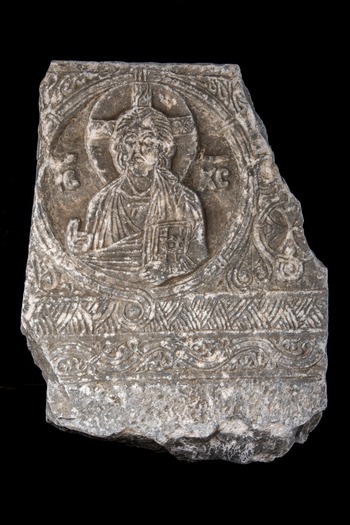
Despite the inclusion of numerous Byzantine sculptures in newly curated museum collections over the past 25 years – often under ideal conservation conditions – the outdated practice of outdoor display has not yet been fully abandoned. One striking case is the capital bearing the monogram of the empress Irene of Athens (Sklavou-Mavroeidi Reference Sklavou-Mavroeidi1999: 82, n. 111). This element is of great historical and artistic significance, representing a vital link between sculptural tradition and the historical identity of Athens. Yet it remains displayed in the garden of the Byzantine and Christian Museum, rather than being given a prominent place in the museum’s permanent galleries. Exposed to sun, rain, birds, and pollution, it continues to deteriorate. Similarly, at the new Archaeological Museum of Thebes, a rare relief of Christ from the area remains in the garden – protected only by a canopy – rather than being exhibited in the permanent collection (Fig. 7.4).

Fig. 7.4. Relief with the bust of Christ, courtyard of the Archaological Museum of Thebes. © Ephorate of Antiquities of Boetia.
The overall assessment of the study and treatment of Byzantine sculpture in Greece in the twenty-first century is a positive one, despite ongoing challenges. Research in this field has expanded significantly compared to previous decades, demonstrating a consistently high standard of academic quality. A new generation of scholars specializing in Byzantine sculpture is being trained at Greek universities, and the number of sculptures presented in articles and reports has grown considerably. Museums have adopted a more inclusive approach to sculpture, as shown by its increased presence in permanent exhibitions. Advances in modern technology are proving increasingly useful in addressing ongoing challenges. Key priorities include the systematic recording and documentation of dispersed material, broader use of scientific analysis – such as marble identification – and more consistent implementation of conservation measures.




 Open access

