

Introduction: history of the journal and 30th birthday celebrations
It is my honour as Editor in Chief of the Journal of Management & Organization to write this state of the journal editorial and 2025 year in review with you and to bring your attention to developments with the journal. As you are likely aware the journal is associated with the Australian and New Zealand Academy of Management (ANZAM) as its flagship journal. This year the journal is celebrating its 30th birthday anniversary. This milestone offers an opportunity to consider how the journal and the academy have progressed over the years to be a central point of authority for management research and practice. Initially, the journal was published as a hard copy version with a blue printed cover depicting the ANZAM association (I still have a hard copy). This was the time before online digital versions of journals and articles became popularized. To submit to the journal initially required authors to mail a printed copy of their article with an electronic version included as a floppy disk to the publisher. This was then reposted to the journal editor who then sent paper copies of the articles to reviewers thereby relying twice on the postal service.
The journal was called ‘JANZAM’ in terms of being the Journal of the Australian and New Zealand Academy of Management and was directly associated with Australian and New Zealand management researchers and practitioners. This association still occurs in the minds of some authors, due to the affiliation with ANZAM, but with the introduction of Cambridge University Press as a new publisher, the name was changed to the Journal of Management & Organization. There have been numerous benefits associated with the more general name of the journal being the Journal of Management & Organization that emphasises the global importance of Australian and New Zealand research engagement. In Australia and New Zealand, we have some of the highest ranked universities and researchers in the world and definitely make an impression on the world stage but we are also global. Whilst the countries Australia and New Zealand are not included in the journal name now they are still very much part of the ethos and mission of the journal. The cultural qualities, positivity, and high quality are embedded into the journal that focuses on innovative and relevant research. This is linked to being published by one of the best publishers in the academic publishing industry Cambridge University Press that is at the forefront of publishing practices. This enables a globally renowned publishing house to be associated with the journal and further give it credence and credibility. Quality is at the heart of Cambridge University Press and this was evident in 2024 when there was cybersecurity issues that delayed publication of some journal issues.
Management topics and areas of interest
The journal is focused on general management areas of interest so takes an inclusiveness approach that recognises the diversity of management practices. This enables different viewpoints and philosophical underpinnings to be incorporated into the journal. To me management is an exciting and forever changing topic area that is emphasised in many business practices. The way it is defined and applied is subjective and alters based on the perceptions of those involved (Foss & Mazzelli, Reference Foss and Mazzelli2025). This is evident with scholars and practitioners of business management having different speciality areas of interest that are based on management involving planning, organizing, leading and controlling (Fleming & Spicer, Reference Fleming and Spicer2014). The way management is applied can also be interdisciplinary, transdisciplinary and cross-disciplinary in meaning that makes it more complex (Blackler, Reference Blackler1993).
The goal of any kind of management study published in the journal is to advance knowledge related to being a manager or being involved in a business management setting. This is important in order to stay up to date with what is happening in the global marketplace in terms of management systems (Teece, Reference Teece2018). The key area of management is to understand how organizational planning is influenced by strategic action and leadership (Murmann, Aldrich, Levinthal & Winter, Reference Murmann, Aldrich, Levinthal and Winter2003). This means many studies are focusing on human resource management in terms of training, compensation, well-being, and employment issues (Piazza & Castellucci, Reference Piazza and Castellucci2014). Related to this is operations management and supply chain management that emphasises logistics and stakeholder engagement. This can involve understanding how to manage marketing practices and family business processes. Effective design management approaches are required to control properly the functioning of a business (Glaser, Sloan & Gehman, Reference Glaser, Sloan and Gehman2024). To do this can require a project management perspective that incorporates financial management tools such as budgeting and investment considerations as well as an emphasis on sustainable development goals (Ligorio, Venturelli, Rosato & Campo, Reference Ligorio, Venturelli, Rosato and Campo2025).
Businesses need to focus on facilitating organizational growth through their competitive advantages (Kalliath & Brough, Reference Kalliath and Brough2008) as well as focusing on sustainable business models (Stubbs, Farrelly, Fabianke, Burch & Ramesh, Reference Stubbs, Farrelly, Fabianke, Burch and Ramesh2024). By identifying new opportunities, international business management becomes more important in terms of launching new businesses (Pereira et al., Reference Pereira, Correia, Braga, Alves, Ratten and Braga2025; Ratten & Braga, Reference Ratten and Braga2024). This is important in terms of cultural considerations and recognising geopolitical trends as well as talent management (Luna-Arocas & Danvila-del-Valle, Reference Luna-Arocas and Danvila-del-Valle2024). Entrepreneurship and innovation are embedded in international management that ensures new ideas are progresses (Lewin, Reference Lewin2014). Other speciality areas of management interest include healthcare and technology that are increasingly linked to artificial intelligence (Perotti, Dhir, Ferraris & Kliestik, Reference Perotti, Dhir, Ferraris and Kliestik2024). In addition, teaching practices that are part of educational management practices are essential and the journal publishes articles on these topics. Table 1 states the final decisions for the journal for the past year in terms of acceptance and rejection ratio. A large number of articles have been submitted that reflects the interest in management and organization research as well as the high standing of the journal in the field. A total acceptance ration of 8.4% resulted, which indicates only the best and most relevant research is published in the journal.
Table 1. Final decisions for the Journal of Management & Organization

Submission date is between 1 October 2024 and 30 September 2025.
Accepted articles and transition to open access
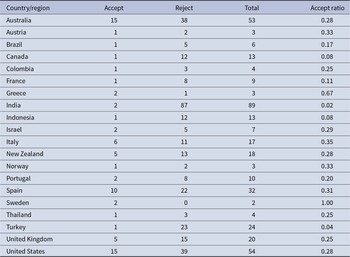
Once articles are accepted for publication they are then published online in a relatively short time period. This is essential for ensuring that knowledge gets disseminated to a global audience in a quick way. All articles published from February 2025 onwards have been open access with all articles in issues from 2026 being open access. This is a great step in ensuring knowledge is accessible to everyone and capitalises on open society initiatives. The open access publishing model is likely to accelerate further citation rates due to readers being able to freely access information and often this is a requirement for grant recipients. Table 2 states the manuscripts accepted by country and region in the past year with statistics in terms of number of articles submitted. Only accepted articles are included in this analysis and it shows the geographical diversity of authors publishing in the journal.
Table 2. Manuscripts accepted by country/region for Journal of Management & Organization (only accepted articles by region shown)

Decision date is between 1 October 2024 and 30 September 2025.
Review process
The journal recognises that a fast and timely approach is needed in order to manage the review process. To do this quick decisions are made with a high level of desk rejects to ensure that articles entering the review process have a high likelihood of acceptance. This ensures precious editor, reviewer, and author resources are not wasted as time is critical in publishing excellent management articles. Once an article is deemed as having a good chance of being published, it is designated to an associate editor who then sends it to a minimum of two reviewers. Similar to other high-quality journals, we are trying to reduce the number of review rounds and have a general policy of trying to have a maximum of three review rounds. This ensures that amendments to the article are made as suggested by the reviewers but also enables the originality of the article to be continued. This is important as multiple review rounds can substantially change the essence of an article and create difficult situations between authors who want to maintain integrity but also respect reviewer’s suggestions.
We are trying to recognise more the work of reviewers for the journal who spend a lot of time in reading and reviewing articles. To achieve this goal, we have implemented monthly reviewer awards with a certificate to recipients issued that are stated in Table 3. We also have issued certificates for top downloaded articles with downloads often indicative of future citation patterns. This helps to acknowledge what people are reading and the interest of readers on certain topics. Associated with this are certificates for most highly cited articles that recognise the impact of articles on publishing patterns. Please also find the list of reviewers for 2025 who have kindly reviewed for the journal in the appendix of this editorial.
Table 3. Best reviewers by month and institutional affiliation

Journal metrics
The journal has been growing significantly in the past year with the Scopus CiteScore on the 5 May 2025 being 7.3, having grown from 6.6 in 2024. This upward trend is evident in the journal being quartile 1 in Organizational behaviour and human resource management (78th percentile) and quartile 1 in Business and international management (76th percentile). This means the journal is in the top quartile in both management categories in Scopus and also links with the journal’s essential mission of being a top publisher of management research and practice. As more universities move to recognising quartile 1 publications it is great to see the journal being in the quartile 1 category for two business management categories. Related to this is more people being concerned about what quartile categories journals are listed in as this does matter in ensuring that research is published in a specific management outlet. Table 4 states in more detail the journal’s metrics.
Table 4. Journal metrics (5 May 2025)

Collaborative approach
The journal is based on a collaborative approach between all stakeholders involved in the publication and promotion process. I thank very much the President of ANZAM Professor Ruth McPhail for her strategic insights, past Presidents Kevin Lowe and Kerry Brown, and future President Sara Walton for their help with this. Associated with this is stakeholders in academia and management practice that read the journal articles and recognise it as being high quality. I also acknowledge the Associate Editors of the journal for their help. Many thanks to the Academy Manager Emma Nixon and the Journal Manager Ann Williamson. I also thank Jamie Davidson and Craig Baxter at Cambridge University Press. It is a pleasure working with the board and members of the ANZAM are lucky to have such a great group of people.
Conclusion
In the future, I hope to see the continued growth of the journal and more emphasis on new article categories such as teaching case studies, policy thought pieces, viewpoints, debates, and other innovative article categories. This will further support our essential business of publishing empirical and conceptual articles from a range of methodological perspectives that offer useful insights to management practice. Please do reach out if you have any suggestions about the journal and I look forward to a further productive year that emphasises the linkage between Australian and New Zealand as well as international management researchers and the Journal of Management & Organization.
Appendix. List of reviewers for 2025 (up until 1/10/2025)




 Open access

