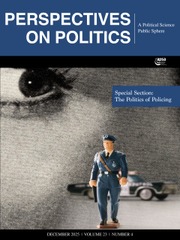


The Politics of Policing
Policing is a crucial topic for political science not only due to its intrinsic importance but also as a window into larger questions related to authority, law, state–society relations, inequality, violence, organizational culture, bureaucratic politics, and race and racism, among others. This special section probes the politics of policing with approaches as diverse as political theory, geospatial analysis, large-n events data, survey experiments, and single and comparative case studies. As a collection, these articles shed light on policing as a dependent variable and an independent variable, examine its relationships to social movements and racial segregation, and explore the circumstances that lead law enforcement agents to harm the very communities that they are charged with protecting.
The first two articles treat policing behavior as an outcome to be explained. “A Democracy of Authorities: Broken Windows Policing and the Neoconservative Political Theory of Law and Order” argues that standard neoliberal interpretations of policing fail to account for support for tough-on-crime agendas from marginalized communities. Probing this puzzle, Milo Ward shifts from an explanation centered on neoliberalism to one focused on neoconservatism and theorizes the right-wing political sensibilities underlining broken windows policing. Ward traces these ideas to James Q. Wilson’s theories developed after the urban crisis of the 1960s and 1970s, as scrutinized in Wilson’s papers at the RAND Corporation Archives. He argues that Wilson viewed urban problems as a crisis of moral and political authority rather than material deprivation and thus envisioned punitive policing less as a strategy for reducing crime than a way of restoring authorities in communities. Specifically, broken windows policing was seen as a way to cultivate relationships between formal authorities, such as the police, and informal leaders, such as parents, teachers, and business owners, and thereby ease urban communities’ anxieties and empower them from within. Challenging the view that overpoliced communities are inherently opposed to the police as instruments of state repression, this work contributes to a growing literature on the multiracial and cross-class coalitions that support punitive politics and encourages continued nuanced work in this realm.
“The George Floyd Effect: How Protests and Public Scrutiny Changed Police Behavior” shifts from the role of ideas and ideology in shaping policing to the impact of protest activity. Marcel Roman, Klara Fredriksson, Chris Cassella, Derek A. Epp, and Hannah L. Walker note that some believe that the 2020 Black Lives Matter demonstrations sparked a “Ferguson Effect,” whereby protest and concomitant public scrutiny led to a decrease in policing in general, and the withdrawal of police from discretionary stops and searches in particular, resulting in an increase in violent crime. Using data from four U.S. cities between 2018 and 2023, regression discontinuity-in-time analysis identifies a discontinuous and persistent drop in officer contact with civilians after the 2020 protests that is not driven by a decline in citizen requests for assistance. The authors then evaluate competing hypotheses about whether this decline in policing is prosocial, in terms of leading to improvements in the efficiency and quality of policing activity through more contraband per stop, more arrests per stop, and diminished racial disparities; or antisocial, in terms of being accompanied with no such change in overall quality in stops or instead being associated with worsening quality. Their findings suggest that the character of postprotest depolicing is mixed and context dependent but, on balance, point to an improvement in arrest rates for reasons related to criminal activity and, importantly, no increase in violent crime. The study yields systematic evidence that protests can compel widespread and durable changes in police behavior and calls for ongoing work to disentangle the mechanisms through which those changes occur and the circumstances that affect the character they take.
The next two articles in the section turn from the drivers of policing behavior to its consequences or implications. “How Police Behavior Shapes Perceptions of Protests: Evidence from Black Lives Matter” looks specifically at protest policing and investigates how it shapes public perceptions of violence and social movements. Jasmine English, Ariel White, and Laurel Eckhouse develop an original dataset of police behavior at more than 1,000 Black Lives Matter protests between 2014 and 2017. This provides new descriptive evidence that police responses to these protests varied widely, even across protests with similar messages and tactics. The authors then carry out a survey experiment to examine the implications of this variation. They find that, when news of a protest is accompanied by a photograph of a large and armed police deployment, respondents are more likely to describe the protest as violent and having violent and trouble-making intentions, though exposure to a single police response is insufficient to shift broader support for the protest movement. Exploratory analysis suggests that white respondents are more responsive to these cues of a heavy police presence than are nonwhite respondents, and Black respondents appear nonresponsive to that cue. Challenging arguments that police violence generates public sympathy for nonviolent protesters, these findings point to the role of the police in creating perceptions of movement violence and, thereby, possibly affecting movement support and success. The study encourages further research into the police as strategic actors constructing narratives about protest, including public perceptions of violence or nonviolence that can differ from the actual forms of protest used by social movements.
Allison Verrilli, Marcel Roman, Hannah Walker, Derek Epp, Amy Liu, and Mike Findley shift the spotlight to the everyday work of policing stops and arrests and consider how they both shape and are shaped by space. “Policing Socio-Geographic Boundaries and Inequality” notes that many critical race scholars have theorized that police work to maintain boundaries between racially segregated neighborhoods, but we lack empirical studies to evaluate and substantiate these relationships. Filling this gap, the authors use census demographic data to develop a novel, data-driven metric of racial boundary zone status at the block level. They then use granular police data on stops, arrests, and crime, along with methods of areal wombling, to identify racial boundary zones in seven American cities and evaluate the impact of boundaries on police activity. This dataset decouples policing and crime and reveals that police activity is higher in racial boundary zones, exceeds observed crime, and results from policing practices as much as from conflict between private citizens. This agenda-setting study recasts the borders between communities as the outcome of political processes rather than interpersonal ones and encourages future work to unpack the role of policing in those processes.
Another major topic in the study of the politics of policing is police violence. The final two articles in this special section delve into a particular form of such violence: the use of torture by law enforcement agents. “Torture’s Bureaucracy and the ‘Legitimacy Effect’” examines Israel’s Inspector for Complaints Against General Security Service Interrogators (Mavtan), a department in the Ministry of Justice charged with investigating allegations of the use of torture against Palestinian detainees. Drawing on diverse data sources—including internal correspondence, ethnographic fieldwork, responses to Freedom of Information requests, interviews with key actors, and files from 125 case files from 2012 to 2022 accessed in the archive of Israel’s Public Committee Against Torture—Hagar Kotef and Merav Amir show that Mavtan’s review of more than 1,400 torture complaints has never led to criminal charges. Extensive bureaucratic activity and procedural diligence, they conclude, result in the appearance of accountability without actual accountability. To describe and interpret this outcome, the authors develop the concept of the “legitimacy effect,” or the semblance of good governance and rule of law that enables impunity by concealing rather than revealing facts of abuse. This conceptual and empirical contribution encourages future research to reconcile liberal legalism with pervasive human rights violations, including by tracing how legal bureaucratic apparatuses can function to promote rather than constrain state violence.
“Chicago Police Torture and the Limits of Human Rights Enforcement in Liberal Democracies” similarly considers why liberal institutions fail to stop patterns of police torture, as well as how survivors can eventually win redress. Mark S. Berlin builds a case study of police torture in Chicago between 1972 and 1991 through analysis of court documents, archival records, news reporting, and a brief comparison of torture cases to the police killing of Black Panther activists in 1969. Extending research that distinguishes between the consequences of oppressive and repressive state violence, Berlin argues that the latter category, such as state violence that targets marginalized individuals uninvolved in political activity, is less likely to trigger the practical, affective, and informational mechanisms that push liberal institutions, such as courts, elected officials, media, and civil society, to fulfill their functions in prohibiting rights violations. In the Chicago case, it was only when exogenous developments increased the supply of information and public concern that survivors and their advocates managed to catalyze media and civil society to apply pressure on courts and elected officials to act as rights enforcers. This new framework for understanding the persistence of state violence in democracies calls for deeper understanding of the obstacles to activating liberal institutions to prevent policing abuses, as well as continued study of how this type of abuse can render those obstacles especially difficult to overcome.
Digital Politics
Information technologies shape all domains of modern life, including access to and struggles over power. In this respect, the digital realm is a critical field for theory-building and empirical analysis in political science. The three articles in this special section push forward research on digital politics by examining both dynamics of change internal to digital platforms and the changes that these platforms create in the world. In doing so, each article emphasizes the significance of human agency as well as how that agency influences and is influenced by institutional constraints. They thus offer an important call to political scientists to attend to what makes digital technologies new and distinct, but never to lose sight of the people who create and use them.
“Institutional Change on Digital Platforms: Temporal Shifts in the Power of Users, Businesses, and States” notes that much of existing political science research on digital technology focuses on interactions between platforms and states. In contrast, Sverrir Steinsson emphasizes the importance of user power and investigates under what conditions user-generated digital content platforms are responsive to pressures from not only states but also users and businesses. The author adopts a historical institutionalist perspective to build a comparative study of Facebook, Wikipedia, Digg, and Reddit that assesses online archival data, secondary reporting on internal debates about platform management, and, in the case of Facebook, internal communications made publicly available in antitrust lawsuits. Findings connect the significance of network effects to temporal sequencing: specifically, when users alter the institutional architecture early in the life of a platform, they can lock in pro-user institutional characteristics; otherwise, the threat of user revolts becomes less consequential as a platform grows. This work demonstrates the utility of applying historical institutionalist frameworks to digital politics in order to analyze how timing, sequencing, and path dependence shape digital platforms in general, and the potential agency and power of users, in particular.
Whereas Steinsson considers the institutional structure of digital platforms as a dependent variable, W. Lance Bennett and Steven Livingston turn to digitally networked organizations as an independent variable explaining one of the most pressing outcomes of contemporary politics: crises in liberal democracy. In “Platforms, Politics, and the Crisis of Democracy: Connective Action and the Rise of Illiberalism,” they review and synthesize literature on the sources of democratic backsliding, distinguishing between what they call the technocentric paradigm, focused on the role of digital platforms in spreading disinformation and amplifying extremist content, and the institutionalist paradigm, centered on the social, economic, and political organizational factors that draw more extremist groups into conservative parties. The authors craft an integrated framework that explains how digitally networked publics interact with more traditional party surrogates and electoral processes to bring theretofore-scattered extremist factions into conservative parties, pushing both institutions and communication processes in illiberal directions. They illustrate this framework by tracing how Donald Trump’s Make America Great Again movement transformed the Republican Party in the United States. In highlighting the interactive, organizational dynamics of networked extremism, this reflection essay points to the need to look beyond individual leaders and instead deepen our understanding of the relationships between disruptive technologies and institutional erosion in democratic contexts.
The final article in this section, “Platforms are People Too: Social Media Firms and International Relations,” also considers the impact of digital technologies on politics but shifts from the domestic to the international sphere. Jonathan Fisher and Idayat Hassan ask how and why social media have the influence they do on global politics and why this influence manifests differently in different polities and contexts. Emphasizing the need to understand the corporations behind platforms and their algorithms, the authors call to disaggregate social media firms into their executives, employees, and organizational contexts and examine how their role and composition shapes them as actors in global politics. Using semistructured interviews and analysis of public statements and documents, the authors argue that social media firms’ influence on global politics is the consequence of choices and pressure applied by human decision-makers. This influence is especially shaped by their embeddedness in Global North networks that deprioritize relationships with the rest of the world. This reflection essay sets an agenda for further research on social media firms as an emerging actor in international relations, encouraging more studies that view them as political units that exist in time and space and that trace how they interact in institutional environments consisting of a multiplicity of power centers, perspectives, and expressions of agency.
Shaping Political Attitudes and Perceptions
Political scientists study a wide range of attitudes and perceptions that influence political life. This section brings together studies of how states seek to influence public opinion and whether such efforts succeed, as well as research examining what shapes the attitudes and perceptions of different kinds of political actors—voters, legislators, and think tanks—across various political contexts. These papers’ arguments and findings open new avenues for research on the behavior of authoritarian regimes, the effects of information campaigns, the role of meso-level actors in processes of polarization and depolarization, and the conditions under which gender bias is likely to emerge.
The first two articles in the section explore how states seek to shape attitudes and perceptions within their polities. While international alliances can sustain legitimacy-building efforts for authoritarian leaders, they also raise challenges when those allies’ actions are at odds with a regime’s official discourse. In “Mirrors and Mosaics: Deciphering Chinese and Russian Domestic Bloc-Building Narratives,” Ming Ma, Daniil Romanov, Alexander Libman, and Genia Kostka ask how authoritarian leaders communicate with their domestic publics and elites regarding bloc-building efforts with other authoritarian states. They show that when autocratic governments form alliances that might appear to contradict their national interests or undermine domestic legitimacy, they seek to win the support of domestic audiences by crafting strategic narratives that frame their cooperation as beneficial. The authors deploy computational text analysis coupled with a critical reading of a sample of state-media content from Russia and China to demonstrate that both countries’ official discourse is unified in its depiction of Western democracies and its criticism of U.S. leadership in international affairs but diverges in the strategic narratives presented to domestic audiences to justify their alliance. While Russia relies heavily on anti-Westernism, China frames the cooperation benefits in economic and cultural terms. The study advances the literature on interstate cooperation by highlighting the role of strategic narratives in transferring external recognition from authoritarian peers to domestic audiences. It also contributes to our understanding of propaganda and authoritarian legitimation by explaining how authoritarian states build narratives that not only divert attention but also influence how citizens interpret geopolitical events and alliances.
Another way that states shape public attitudes and perceptions is through strategic use of images. Philipp M. Lutscher and Karsten Donnay investigate the effects of visual propaganda in “Does Hard Propaganda (Also) Work in Democracies? Evidence from the United States.” Heavy-handed images of political leaders and security forces are commonly used by authoritarian regimes to communicate simple but powerful messages that signal state strength and resolve—what a branch of the literature has described as “hard propaganda.” This study considers whether this type of political communication yields the same result in democratic contexts. In a preregistered online survey of U.S. citizens fielded in June 2020, the authors expose participants to randomized pairs of real-world images from the Trump administration’s response to the 2020 Black Lives Matter protests that resemble the type of “hard propaganda” the literature has studied in authoritarian settings, such as depicting the president walking surrounded by his inner circle or giving a speech to security forces. The authors find that respondents exposed to visual propaganda do indeed perceive the government to be stronger and that effect holds across partisan divides. Yet unlike citizens subject to heavy-handed forms of propaganda in autocratic settings, government opponents in democracies who see overt and crude propaganda images have a greater willingness to join antigovernment protests. Despite perceiving the government as stronger, government opponents are not deterred from resisting those governments and have a higher potential to mobilize than those in the control group. The study advances our understanding of propaganda in democracies. It also contributes to studies of democratic backsliding by highlighting how partisanship influences citizen responses to hard propaganda in polarized democracies.
Moving from state- to individual-level drivers of attitudes, in “Beyond Changing Minds: Raising the Issue Importance of Expanding Legal Immigration,” Alexander Kustov takes a new angle to assess voters’ perceptions of immigration. Building on prior work showing that anti-immigration voters care about the issue more than pro-immigration voters do, the author explores the conditions under which the personal issue importance of immigration can change. The study relies on a nationally representative survey experiment treating respondents with verifiable arguments about the benefits of boosting legal immigration. Baseline data corroborate previous findings that opponents tend to care about immigration more than supporters care about it. The data also make a novel intervention by suggesting key differences in the perceived importance of subissues such as border security and admission numbers. Based on a new measure of issue public membership, the study finds that providing relevant information brought pro-immigration voters to care more about the issue, without mobilizing immigration opponents. Against the author’s expectations, the treatment did not change participants’ willingness to sign a petition or their priorities among different issues related to immigration. Also contrary to expectations, the results suggest that offering factual narratives increased pro-immigration attitudes among anti-immigration voters. These findings make substantive and descriptive contributions to the literature on immigration politics and persuasion and open new avenues of research on how information campaigns can influence both attitudes and political behavior.
Research on political polarization also increasingly examines how attitudes and perceptions are formed and influenced. While most studies focus their attention on elites or masses, Katarzyna Jezierska, Andrea Krizsán, and Adrienne Sörbom turn to the meso-level of civil society organizations. In “(De)Polarization Entrepreneurs? Think Tanks and Pernicious Polarization in Central Europe,” the authors investigate whether think tanks engage in polarization or depolarization processes, and what mechanisms drive these dynamics. Based on 53 semistructured interviews collected from 41 think tanks in Hungary and Poland between 2020 and 2022, the authors argue that think tanks are not merely passive receptors of polarization dynamics but active agents that contribute to both polarization and depolarization. They do so by altering perceptions about “us,” “them,” and “the middle ground,” which in turn translate into specific patterns of discourse and interactions. In Hungary and Poland, the authors find that think tanks contribute to polarization more often than they contribute to depolarization, despite the potential for social desirability bias in their interviews. These think tanks function, they argue, as “polarization entrepreneurs” by homogenizing views within political camps, widening divisions between opposing sides, and eroding the moderate middle ground that could serve as space for constructive debate. Turning a spotlight on think tanks as an understudied source of political influence, this article advances the literature on polarization, democratic backsliding, and interest group politics.
Closing this section, in “Gendered Perceptions of Legislative Influence,” Jaclyn Kaslovsky, Tabitha Koch, and Michael P. Olson turn the focus to the perceptions of women legislators by their peers. Inquiring whether legislators and legislative insiders are biased against women legislators and their achievements in office, the authors employ data from the North Carolina General Assembly consisting of subjective evaluations from state legislators, journalists, and lobbyists on the extent to which members of the legislature are influential. By comparing these subjective data with more objective measures of involvement in the legislative process, such as bill sponsorship, committee assignments, and leadership positions, they find little evidence of discrimination against women legislators. A large body of research shows that women candidates and legislators have to work harder to win elections and hold their seats. By contrast, this study finds that women and men are perceived similarly when they enter the chamber and legislative insiders adjust their evaluations as women and men evolve over the course of their careers. Changes in the standing of a legislator, such as a new committee assignment or promotion to a leadership position, are interpreted similarly regardless of the legislator’s gender. The results do suggest, however, that ageism and sexism may create an intersectional bias, as women legislators were perceived as less effective as they gained seniority, though the authors note that this finding might be limited by the small number of senior women in the sample. This research advances our understanding of gender inequality in legislatures around the world and, more generally, of the likelihood of different types of gender bias across contexts.
Political Thought in Historical Context
The articles in this final section reflect on foundational ideas that shape political thought and political theory, situating thinkers in the times in which they lived and considering both how they interacted with those times and how their ideas remain pertinent into the present. In doing so, they analyze overlooked interventions that invite us to reconsider established views on critical contemporary problems, from intergenerational obligations to hope and political anxiety. They also shed light on the history of political theory in the United States and political scientists’ influence in political life.
Questions of intergenerational justice—what one generation owes to the next—remain central to contemporary political debates over climate policy, public debt, and constitutional amendments. Two founding-era American thinkers, Thomas Paine and Thomas Jefferson, developed influential early frameworks for thinking about these obligations, and their ideas continue to shape modern discussions. While the conventional scholarly view aligns Paine with Jefferson’s approach to intergenerational rights, Samuel Burry challenges this consensus in “Thomas Paine and the Idea of Intergenerational Rights.” By examining one of Paine’s lesser-known works, Dissertations on Government; the Affairs of the Bank; and Paper Money (1786), Burry argues that the financial crisis of the nascent American republic shaped Paine’s thoughts on intergenerational rights, leading him to develop ideas distinct from Jefferson’s Paris writings. Notably, Paine’s framework includes a redistributive element absent in Jefferson’s account, which imposes an obligation on present generations to ensure not only the stewardship of resources but also a rightful inheritance for all future individuals. By drawing on a previously overlooked source, Burry offers a fresh interpretation that contributes to scholarship on both intergenerational rights and Paine’s legacy.
In “Rawls and the Rediscovery of Liberal Hope,” Connor K. Grubaugh examines another essential concept in political thought with pressing contemporary relevance: hope. Despite its prominent role in recent Anglo-American liberal democratic discourse, scholars have largely overlooked Rawls’s treatment of this theme, either ignoring it entirely or glossing over important shifts in his ideas over time. By analyzing Rawls’s changing perspective throughout his major works, Grubaugh argues that hope became central in Rawls’s final work, The Law of Peoples (1999), marking a significant but underappreciated shift in his thinking about moral psychology, political stability, and theodicy. This transformation represents Rawls’s move away from his earlier reliance on a form of modern theodicy, which emphasized rational justifications that rendered hope unnecessary, toward embracing hope as an essential virtue for navigating temporal uncertainty. Grubaugh further argues that Rawls’s late turn reveals a fundamental tension: liberalism relies on a virtue that it struggles to justify within the bounds of public reason and secular norms. The spiritual undertones of liberal hope clash with secular commitments yet hope remains indispensable for defending liberal ideals against illiberalism. By tracing this development in Rawls’s thinking in the context of his major works, Grubaugh illuminates the problematic relationship between liberalism and hope while advancing our understanding of Rawlsian thought.
Nathan H. Feldman takes us from analyzing political thinkers in the context of their times to tracking the historical context of the evolution of political theory as a field within political science. In the reflection “Political Theory within and without Political Science,” the author seeks to explain how, when, and why a schism occurred between political theory and the broader discipline of political science in the United States. Relying on archival evidence, including material from Sheldon Wolin’s archives and papers from the Conference for the Study of Political Thought, Feldman traces the development of political theory in the period between the 1940s and 1970s. He argues that the division between political theory and other subfields in political science was largely shaped by a group of leading political theorists such as Leo Strauss and Sheldon Wolin who, across these three decades, identified their work with humanism and positioned it in opposition to “positivism” and “methodism.” This stance emerged as a response to the behavioralist approach of the 1940s and 1950s, which emphasized empirical data and the study of political behavior rather than normative theories. The political upheavals of the 1960s further widened this divide by encouraging theorists to align their work more closely with radical political change. By examining this historical development, Feldman sheds light on the ongoing marginalization of political theory within political science and invites reflection on both the common ground among all political science subfields, as well as the unique role of political theory within the broader discipline.
Closing this section, Nick Dorzweiler also situates political thought in historical context by focusing on the political ideas and activity of one of the leading political scientists of the mid-twentieth century: Harold Lasswell. In “‘Human Nature in Action’: Harold Lasswell, NBC Radio, and the Psychotherapy Program for the American Masses,” the author explores Lasswell’s theories regarding the American public’s psychological ills and examines NBC Radio’s motivations for supporting his unprecedented initiative to deliver psychotherapy on a mass scale. Drawing on previously unexamined archival material, Dorzweiler argues that Lasswell saw widespread psychological insecurities stemming from American individualism and conflicting societal demands as a critical threat to social stability and democratic governance. His radio show “Human Nature in Action,” which aired weekly on NBC’s Red Network for nearly two years in the 1930s, was devised as “preventive politics”: an intervention to reduce psychic tensions and contentious political activity. The author contends that NBC supported the initiative to demonstrate its educational influence beyond entertainment and counter concerns about radio’s negative effects on Americans. The article invites us to reconsider the similar reliance of contemporary political commentary on narratives about the danger of anxiety and proposes that anxiety be understood as a meaningful component of individual and collective life. It also contributes to the history of political science and the growing literature on the ways in which political scientists have influenced political life beyond academia.


