


No CrossRef data available.
Article contents
Myth and Meaning in Shang Bronze Motifs
Published online by Cambridge University Press: 26 March 2015
Abstract
An abstract is not available for this content so a preview has been provided. Please use the Get access link above for information on how to access this content.
Information
- Type
- Research Notes and Communications
- Information
- Copyright
- Copyright © Society for the Study of Early China 1985
References
NOTES
1. Malinowski, Bronislaw, Myth in Primitive Psychology (London, 1926Google Scholar.
2. Loehr, Max, Ritual Vessels of Bronze Age China (New York, 1968)Google Scholar, see pls. 3 and 4.
3. See Chi, Li, The Beginnings of Chinese Civilization (Seattle: 1957), pls. 49, 50 (from HPKM 1004)Google Scholar.
4. The Genius of China: An Exhibition of Archaeological Finds of the People's Republic of China (London, 1974), no. 79Google Scholar.
5. Chunqiu jingzhuan jijie 蕃秋嫂傅潭解 (congkan, Sibu edition). (Wengong 18.9)Google Scholar.
6. Lushi chunqiu, 16:13a (Sibu congkan).
7. “Sons of suns: myth and totemism in early China,” Bulletin of the School of Oriental and African Studies 44, pt. 2 (1981): 290–326CrossRefGoogle Scholar; See also Houxuan, Hu “Jiaguwen Shangzu niao tuteng de yuji”
  Lishi lunzong
 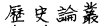 1 (1964):133–59Google Scholar, and “Jiaguwen sojian Shangzu niao tuteng de xin zhengju“
  Wenwu 1977.2:84–87Google Scholar.
8. Elisseeff, Vadime, Bronzes archaiques Chinois au Musée Cernuschi, vol. 1, no. 46Google Scholar; Shigeki, Kaizuka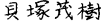 , Sekai bijutsu zenshü
  vol. 12 (Tokyo, 1962), no. 28Google Scholar.
9. yanjiusuo, Zhongguo shehui kexueyuan kaogu
 , Yinxu fu hao mu
 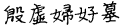 (Beijing, 1980), col. pl. 13.1Google Scholar.
10. Chang, K. C., Art, Myth and Ritual: The Path to Political Authority in Ancient China (Cambridge, Mass., 1983), p. 73Google Scholar.