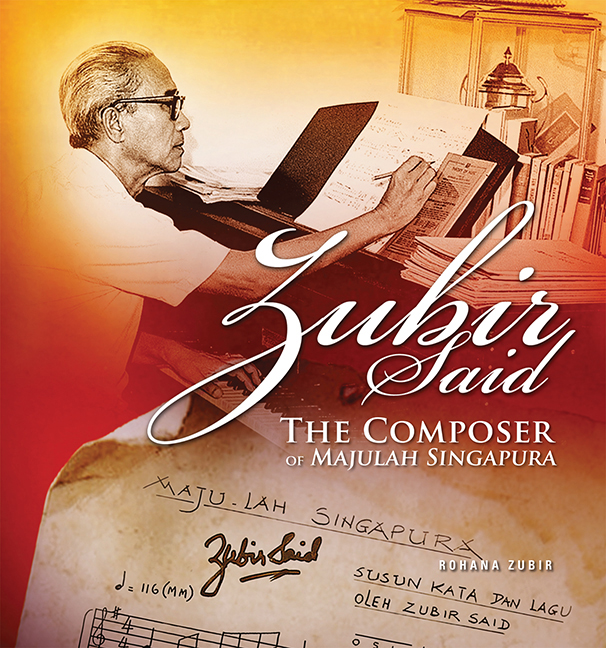
Zubir Said, the Composer of Majulah Singapura

-
Select format
-
- Publisher:
- ISEAS–Yusof Ishak Institute
- Publication date:
- October 2015
- September 2012
- ISBN:
- 9789814311823
- 9789814311816
- Dimensions:
- Weight & Pages:
- 00kg,
- Dimensions:
- Weight & Pages:
- Series:
- Local History and Memoirs
Show more authors 
You may already have access via personal or institutional login
Book description
Zubir Said is best known as the composer of Majulah Singapura, the national anthem of Singapore; Semoga Bahagia, the Singapore school anthem; and Melayu Raya. Born into a humble and religious family in Sumatra where music was considered haram, at 21 he set out to seek his fortune in Singapore, attracted initially by the glittering lights and the availability of butter and kopi susu, but soon by the opportunities it offered him to pursue his dreams. Armed with his first musical instrument, a bamboo flute he had carved himself, and a basic knowledge of music number notations, Zubir taught himself to read, write and compose music. Despite the many challenges he faced, he became a musical icon of the 1950s and 1960s on both sides of the Straits of Johor, at a time when Independence was the clarion call and nationalist fervour was running high.The nationalist sentiments nurtured in Zubir's youth during the Dutch and Japanese occupations of Indonesia were channelled into his numerous compositions of national songs. Highly acclaimed at the time, some of the compositions later became a source of discontent and a platform for political debate. During a period in the wilderness, he immersed himself in the world of films, composing songs and background or "mood" music, and pioneering voice dubbing. The advent of recorded music in films, however, led to a third career. During the lean post-war years, he had mastered the art of photography and became a busy freelance photographer. He developed a unique method of teaching music, the SOLMISASI system of number notations, to nurture talent and a love of music among young children.This book, which includes numerous photographs, documents, musical scores and articles, as well as a CD of a selection of Zubir Said's compositions, vividly reveals one of Singapore's leading composers as family man, friend, composer and mentor. It also accords Zubir Said his rightful place in the history of Singapore.
Contents
Contents
Metrics
Full text views
Full text views helpTotal number of HTML views: 0
Total number of PDF views: 0 *
 Loading metrics...
* Views captured on Cambridge Core between #date#. This data will be updated every 24 hours.
Usage data cannot currently be displayed.
Accessibility standard: Unknown
Why this information is here
This section outlines the accessibility features of this content - including support for screen readers, full keyboard navigation and high-contrast display options. This may not be relevant for you.
Accessibility Information
Accessibility compliance for the PDF of this book is currently unknown and may be updated in the future.