The Year That Shaped the Victorian Age
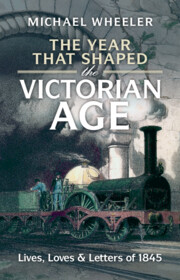

-
Select format
-
- Publisher:
- Cambridge University Press
- Publication date:
- 08 December 2022
- 22 December 2022
- ISBN:
- 9781009268868
- 9781009268851
- Dimensions:
- (216 x 138 mm)
- Weight & Pages:
- 0.7kg, 280 Pages
- Dimensions:
- Weight & Pages:
- Subjects:
- Literature, English Literature 1830-1900
You may already have access via personal or institutional login- Subjects:
- Literature, English Literature 1830-1900
Show more authors 
You may already have access via personal or institutional login
Book description
What was special about 1845 and why does it deserve particular scrutiny? In his much-anticipated new book, one of the leading authorities on the Victorian age argues that this was the critical year in a decade which witnessed revolution on continental Europe, the threat of mass insurrection at home and radical developments in railway transport, communications, religion, literature and the arts. The effects of the new poor law now became visible in the workhouses; a potato blight started in Ireland, heralding the Great Famine; and the Church of England was rocked to its foundations by John Henry Newman's conversion to Roman Catholicism. What Victorian England became was moulded, says Michael Wheeler, in the crucible of 1845. Exploring pivotal correspondence, together with pamphlets, articles and cartoons, the author tells the riveting story of a seismic epoch through the lives, loves and letters of leading contemporaneous figures.
Reviews
‘This lively account shows how a single year came to epitomise so many of the overarching themes of the Victorian age. An inviting read even for those already familiar with the episodes depicted, this is a meticulous and thoroughly-researched tour de force of scholarship by an author who always has new things to say.’
Rohan McWilliam - Professor of Modern British History, Anglia Ruskin University
‘Remarkably informative, interesting, well-researched, and well-expressed, this study complements the many existing books on Victorian life and culture with both well- known and little-known material approached from a fresh point of view and supplemented in places by the use of hitherto unpublished documents.’
Rosemary Ashton - Emeritus Quain Professor of English Language and Literature, University College London
‘Wheeler is a fine cultural historian, and anyone who picks up this book will learn a great deal about the figures he has chosen … (his) study is careful and consistently interesting.’
Robert Douglas-Fairhurst Source: The Spectator
‘In this enthralling study, Wheeler argues that it was in 'the crucible of 1845' that Victorian England came to define itself … Reading Wheeler’s chapter on … John Henry Newman - so well does he tell the familiar story - it is as if we are hearing it for the first time.’
John Pridmore Source: Church Times
‘A fascinating and insightful exploration of how open and private letters connected to key events of this calendar year reveal a new way to consider studies of the Victorian era. Wheeler’s grasp of the politics, literature, relationships, movements, and questions of 1845 are vastly impressive, and are conveyed to the reader in thematically organized sections that progressively build upon one another. Wheeler skillfully weaves his argument and reflects on previous chapters to highlight connections while transitioning to new analyses to maintain a united purpose: to demonstrate how public and private correspondence of 1845 reveals a society grappling with change, crises, and reform.’
Jacqueline H. Harris Source: Victorian Studies
Contents
Contents
References
Metrics
Altmetric attention score
Full text views
Full text views helpTotal number of HTML views: 0
Total number of PDF views: 0 *
 Loading metrics...
* Views captured on Cambridge Core between #date#. This data will be updated every 24 hours.
Usage data cannot currently be displayed.
Accessibility standard: Unknown
Why this information is here
This section outlines the accessibility features of this content - including support for screen readers, full keyboard navigation and high-contrast display options. This may not be relevant for you.
Accessibility Information
Accessibility compliance for the PDF of this book is currently unknown and may be updated in the future.