Writing and the Revolution

-
The digital format of this book is no longer available to purchase from Cambridge Core. Other formats may be available.
-
Select format
-
- Publisher:
- Liverpool University Press
- Publication date:
- 11 July 2020
- 25 June 2019
- ISBN:
- 9781786942821
- 9781786942197
- Dimensions:
- Weight & Pages:
- Dimensions:
- Weight & Pages:
You may already have access via personal or institutional login- Series:
- Liverpool Latin American Studies
Show more authors 
You may already have access via personal or institutional login
Book description
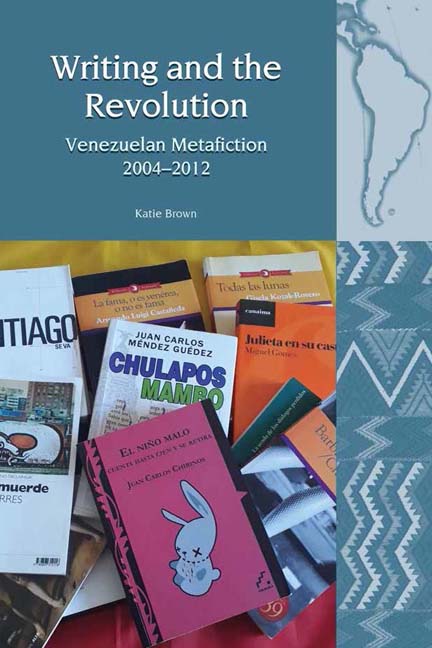
In contrast to recent theories of the 'global' Latin American novel, this book reveals the enduring importance of the national in contemporary Venezuelan fiction, arguing that the novels studied respond to both the nationalist and populist cultural policies of the Bolivarian Revolution and Venezuela's literary isolation. The latter results from factors including the legacy of the Boom and historically low levels of emigration from Venezuela. Grounded in theories of metafiction and intertextuality, the book provides a close reading of eight novels published between 2004 (the year in which the first Minister for Culture was appointed) and 2012 (the last full year of President Chávez's life), relating these novels to the context of their production. Each chapter explores a way in which these novels reflect on writing, from the protagonists as readers and writers in different contexts, through appearances from real life writers, to experiments with style and popular culture, and finally questioning the boundaries between fiction and reality. This literary analysis complements overarching studies of the Bolivarian Revolution by offering an insight into how Bolivarian policies and practices affect people on an individual, emotional and creative level. In this context, self-reflexive narratives afford their writers a form of political agency.
Contents
Contents
Metrics
Full text views
Full text views helpTotal number of HTML views: 0
Total number of PDF views: 0 *
 Loading metrics...
* Views captured on Cambridge Core between #date#. This data will be updated every 24 hours.
Usage data cannot currently be displayed.
Accessibility standard: Unknown
Why this information is here
This section outlines the accessibility features of this content - including support for screen readers, full keyboard navigation and high-contrast display options. This may not be relevant for you.
Accessibility Information
Accessibility compliance for the PDF of this book is currently unknown and may be updated in the future.