
Skip to main content Accessibility help
×
  • Cited by 5
    • Show more authors
    • You may already have access via personal or institutional login
    • Select format
    • Publisher:
      Cambridge University Press
      Publication date:
      20 April 2023
      27 April 2023
      ISBN:
      9781009029957
      9781316516423
      9781009014267
      Dimensions:
      (229 x 152 mm)
      Weight & Pages:
      0.63kg, 342 Pages
      Dimensions:
      (229 x 152 mm)
      Weight & Pages:
      0.496kg, 342 Pages
    You may already have access via personal or institutional login
  • Selected: Digital
    Add to cart View cart Buy from Cambridge.org

    Book description

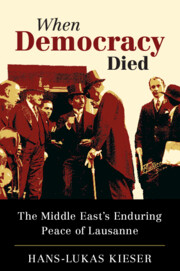
    The Treaty of Lausanne, signed in Switzerland in July 1923, officially settled the conflict between the Ottoman Empire and the Allied forces. Not only did the Treaty establish the borders of the modern Turkish republic, but it also defined boundaries, political systems, and understandings of citizenship in the newly formed post-Ottoman nation-states. Here, Hans-Lukas Kieser recounts how the eight dramatic months of the Lausanne Conference concluded more than ten years of war and genocide in the late Ottoman Empire. Crucially, the Treaty was in favour of a homogeneous Turkish state in Asia Minor and became the basis for the compulsory 'unmixing of people' that facilitated the persecution of minority groups, including Armenians, Kurds, and Arabs. Not only did this significant yet oft-overlooked treaty mark the end of the League of Nations' project of self-determination and security for small peoples, but it was crucial in shaping the modern Middle East, and dictatorships in Turkey and Europe.

    Reviews

    ‘Rather than viewing the Treaty of Lausanne from the perspective of the victorious founders of the Turkish Republic, this critical study examines the Treaty from that of its losers. Kieser convincingly argues that the Treaty legalized and rewarded ethnic cleansing; sounded the death-knell for democratic self-determination; and ushered in extreme nationalist, authoritarian rule in Turkey.’

    Marc Baer - London School of Economics

    ‘This study gives an original interpretation of the Lausanne Treaty. It allows us to understand the emergence of the two new regimes of the post-Great War period: fascism in Italy and Kemalism in Turkey, which, together with the Bolshevik Soviet Union, considered themselves to be the pillars of an antidemocratic age to come.’

    Hamit Bozarslan - EHESS, School for Advanced Studies in the Social Sciences, Paris

    ‘Kieser offers an important corrective to histories of modern Turkey. He shows that ‘colonialism’ is not the only process to blame for the Middle East’s anti-democratic tradition, and that Europe owes some of its interwar fascism and ultranationalism to the Lausanne Conference. The Lausanne Treaty, the book shows, reads like a manual on how to get away with genocide. Germany was watching.’

    Lerna Ekmekcioglu - Massachusetts Institute of Technology

    ‘In this brilliant study, Kieser shows how the Lausanne Treaty proved both a crucial endpoint of the Paris system and the basis for the rise of authoritarianism. Carefully researched and cogently argued, it finetunes understandings of fascism by revealing the family resemblances between Turkey and other regimes that sought to eliminate minorities.’

    Michelle Tusan - University of Nevada, Las Vegas

    ‘Hans-Lukas Kieser’s carefully researched monograph … considers the post-Ottoman fate of the Anatolian Peninsula through the prism of the Lausanne Conference … Kieser overturns a surprisingly resilient narrative that has cast the post-World War I foundation of Türkiye in a heroic light.’

    Stacy E. Holden Source: H-Net: Humanities and Social Science Online

    Refine List

    Actions for selected content:

    Select all | Deselect all
    • View selected items
    • Export citations
    • Download PDF (zip)
    • Save to Kindle
    • Save to Dropbox
    • Save to Google Drive

    Save Search

    You can save your searches here and later view and run them again in "My saved searches".

    Please provide a title, maximum of 40 characters.
    ×

    Contents

    Metrics

    Altmetric attention score

    Full text views

    Total number of HTML views: 0
    Total number of PDF views: 0 *
    Loading metrics...

    Book summary page views

    Total views: 0 *
    Loading metrics...

    * Views captured on Cambridge Core between #date#. This data will be updated every 24 hours.

    Usage data cannot currently be displayed.

    Accessibility standard: Unknown

    Why this information is here

    This section outlines the accessibility features of this content - including support for screen readers, full keyboard navigation and high-contrast display options. This may not be relevant for you.

    Accessibility Information

    Accessibility compliance for the PDF of this book is currently unknown and may be updated in the future.
