
Skip to main content Accessibility help
×
  • Cited by 1
    • Show more authors
    • You may already have access via personal or institutional login
    • Select format
    • Publisher:
      Cambridge University Press
      Publication date:
      February 2024
      February 2024
      ISBN:
      9781009469937
      9781009469968
      9781009469951
      Dimensions:
      (216 x 140 mm)
      Weight & Pages:
      0.57kg, 354 Pages
      Dimensions:
      (216 x 140 mm)
      Weight & Pages:
      0.438kg, 354 Pages
    You may already have access via personal or institutional login
  • Selected: Digital
    Add to cart View cart Buy from Cambridge.org

    Book description

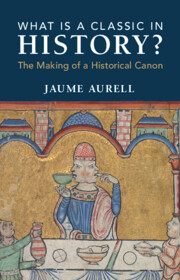
    What is a classic in historical writing? How do we explain the continued interest in certain historical texts, even when their accounts and interpretations of particular periods have been displaced or revised by newer generations of historians? How do these texts help to maintain the historiographical canon? Jaume Aurell's innovative study ranges from the heroic writings of ancient Greek historians such as Herodotus to the twentieth century microhistories of Carlo Ginzburg. The book explores how certain texts have been able to stand the test of time, gain their status as historiographical classics, and capture the imaginations of readers across generations. Investigating the processes of permanence and change in both historiography and history, Aurell further examines the creation of historical genres and canons. Taking influence from methodologies including sociology, literary criticism, theology, and postcolonial studies, What Is a Classic in History? encourages readers to re-evaluate their ideas of history and historiography alike.

    Reviews

    ‘Jaume Aurell's book on the emergence, meaning, and cultural position of works of history that are considered, or at least colloquially referred to as, classics is not going to compete with any other book on this topic because there aren't any others. What Is a Classic in History? maps out the entire terrain, chronologically and thematically, of a new specialized field.’

    Nancy Partner - Professor of History Emeritus, McGill University

    ‘What Is a Classic in History? makes a strong case for seeing canonicity in works of history as something liquid and protean, with works and even entire genres falling out of or into favour.’

    Daniel Woolf - Professor of History, Queen’s University

    ‘Aurell's contemplation of historical canon likely would make a useful and provocative addition to a graduate historiography course. Additionally, practitioners who have not considered what that canon might entail may find that this book prompts them to look further. … Recommended.’

    M. A. Singer Source: Choice

    Refine List

    Actions for selected content:

    Select all | Deselect all
    • View selected items
    • Export citations
    • Download PDF (zip)
    • Save to Kindle
    • Save to Dropbox
    • Save to Google Drive

    Save Search

    You can save your searches here and later view and run them again in "My saved searches".

    Please provide a title, maximum of 40 characters.
    ×

    Contents

    Metrics

    Altmetric attention score

    Full text views

    Total number of HTML views: 0
    Total number of PDF views: 0 *
    Loading metrics...

    Book summary page views

    Total views: 0 *
    Loading metrics...

    * Views captured on Cambridge Core between #date#. This data will be updated every 24 hours.

    Usage data cannot currently be displayed.

    Accessibility standard: Unknown

    Why this information is here

    This section outlines the accessibility features of this content - including support for screen readers, full keyboard navigation and high-contrast display options. This may not be relevant for you.

    Accessibility Information

    Accessibility compliance for the PDF of this book is currently unknown and may be updated in the future.
