
Skip to main content Accessibility help
×
  • Cited by 17
    • Show more authors
    • You may already have access via personal or institutional login
    • Select format
    • Publisher:
      Cambridge University Press
      Publication date:
      05 September 2015
      31 August 2015
      ISBN:
      9781316162989
      9781107099357
      9781107492097
      Dimensions:
      (228 x 152 mm)
      Weight & Pages:
      0.56kg, 301 Pages
      Dimensions:
      (229 x 152 mm)
      Weight & Pages:
      0.47kg, 306 Pages
    You may already have access via personal or institutional login
  • Selected: Digital
    Add to cart View cart Buy from Cambridge.org

    Book description

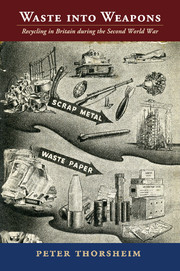
    During the Second World War, the United Kingdom faced severe shortages of essential raw materials. To keep its armaments factories running, the British government enlisted millions of people in efforts to recycle a wide range of materials for use in munitions production. Recycling not only supplied British munitions factories with much-needed raw materials - it also played a key role in the efforts of the British government to maintain the morale of its citizens, to secure billions of dollars in Lend-Lease aid from the United States, and to uncover foreign intelligence. However, Britain's wartime recycling campaign came at a cost: it consumed items that would never have been destroyed under normal circumstances, including significant parts of the nation's cultural heritage. Based on extensive archival research, Peter Thorsheim examines the relationship between armaments production, civil liberties, cultural preservation, and diplomacy, making Waste into Weapons the first in-depth history of twentieth-century recycling in Britain.

    Awards

    Shortlisted, 2017 Turku Book Award, Environmental Society for European History and the Rachel Carson Center for Environment and Society

    Reviews

    'An important contribution to our understanding of total war. This is a vivid and original account of the shifts and expedients of warfare as they interacted with the voracious demands of a war economy. This study deserves attention.'

    Jeremy Black - University of Exeter

    'Waste into Weapons is a novel study. Historians have not given due attention to the important role of preserving resources in wartime, which speaks both to the urgency of the war and the kind of sacrifices expected from the citizenry. But as Peter Thorsheim pointedly reminds us, there was an ‘urge to destroy’ parts of the material culture that transcended the patriotic duty of winning the war. This is a book that brings together the materiality and culture of the war like few others.'

    Martin V. Melosi - author of The Sanitary City

    'This is an excellent book. Salvage collection and recycling during the Second World War made a major contribution to the British war effort, and at last we have a full history. Based on extensive research in many archives, Thorsheim finally gives this unique episode in the history of recycling the attention it deserves. The analysis ranges from the strategic and diplomatic to the economic and psychological, providing new insight into the efforts made to secure scrap metal; the sacrifice of historical artifacts, books, and documents; and women’s and children’s contributions as salvage collectors.'

    Ina Zweiniger-Bargielowska - University of Illinois, Chicago

    'This book is written in a lively and accessible way. It reveals that there is still much to learn about this conflict. Aside from being a key text on recycling and salvage in wartime, this book, owing to the breadth and depth in which topics such as the home front, women and Britain’s international relations are examined, is likely to become essential reading for scholars and general readers alike, interested in the complex nature of the Second World War.'

    Mark J. Crowley Source: Twentieth Century British History

    'Waste into Weapons is a timely and insightful addition to the growing literature on waste and recycling. Thorsheim’s meticulous research has amply demonstrated the paradox of the Second World War - that Britons were encouraged and ordered to conserve and recycle in order that the war effort could destroy. Waste into Weapons reveals the militarization of everyday life that redefined rubbish and that destroyed historical artifacts, buildings, and manuscripts. It speaks to the power of propaganda but also to the limits of coercion. This is a must-read for historians of war, the environment, consumption, and waste. Thorsheim’s work is a valuable addition to the literature and is also evidence that the Second World War remains a fruitful field of study.

    Sandra Dawson Source: H-War

    'Waste into Weapons is a very good book that will appeal to scholars and general audiences interested in military history, environmental history, waste management, material culture, and heritage conservation.'

    Alex Souchen Source: Canadian Military History

    Refine List

    Actions for selected content:

    Select all | Deselect all
    • View selected items
    • Export citations
    • Download PDF (zip)
    • Save to Kindle
    • Save to Dropbox
    • Save to Google Drive

    Save Search

    You can save your searches here and later view and run them again in "My saved searches".

    Please provide a title, maximum of 40 characters.
    ×

    Contents

    Metrics

    Altmetric attention score

    Full text views

    Total number of HTML views: 0
    Total number of PDF views: 0 *
    Loading metrics...

    Book summary page views

    Total views: 0 *
    Loading metrics...

    * Views captured on Cambridge Core between #date#. This data will be updated every 24 hours.

    Usage data cannot currently be displayed.

    Accessibility standard: Unknown

    Why this information is here

    This section outlines the accessibility features of this content - including support for screen readers, full keyboard navigation and high-contrast display options. This may not be relevant for you.

    Accessibility Information

    Accessibility compliance for the PDF of this book is currently unknown and may be updated in the future.
