
Skip to main content Accessibility help
×
  • Cited by 4
    • Show more authors
    • You may already have access via personal or institutional login
    • Select format
    • Publisher:
      Cambridge University Press
      Publication date:
      05 February 2021
      18 February 2021
      ISBN:
      9781316135730
      9781107091979
      9781107465015
      Dimensions:
      (228 x 152 mm)
      Weight & Pages:
      0.6kg, 310 Pages
      Dimensions:
      (228 x 152 mm)
      Weight & Pages:
      0.45kg, 310 Pages
    You may already have access via personal or institutional login
  • Selected: Digital
    Add to cart View cart Buy from Cambridge.org

    Book description

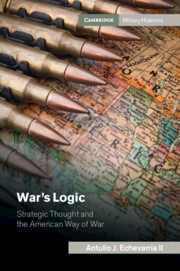
    Antulio J. Echevarria II reveals how successive generations of American strategic theorists have thought about war. Analyzing the work of Alfred Thayer Mahan, Billy Mitchell, Bernard Brodie, Robert Osgood, Thomas Schelling, Herman Kahn, Henry Eccles, Joseph Wiley, Harry Summers, John Boyd, William Lind, and John Warden, he uncovers the logic that underpinned each theorist's critical concepts, core principles, and basic assumptions about the nature and character of war. In so doing, he identifies four paradigms of war's nature - traditional, modern, political, and materialist - that have shaped American strategic thought. If war's logic is political, as Carl von Clausewitz said, then so too is thinking about war.

    Reviews

    ‘Echevarria traces the evolution of American strategic thought and how it influenced U.S. military theory and the conduct of war over the last 125 years. This book will be immediately essential to all security studies programs, and invaluable to any student of war trying to discern how the American Way of War has evolved.'

    Frank G. Hoffman - author of Mars Adapting: Military Change in War (forthcoming)

    ‘In this sharp, critical and deeply-researched book, Echevarria brings to life America's leading strategic thinkers from Mahan and Mitchell to Boyd and Warden.'

    Lawrence Freedman - author of Strategy: A History

    ‘A thought-provoking look at a dozen makers of American strategy from the late-19th century to the present. Echevarria ties the milieus in which prominent theorists lived to their vision of the nature and character of war and in so doing lays bare the assumptions that have driven American views on strategic discourse since the turn of the 20th century.'

    Peter R. Mansoor - author of Surge: My Journey with General David Petraeus and the Remaking of the Iraq War

    ‘Echevarria explores the thinking of some of America's most influential civilian and military strategists, analyzing how they viewed the continuous interactions of technology, politics, human nature, chance and uncertainty, all of which form a compelling and enduring Logic of War that will enrich the thinking of students, teachers, and practitioners alike.'

    Nadia Schadlow - author of War and the Art of Governance: Consolidating Combat Success into Political Victory

    ‘An articulate, penetrating, refreshing, intellectually satisfying, unvarnished and well researched treatise that captures, through compelling, essential biographies, the evolving American Way of War. A fabulous and engaging book.'

    Patricia M. Shields - Editor-in-Chief of Armed Forces & Society

    Refine List

    Actions for selected content:

    Select all | Deselect all
    • View selected items
    • Export citations
    • Download PDF (zip)
    • Save to Kindle
    • Save to Dropbox
    • Save to Google Drive

    Save Search

    You can save your searches here and later view and run them again in "My saved searches".

    Please provide a title, maximum of 40 characters.
    ×

    Contents

    Metrics

    Altmetric attention score

    Full text views

    Total number of HTML views: 0
    Total number of PDF views: 0 *
    Loading metrics...

    Book summary page views

    Total views: 0 *
    Loading metrics...

    * Views captured on Cambridge Core between #date#. This data will be updated every 24 hours.

    Usage data cannot currently be displayed.

    Accessibility standard: Unknown

    Why this information is here

    This section outlines the accessibility features of this content - including support for screen readers, full keyboard navigation and high-contrast display options. This may not be relevant for you.

    Accessibility Information

    Accessibility compliance for the PDF of this book is currently unknown and may be updated in the future.
