
Skip to main content Accessibility help
×
  • Cited by 13
    • Show more authors
    • You may already have access via personal or institutional login
    • Select format
    • Publisher:
      Cambridge University Press
      Publication date:
      August 2019
      August 2019
      ISBN:
      9781108644006
      9781108486071
      9781108713931
      Dimensions:
      (228 x 152 mm)
      Weight & Pages:
      0.58kg, 324 Pages
      Dimensions:
      (229 x 152 mm)
      Weight & Pages:
      0.49kg, 326 Pages
    You may already have access via personal or institutional login
  • Selected: Digital
    Add to cart View cart Buy from Cambridge.org

    Book description

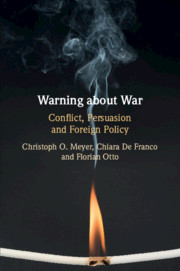
    What does it take for warnings about violent conflict and war to be listened to, believed and acted upon? Why are warnings from some sources noticed and largely accepted, while others are ignored or disbelieved? These questions are central to considering the feasibility of preventing harm to the economic and security interests of states. Challenging conventional accounts that tend to blame decision-makers' lack of receptivity and political will,  the authors offer a new theoretical framework explaining how distinct 'paths of persuasion' are shaped by a select number of factors, including conflict characteristics, political contexts, and source-recipient relations. This is the first study to systematically integrate persuasion attempts by analysts, diplomats and senior officials with those by journalists and NGO staff. Its ambitious comparative design encompasses three states (the US, UK, and Germany) and international organisations (the UN, EU, and OSCE) and looks in depth at four conflict cases: Rwanda (1994), Darfur (2003), Georgia (2008) and Ukraine (2014).

    Awards

    Winner, ISA Annual Best Book Award, International Studies Association

    Winner, 2021 ICOMM Best Book Award, International Studies Association

    Reviews

    'Meyer, De Franco, and Otto show that the problem of warning needs to be conceptualized broadly and seen as part of an interactive foreign policy process, with important warners being not only government officials, but NGOs, the media, and informal advisors. The sophisticated analysis is supported by detailed case studies drawing on a wide variety of unusual sources, and the result is a book of great interest.'

    Robert Jervis - Adlai E. Stevenson Professor, Columbia University and author of How Statesmen Think

    'Warning about War is essential reading for all those who study and work in the field of conflict and atrocity prevention. It makes a significant contribution to our understanding of when warnings about violence are heeded, and what warners could do to make their messages more persuasive. Meyer, de Franco and Otto argue that warnings about conflict take place in the wider context of foreign policy-making, and they provide an innovative conceptual and theoretical framework for explaining when and why warnings have an effect on foreign policy-makers. Case studies include the Rwandan genocide and the more recent Russian-Ukrainian conflict.'

    Karen Smith - London School of Economics and Political Science

    'A fascinating study of how and when warnings about future conflict are listened to. The authors show that warnings are rarely as clear or as numerous in the actual event as they later seem in hindsight, making the job of warning of and preventing conflicts and humanitarian crises even more difficult than many believe.'

    Erik J. Dahl - Naval Postgraduate School, Monterey

    'There has been a surge of academic interest in improving conflict predictions, often based on the premise that early warning can help promote early action to prevent conflict outbreaks or limit escalation, but often very little attention to how policy makers respond to prediction and when it is likely to motivate action. Popular discourse often tend to see conflicts and disasters as predictable, and criticize politicians for failing to act, with limited attention to the problems of hindsight bias and the difficulties in predicting conflict ex ante. This book summarizes a sustained research program on when warnings are likely to lead to action and what makes warnings more or less persuasive. It will deserves to be read by all scholars interested in conflict prediction, conflict management, and how to bridge the gap between research and policy.'

    Kristian Skrede Gleditsch - University of Essex and Peace Research Institute, Oslo

    'Warning about War: Conflict, Persuasion and Foreign Policy makes a tremendously valuable contribution to the study of and strategy for conflict prevention, and the ‘warning-response gap’ in particular. It draws on extensive research, integrates literatures across subfields too often treated separately, and builds its analysis through mixed methodologies. In so doing it both advances theoretical understanding of these crucial issues and delineates policy recommendations to help close the warning-response gap.'

    Bruce W. Jentleson - William Preston Few Professor of Public Policy, Duke University

    ‘This sophisticated analytical treatment of the theory of political conflict will interest specialists and professionals studying or involved in conflict resolution.’

    J. A. Rhodes Source: Choice

    Refine List

    Actions for selected content:

    Select all | Deselect all
    • View selected items
    • Export citations
    • Download PDF (zip)
    • Save to Kindle
    • Save to Dropbox
    • Save to Google Drive

    Save Search

    You can save your searches here and later view and run them again in "My saved searches".

    Please provide a title, maximum of 40 characters.
    ×

    Contents

    Metrics

    Altmetric attention score

    Full text views

    Total number of HTML views: 0
    Total number of PDF views: 0 *
    Loading metrics...

    Book summary page views

    Total views: 0 *
    Loading metrics...

    * Views captured on Cambridge Core between #date#. This data will be updated every 24 hours.

    Usage data cannot currently be displayed.

    Accessibility standard: Unknown

    Why this information is here

    This section outlines the accessibility features of this content - including support for screen readers, full keyboard navigation and high-contrast display options. This may not be relevant for you.

    Accessibility Information

    Accessibility compliance for the PDF of this book is currently unknown and may be updated in the future.
