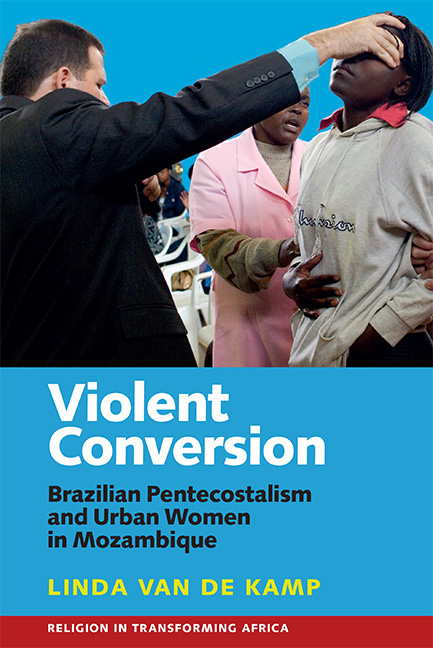
Violent Conversion

-
Select format
-
- Publisher:
- Boydell & Brewer
- Publication date:
- 24 October 2017
- 21 October 2016
- ISBN:
- 9781782048459
- 9781847011527
- Dimensions:
- Weight & Pages:
- 00kg,
- Dimensions:
- Weight & Pages:
- Series:
- Religion in Transforming Africa
- Subjects:
- Religion, Religion: General Interest
You may already have access via personal or institutional login- Series:
- Religion in Transforming Africa
- Subjects:
- Religion, Religion: General Interest
Show more authors 
You may already have access via personal or institutional login
Book description
There has been an extraordinary growth in Pentecostalism in Africa, with Brazilian Pentecostals establishing new transnational Christian connections, initiating widespread changes not only in religious practice but in society. This book describes its rise in Maputo, capital of Mozambique, where large numbers of urban women are taking advantage of the opportunities Pentecostalism offers to overcome restrictions at home, pioneer new life spaces and change their lives. Yet, while its discourses and practices are persuading followers to take control of their lives through the power of the Holy Spirit, conversion also means a violent rupturing with the past, with family and with social networks.
In this book, the author examines the, sometimes dramatic, impact of Pentecostalism on women's lives. As the pastors encourage them to make a break with the past, including ancestral spirits, these women come to see their kin and husbands as imbued with evil powers, and many leave their families. Conquering spheres that used to be forbidden to them, they often live alone as unmarried women, sometimes earning more than men of a similar age. They are also expected to donate huge sums to the churches, often money that they can ill afford, bringing new hardships.
Linda van de Kamp is Assistant Professor in the Department of Sociology, University of Amsterdam, The Netherlands.
Contents
Contents
Metrics
Full text views
Full text views helpTotal number of HTML views: 0
Total number of PDF views: 0 *
 Loading metrics...
* Views captured on Cambridge Core between #date#. This data will be updated every 24 hours.
Usage data cannot currently be displayed.
Accessibility standard: Unknown
Why this information is here
This section outlines the accessibility features of this content - including support for screen readers, full keyboard navigation and high-contrast display options. This may not be relevant for you.
Accessibility Information
Accessibility compliance for the PDF of this book is currently unknown and may be updated in the future.