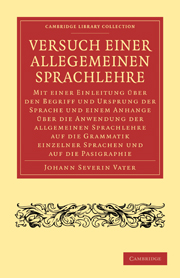

Johann Severin Vater (1771–1826) was professor of theology and Oriental languages at Halle, but his linguistic interests ranged far more widely. This 1801 publication is the thirty-year-old scholar's ambitious attempt to outline a universal theory of language. Vater begins with a short definition of language, and two chapters speculating on the origins of human language and mechanisms for language change. These theoretical chapters, Vater says, were intended to be accessible to students making the transition from classics to philosophy. Vater then proposes the possibility of an overarching theory that could accommodate the different sounds, structures and vocabularies used to encode language functions, and which could be used by scholars to describe the grammar of different languages. He goes a stage further in suggesting that this could be the basis of a universal language. The book ends with a fascinating bibliography of early modern writings on language.
Loading metrics...
* Views captured on Cambridge Core between #date#. This data will be updated every 24 hours.
Usage data cannot currently be displayed.
This section outlines the accessibility features of this content - including support for screen readers, full keyboard navigation and high-contrast display options. This may not be relevant for you.
Accessibility compliance for the PDF of this book is currently unknown and may be updated in the future.
