Skip to main content Accessibility help
×
    Show more authors
  • You may already have access via personal or institutional login
  • Select format
  • Publisher:
    Cambridge University Press
    Publication date:
    October 2025
    October 2025
    ISBN:
    9781009635134
    9781009635158
    9781009635127
    Dimensions:
    (228 x 152 mm)
    Weight & Pages:
    0.53kg, 288 Pages
    Dimensions:
    (228 x 152 mm)
    Weight & Pages:
    0.44kg, 288 Pages
You may already have access via personal or institutional login
  • Selected: Digital
    Add to cart View cart Buy from Cambridge.org

    Book description

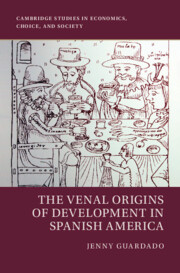
    Venal Origins is a comparative and historical study of the roots of spatial inequalities in Spanish America. The book focuses on the Spanish colonial administration and the 18th-century practice of office-selling-where colonial positions were exchanged for money-to analyze its lasting impact on local governance, regional disparities, and economic development. Drawing on three centuries of rich archival and administrative data, it demonstrates how office-selling exacerbated venality and profit-seeking behaviors among colonial officials, fostering indigenous segregation, violent uprisings, and the institutionalization of exploitative fiscal and labor systems. The enduring legacies from their rule remain visible today, in the form of subnational authoritarian enclaves, localized cycles of violence, and marginalized indigenous communities, which have reinforced and deepened regional inequalities. By integrating perspectives from history, political science, and economics, Venal Origins provides a nuanced and empirically grounded analysis of how colonial officials shaped-and still influence-subnational development in Spanish America.

    Refine List

    Actions for selected content:

    Select all | Deselect all
    • View selected items
    • Export citations
    • Download PDF (zip)
    • Save to Kindle
    • Save to Dropbox
    • Save to Google Drive

    Save Search

    You can save your searches here and later view and run them again in "My saved searches".

    Please provide a title, maximum of 40 characters.
    ×

    Contents

    Metrics

    Full text views

    Total number of HTML views: 0
    Total number of PDF views: 0 *
    Loading metrics...

    Book summary page views

    Total views: 0 *
    Loading metrics...

    * Views captured on Cambridge Core between #date#. This data will be updated every 24 hours.

    Usage data cannot currently be displayed.

    Accessibility standard: Missing or limited accessibility features

    Why this information is here

    This section outlines the accessibility features of this content - including support for screen readers, full keyboard navigation and high-contrast display options. This may not be relevant for you.

    Accessibility Information

    The PDF of this book is known to have missing or limited accessibility features. We may be reviewing its accessibility for future improvement, but final compliance is not yet assured and may be subject to legal exceptions. If you have any questions, please contact accessibility@cambridge.org.

    Content Navigation
    Table of contents navigation

    Allows you to navigate directly to chapters, sections, or non‐text items through a linked table of contents, reducing the need for extensive scrolling.

    Index navigation

    Provides an interactive index, letting you go straight to where a term or subject appears in the text without manual searching.

    Reading Order and Textual Equivalents
    Single logical reading order

    You will encounter all content (including footnotes, captions, etc.) in a clear, sequential flow, making it easier to follow with assistive tools like screen readers.

    Structural and Technical Features
    ARIA roles provided

    You gain clarity from ARIA (Accessible Rich Internet Applications) roles and attributes, as they help assistive technologies interpret how each part of the content functions.