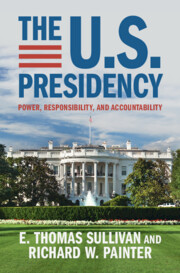
The U.S. Presidency

-
Select format
-
- Publisher:
- Cambridge University Press
- Publication date:
- 30 November 2025
- 18 December 2025
- ISBN:
- 9781009521970
- 9781009521987
- 9781009521994
- Dimensions:
- (229 x 152 mm)
- Weight & Pages:
- 0.611kg, 308 Pages
- Dimensions:
- (229 x 152 mm)
- Weight & Pages:
- 0.448kg, 308 Pages
You may already have access via personal or institutional login
Show more authors 
You may already have access via personal or institutional login
Book description
In The U.S. Presidency, E. Thomas Sullivan and Richard W. Painter examine the evolving state of presidential power in the United States, specifically facilitating discussion and debate concerning the power, responsibility, and accountability of U.S. Presidents. How is power acquired? How is it used or misused? How are the President's powers checked and how are they held accountable to and by the people? Rather than promote a single theory of presidential power, Sullivan and Painter answer these questions with a wide range of arguments for and against power in a broad number of circumstances and Supreme Court holdings. Grounded in the intersection of law, politics, and history, this book engages readers across disciplines, helping them understand the remarkable transformation of the United States presidency. Objective and timely, The U.S. Presidency makes a case for a democratic model of self-government centered on accountability and the rule of law.
Reviews
‘So much of today’s turmoil could have been prevented if political leadership better understood our Constitution and its concept of shared powers as brilliantly laid out in The U.S. Presidency by Professors Sullivan and Painter. How well we understand shared responsibility in sports yet find it so elusive in governance. The U.S. Presidency is an essential read for all citizens and should be required reading for all elected officials.’
Arne H. Carlson - Governor of Minnesota (1991–1999)
‘This is a wonderfully wide-ranging and informative look at presidential power throughout American history. Sullivan and Painter guide readers through the major constitutional theories and events that have shaped the presidency and that continue to animate debates over presidential power today. An important and timely work.’
Heidi Kitrosser - William W. Gurley Professor of Law, Northwestern Pritzker School of Law
‘Professors Sullivan and Painter have created a thorough and insightful overview of the legal and political episodes that have helped to transform the presidency into something radically different from the checked-and-balanced Chief Magistrate envisioned by the Framers. Their study is invaluable for understanding how dramatic increases in presidential power and responsibility have outpaced the development of mechanisms for presidential accountability.’
Peter M. Shane - Distinguished Scholar in Residence, New York University School of Law
Contents
References
Metrics
Full text views
Full text views helpTotal number of HTML views: 0
Total number of PDF views: 0 *
 Loading metrics...
* Views captured on Cambridge Core between #date#. This data will be updated every 24 hours.
Usage data cannot currently be displayed.
Accessibility standard: Missing or limited accessibility features
Why this information is here
This section outlines the accessibility features of this content - including support for screen readers, full keyboard navigation and high-contrast display options. This may not be relevant for you.
Accessibility Information
The PDF of this book is known to have missing or limited accessibility features. We may be reviewing its accessibility for future improvement, but final compliance is not yet assured and may be subject to legal exceptions. If you have any questions, please contact accessibility@cambridge.org.
Content Navigation
Table of contents navigation
Allows you to navigate directly to chapters, sections, or non‐text items through a linked table of contents, reducing the need for extensive scrolling.
Index navigation
Provides an interactive index, letting you go straight to where a term or subject appears in the text without manual searching.
Reading Order and Textual Equivalents
Single logical reading order
You will encounter all content (including footnotes, captions, etc.) in a clear, sequential flow, making it easier to follow with assistive tools like screen readers.
Visualised data also available as non‐graphical data
You can access graphs or charts in a text or tabular format, so you are not excluded if you cannot process visual displays.
Visual Accessibility
Use of colour is not sole means of conveying information
You will still understand key ideas or prompts without relying solely on colour, which is especially helpful if you have colour vision deficiencies.
Use of high contrast between text and background colour
You benefit from high‐contrast text, which improves legibility if you have low vision or if you are reading in less‐than‐ideal lighting conditions.