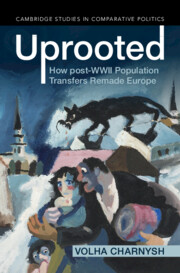
Uprooted

-
Select format
-
- Publisher:
- Cambridge University Press
- Publication date:
- 07 November 2024
- 21 November 2024
- ISBN:
- 9781009441995
- 9781009442008
- 9781009441971
- Dimensions:
- (229 x 152 mm)
- Weight & Pages:
- 0.62kg, 342 Pages
- Dimensions:
- (229 x 152 mm)
- Weight & Pages:
- 0.48kg, 342 Pages
You may already have access via personal or institutional login
Show more authors 
You may already have access via personal or institutional login
Book description
Each year, millions of people are uprooted from their homes by wars, repression, natural disasters, and climate change. In Uprooted, Volha Charnysh presents a fresh perspective on the developmental consequences of mass displacement, arguing that accommodating the displaced population can strengthen receiving states and benefit local economies. Drawing on extensive research on post-WWII Poland and West Germany, Charnysh shows that the rupture of social ties and increased cultural diversity in affected communities not only decreased social cohesion, but also shored up the demand for state-provided resources, which facilitated the accumulation of state capacity. Over time, areas that received a larger and more diverse influx of migrants achieved higher levels of entrepreneurship, education, and income. With its rich insights and compelling evidence, Uprooted challenges common assumptions about the costs of forced displacement and cultural diversity and proposes a novel mechanism linking wars to state-building.
Awards
Winner, 2025 Merze Tate - Elinor Ostrom Outstanding Book Award, American Political Science Association
Reviews
‘In this brilliant and rigorous analysis, Volha Charnysh shows how forced migration in postwar Europe was a short-term tragedy and a long-term boon. As migrants turned to the state, the state met the challenge, leading to higher public goods provision and more intensive economic growth. For scholars of migration, development, and the state, this is a must-read.’
Anna Grzymala-Busse - Michelle and Kevin Douglas Professor of International Studies, Stanford University
‘In this pathbreaking study Volha Charnysh upends what we thought we knew about the interaction between social cohesion and state capacity. Examining one of history’s biggest population displacements, she shows convincingly that areas with more diverse populations after the transfers saw greater improvements in state capacity and economic performance. This is a major addition to scholarship.’
David Stasavage - Dean for the Social Sciences & Julius Silver Professor of Politics, New York University
‘Are migrants and local diversity a net economic gain for the receiving country? In this theoretically rich and historically nuanced study of post-World War II population transfers, Charnysh offers evidence that will make liberals swoon: where the receiving state is willing to supply public goods, diversity outperforms homogeneity.’
Jason Wittenberg - Professor of Political Science, University of California, Berkeley
Contents
Contents
References
Metrics
Altmetric attention score
Full text views
Full text views helpTotal number of HTML views: 0
Total number of PDF views: 0 *
 Loading metrics...
* Views captured on Cambridge Core between #date#. This data will be updated every 24 hours.
Usage data cannot currently be displayed.
Accessibility standard: Unknown
Why this information is here
This section outlines the accessibility features of this content - including support for screen readers, full keyboard navigation and high-contrast display options. This may not be relevant for you.
Accessibility Information
Accessibility compliance for the PDF of this book is currently unknown and may be updated in the future.