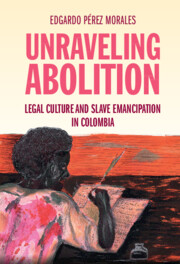
'Lucid and engrossing, Unraveling Abolition spotlights the enslaved people who spearheaded Colombia’s antislavery legal culture alongside jurists and politicians. This sweeping account brims with insights for historians of republicanism and its limits in the revolutionary Americas.'
Caitlin Fitz - Northwestern University
'Unraveling Abolition is a masterful retelling of the struggle over emancipation at the dawn of the Colombian republic. Edgardo Pérez Morales ably shows the significance of the enslaved and free people who engaged in 'legal tinkering'. By fighting to end legal bondage through the judicial sphere, they remade the law itself. This book will no doubt be a valuable contribution to the fields of slavery and emancipation, legal history, and the Age of Revolutions.'
Jason McGraw - Indiana University
'Unraveling Abolition is a welcome addition to the scholarship on enslaved litigants in Latin America who forged new paths to freedom using the courts. Pérez Morales skillfully demonstrates how enslaved people envisioned emancipation and pushed for abolition far beyond the cautious contours of gradual emancipation in the transition from colony to the republic of Gran Colombia.'
Michelle McKinley - University of Oregon School of Law and author of Fractional Freedoms: Slavery, Intimacy and Legal Mobilization in Colonial Lima, 1600-1700
'This book rightly centers the agency of Afro-Colombians for understanding the legal history of slavery and for promoting new ideas of human freedom. Pérez Morales uncovers a rich tradition of enslaved people appropriating the law, and even inventing new legal claims, to push for emancipation, both under Spanish colonialism and in the new independent Colombian republic. A major contribution.'
James E. Sanders
‘… a fundamental contribution to the historiography of slavery, abolition, and revolution in Colombia. It offers a narrative that lucidly explains the historical imbrication of these three aspects and proposes a suggestive methodology for legal history. It also adds to the growing field of the African diaspora’s intellectual history, taking seriously the original notions developed by the enslaved about slavery, freedom, and political belonging.’
Katherine Bonil Gomez
Source: Hispanic American Historical Review
‘An important read.’
Bruno Lima
Source: Rechtsgeschichte - Legal History