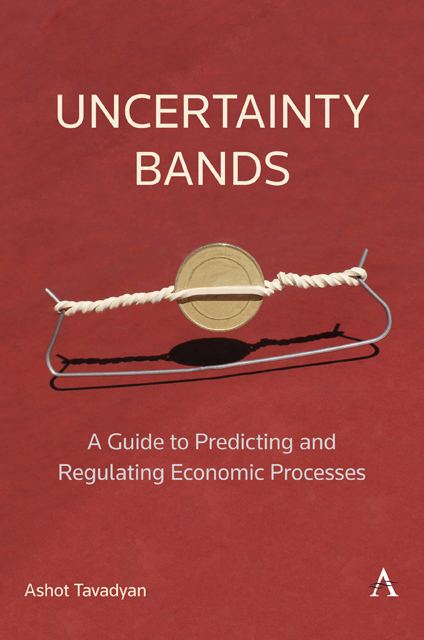
Uncertainty Bands

-
Select format
-
- Publisher:
- Anthem Press
- Publication date:
- 09 December 2022
- 14 June 2022
- ISBN:
- 9781839983993
- 9781839983986
- Dimensions:
- Weight & Pages:
- Dimensions:
- Weight & Pages:
You may already have access via personal or institutional login
Show more authors 
You may already have access via personal or institutional login
Book description
With the increasing role of economic uncertainty, improving the efficiency of forecasts is ever so important. This book makes suggestions on how to evaluate the key economic indicators under uncertainty. It presents the interval method to study economic indicators, which will allow us to understand the possibilities of forecasting and the irregular nature of the economy. It is shown that with the accumulation of negative phenomena in a seemingly stable situation the effect of a compressed spring may snap into action. The book outlines the uncertainty relations in the economy, the minimal uncertainty interval, the effect of an expanding uncertainty band, sensitivity thresholds, as well as the principles of systematization and forecasting of economic indicators. The book presents ways to facilitate economic development, assess the quality of a forecast, and increase the efficiency of forecasts and decision-making in conditions of uncertainty.
Contents
Contents
Metrics
Full text views
Full text views helpTotal number of HTML views: 0
Total number of PDF views: 0 *
 Loading metrics...
* Views captured on Cambridge Core between #date#. This data will be updated every 24 hours.
Usage data cannot currently be displayed.
Accessibility standard: Unknown
Why this information is here
This section outlines the accessibility features of this content - including support for screen readers, full keyboard navigation and high-contrast display options. This may not be relevant for you.
Accessibility Information
Accessibility compliance for the PDF of this book is currently unknown and may be updated in the future.