
Skip to main content Accessibility help
×
  • Cited by 2
    • Show more authors
    • You may already have access via personal or institutional login
    • Select format
    • Publisher:
      Cambridge University Press
      Publication date:
      19 October 2023
      09 November 2023
      ISBN:
      9781009235822
      9781009235808
      Dimensions:
      (229 x 152 mm)
      Weight & Pages:
      0.55kg, 316 Pages
      Dimensions:
      Weight & Pages:
    You may already have access via personal or institutional login
  • Selected: Digital
    Add to cart View cart Buy from Cambridge.org

    Book description

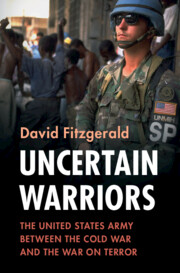
    In an era where 'history' had supposedly ended, what was an Army for? This question confronted the US Army at the end of the Cold War. Although public support for the military remained high, fewer were sending their children to enlist and questions were raised about the uncertainty of future operations: How would Army leaders prepare soldiers for difficult peacekeeping operations that called for a more human-oriented approach in light of the promises of high-tech warfare? How best to navigate the broader debates about changing gender and sexual norms in American society? Pulled in different directions, the Army struggled to put forward a compelling vision of who and what the American solder should be. In Uncertain Warriors, David Fitzgerald reveals how, in response to this uncertainty, they eventually fell back on an older vision of martial masculinity, embracing a 'warrior ethos' that was meant to define the contemporary American soldier.

    Reviews

    ‘What’s an Army without an enemy? David Fitzgerald skilfully probes the predicament of the US military after the collapse of its Soviet nemesis and before an elusive new enemy-'terror’-took its place. Deeply researched and briskly paced, Uncertain Warriors uncovers a fraught decade of armed intervention overseas and culture war skirmishes at home. Essential reading for anyone looking to better understand the contradictions of contemporary America.’

    Susan Carruthers - author of Dear John: Love and Loyalty in America

    ‘David Fitzgerald deftly situates the US Army of the 1990s within its tumultuous societal, political, technological, and bureaucratic context. He masterfully illustrates both the logic and contradictions within the army’s response to these buffeting influences. The tensions within this mixed record would soon become evident in Iraq and Afghanistan.’

    J. P. Clark - author of Preparing for War: The Emergence of the Modern U.S. Army, 1815–1914

    ‘Uncertain Warriors is a pathbreaking historical study of the US Army between the triumph of Desert Storm and the interminable Iraq-Afghanistan conflicts. Impressively researched, well written, and cogently argued, it deserves to be read by historians, officers, and all those interested in how military institutions adapt to revolutionary changes.’

    Brian McAllister Linn - author of Elvis's Army: Cold War GIs and the Atomic Battlefield

    ‘Uncertain Warriors beautifully weaves together political, institutional, military, and social history to convincingly argue that U.S. Army’s modern ‘warrior ethos,’ for better or worse, is as much a product of the Army’s post-Cold War uncertainty as it is of 9/11 and the wars that came after.’

    Amy J. Rutenberg - author of Rough Draft: Cold War Military Manpower Policy and the Origins of Vietnam-Era Draft Resistance

    ‘Recommended.’

    D. W. Bath Source: CHOICE

    ‘The Army is fortunate to have a scholar of Fitzgerald’s discretion and skill so interested in its history. As it looks to refocus on large-scale combat operations, today’s Army leaders would be well served to contemplate the lessons presented in Uncertain Warriors.’

    John Nagl Source: Parameters: The US Army War College Quarterly

    ‘… an important and well-written work. As a study of an army that is not at war, “Uncertain Warriors” explores the intersection of institutional, political, and social history of the US Army in the 1990s. The reader gets an in-depth sense of how the army grappled with its self-identity, as Fitzgerald's work weaves together sources on the internal uneasiness of army leadership with the highly public debates playing out in American media and the political sphere.’

    Brandon Kinney Source: H-War, H-Net Reviews

    ‘Military historians should read this book; it is well-written and researched. It should certainly be on the shelves of historians of the Global War on Terror because of how well Fitzgerald explains the state of the U.S. Army leading up to the morning of 11 September 2001.’

    Mark R. Folse and John Worsencroft Source: Journal of Military History

    Refine List

    Actions for selected content:

    Select all | Deselect all
    • View selected items
    • Export citations
    • Download PDF (zip)
    • Save to Kindle
    • Save to Dropbox
    • Save to Google Drive

    Save Search

    You can save your searches here and later view and run them again in "My saved searches".

    Please provide a title, maximum of 40 characters.
    ×

    Contents

    Metrics

    Altmetric attention score

    Full text views

    Total number of HTML views: 0
    Total number of PDF views: 0 *
    Loading metrics...

    Book summary page views

    Total views: 0 *
    Loading metrics...

    * Views captured on Cambridge Core between #date#. This data will be updated every 24 hours.

    Usage data cannot currently be displayed.

    Accessibility standard: Unknown

    Why this information is here

    This section outlines the accessibility features of this content - including support for screen readers, full keyboard navigation and high-contrast display options. This may not be relevant for you.

    Accessibility Information

    Accessibility compliance for the PDF of this book is currently unknown and may be updated in the future.
