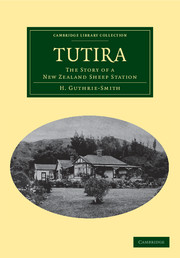

In 1880, William Herbert Guthrie-Smith (1862–1940) emigrated from Scotland to New Zealand, where he learned the basics of sheep farming and acquired Tutira, a disused sheep station of 20,000 acres in the Hawke's Bay region of the North Island. Tutira, published in 1921, describes every aspect of Guthrie-Smith's enterprise, including the redevelopment of the land and comprehensive advice on sheep farming. The book also covers the history of the local Maori and of European settlement, and provides an extensive account of the farm's natural history including its geological configuration, meteorological patterns, the formation of lakes and waterways, and the native plant and bird species Guthrie-Smith discovered on his land. It also draws attention to the impact of introduced, 'alien' plants and animals. Tutira is one of the great classics of New World environmental consciousness; it was reprinted in 1926, and a posthumous revised edition appeared in 1953.
Loading metrics...
* Views captured on Cambridge Core between #date#. This data will be updated every 24 hours.
Usage data cannot currently be displayed.
This section outlines the accessibility features of this content - including support for screen readers, full keyboard navigation and high-contrast display options. This may not be relevant for you.
Accessibility compliance for the PDF of this book is currently unknown and may be updated in the future.
