Metrics
Full text views
Full text views help
Loading metrics...
* Views captured on Cambridge Core between #date#. This data will be updated every 24 hours.
Usage data cannot currently be displayed.
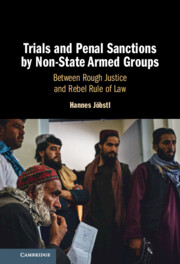
During armed conflict, non-State armed groups frequently establish their own judicial systems to resolve disputes, impose penal sanctions and implement social control. Examples such Hamas in Gaza, Rojava in Syria, or the 'People's Republics' in Eastern Ukraine demonstrate that this aspect of 'rebel governance' has become increasingly common. How can or should international law regulate the establishment of courts, conduct of trials and passing of penal sanctions by insurgent movements that challenge the judicial monopoly of states? Based on an in-depth doctrinal analysis, this study demonstrates that the administration of criminal justice by insurgents is not inherently illegal or illegitimate, and explains how to measure the conduct of armed groups against clear legal standards. Drawing on a broad range of real-world examples, this study makes a vital contribution to the law applicable in armed conflict.
Loading metrics...
* Views captured on Cambridge Core between #date#. This data will be updated every 24 hours.
Usage data cannot currently be displayed.
This section outlines the accessibility features of this content - including support for screen readers, full keyboard navigation and high-contrast display options. This may not be relevant for you.
The PDF of this book complies with version 2.2 of the Web Content Accessibility Guidelines (WCAG), offering more comprehensive accessibility measures for a broad range of users and attains the highest (AAA) level of WCAG compliance, optimising the user experience by meeting the most extensive accessibility guidelines.
Allows you to navigate directly to chapters, sections, or non‐text items through a linked table of contents, reducing the need for extensive scrolling.
Provides an interactive index, letting you go straight to where a term or subject appears in the text without manual searching.
You will encounter all content (including footnotes, captions, etc.) in a clear, sequential flow, making it easier to follow with assistive tools like screen readers.
You get concise descriptions (for images, charts, or media clips), ensuring you do not miss crucial information when visual or audio elements are not accessible.
You can access graphs or charts in a text or tabular format, so you are not excluded if you cannot process visual displays.
You will still understand key ideas or prompts without relying solely on colour, which is especially helpful if you have colour vision deficiencies.
You benefit from high‐contrast text, which improves legibility if you have low vision or if you are reading in less‐than‐ideal lighting conditions.
