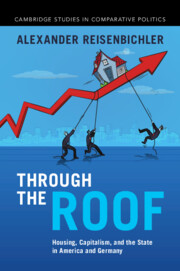
Through the Roof

-
Select format
-
- Publisher:
- Cambridge University Press
- Publication date:
- 28 August 2025
- 11 September 2025
- ISBN:
- 9781009596619
- 9781009596602
- 9781009596657
- Dimensions:
- (229 x 152 mm)
- Weight & Pages:
- 0.633kg, 324 Pages
- Dimensions:
- (229 x 152 mm)
- Weight & Pages:
- 0.47kg, 324 Pages
You may already have access via personal or institutional login
Show more authors 
You may already have access via personal or institutional login
Book description
Housing is the defining issue of our time, driving a persistent affordability crisis, financial instability, and economic inequality. Through the Roof examines the crucial role of the state in shaping the housing markets of two economic powerhouses-the United States and Germany. The book starts with a puzzle: laissez-faire America has vigorously supported homeownership markets with generous government programs, while social democratic Germany has slashed policy support for both homeownership and rental markets. The book explains why both nations have adopted such radically different and unexpected housing policy approaches. Drawing on extensive archival material and interviews with policymakers, it argues that contrasting forms of capitalism-demand-led in the United States and export-oriented in Germany-resulted in divergent housing policies. In both countries, these policies have subsequently transformed capitalism itself.
Reviews
‘Alexander Reisenbichler was among the first political economists who studied how the policies to promote homeownership sank rich North Atlantic economies in the 2000s. He has now distilled his research into a fascinating account of Germany and the U.S. that effectively defies stereotypes about the Germanobsession with savings and the American obsession with free markets.’
Waltraud Schelkle - Professor, European University Institute
‘Reisenbichler’s exquisitely detailed argument surfaces and explains the paradox that allegedly free-market America has, as Bourdieu would expect, a housing market nearly totally shaped by the state, while corporatist Germany has seen the state retreat from the housing market in the past twenty years.’
Mark Schwartz - Professor of Politics, University of Virginia
‘The U.S. created a housing crisis by turning housing into an asset class. Germany did not make that mistake and yet ended up with a similar crisis. Reisenbichler deftly explains both cases by reference to each country’s underlying growth regime. A masterful political economy account that shows us how growth, housing, and inequality are all interlinked.’
Mark Blyth - William R. Rhodes ’57 Professor of International Economics, Brown University
Contents
Contents
Metrics
Altmetric attention score
Full text views
Full text views helpTotal number of HTML views: 0
Total number of PDF views: 0 *
 Loading metrics...
* Views captured on Cambridge Core between #date#. This data will be updated every 24 hours.
Usage data cannot currently be displayed.
Accessibility standard: Missing or limited accessibility features
Why this information is here
This section outlines the accessibility features of this content - including support for screen readers, full keyboard navigation and high-contrast display options. This may not be relevant for you.
Accessibility Information
The PDF of this book is known to have missing or limited accessibility features. We may be reviewing its accessibility for future improvement, but final compliance is not yet assured and may be subject to legal exceptions. If you have any questions, please contact accessibility@cambridge.org.
Content Navigation
Table of contents navigation
Allows you to navigate directly to chapters, sections, or non‐text items through a linked table of contents, reducing the need for extensive scrolling.
Index navigation
Provides an interactive index, letting you go straight to where a term or subject appears in the text without manual searching.
Reading Order and Textual Equivalents
Single logical reading order
You will encounter all content (including footnotes, captions, etc.) in a clear, sequential flow, making it easier to follow with assistive tools like screen readers.
Structural and Technical Features
ARIA roles provided
You gain clarity from ARIA (Accessible Rich Internet Applications) roles and attributes, as they help assistive technologies interpret how each part of the content functions.