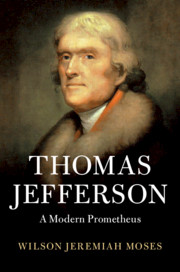

In Thomas Jefferson: A Modern Prometheus, Wilson Jeremiah Moses provides a critical assessment of Thomas Jefferson and the Jeffersonian influence. Scholars of American history have long debated the legacy of Thomas Jefferson. However, Moses deviates from other interpretations by positioning himself within an older, 'Federalist' historiographic tradition, offering vigorous and insightful commentary on Jefferson, the man and the myth. Moses specifically focuses on Jefferson's complexities and contradictions. Measuring Jefferson's political accomplishments, intellectual contributions, moral character, and other distinguishing traits against contemporaries like George Washington and Benjamin Franklin but also figures like Machiavelli and Frederick the Great, Moses contends that Jefferson fell short of the greatness of others. Yet amid his criticism of Jefferson, Moses paints him as a cunning strategist, an impressive intellectual, and a consummate pragmatist who continually reformulated his ideas in a universe that he accurately recognized to be unstable, capricious, and treacherous.
'Wilson Jeremiah Moses has assembled a daring intellectual history of Thomas Jefferson that is as bold in its arguments as it is sweeping in its scope. The study’s treatment of historical scholarship and literary sources goes beyond detailing the ideas of Jefferson, to guide the reader through the creation, development, and perpetuation of Jeffersonian beliefs. Within this narrative of racism, philosophy, and polemics, Thomas Jefferson: A Modern Prometheus employs gripping prose to sustain a cohesive anthology of the most far-reaching critiques of Jefferson’s intellectual reasoning.'
Ronald Angelo Johnson - author of Diplomacy in Black and White: John Adams, Toussaint Louverture, and Their Atlantic World Alliance
'Wilson Jeremiah Moses offers us an intriguing, essayistic portrait of Jefferson and of the meanings of Jefferson throughout American history. We get to know how Theodore Roosevelt disliked Jefferson, how Jefferson's agrarianism should be comprehended, what Jeffersonian Confucianism was like, and what to think of his post-feudal world in general.'
Ari Helo - author of Thomas Jefferson’s Ethics and the Politics of Human Progress
'… offers a critical intellectual assessment of the man [Jefferson] and his influence.'
G. A. Smith Source: Choice
Loading metrics...
* Views captured on Cambridge Core between #date#. This data will be updated every 24 hours.
Usage data cannot currently be displayed.
This section outlines the accessibility features of this content - including support for screen readers, full keyboard navigation and high-contrast display options. This may not be relevant for you.
Accessibility compliance for the PDF of this book is currently unknown and may be updated in the future.
