
Skip to main content Accessibility help
×
  • Cited by 4
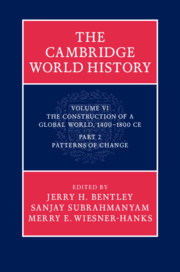
    • Volume 6: The Construction of a Global World, 1400-1800 CE, Part 2: Patterns of Change
      Show more authors
    • You may already have access via personal or institutional login
    • Select format
    • Publisher:
      Cambridge University Press
      Publication date:
      May 2015
      April 2015
      ISBN:
      9781139022460
      9780521192460
      9781108407748
      Dimensions:
      (228 x 152 mm)
      Weight & Pages:
      0.94kg, 512 Pages
      Dimensions:
      (228 x 152 mm)
      Weight & Pages:
      0.76kg, 514 Pages
    You may already have access via personal or institutional login
  • Selected: Digital
    Add to cart View cart Buy from Cambridge.org

    Book description

    The era from 1400 to 1800 saw intense biological, commercial, and cultural exchanges, and the creation of global connections on an unprecedented scale. Divided into two books, Volume 6 of the Cambridge World History series considers these critical transformations. The first book examines the material and political foundations of the era, including global considerations of the environment, disease, technology, and cities, along with regional studies of empires in the eastern and western hemispheres, crossroads areas such as the Indian Ocean, Central Asia, and the Caribbean, and sites of competition and conflict, including Southeast Asia, Africa, and the Mediterranean. The second book focuses on patterns of change, examining the expansion of Christianity and Islam, migrations, warfare, and other topics on a global scale, and offering insightful detailed analyses of the Columbian exchange, slavery, silver, trade, entrepreneurs, Asian religions, legal encounters, plantation economies, early industrialism, and the writing of history.

    Refine List

    Actions for selected content:

    Select all | Deselect all
    • View selected items
    • Export citations
    • Download PDF (zip)
    • Save to Kindle
    • Save to Dropbox
    • Save to Google Drive

    Save Search

    You can save your searches here and later view and run them again in "My saved searches".

    Please provide a title, maximum of 40 characters.
    ×

    Contents


    Page 1 of 2


    • 13 - The scholarly discovery of religion in early modern times
      pp 313-333
    • View abstract

      Summary

      This chapter approaches migrations by first summarizing in broad strokes the continuities and changes by macro-region across the globe from the earlier centuries to about 1500. Next, the penetration of heavily armed mobile Europeans into the societies of the Caribbean and South America, West Africa, the Indian Ocean's littorals and Southeast Asian islands are analyzed in terms of displacement of and dominance over resident settled or mobile peoples. Since the European, powerful newcomers lacked knowledge of the languages, cultures, and customs of the economically or politically annexed territories and peoples, they required intermediaries. The mobility of intrusive investors and supportive state personnel resulted in vast, mostly forced, migrations of men and women as laborers to produce for the Europeans' demand. The chapter also summarizes the migration of Europeans who also had difficulty in gaining their livelihood, the ideology of European superiority and whiteness discourses veil the poverty endemic in many regions of Europe, forcing rural and urban underclasses to depart.
    • 14 - Christianity in Europe and overseas
      pp 334-357
    • View abstract

      Summary

      The standard distinction between settled societies and nomadic or seminomadic peoples captures contrasts in the scale and organisation of warfare. Nomadic and semi-nomadic peoples, who generally relied on pastoral agriculture or slash-and-burn shifting cultivation, were less populous and their governmental structures were less developed. The timing and rate of change are also issues in assessing whether there was a Military Revolution in the early modern period. The standard account posits one period of revolution from 1560 to 1660, indecisiveness and stagnation, then a second period of revolution that began with the outbreak of the War of American Independence in 1775 and continued with the French Revolutionary Wars to 1815. The Ottoman army, and even more the navy, of 1600 were very different from those of 1450, such that there was a sustained transformation in Ottoman war-making. The political culture of the Ottoman court and public finances also failed to support the enhancement of Turkish military capability.
    • 15 - Islam in the early modern world
      pp 358-386
    • View abstract

      Summary

      Interactions among cultures, by 1400 CE, did not involve the peoples of the Americas with those of Eurasia and Africa. This chapter looks at interactions centered on China, Islam, South Asia, and the eastern Mediterranean. It discusses the new global interactions of the Europeans with the great civilizations of the Americas and of Africans with Europeans in Africa and the Americas. There was a logic of political advantage and cultural content in the interactions between Mongols and Tibetans. Careful recording of lineages of teacher-student relations was important both in Islam and in other Chinese traditions, Confucian and Buddhist. The reach of Islam into the unbelieving world was strongly supported by Sufism, and eventually by impressive continuities of Sufi lineages and lodges. The eastern Mediterranean was the scene of dramatic 'clash of civilizations' in the world of the fifteenth and sixteenth centuries. The chapter also explains about Spaniards, Aztecs, Mayas, Incas, Neo-African cultures, and extra-European interactions.
    • 16 - Religious change in East Asia
      pp 387-422
    • View abstract

      Summary

      In 1636, the Dutch East India Company official, Joost Schouten sat down to pen an account of the kingdom of Ayutthaya, or Siam. He described what he saw as an exotic and utterly unfamiliar legal system, characterized by despotic excesses and unfathomable customs. This chapter outlines an approach on Alexandrowicz's insights about the emergence of a comprehensive law of nations and that recognizes the importance of empires to the international order without defining non-European law and sovereignty as problems that Western jurists and international lawyers had to solve. As with protocol and jurisdiction, the long nineteenth century brought important shifts in the way protection functioned internationally. A quality of imprecision in such basic understandings could provide valuable flexibility and prevent conflict. It sometimes also sharpened conflict by introducing new jurisdictional tensions, creating opportunities for flawed performances of protocol, or exposing the fictions embedded within offers of protection.

    Page 1 of 2


    Metrics

    Altmetric attention score

    Full text views

    Total number of HTML views: 0
    Total number of PDF views: 0 *
    Loading metrics...

    Book summary page views

    Total views: 0 *
    Loading metrics...

    * Views captured on Cambridge Core between #date#. This data will be updated every 24 hours.

    Usage data cannot currently be displayed.

    Accessibility standard: Unknown

    Why this information is here

    This section outlines the accessibility features of this content - including support for screen readers, full keyboard navigation and high-contrast display options. This may not be relevant for you.

    Accessibility Information

    Accessibility compliance for the PDF of this book is currently unknown and may be updated in the future.
