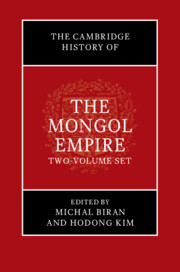

In the thirteenth and fourteenth centuries Chinggis Khan and his progeny ruled over two-thirds of Eurasia. Connecting East, West, North and South, the Mongols integrated most of the Old World, promoting unprecedented cross-cultural contacts and triggering the reshuffle of religious, ethnic, and geopolitical identities. The Cambridge History of the Mongol Empire studies the Empire holistically in its full Eurasian context, putting the Mongols and their nomadic culture at the center. Written by an international team of more than forty leading scholars, this two-volume set provides an authoritative and multifaceted history of 'the Mongol Moment' (1206–1368) in world history and includes an unprecedented survey of the various sources for its study, textual (written in sisteen languages), archaeological, and visual. This groundbreaking Cambridge History sets a new standard for future study of the Empire. It will serve as the fundamental reference work for those interested in Mongol, Eurasian, and world history.
Winner, 2024 Choice Awards
‘Scholars and students of the Mongols will find this set an invaluable aid in their research and teaching because for the first time scholarship on virtually every area and group enveloped in the Mongol Empire, as well as parts of the world that touched but were never conquered by the Mongols - e.g., Europe, the Arab Middle East, and South Asia - is collected under one cover. … Highly recommended.’
M. C. Brose Source: Choice
Loading metrics...
* Views captured on Cambridge Core between #date#. This data will be updated every 24 hours.
Usage data cannot currently be displayed.
This section outlines the accessibility features of this content - including support for screen readers, full keyboard navigation and high-contrast display options. This may not be relevant for you.
Accessibility compliance for the PDF of this book is currently unknown and may be updated in the future.
