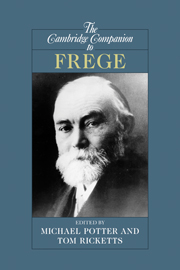

Gottlob Frege (1848–1925) was unquestionably one of the most important philosophers of all time. He trained as a mathematician, and his work in philosophy started as an attempt to provide an explanation of the truths of arithmetic, but in the course of this attempt he not only founded modern logic but also had to address fundamental questions in the philosophy of language and philosophical logic. Frege is generally seen (along with Russell and Wittgenstein) as one of the fathers of the analytic method, which dominated philosophy in English-speaking countries for most of the twentieth century. His work is studied today not just for its historical importance but also because many of his ideas are still seen as relevant to current debates in the philosophies of logic, language, mathematics and the mind. The Cambridge Companion to Frege provides a route into this lively area of research.
'Central to this end were Frege's insights on quantification, the notation that expressed it, the logicist project, and the extension of mathematical notions like function and argument to natural language. The long-awaited Cambridge Companion to Frege is a compendium of Fregean scholarship that rigorously explores these and similar topics; editors Thomas Ricketts and Michael Potter have compiled a comprehensive collection of fourteen essays that individually provide focused appraisals of a number of Frege's most substantial insights.'
Alexander Bozzo - University of Milwaukee
'The long-awaited publication of The Cambridge Companion to Frege is a major event in Frege scholarship … Every serious reader of Frege should read it.'
Source: Notre Dame Philosophical Reviews (ndpr.nd.edu)
Loading metrics...
* Views captured on Cambridge Core between #date#. This data will be updated every 24 hours.
Usage data cannot currently be displayed.
This section outlines the accessibility features of this content - including support for screen readers, full keyboard navigation and high-contrast display options. This may not be relevant for you.
Accessibility compliance for the PDF of this book is currently unknown and may be updated in the future.
