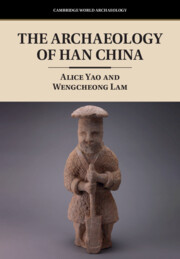
The Archaeology of Han China

-
Select format
-
- Publisher:
- Cambridge University Press
- Publication date:
- December 2024
- December 2024
- ISBN:
- 9781316884508
- 9781107185555
- 9781316636435
- Dimensions:
- (254 x 178 mm)
- Weight & Pages:
- 0.96kg, 370 Pages
- Dimensions:
- (254 x 178 mm)
- Weight & Pages:
- 0.81kg, 370 Pages
You may already have access via personal or institutional login
Show more authors 
You may already have access via personal or institutional login
Book description
The Han Dynasty, which ruled from 202 BCE to 212 CE, is often taken as a reference point and model for Chinese identity and tradition. Covering a geographical expanse comparable to that of the People's Republic of China, it is foundational to understanding Chinese culture and politics, past and present. This volume offers an up-to-date overview of the archaeology of the Han Empire. Alice Yao and Wengcheong Lam study the period via an interdisciplinary approach that combines textual and archaeological evidence. Exploring the dynamics of empire building in East Asia, Yao and Lam draw on recent archaeological discoveries to recast Western Han imperialism as a series of contingent material projects, including the organization of spatial orders, foodways, and the expansion of communication and ritual activities. They also demonstrate how the archaeology of everyday life offers insights into the impact of social change, and how people negotiated their identities and cultural affiliations as individuals and imperial subordinates.
Contents
Contents
Metrics
Altmetric attention score
Full text views
Full text views helpTotal number of HTML views: 0
Total number of PDF views: 0 *
 Loading metrics...
* Views captured on Cambridge Core between #date#. This data will be updated every 24 hours.
Usage data cannot currently be displayed.
Accessibility standard: Unknown
Why this information is here
This section outlines the accessibility features of this content - including support for screen readers, full keyboard navigation and high-contrast display options. This may not be relevant for you.
Accessibility Information
Accessibility compliance for the PDF of this book is currently unknown and may be updated in the future.