
Skip to main content Accessibility help
×
  • Cited by 40
    • Show more authors
    • You may already have access via personal or institutional login
    • Select format
    • Publisher:
      Cambridge University Press
      Publication date:
      06 January 2010
      06 September 1979
      ISBN:
      9780511622274
      9780521278898
      Dimensions:
      Weight & Pages:
      Dimensions:
      (228 x 152 mm)
      Weight & Pages:
      0.274kg, 172 Pages
    You may already have access via personal or institutional login
  • Selected: Digital
    Add to cart View cart Buy from Cambridge.org

    Book description

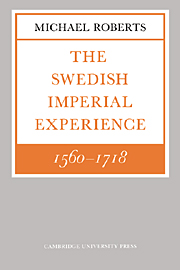
    In his Wiles Lectures for 1977 Professor Roberts examines some of the problems raised by Sweden's brief career as a great power, and seeks to answer some of the questions that flow from them. Were the underlying considerations which prompted the unexpected development geopolitical, or social, or economic? How was it possible to produce the financial resources and the manpower which the enterprise demanded? How far was seventeenth-century Sweden a militarized society? What importance had official propaganda and national myths? Did the consititutional situation help to make an expansionist foreign policy easier? The structure of the empire is next examined: its administration, the ties that held it together, the differing interests of the provinces, the varying responses of the metropolitan power was there, in fact, anything deserving the name of an imperial policy? How did the provinces view the Swedish connexion? In a final chapter the author tries to answer the question why, if Sweden could acquire an empire without undue strain, she could not retain it; why the collapse was so rapid and so total; and whether her career as a great power had real relevance to the country's subsequent history. On almost all these topics little information is available in English, and no comparable treatment of them on this scale exists in any language.

    Reviews

    'Professor Michael Roberts is our foremost English expert in Swedish history … he writes with elegance and wit, likes a paradox and loves a fight, so that his work, while factually informative, is highly readable and delights by its controversial tone … [This] is a rich book … a beautifully composed and extremely satisfying review of the whole field.'

    Source: English Historical Review

    'Professor Roberts has clearly provided both a wealth of stimulating argument for those already acquainted with the subject, and, for a wider public, a succinct and clearly argued introduction to this important theme in early modern European history.'

    Source: History Today

    ' … essential reading for every early modernist working in the history of Europe.'

    Source: The Historian

    ' … a masterly, most readable new summary and analysis … the presentation is lucid, convincing, a tribute to the author, and a gain for the student of European history.'

    Source: American Historical Review

    Refine List

    Actions for selected content:

    Select all | Deselect all
    • View selected items
    • Export citations
    • Download PDF (zip)
    • Save to Kindle
    • Save to Dropbox
    • Save to Google Drive

    Save Search

    You can save your searches here and later view and run them again in "My saved searches".

    Please provide a title, maximum of 40 characters.
    ×

    Contents

    Metrics

    Altmetric attention score

    Full text views

    Total number of HTML views: 0
    Total number of PDF views: 0 *
    Loading metrics...

    Book summary page views

    Total views: 0 *
    Loading metrics...

    * Views captured on Cambridge Core between #date#. This data will be updated every 24 hours.

    Usage data cannot currently be displayed.

    Accessibility standard: Unknown

    Why this information is here

    This section outlines the accessibility features of this content - including support for screen readers, full keyboard navigation and high-contrast display options. This may not be relevant for you.

    Accessibility Information

    Accessibility compliance for the PDF of this book is currently unknown and may be updated in the future.
