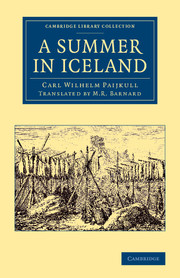

In 1865, the Swedish geologist Carl Wilhelm Paijkull (1836–69) made a voyage from Copenhagen to Iceland, a country that was still little understood by the rest of Europe. In the course of a trip that had a chiefly scientific purpose, Paijkull noted not only the geological features of the island, but also many salient aspects of Icelandic culture in a detailed yet readable style. The book features a number of striking engravings of natural features, including the volcano Hekla, as well as depictions of Icelanders engaging in activities such as drying fish or crossing a river. Paijkull ranges widely in his narrative, commenting on the Icelandic fondness for dogs, historical and contemporary friction with Denmark, and the island's economic fortunes. His perceptive account was first published in Swedish in 1866 and is reissued here in the English translation that appeared in 1868.
Loading metrics...
* Views captured on Cambridge Core between #date#. This data will be updated every 24 hours.
Usage data cannot currently be displayed.
This section outlines the accessibility features of this content - including support for screen readers, full keyboard navigation and high-contrast display options. This may not be relevant for you.
Accessibility compliance for the PDF of this book is currently unknown and may be updated in the future.
