Skip to main content Accessibility help
×
  • Cited by 1
    • Show more authors
    • Open Access
      You have digital access to this book
    • Select format
    • Publisher:
      Cambridge University Press
      Publication date:
      03 August 2023
      17 August 2023
      ISBN:
      9781009362719
      9781009362726
      9781009362733
      Creative Commons:
      Creative Common License - CC Creative Common License - BY Creative Common License - NC
      This content is Open Access and distributed under the terms of the Creative Commons Attribution licence CC-BY-NC 4.0.
      https://creativecommons.org/creativelicenses
      Dimensions:
      (229 x 152 mm)
      Weight & Pages:
      0.58kg, 314 Pages
      Dimensions:
      (229 x 152 mm)
      Weight & Pages:
      0.456kg, 314 Pages
    Open Access
    You have digital access to this book
    Selected: Digital
    View content
    Add to cart View cart Buy from Cambridge.org

    Book description

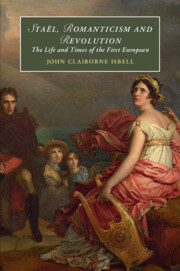
    Two centuries of sexism have hidden Staël's place in international history. Straddling the divides of the French Revolution, Napoleonic Europe, emergent nationalism, and European Romanticism, and playing pivotal roles in those movements, she was also a friend of Byron, Jefferson, and Tsar Alexander. Extensive archival research, and a complete contextual overview of Staël's writings, here restore Staël's canonical status as political philosopher, historian, European Romantic theorist, and Revolutionary. While the term stateswoman is not commonly used, it describes Staël aptly, acting as she necessarily did through men around her. The brilliant game of masks and proxies imposed on her by patriarchy is detailed here, alongside her unending fight for the oppressed, from the nations of Napoleon's subjugated Europe to the victims of the Atlantic slave trade. This title is part of the Flip it Open Programme and may also be available Open Access. Check our website Cambridge Core for details.

    Awards

    Winner, 2024 Choice Awards

    Reviews

    ‘Beautifully written and impeccably researched, [this book] is a satisfyingly thorough examination of a popular author’s work, and it becomes an indispensable addition to the understanding of Staël’s literary career in the panorama of nineteenth-century Europe by confidently demonstrating the long-lasting repercussions of her oeuvre.’

    Carmen Casaliggi Source: European Romantic Review

    Refine List

    Actions for selected content:

    Select all | Deselect all
    • View selected items
    • Export citations
    • Download PDF (zip)
    • Save to Kindle
    • Save to Dropbox
    • Save to Google Drive

    Save Search

    You can save your searches here and later view and run them again in "My saved searches".

    Please provide a title, maximum of 40 characters.
    ×

    Contents

    Full book PDF

    Page 1 of 2


    • Staël, Romanticism and Revolution
      pp i-i
    • Cambridge Studies in Romanticism - Series page
      pp ii-ii
    • Staël, Romanticism and Revolution - Title page
      pp iii-iii
    • The Life and Times of the First European
    • Copyright page
      pp iv-iv
    • Epigraph
      pp v-vi
    • Contents
      pp vii-viii
    • Preface
      pp ix-x
    • Acknowledgments
      pp xi-xii
    • Abbreviations
      pp xiii-xvi
    • Additional material
      pp xvii-xviii
    • Introduction
      pp 1-3
    • Chapter 1 - The Painful Birth of the Romantic Heroine
      pp 4-11
    • Staël as Political Animal, 1786–1821
    • Chapter 4 - The Social Contract for Staël and Constant, or Does Liberty Have a Sex?
      pp 41-50
    • Chapter 7 - Suicide, Meaning, and Power in the Querelle of Delphine
      pp 68-81
    • Chapter 8 - My Father, Myself
      pp 82-88
    • Staël and the Manuscrits de M. Necker
    • Chapter 9 - Italy, or Corinne
      pp 89-99
    • Chapter 10 - Interlude
      pp 100-108
    • In Search of Romantic Theater
    • Chapter 11 - Napoleon Pulps His Enemies
      pp 109-123
    • Censors, Police, and De l’Allemagne’s Lost 1810 Edition
    • Chapter 12 - The Napoleon Apocalypse
      pp 124-142
    • Chapter 15 - The Italian Romantics and Madame de Staël
      pp 173-184
    • Art, Society, and Nationhood
    • Chapter 16 - Inventing the French Revolution
      pp 185-199
    • Staël Considers National Credit, 1789–1818
    • Chapter 17 - Voices Lost?
      pp 200-211
    • Staël and Slavery, 1786–1830
    • Conclusion
      pp 212-213
    • La Vie dans l’œuvre
    • Notes
      pp 214-267

    Page 1 of 2


    Metrics

    Altmetric attention score

    Full text views

    Total number of HTML views: 0
    Total number of PDF views: 0 *
    Loading metrics...

    Book summary page views

    Total views: 0 *
    Loading metrics...

    * Views captured on Cambridge Core between #date#. This data will be updated every 24 hours.

    Usage data cannot currently be displayed.

    Accessibility standard: Unknown

    Why this information is here

    This section outlines the accessibility features of this content - including support for screen readers, full keyboard navigation and high-contrast display options. This may not be relevant for you.

    Accessibility Information

    Accessibility compliance for the PDF of this book is currently unknown and may be updated in the future.

