
Skip to main content Accessibility help
×
  • Cited by 345
    • Show more authors
    • You may already have access via personal or institutional login
    • Select format
    • Publisher:
      Cambridge University Press
      Publication date:
      24 November 2009
      11 April 2005
      ISBN:
      9780511614644
      9780521851947
      9780521617475
      Dimensions:
      (228 x 152 mm)
      Weight & Pages:
      0.45kg, 248 Pages
      Dimensions:
      (228 x 152 mm)
      Weight & Pages:
      0.337kg, 248 Pages
    You may already have access via personal or institutional login
  • Selected: Digital
    Add to cart View cart Buy from Cambridge.org

    Book description

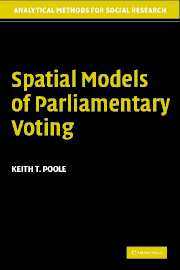
    This book presents a simple geometric model of voting as a tool to analyze parliamentary roll call data. Each legislator is represented by one point and each roll call is represented by two points that correspond to the policy consequences of voting Yea or Nay. On every roll call each legislator votes for the closer outcome point, at least probabilistically. These points form a spatial map that summarizes the roll calls. In this sense a spatial map is much like a road map because it visually depicts the political world of a legislature. The closeness of two legislators on the map shows how similar their voting records are, and the distribution of legislators shows what the dimensions are. These maps can be used to study a wide variety of topics including how political parties evolve over time, the existence of sophisticated voting and how an executive influences legislative outcomes.

    Reviews

    'This book achieves its aim of explaining how to build a spatial model and will be essential reading for those engaged in that, while still being readable and related well to real politics.'

    Source: Political Studies Review

    Refine List

    Actions for selected content:

    Select all | Deselect all
    • View selected items
    • Export citations
    • Download PDF (zip)
    • Save to Kindle
    • Save to Dropbox
    • Save to Google Drive

    Save Search

    You can save your searches here and later view and run them again in "My saved searches".

    Please provide a title, maximum of 40 characters.
    ×

    Contents

    References
    Abramowitz, Alan I. and Segal, Jeffrey A.. 1992. Senate Elections. Ann Arbor, MI: University of Michigan Press
    Albert, A. and Anderson, J. A.. 1984. “On the Existence of Maximum Likelihood Estimates in Logistic Regression Models.” Biometrika, 71:1–10
    Albert, James H. and Chib, Siddhartha. 1993. “Bayesian Analysis of Binary and Polychotomous Response Data.” Journal of the American Statistical Association, 88:669–679
    Aldrich, John H. and McGinnis, Michael D.. 1989. “A Model of Party Constraints on Optimal Candidate Positions.” Mathematical and Computer Modeling, 12:437–450
    Amacher, Ryan C. and Boyes, William J.. 1978. “Cycles in Senatorial Voting Behavior: Implications for the Optimal Frequency of Elections.” Public Choice, 33(3): 5–13
    Andrich, David. 1988. Rasch Models for Measurement. Newbury Park, CA: Sage
    Andrich, David. 1995. “Hyperbolic Cosine Latent Trait Models for Unfolding Direct Responses and Pairwise Preferences.” Applied Psychological Measurement, 19:269–290
    Ansolabehere, Stephen, Snyder, James M. Jr., and Stewart, Charles III., 2001. “Candidate Positioning in U.S. House Elections.” American Journal of Political Science, 45:136–159
    Austen-Smith, David. 1987. “Interest Groups, Campaign Contributions, and Probabilistic Voting.” Public Choice, 54:123–139
    Austen-Smith, David and Banks, Jeffrey S.. 2000. Positive Political Theory I: Collective Preference. Ann Arbor, MI: University of Michigan Press
    Austen-Smith, David and Banks, Jeffrey S.. 2004. Positive Political Theory II: Strategy and Structure. Ann Arbor, MI: University of Michigan Press
    Bailey, Michael. 2002. “Comparing Presidents, Senators, and Justices, 1946–2002.” Working Paper, Georgetown University
    Bailey, Michael and Chang, Kelly. 2001. “Comparing Presidents, Senators, and Justices: Inter-institutional Preference Estimation.” Journal of Law, Economics and Organization, 17:477–506
    Bennett, Joseph F. and Hays, William L.. 1960. “Multidimensional Unfolding: Determining the Dimensionality of Ranked Preference Data.” Psychometrika, 25:27–43
    Berndt, E. K., Hall, Bronwyn H., Hall, Robert E., and Hausman, Jerry. 1974. “Estimation and Inference in Nonlinear Structural Models.” Annals of Economic and Social Measurement, 3/4:653–666
    Bernhard, William and Brian R. Sala. 2004. “The Dynamics of Senate Voting: “Ideological Shirking” and the 17th Amendment.” Paper Presented at the Annual Meetings of the Southern Political Science Association, New Orleans, LA
    Bernhardt, M. Daniel and Ingberman, Daniel E.. 1985. “Candidate Reputations and the ‘Incumbency Effect’.” Journal of Public Economics, 27:47–67
    Best, Alvin M., Young, Forrest W., and Hall, Robert G.. 1979On the Precision of a Euclidean Structure.” Psychometrika, 44:395–408
    Black, Duncan. 1948On the Rationale of Group Decision Making.” Journal of Political Economy, 56:23–34
    Black, Duncan. 1958. The Theory of Committees and Elections. Cambridge, England: Cambridge University Press
    Blokland-Vogelesang, Rian. 1991. Unfolding and Group Consensus Ranking for Individual Preferences. Leiden: DWSO Press
    Borg, Ingwer and Groenen, Patrick. 1997. Modern Multidimensional Scaling: Theory and Applications. New York: Springer
    Brady, Henry. 1990Traits Versus Issues: Factor Versus Ideal-Point Analysis of Candidate Thermometer Ratings.” Political Analysis, 2:97–129
    Brady, David W. and Volden, Craig. 1998. Revolving Gridlock Politics and Policy from Carter to Clinton. Boulder, CO: Westview Press
    Cahoon, Lawrence S. 1975. Locating a Set of Points Using Range Information Only. Ph.D. Dissertation, Department of Statistics, Carnegie-Mellon University
    Cahoon, Lawrence S., Melvin J. Hinich, and Peter C. Ordeshook. 1976. “A Multidimensional Statistical Procedure for Spatial Analysis.” Manuscript, Carnegie-Mellon University
    Cahoon, Lawrence S., Hinich, Melvin J., and Ordeshook, Peter C.. 1978. “A Statistical Multidimensional Scaling Method Based on the Spatial Theory of Voting.” In Graphical Representation of Multivariate Data, edited by Wang, P. C.. New York: Academic Press
    Calvert, Randall. 1985Robustness of the Multidimensional Voting Model: Candidates' Motivations, Uncertainty, and Convergence.” American Journal of Political Science, 29:69–95
    Campbell, Angus, Converse, Philip E., Miller, Warren E., and Stokes, Donald E.. 1960. The American Voter. New York: Wiley
    Carmines, Edward G. and Stimson, James A.. 1989. Issue Evolution: Race and the Transformation of American Politics. Princeton, NJ: Princeton University Press
    Carroll, J. Douglas. 1972. “Individual Differences and Multidimensional Scaling.” In Multidimensional Scaling: Theory and Applications in the Behavioral Sciences, edited by Romney, A. Kimball, Shepard, Roger N., and Nerlove, Sara Beth. New York: Seminar Press
    Carroll, J. Douglas. 1980. “Models and Methods for Multidimensional Analysis of Preferential Choice (or Other Dominance) Data.” In Similarity and Choice, edited by Lantermann, E. D. and Feger, H.. Bern, Switzerland: Huber
    Carroll, J. Douglas and Chang, Jih-Jie. 1970. “Analysis of Individual Differences in Multidimensional Scaling via an N-Way Generalization of ‘Eckart–Young’ decomposition.” Psychometrika, 35:283–320
    Chang, Jih-Jie and J. Douglas Carroll. 1969. “How to Use MDPREF, a Computer Program for Multidimensional Analysis of Preference Data.” Multidimensional Scaling Program Package of Bell Laboratories, Bell Laboratories, Murray Hill, NJ
    Chater, Nick. 1999. “The Search for Simplicity: A Fundamental Cognitive Principle?” Quarterly Journal of Experimental Psychology, 52A:273–302
    Cheng, Ken. 2000Shepard's Universal Law Supported by Honeybees in Spatial Generalization.” Psychological Science, 5:403–408
    Clinton, Joshua D. 2003. “Same Principals, Same Agents, Different Institutions: Roll Call Voting in the Continental Congress, Congresses of Confederation and the U.S. Senate, 1774–1786.” Working Paper, Princeton University
    Clinton, Joshua D. and Meirowitz, Adam H.. 2003Integrating Voting Theory and Roll-Call Analysis: A Framework.” Political Analysis, 11:381–396
    Clinton, Joshua D. and Meirowitz, Adam H.. 2004Testing Accounts of Legislative Strategic Voting: The Compromise of 1790.” American Journal of Political Science, 48:675–689
    Clinton, Joshua D., Jackman, Simon D., and Rivers, Douglas. 2004The Statistical Analysis of Roll Call Data: A Unified Approach.” American Political Science Review, 98:355–370
    Converse, Philip E. 1964. “The Nature of Belief Systems in Mass Publics.” In Ideology and Discontent, edited by Apter, David E.. New York: Free Press
    Coombs, Clyde. 1950Psychological Scaling Without a Unit of Measurement.” Psychological Review, 57:148–158
    Coombs, Clyde. 1964. A Theory of Data. New York: Wiley
    Courant, Richard and Hilbert, David. 1937. Methods of Mathematical Physics: Volume I. Berlin: Julius Springer
    Cox, Gary W. 1999The Empirical Content of Rational Choice Theory: A Reply to Green and Shapiro.” Journal of Theoretical Politics, 11:147–169
    Cox, Gary W. 2004. “Lies, Damned Lies and Rational Choice Analysis.” In Problems and Methods in the Study of Politics, edited by Shapiro, Ian, Smith, Rogers M., and Masoud, Tarek E.. Cambridge: Cambridge University Press
    Cox, Gary W. and Katz, Jonathan N.. 2002. Elbridge Gerry's Salamander: The Electoral Consequences of the Reapportionment Revolution. New York: Cambridge University Press
    Cox, Gary W. and McCubbins, Mathew D.. 1993. Legislative Leviathan. Berkeley, CA: University of California Press
    Cox, Gary W. and Mathew D. McCubbins. 2004. “Setting the Agenda: Responsible Party Government in the US House of Representatives.” Manuscript, University of California, San Diego
    Cox, Gary W. and Poole, Keith T.. 2002a. “On Measuring Partisanship in Roll Call Voting: The U.S. House of Representatives, 1877–1999.” American Journal of Political Science, 46:477–489
    Cox, Gary W. and Keith T. Poole. 2002b. “Measuring Group Differences in Roll Call Voting.” Manuscript, University of Houston
    Cox, Trevor F. and Michael, A. A. Cox. 2001. Multidimensional Scaling. New York: Chapman and Hall/CRC
    Cragg, John G. and Donald, Stephen G.. 1997Inferring the Rank of a Matrix.” Journal of Econometrics, 76:223–250
    D'Andrade, Roy G., Quinn, Naomi R., Nerlove, Sara Beth, and Romney, A. Kimball. 1972. “Categories of Disease in American-English and Mexican-Spanish.” In Multidimensional Scaling: Theory and Applications in the Behavioral Sciences, edited by Romney, A. Kimball, Shepard, Roger N., and Nerlove, Sara Beth. New York: Seminar Press
    Davis, Otto A. and Hinich, Melvin J.. 1966. “A Mathematical Model of Policy Formation in a Democratic Society.” In Mathematical Applications in Political Science, II, edited by Bernd, J. L.. Dallas: SMU Press, pp. 175–208
    Davis, Otto A. and Hinich, Melvin J.. 1967. “Some Results Related to a Mathematical Model of Policy Formation in a Democratic Society.” In Mathematical Applications in Political Science III, edited by Bernd, J.. Charlottesville, VA: University of Virginia Press, pp. 14–38
    Davis, Otto A., Hinich, Melvin J., and Ordeshook, Peter C.. 1970An Expository Development of a Mathematical Model of the Electoral Process.” American Political Science Review, 64:426–448
    DeSarbo, Wayne S. and Cho, Jaewun 1989A Stochastic Multidimensional Scaling Vector Threshold Model for the Spatial Representation of ‘Pick Any/N’ Data.” Psychometrika, 54:105–129
    DeSarbo, Wayne S. and Hoffman, Donna L.. 1987Constructing MDS Joint Spaces from Binary Choice Data: A Multidimensional Unfolding Threshold Model for Marketing Research.” Journal of Marketing Research, 24:40–54
    Dhrymes, Phoebus J. 1978. Introductory Econometrics. New York: Springer-Verlag
    Diermeier, Daniel. 1996. “Rational Choice and the Role of Theory in Political Science.” In The Rational Choice Controversy, edited by Friedman, Jeffrey. New Haven: Yale University Press
    Downs, Anthony. 1957. An Economic Theory of Democracy. New York: Harper & Row
    Eckart, Carl and Young, Gale. 1936The Approximation of One Matrix by Another of Lower Rank.” Psychometrika, 1: 211–218
    Efron, Bradley. 1979Bootstrap Methods: Another Look at the Jackknife.” Annals of Statistics, 7:1–26
    Efron, Bradley and Tibshirani, Robert J.. 1993. An Introduction to the Bootstrap. New York: Chapman & Hall
    Ekman, Gosta. 1954Dimensions of Color Vision.” Journal of Psychology, 38:467–474
    Ellenberg, Jordan. 2001. “Growing Apart: The Mathematical Evidence for Congress' Growing Polarization.” Slate, 26 December 2001
    Elling, Richard C. 1982. “Ideological Change in the U.S. Senate: Time and Electoral Responsiveness.” Legislative Studies Quarterly, 7(1):75–92
    Embretson, Susan and Reise, Steven P.. 2000. Item Response Theory for Psychologists. Mahwah, NJ: Lawrence Erlbaum
    Enelow, James M. and Hinich, Melvin. 1984. The Spatial Theory of Voting. New York: Cambridge University Press
    Ennis, Daniel M. 1988a. “Confusable and Discriminable Stimuli: Comment on Nosofsky (1986) and Shepard (1986).” Journal of Experimental Psychology: General, 117:408–411
    Ennis, Daniel M. 1988b. “Technical Comments: Toward a Universal Law of Generalization.” Science, 242:944
    Ennis, Daniel M., Palen, Joseph J., and Mullen, Kenneth. 1988A Multidimensional Stochastic Theory of Similarity.” Journal of Mathematical Psychology, 32:449–465
    Feldman, Stanley and Zaller, John. 1992Political Culture of Ambivalence: Ideological Responses to the Welfare State.” American Journal of Political Science, 36:268–307
    Ferejohn, John and Satz, Debra. 1996. “Unification, Universalism, and Rational Choice Theory.” In The Rational Choice Controversy, edited by Friedman, Jeffrey. New Haven: Yale University Press
    Ferejohn, John and Debra Satz. 2000. “Rational Choice Theory and Mental Models.” Working Paper, Stanford University
    Feyerabend, Paul K. 1975. Against Method. London: New Left Press
    Fiorina, Morris P. 1996. “Rational Choice, Empirical Contributions, and the Scientific Enterprise.” In The Rational Choice Controversy, edited by Friedman, Jeffrey. New Haven: Yale University Press
    Firth, David and Arthur Spirling. 2003. “Divisions of the United Kingdom House of Commons, from 1992 to 2003 and Beyond.” Working Paper, Nuffield College, Oxford
    Fischer, Gerhard H. and Molenaar, Ivo W.. 1995. Rasch Models: Foundations, Recent Developments, and Applications. New York: Springer-Verlag
    Garner, Wendell R. 1974. The Processing of Information and Structure. New York: Wiley
    Gelfand, Alan E. and Smith, Adrian F. M.. 1990Sampling-Based Approaches to Calculating Marginal Densities.” Journal of the American Statistical Association, 85:398–409
    Gelman, Andrew. 1992Iterative and Non-iterative Simulation Algorithms.” Computing Science and Statistics, 24:433–438
    Gelman, Andrew, Carlin, John B., Stern, Hal S., and Rubin, Donald B.. 2000. Bayesian Data Analysis. New York: Chapman and Hall/CRC
    Geman, Donald and Geman, Stuart. 1984Stochastic Relaxation, Gibbs Distributions, and the Bayesian Restoration of Images.” IEEE Transactions on Pattern Analysis and Machine Intelligence, 6:721–741
    Gerber, Elizabeth R. and Jeffrey B. Lewis. 2002. “Beyond the Median: Voter Preferences, District Heterogeneity, and Representation.” Working Paper, UCLA
    Gifi, Albert. 1990. Nonlinear Multivariate Analysis. Chicester, England: Wiley
    Gill, Jeff. 2002. Bayesian Methods: A Social and Behavioral Sciences Approach. Boca Raton, FL: Chapman & Hall/CRC
    Gleason, Terry C. and Staelin, Richard. 1975A Proposal for Handling Missing Data.” Psychometrika, 40:229–252
    Gluck, Mark A. 1991Stimulus Generalization and Representation in Adaptive Network Models of Category Learning.” Psychological Science, 2:50–55
    Gombrich, Ernst Hans. 1978. The Story of Art (13th edition). New York: Phaidon Press
    Goodman, Craig. 2004. “Ideological Constraint in Congress: Experiments in Roll Call Voting.” Ph.D. Dissertation, University of Houston
    Green, Donald P. and Shapiro, Ian. 1994. Pathologies of Rational Choice Theory: A Critique of Applications in Political Science. New Haven: Yale University Press
    Greene, William H. 1993. Econometric Analysis. Englewood Cliffs, NJ: Prentice Hall
    Guttman, Louis L. 1944A Basis for Scaling Qualitative Data.” American Sociological Review, 9:139–150
    Guttman, Louis L. 1954. “A New Approach to Factor Analysis.” In Mathematical Thinking in the Social Sciences, edited by Lazarsfeld, P. F.. Glencoe, IL: Free Press
    Haberman, Shelby J. 1977Maximum Likelihood Estimation in Exponential Response Models.” Annals of Statistics, 5:815–841
    Hammond, Thomas H. and Fraser, Jane M.. 1983Baselines for Evaluating Explanations of Coalition Behavior in Congress.” Journal of Politics, 45:635–656
    Harrington, Joseph. 1992The Role of Party Reputation in the Formation of Policy.” Journal of Public Economics, 49:107–121
    Hastings, W. Keith. 1970Monte Carlo Sampling Methods Using Markov Chains and Their Applications.” Biometrika, 54:97–109
    Heckman, James J. and Snyder, James M.. 1997Linear Probability Models of the Demand for Attributes with an Empirical Application to Estimating the Preferences of Legislators.” Rand Journal of Economics, 28:142–189
    Heiser, Willem J. 1981. Unfolding Analysis of Proximity Data. Leiden: University of Leiden
    Hinich, Melvin J. and Munger, Michael. 1994. Ideology and the Theory of Political Choice. Ann Arbor, MI: University of Michigan Press
    Hinich, Melvin J. and Munger, Michael. 1997. Analytical Politics. New York: Cambridge University Press
    Hinich, Melvin J. and Pollard, Walker. 1981A New Approach to the Spatial Theory of Electoral Competition.” American Journal of Political Science, 25:323–341
    Hinich, Melvin J. and Roll, Richard. 1981Measuring Nonstationarity in the Parameters of the Market Model.” Research in Finance, 3:1–51
    Hitchcock, David B. 2003A History of the Metropolis–Hastings Algorithm.” The American Statistician, 57:254–257
    Hoadley, John F. 1980The Emergence of Political Parties in Congress, 1789–1803.” American Political Science Review, 74:757–779
    Hoffer, Eric. 1951. The True Believer: Thoughts on the Nature of Mass Movements. New York: Harper & Row (Perennial Library Edition, 1966, 1989)
    Hojo, Hiroshi. 1994A New Method for Multidimensional Unfolding.” Behaviormetrika, 21:131–147
    Horst, Paul. 1963. Matrix Algebra for Social Scientists. New York: Holt, Rinehart and Winston
    Hotelling, Harold. 1929Stability in Competition.” The Economic Journal, 39:41–57
    Jackman, Simon D. 2000a. “Estimation and Inference via Bayesian Simulation: An Introduction to Markov Chain Monte Carlo.” American Journal of Political Science, 44:375–404
    Jackman, Simon D. 2000b. “Estimation and Inference are ‘Missing Data’ Problems: Unifying Social Science Statistics via Bayesian Simulation.” Political Analysis, 8:307–332
    Jackman, Simon D. 2001Multidimensional Analysis of Roll Call Data via Bayesian Simulation: Identification, Estimation, Inference and Model Checking.” Political Analysis, 9:227–241
    Jenkins, Jeffery A. and Munger, Michael C.. 2003. “Investigating the Incidence of Killer Amendments in Congress.” Journal of Politics, 65:498–517
    Jenkins, Jeffery A. and Sala, Brian R.. 1998. “The Spatial Theory of Voting and the Presidential Election of 1824.” American Journal of Political Science, 42:1157–1179
    Johnson, Richard M. 1963On a Theorem Stated by Eckart and Young.” Psychometrika, 28:259–263
    Keller, Joseph B. 1962Factorization of Matrices by Least-Squares.” Biometrika, 49:239–242
    Kiewiet, D. Roderick and McCubbins, Mathew D.. 1991. The Logic of Delegation: Congressional Parties and the Appropriation Process. Chicago: University of Chicago Press
    King, Gary, Honaker, James, Joseph, Anne, and Scheve, Kenneth. 2001Analyzing Incomplete Political Science Data: An Alternative Algorithm for Multiple Imputation.” American Political Science Review, 95:49–69
    King, David. 1998. “Party Competition and Polarization in American Politics.” Paper Prepared for the 1998 Annual Meeting of the Midwest Political Science Association
    Krehbiel, Keith. 1993. “Where's the Party?” British Journal of Political Science, 23(1):235–266
    Krehbiel, Keith. 1998. Pivotal Politics: A Theory of U.S. Lawmaking. Chicago: University of Chicago Press
    Kruskal, Joseph B. 1964a. “Multidimensional Scaling by Optimizing a Goodness of Fit to a Nonmetric Hypothesis.” Psychometrika, 29:1–27
    Kruskal, Joseph B. 1964b. “Nonmetric Multidimensional Scaling: A Numerical Method.” Psychometrika, 29:115–129
    Kruskal, Joseph B. and Wish, Myron. 1978. Multidimensional Scaling. Beverly Hills, CA: Sage
    Kruskal, Joseph B., Forrest W. Young, and Judith B. Seery. 1973. “How to Use KYST: A Very Flexible Program to Do Multidimensional Scaling and Unfolding.” Multidimensional Scaling Program Package of Bell Laboratories, Bell Laboratories, Murray Hill, NJ
    Kuhn, Thomas S. 1962/1996. The Structure of Scientific Revolutions (3rd edition). Chicago: University of Chicago Press
    Ladha, Krishna K. 1991A Spatial Model of Legislative Voting with Perceptual Error.” Public Choice, 68:151–174
    Laudan, Larry. 1984. Science and Values: The Aims of Science and Their Role in Scientific Debate. Berkeley, CA: University of California Press
    Laudan, Larry. 1996. Beyond Positivism and Relativism: Theory, Method and Evidence. Boulder, CO: Westview Press
    Lawson, Charles L. and Hanson, Richard J.. 1974. Solving Least Squares Problems. Englewood Cliffs, NJ: Prentice-Hall
    Lewis, Jeffrey B. and King, Gary. 1999No Evidence on Directional vs. Proximity Voting.” Political Analysis, 8:21–33
    Lewis, Jeffrey B. and Poole, Keith T.. 2004. “Measuring Bias and Uncertainty in Ideal Point Estimates via the Parametric Bootstrap.” Political Analysis, 12:105–127
    Livingstone, Margaret S. 2002. Vision and Art: The Biology of Seeing. New York: Harry N. Abrams
    Londregan, John B. 2000a. “Estimating Legislators' Preferred Points.” Political Analysis, 8(1):35–56
    Londregan, John B. 2000b. Legislative Institutions and Ideology in Chile. New York: Cambridge University Press
    Londregan, John B. and Snyder, James M. Jr. 1994Comparing Committee and Floor Preferences.” Legislative Studies Quarterly, 19:233–266
    Loomis, Michael. 1995. “Constituent Influences Outside the Spatial Structure of Legislative Voting.” Doctoral Dissertation, Carnegie-Mellon University
    Lord, Frederic M. 1983Unbiased Estimates of Ability Parameters, of Their Variance, and of Their Parallel Forms Reliability.” Psychometrika, 48:477–482
    Lott, John R. Jr. and Bronars, Stephen G.. 1993Time Series Evidence on Shirking in the U.S. House of Representatives.” Public Choice, 76:125–150
    Lublin, David (1997). The Paradox of Representation: Racial Gerrymandering and Minority Representation in Congress. Princeton, NJ: Princeton University Press
    Macdonald, Stuart, Rabinowitz, George, and Listhaug, Ola. 2001Sophistry versus Science: On Further Efforts to Rehabilitate the Proximity Model.” The Journal of Politics, 63:482–500
    MacRae, Duncan Jr. 1958. Dimensions of Congressional Voting. Berkeley: University of California Press
    MacRae, Duncan Jr. 1970. Issues and Parties in Legislative Voting. New York: Harper and Row
    McCarty, Nolan M. 1997. “Presidential Reputation and the Veto.” Economics and Politics, 9(1):1–26
    McCarty, Nolan M. 2000. “Proposal Rights, Veto Rights, and Political Bargaining.” American Journal of Political Science, 44(3):506–522
    McCarty, Nolan M. and Poole, Keith T.. 1995. “Veto Power and Legislation: An Empirical Analysis of Executive and Legislative Bargaining from 1961–1986.” Journal of Law, Economics, and Organization, 11:
    McCarty, Nolan M., Poole, Keith T., and Rosenthal, Howard. 1997. Income Redistribution and the Realignment of American Politics. Washington, DC: AEI Press
    McCarty, Nolan M., Poole, Keith T., and Rosenthal, Howard. 2001The Hunt for Party Discipline in Congress.” American Political Science Review, 95:673–687
    McCarty, Nolan M., Keith T. Poole, and Howard Rosenthal. 2003. “Political Polarization and Income Inequality.” Manuscript, University of Houston
    McCarty, Nolan M. and Rothenberg, Lawrence S. (1996). “Commitment and the Campaign Contribution Contract.” American Journal of Political Science, 40:872–904
    McCarty, Nolan M. and Razaghian, Rose. 1999. “Advice and Consent: Senate Response to Executive Branch Nominations 1885–1996.” American Journal of Political Science, 43(3):1122–1143
    McFadden, Daniel. 1976Quantal Choice Analysis: A Survey.” Annals of Economic and Social Measurement, 5:363–390
    Manski, Charles F. 1975Maximum Score Estimation of the Stochastic Utility Model of Choice.” Journal of Econometrics, 3:205–228
    Manski, Charles F. 1985Semiparametric Analysis of Discrete Response: Asymptotic Properties of the Maximum Score Estimator.” Journal of Econometrics, 27:313–333
    Manski, Charles F. and Thompson, T. Scott. 1986Operational Characteristics of Maximum Score Estimation.” Journal of Econometrics, 32:85–108
    Martin, Andrew D. 2003Bayesian Inference for Heterogeneous Event Counts.” Sociological Methods and Research, 32:30–63
    Martin, Andrew D. and Kevin M. Quinn. 2001. “Bayesian Learning about Ideal Points of U. S. Supreme Court Justices, 1953–1999.” Working Paper, Washington University, St. Louis
    Martin, Andrew D. and Quinn, Kevin M.. 2002Dynamic Ideal Point Estimation via Markov Chain Monte Carlo for the U.S. Supreme Court, 1953–1999.” Political Analysis, 10:134–153
    Merrill, Samuel III and Grofman, Bernard. 1999. A Unified Theory of Voting: Directional and Proximity Models. New York: Cambridge University Press
    Metropolis, Nicholas C. and Ulam, Stanislaw. 1949The Monte Carlo Method.” Journal of the American Statistical Association, 44:335–341
    Miller, George A. 1956The Magical Number Seven, Plus Minus One: Some Limits on our Capacity for Processing Information.” Psychological Review, 63:81–97
    Morgenstern, Scott. 2004. Patterns of Legislative Politics: Roll-Call Voting in Latin America and the United States. New York: Cambridge University Press
    Morrison, Richard J. 1972A Statistical Model for Legislative Roll Call Analysis.” Journal of Mathematical Sociology, 2:235–247
    Morton, Rebecca B. 1987A Group Majority Voting Model of Public Good Provision.” Social Choice and Welfare, 4:117–131
    Neyman, Jerzy and Scott, Elizabeth L.. 1948Consistent Estimates Based on Partially Consistent Observations.” Econometrica, 16:1–32
    Nie, Norman H., Verba, Sidney, and Petrocik, John R.. 1979. The Changing American Voter. New York: Replica Books
    Nokken, Timothy P. 2000Dynamics of Congressional Loyalty: Party Defection and Roll Call Behavior, 1947–1997.” Legislative Studies Quarterly, 25:417–444
    Nokken, Timothy P. and Keith T. Poole. 2004. “Congressional Party Defection in American History.” Legislative Studies Quarterly, forthcoming
    Nosofsky, Robert M. 1984Choice, Similarity, and the Context Theory of Classification.” Journal of Experimental Psychology: Learning, Memory and Cognition, 10:104–114
    Nosofsky, Robert M. 1986Attention, Similarity, and the Identification–Categorization Relationship.” Journal of Experimental Psychology: General, 115:39–57
    Nosofsky, Robert M. 1988On Exemplar-Based Exemplar Representations: Reply to Ennis (1988).” Journal of Experimental Psychology: General, 117:412–414
    Nosofsky, Robert M. 1991Stimulus Bias, Asymmetric Similarity, and Classification.” Cognitive Psychology, 23:94–140
    Nosofsky, Robert M. 1992Similarity Scaling and Cognitive Process Models.” Annual Review of Psychology, 43:25–53
    Oppenheimer, Bruce I. 2000. “The Roll Call Behavior of Members Who Switch Parties, 1900–99: The Effect of Variations in Party Strength.” Paper Presented at the Annual Meeting of the Midwest Political Science Association, Chicago
    Ordeshook, Peter C. 1976. “The Spatial Theory of Elections: A Review and a Critique.” In Party Identification and Beyond, edited by Budge, Ian, Crewe, Ivor, and Farlie, Dennis. New York: Wiley
    Ordeshook, Peter C. 1996. “Engineering or Science: What is the Study of Politics?” In The Rational Choice Controversy, edited by Friedman, Jeffrey. New Haven: Yale University Press
    Palfrey, Thomas R. 1984Spatial Equilibrium with Entry.” Review of Economic Studies, 51:139–157
    Perlstein, Rick. 2001. Before the Storm: Barry Goldwater and the Unmaking of the American Consensus. New York: Hill and Wang
    Platt, Glenn, Poole, Keith T., and Rosenthal, Howard. 1992Directional and Euclidean Theories of Voting Behavior: A Legislative Comparison.” Legislative Studies Quarterly, 17:561–572
    Poole, Keith T. 1981. “Dimensions of Interest Group Evaluations of the U.S. Senate, 1969–1978.” American Journal of Political Science, 25(1):49–67
    Poole, Keith T. 1984Least Squares Metric, Unidimensional Unfolding.” Psychometrika, 49:311–323
    Poole, Keith T. 1988Recent Developments in Analytical Models of Voting in the U.S. Congress.” Legislative Studies Quarterly, 13:117–133
    Poole, Keith T. 1990Least Squares Metric, Unidimensional Scaling of Multivariate Linear Models.” Psychometrika, 55:123–149
    Poole, Keith T. 1997. “Non-parametric Analysis of Binary Choice Data.” Manuscript, University of Houston
    Poole, Keith T. 1998Recovering a Basic Space From a Set of Issue Scales.” American Journal of Political Science, 42:954–993
    Poole, Keith T. 1999NOMINATE: A Short Intellectual History.” The Political Methodologist, 9:1–6
    Poole, Keith T. 2000a. “Non-parametric Unfolding of Binary Choice Data.” Political Analysis, 8(3):211–237
    Poole, Keith T. 2000b. “Appendix to Non-parametric Unfolding of Binary Choice Data.” Manuscript, University of Houston
    Poole, Keith T. 2001. “The Geometry of Multidimensional Quadratic Utility in Models of Parliamentary Roll Call Voting.” Political Analysis, 9(3):211–226
    Poole, Keith T. 2003. “Changing Minds? Not in Congress!” Manuscript, University of Houston
    Poole, Keith T. and Romer, Thomas. 1993Ideology, Shirking and Representation.” Public Choice, 77:185–196
    Poole, Keith T. and Rosenthal, Howard. 1984a. “U.S. Presidential Elections 1968–1980: A Spatial Analysis.” American Journal of Political Science, 28:282–312
    Poole, Keith T. and Rosenthal, Howard. 1984b. “The Polarization of American Politics.” Journal of Politics, 46:1061–1079
    Poole, Keith T. and Rosenthal, Howard. 1985A Spatial Model for Legislative Roll Call Analysis.” American Journal of Political Science, 29:357–384
    Poole, Keith T. and Rosenthal, Howard. 1987Analysis of Congressional Coalition Patterns: A Unidimensional Spatial Model.” Legislative Studies Quarterly, 12:55–75
    Poole, Keith T. and Rosenthal, Howard. 1991. “Patterns of Congressional Voting.” American Journal of Political Science, 35:228–278
    Poole, Keith T. and Rosenthal, Howard. 1997. Congress: A Political–Economic History of Roll Call Voting. New York: Oxford University Press
    Poole, Keith T. and Rosenthal, Howard. 2001. “D-NOMINATE After 10 Years: A Comparative Update to Congress: A Political–Economic History of Roll Call Voting.” Legislative Studies Quarterly, 26:5–26
    Poole, Keith T., Sowell, Fallaw B., and Spear, Stephen E.. 1992Evaluating Dimensionality in Spatial Voting Models.” Mathematical and Computer Modeling, 16: 85–101
    Quinn, Kevin M. 2004Bayesian Factor Analysis for Mixed Ordinal and Continuous Responses.” Political Analysis, 12:338–353
    Quinn, Kevin M. and Martin, Andrew D.. 2002An Integrated Computational Model of Multiparty Electoral Competition.” Statistical Science, 17:405–419
    Quinn, Kevin M., Martin, Andrew D., and Whitford, Andrew B.. 1999Voter Choice in Multi-party Democracies: A Test of Competing Theories and Models.” American Journal of Political Science, 43:1231–1247
    Rabinowitz, George. 1976A Procedure for Ordering Object Pairs Consistent with the Multidimensional Unfolding Model.” Psychometrika, 45:349–373
    Rabinowitz, George and Macdonald, Stuart. 1989A Directional Theory of Issue Voting.” American Political Science Review, 83:93–121
    Rasch, Georg. 1961. “On General Laws and the Meaning of Measurement in Psychology.” In Proceedings of the IV Berkeley Symposium on Mathematical Statistics and Probability, vol. 4, pp. 321–333
    Riker, William H. 1982/1988. Liberalism Against Populism: A Confrontation Between the Theory of Democracy and the Theory of Social Choice. Prospect Heights, IL: Waveland Press
    Rivers, Douglas. 2004. “Identification of Multidimensional Spatial Voting Models.” Manuscript, Stanford University
    Romano, Roberta. 1997The Political Dynamics of Derivative Securities Regulation.” Yale Journal on Regulation, 14:279–406
    Rosenberg, Seymour, Nelson, Carnot, and Vivekananthan, P. S.. 1968A Multidimensional Approach to the Structure of Personality Impressions.” Journal of Personality and Social Psychology, 9:283–294
    Rosenthal, Howard and Voeten, Erik. 2004. “Analyzing Roll Calls with Perfect Spatial Voting: France 1946–1958.” American Journal of Political Science, 48:620–632
    Ross, John and Cliff, Norman. 1964A Generalization of the Interpoint Distance Model.” Psychometrika, 29:167–176
    Rothenberg, Lawrence S. and Sanders, Mitchell S.. 2000Severing the Electoral Connection: Shirking in the Contemporary Congress.” American Journal of Political Science, 44:316–325
    Rothkopf, Ernst Z. 1957A Measure of Stimulus Similarity and Errors in Some Paired-Associate Learning Tasks.” Journal of Experimental Psychology, 53:94–101
    Ruger, Theodore W., Kim, Pauline T., Martin, Andrew D., and Quinn, Kevin M.. 2004. “The Supreme Court Forecasting Project: Legal and Political Science Approaches to Predicting Supreme Court Decision-Making.” Columbia Law Review, 104:1150–1209
    Schofield, Norman. 1996. “Rational Choice Theory and Political Economy.” In The Rational Choice Controversy, edited by Friedman, Jeffrey. New Haven: Yale University Press
    Schofield, Norman, Martin, Andrew D., Quinn, Kevin M., and Whitford, Andrew B.. 1998Multiparty Electoral Competition in the Netherlands and Germany: A Model Based on Multinomial Probit.” Public Choice, 97:257–293
    Schonemann, Peter H. 1966A Generalized Solution of the Orthogonal Procrustes Problem.” Psychometrika, 31:1–10
    Schonemann, Peter H. 1970Fitting a Simplex Symmetrically.” Psychometrika, 35: 1–21
    Schonemann, Peter H. and Carroll, Robert M.. 1970Fitting One Matrix to Another Under Choice of a Central Dilation and Rigid Motion.” Psychometrika, 35:245–256
    Schonhardt-Bailey, Cheryl. 2003. “Ideology, Party and Interests in the British Parliament of 1841–1847,” British Journal of Political Science, 33:581–605
    Schonhardt-Bailey, Cheryl. 2004. Interests, Ideas and Institutions: Repeal of the Corn Laws Re-told. Manuscript, London School of Economics and Political Science
    Sen, Amartya K. 1970. Collective Choice and Social Welfare. San Francisco, CA: Holden-Day
    Shepard, Roger N. 1962a. “The Analysis of Proximities: Multidimensional Scaling with an Unknown Distance Function. I.” Psychometrika, 27:125–139
    Shepard, Roger N. 1962b. “The Analysis of Proximities: Multidimensional Scaling with an Unknown Distance Function. II.” Psychometrika, 27: 219–246
    Shepard, Roger N. 1963Analysis of Proximities as a Technique for the Study of Information Processing in Man.” Human Factors, 5:33–48
    Shepard, Roger N. 1986Discrimination and Generalization in Identification and Classification: Comment on Nosofsky.” Journal of Experimental Psychology: General, 115:58–61
    Shepard, Roger N. 1987Toward a Universal Law of Generalization for Psychological Science.” Science, 237:1317–1323
    Shepard, Roger N. 1988a. “Technical Comments: Toward a Universal Law of Generalization.” Science, 242:944
    Shepard, Roger N. 1988b. “Time and Distance in Generalization and Discrimination: Reply to Ennis (1988).” Journal of Experimental Psychology: General, 117:415–416
    Shepard, Roger N. 1991. “Integrality Versus Separability of Stimulus Dimensions: Evolution of the Distinction and a Proposed Theoretical Basis.” In Perception of Structure, edited by Pomerantz, James R. and Lockhead, Gregory. Washington, DC: APA
    Shepsle, Kenneth A. 1996. “Statistical Political Philosophy and Positive Political Theory.” In The Rational Choice Controversy, edited by Friedman, Jeffrey. New Haven: Yale University Press
    Shipan, Charles R. and Moraski, Bryon. 1999The Politics of Supreme Court Nominations: A Theory of Institutional Constraints and Choices.” American Journal of Political Science, 43:1069–1095
    Silvapulle, Mervyn J. 1981. “On the Existence of Maximum Likelihood Estimators for the Binomial Response Models.” Journal of the Royal Statistical Society Series B, 43(3):310–313
    Simmons, George F. 1972. Differential Equations with Applications and Historical Notes. New York: McGraw-Hill
    Smithies, Arthur. 1941Optimum Location in Spatial Competition.” The Journal of Political Economy, 49:423–439
    Snyder, James M. Jr. 1992Artificial Extremism in Interest Group Ratings.” Legislative Studies Quarterly, 17:319–345
    Snyder, James M. Jr., and Groseclose, Timothy. 2000. “Estimating Party Influence in Congressional Roll-Call Voting.” American Journal of Political Science, 44(2):193–211
    Sowell, Thomas. 1987. A Conflict of Visions: Ideological Origins of Political Struggles. New York: Quill
    Spector, David. 2000Rational Debate and One-Dimensional Conflict.” Quarterly Journal of Economics, 115:181–200
    Stratmann, Thomas. 2000Congressional Voting Over Legislative Careers: Shifting Positions and Changing Constraints.” The American Political Science Review, 94:665–676
    Tajfel, Henri. 1981. Human Groups and Social Categories. London: Cambridge University Press
    Thomas, Martin. 1985. “Election Proximity and Senatorial Roll Call Voting.” American Journal of Political Science, 29(1):96–111
    Torgerson, Warren S. 1952Multidimensional Scaling: I. Theory and Method.” Psychometrika, 17:401–419
    Treier, Shawn and Simon Jackman. 2003. “Democracy as a Latent Variable.” Manuscript, Stanford University
    Tucker, Ledyard R. 1960. “Intra-individual and Inter-individual Multidimensionality.” In Psychological Scaling: Theory and Applications, edited by Gulliksen, Harold and Messick, Samuel. New York: Wiley
    Tversky, Amos. 1977Features of Similarity.” Psychological Review, 84:327–352
    Voeten, Erik. 2000Clashes in the Assembly.” International Organization, 54:185–215
    Voeten, Erik. 2001Outside Options and the Logic of Security Council Action.” The American Political Science Review, 95:845–858
    Voeten, Erik. 2004. “Resisting the Lonely Superpower: Responses of States in the U.N. to U.S. Dominance.” Journal of Politics, 66:729–754
    Wang, Ming-Mei, Schonemann, Peter H., and Rusk, Jerrold G.. 1975A Conjugate Gradient Algorithm for the Multidimensional Analysis of Preference Data.” Multivariate Behavioral Research, 10:45–80
    Weisberg, Herbert F. 1968. Dimensional Analysis of Legislative Roll Calls. Doctoral Dissertation, University of Michigan
    Weisberg, Herbert F. 1978Evaluating Theories of Congressional Roll-Call Voting.” American Journal of Political Science, 22:551–577
    Weisberg, Herbert F. 1983Alternative Baseline Models and Their Implications for Understanding Coalition Behavior in Congress.” Journal of Politics, 45:657–671
    Weisberg, Herbert F. and Rusk, Jerrold G.. 1970Dimensions of Candidate Evaluation.” American Political Science Review, 64:1167–1185
    Wills, Garry. 1982. The Federalist Papers by Alexander Hamilton, James Madison, and John Jay. New York: Bantam Books
    Wish, Myron. 1971. “Individual Differences in Perceptions and Preferences Among Nations.” In Attitude Research Reaches New Heights, edited by King, Charles W. and Tigert, Douglas J.. Chicago: American Marketing Association
    Wish, Myron and Carroll, J. Douglas. 1974. “Applications of Individual Differences Scaling to Studies of Human Perception and Judgment.” In Handbook of Perception, vol. 2, edited by Carterette, Edward C. and Friedman, Morton P.. New York: Academic Press
    Wittman, Donald A. 1977Candidates with Policy Preferences: A Dynamic Model.” Journal of Economic Theory, 14:180–189
    Wittman, Donald A. 1983. “Candidate Motivations: A Synthesis of Alternatives.” American Political Science Review, 77:142–157
    Wright, Gerald C. and Berkman, Michael B.. 1986. “Candidates and Policy in United States Senate Elections.” American Political Science Review, 80(2):567–588
    Wright, Gerald C. and Schaffner, Brian F.. 2002The Influence of Party: Evidence from the State Legislatures.” American Political Science Review, 96:367–379
    Young, Gale and Householder, A. S.. 1938Discussion of a Set of Points in Terms of their Mutual Distances.” Psychometrika, 3:19–22

    Metrics

    Altmetric attention score

    Full text views

    Total number of HTML views: 0
    Total number of PDF views: 0 *
    Loading metrics...

    Book summary page views

    Total views: 0 *
    Loading metrics...

    * Views captured on Cambridge Core between #date#. This data will be updated every 24 hours.

    Usage data cannot currently be displayed.

    Accessibility standard: Unknown

    Why this information is here

    This section outlines the accessibility features of this content - including support for screen readers, full keyboard navigation and high-contrast display options. This may not be relevant for you.

    Accessibility Information

    Accessibility compliance for the PDF of this book is currently unknown and may be updated in the future.
