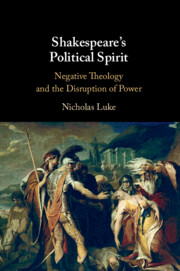
Shakespeare's Political Spirit

-
Select format
-
- Publisher:
- Cambridge University Press
- Publication date:
- 12 December 2024
- 19 December 2024
- ISBN:
- 9781009348232
- 9781009348249
- Dimensions:
- (229 x 152 mm)
- Weight & Pages:
- 0.56kg, 284 Pages
- Dimensions:
- Weight & Pages:
You may already have access via personal or institutional login
Show more authors 
You may already have access via personal or institutional login
Book description
This exciting and challenging study reorients how we think about politics in Shakespeare and on the early modern stage. By reading Shakespeare's political drama as a negative mode of political experience and thought, Nicholas Luke allows us to appreciate the imaginative and disruptive elements of plays that might seem politically pessimistic. Drawing on a long religious and philosophical tradition of negativity and considering the writings of Hegel, Kierkegaard, Benjamin, Adorno, Derrida and Badiou, Luke pursues a phenomenology of political spirit that looks to the creative potential of experiences of failure, haunting, estrangement, impasse and dream. Through his notion of a negative political theology, he challenges traditional understandings of political theology and shows that Shakespeare's drama of negativity is more than a form of pessimistic critique, but rather a force of freedom and invention that animates the political imaginations of its audience.
Reviews
‘This book breaks new ground in Shakespeare criticism, by arguing, via a political version of ‘negative theology', that politically-deadlocked plays (Coriolanus, Lear) see beyond the intransigence to which their characters and communities are condemned. The Hegelian notion of spirit is brilliantly conscripted in support of the negative-cum-positive reading; as is Hegel's idea of the master-slave relationship in which, unlike the master who reposes in the stasis of his mastery, the slave is forced by the crushing void of his servitude into a free act of ontological self-and-world-creation. Luke marries his philosophical perspective richly with a criticism that sees meaning as ‘distributed' beyond characters to a poetic gestalt as apprehended by the audience.'
John Gillies - Professor Emeritus in Literature, University of Essex
Shakespeare's Political Spirit proposes a radical rethinking of the political in Shakespeare. Writing against traditional positivist approaches, Luke's revisionary critical practice recuperates the negativity staged in political disruptions, contradictions, defeats, and failures and thereby opens Shakespeare's plays to a surprising, yet compelling array of hopeful political and social imaginaries.
Howard Marchitello - University Professor of English, Rutgers University-Camden
Contents
Contents
References
Metrics
Altmetric attention score
Full text views
Full text views helpTotal number of HTML views: 0
Total number of PDF views: 0 *
 Loading metrics...
* Views captured on Cambridge Core between #date#. This data will be updated every 24 hours.
Usage data cannot currently be displayed.
Accessibility standard: Unknown
Why this information is here
This section outlines the accessibility features of this content - including support for screen readers, full keyboard navigation and high-contrast display options. This may not be relevant for you.
Accessibility Information
Accessibility compliance for the PDF of this book is currently unknown and may be updated in the future.