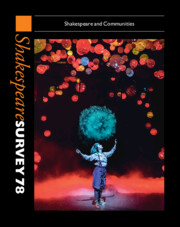
Shakespeare Survey 78

-
Select format
-
- Publisher:
- Cambridge University Press
- Publication date:
- 08 October 2025
- 16 October 2025
- ISBN:
- 9781009647564
- 9781009647571
- Dimensions:
- (254 x 203 mm)
- Weight & Pages:
- 1.11kg, 422 Pages
- Dimensions:
- Weight & Pages:
- Series:
- Shakespeare Survey (78)
Show more authors 
You may already have access via personal or institutional login
Book description
Shakespeare Survey is a yearbook of Shakespeare studies and production. Since 1948, Survey has published the best international scholarship in English and many of its essays have become classics of Shakespeare criticism. Each volume is devoted to a theme, or play, or group of plays; each also contains a section of reviews of that year's textual and critical studies and of the year's major British performances. The theme for Volume 78 is 'Shakespeare's Communities'. The complete set of Survey volumes is also available online at www.cambridge.org/core/publications/collections/cambridge-shakespeare. This searchable resource enables users to browse by author, essay and volume, search by play, theme and topic, and save and bookmark their results.
Contents
Contents
Metrics
Altmetric attention score
Full text views
Full text views helpTotal number of HTML views: 0
Total number of PDF views: 0 *
 Loading metrics...
* Views captured on Cambridge Core between #date#. This data will be updated every 24 hours.
Usage data cannot currently be displayed.
Accessibility standard: WCAG 2.1 AA
Why this information is here
This section outlines the accessibility features of this content - including support for screen readers, full keyboard navigation and high-contrast display options. This may not be relevant for you.
Accessibility Information
The PDF of this book complies with version 2.1 of the Web Content Accessibility Guidelines (WCAG), covering newer accessibility requirements and improved user experiences and achieves the intermediate (AA) level of WCAG compliance, covering a wider range of accessibility requirements.
Content Navigation
Table of contents navigation
Allows you to navigate directly to chapters, sections, or non‐text items through a linked table of contents, reducing the need for extensive scrolling.
Index navigation
Provides an interactive index, letting you go straight to where a term or subject appears in the text without manual searching.
Reading Order and Textual Equivalents
Single logical reading order
You will encounter all content (including footnotes, captions, etc.) in a clear, sequential flow, making it easier to follow with assistive tools like screen readers.
Short alternative textual descriptions
You get concise descriptions (for images, charts, or media clips), ensuring you do not miss crucial information when visual or audio elements are not accessible.
Full alternative textual descriptions
You get more than just short alt text: you have comprehensive text equivalents, transcripts, captions, or audio descriptions for substantial non‐text content, which is especially helpful for complex visuals or multimedia.
Visual Accessibility
Use of colour is not sole means of conveying information
You will still understand key ideas or prompts without relying solely on colour, which is especially helpful if you have colour vision deficiencies.
Structural and Technical Features
ARIA roles provided
You gain clarity from ARIA (Accessible Rich Internet Applications) roles and attributes, as they help assistive technologies interpret how each part of the content functions.