
Skip to main content Accessibility help
×
  • Cited by 4
    • Show more authors
    • You may already have access via personal or institutional login
    • Select format
    • Publisher:
      Cambridge University Press
      Publication date:
      06 October 2020
      15 October 2020
      ISBN:
      9781108866316
      9781108496179
      9781108791618
      Dimensions:
      (228 x 152 mm)
      Weight & Pages:
      0.59kg, 308 Pages
      Dimensions:
      (229 x 152 mm)
      Weight & Pages:
      0.448kg, 308 Pages
    You may already have access via personal or institutional login
  • Selected: Digital
    Add to cart View cart Buy from Cambridge.org

    Book description

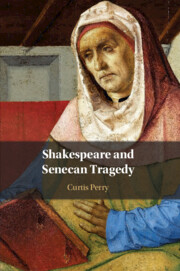
    Shakespeare's tragic characters have often been seen as forerunners of modern personhood. It has been assumed that Shakespeare was able to invent such lifelike figures in part because of his freedom from the restrictions of classical form. Curtis Perry instead argues that characters such as Hamlet and King Lear have seemed modern to us in part because they are so robustly connected to the tradition of Senecan tragedy. Resituating Shakespearean tragedy in this way - as backward looking as well as forward looking - makes it possible to recover a crucial political dimension. Shakespeare saw Seneca as a representative voice from post-republican Rome: in plays such as Coriolanus and Othello he uses Senecan modes of characterization to explore questions of identity in relation to failures of republican community. This study has important implications for the way we understand character, community, and alterity in early modern drama.

    Reviews

    'Curtis Perry’s Shakespeare and Senecan Tragedy is a rich, complex and thought provoking book that breaks new ground in Shakespeare studies … manages to reorient many of the critical issues that have been central to modern and contemporary scholarly discussions of Shakespeare, thereby producing brilliant results and providing a hugely valuable contribution to Shakespeare and early modern studies, as well as classical reception studies.’

    Domenico Lovascio Source: Early Modern Literary Studies

    Refine List

    Actions for selected content:

    Select all | Deselect all
    • View selected items
    • Export citations
    • Download PDF (zip)
    • Save to Kindle
    • Save to Dropbox
    • Save to Google Drive

    Save Search

    You can save your searches here and later view and run them again in "My saved searches".

    Please provide a title, maximum of 40 characters.
    ×

    Contents

    Metrics

    Altmetric attention score

    Full text views

    Total number of HTML views: 0
    Total number of PDF views: 0 *
    Loading metrics...

    Book summary page views

    Total views: 0 *
    Loading metrics...

    * Views captured on Cambridge Core between #date#. This data will be updated every 24 hours.

    Usage data cannot currently be displayed.

    Accessibility standard: Unknown

    Why this information is here

    This section outlines the accessibility features of this content - including support for screen readers, full keyboard navigation and high-contrast display options. This may not be relevant for you.

    Accessibility Information

    Accessibility compliance for the PDF of this book is currently unknown and may be updated in the future.
